ECG in China: Cost and How to Book for International Visitors
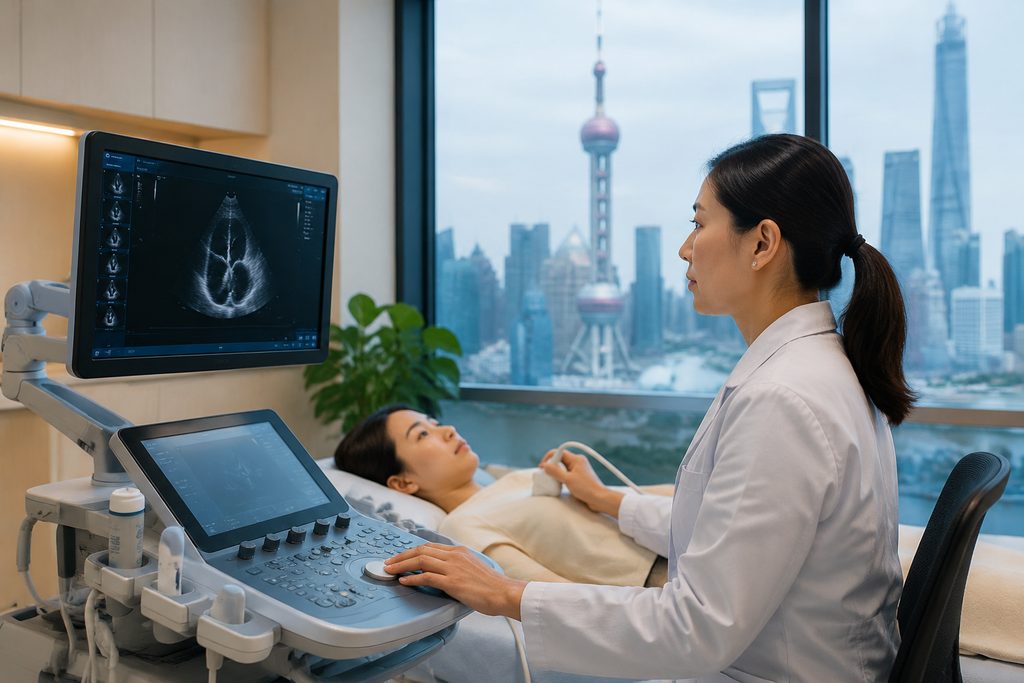
An electrocardiogram — ECG, sometimes called EKG — is a painless test that records your heart’s electrical activity through small electrodes placed on your chest, arms, and legs. It takes about ten minutes, produces a squiggly line graph, and helps a cardiologist spot arrhythmias, signs of ischemia, or evidence of a previous heart attack. Simple enough. So what does an ECG test cost in China, and how does a visitor actually book one?
Short answer: at a public tertiary hospital in a major city, a standard resting ECG typically runs between $15 and $40. At a private international clinic, expect $80 to $120. Booking is the part that trips people up — public hospitals generally don’t accept overseas appointments for routine outpatient tests, so the path depends on which type of facility you choose.
ECG Test Cost China: The Short Answer
For a resting 12-lead ECG at a public Grade 3A hospital, most international patients pay somewhere in the range of $15 to $40, including the physician’s interpretation. A 24-hour Holter monitor, which records continuously, runs higher — often $80 to $200 depending on hospital tier and whether analysis is included. Stress ECG (treadmill testing) sits in the middle, roughly $50 to $150.
Those figures come with a caveat. Prices at Chinese public hospitals are set by provincial pricing bureaus, so the same test can cost slightly different amounts in Beijing, Shanghai, and Chengdu. And the number on the receipt is rarely the whole story — there’s registration, the doctor’s consultation fee, and possibly a follow-up visit to discuss results. Budget for the visit, not just the test.
Who This Is Right For — and Who It Isn’t
An ECG in China makes practical sense for a few groups. Travelers already in the country who develop palpitations, chest discomfort, or dizziness. Long-stay expatriates who want a cardiac check without flying home. Medical tourists combining a cardiac workup with other treatment. And anyone who needs a routine ECG as part of a broader executive health screening, which Chinese hospitals offer at genuinely competitive prices.
Who should not pursue this? Anyone with active chest pain, fainting, or shortness of breath should go to an emergency department immediately — not book a routine ECG. An ECG is a screening and diagnostic tool, not an emergency intervention. Also, if you’re outside China and asymptomatic, there is little reason to travel for a test your own doctor can order in a week. And if you carry a device like a pacemaker, tell the technician before electrodes go on; most ECGs are still fine, but the team needs to know.
The Options, Compared
| Option | Typical Cost | Booking Lead Time | English Support | Best For |
|---|---|---|---|---|
| Public Grade 3A hospital, standard queue | $15–$40 | Same day or next day, walk-in registration | Limited; varies by hospital | Budget-conscious patients already in China |
| Public hospital international department | $60–$150 | 1–5 days, often bookable in advance | Yes, dedicated English staff | Visitors who want a scheduled slot |
| Private international clinic (JCI-accredited) | $80–$120 | 1–3 days, online booking common | Yes, fully English-speaking | Tourists with insurance or tight schedules |
| Health screening package including ECG | $200–$800 | 3–10 days | Varies; premium packages include it | Patients wanting a full cardiac and metabolic panel |
If you’re already in China and cost is the priority, the standard public queue is unbeatable on price. If you’re flying in and need a confirmed appointment before you arrive, the international department or a private clinic is the realistic route. The middle column is where most readers should focus their attention.
Is ECG Safe in China Hospitals?
Yes — and this question deserves a direct answer rather than reassurance. An ECG is non-invasive, uses no radiation, and involves no needles. The electrodes simply record electrical signals your heart produces on its own. There is no meaningful risk to the test itself.
The legitimate concern isn’t safety. It’s quality and communication. Chinese public hospitals see enormous volumes — some top-tier facilities handle more than 10,000 outpatient visits a day — and equipment standards at Grade 3A hospitals are generally excellent, often the same machines used in Europe and North America. What varies is how results get explained to a non-Chinese speaker. A tracing handed to you without interpretation is close to useless.
That’s the gap worth planning around. If your Mandarin isn’t functional, arrange for interpretation or use a hospital with an international department. The test is safe. Understanding the result is the part that needs management.
How Much Does an ECG Cost in Shanghai vs. Beijing?
Shanghai and Beijing price similarly for a resting ECG — both typically fall in the $20 to $45 range at public hospitals, with private clinics in either city charging $80 to $120. Shanghai has a slightly denser concentration of international clinics, which tends to make same-week booking easier. Beijing’s advantage is depth: it hosts more of the hospitals ranked in the Fudan Top 100 than any other city, including 21 institutions on that list.
For a routine ECG, you do not need a top-ranked hospital. Any Grade 3A facility can perform one competently. Save the flagship institutions for complex cases — an abnormal tracing, a suspected arrhythmia, or a workup that may lead to ablation or other intervention. If you do want the best hospital for ECG in Beijing with English support, look at the international departments of the major teaching hospitals rather than the general outpatient queue.
Readers comparing cities can browse the hospital listings by location on our Fudan-ranked hospital directory, which groups facilities by city and tier.
How to Book an ECG Appointment in China
This is where expectations need adjusting. Public hospitals in China do not operate like Western clinics. Routine outpatient registration typically happens on the day, in person, at a registration window or self-service kiosk. You take a number, wait, see a physician, and receive a test order. Only then do you proceed to the ECG room. You cannot usually reserve a specific ECG slot from overseas.
The workaround is the international or VIP department, which does accept advance scheduling and provides English-speaking staff. Expect to pay roughly 1.5 to 2 times the standard fee for that convenience. Private international hospitals — United Family, Jiahui, Parkway, Raffles among them — allow online booking and often bill insurance directly.
For visitors who want the public-hospital price without navigating the queue alone, a bilingual medical companion can handle registration, payment, wayfinding, and interpretation on the day. That’s a labor service, not a queue-jumping arrangement — nobody is promising you a specific doctor or a faster slot.
Practical Considerations for Tourists
Payment at public hospitals is usually upfront, by cash, Alipay, WeChat Pay, or UnionPay card. International credit cards are accepted at private clinics but often not at public registration windows. If you plan to claim reimbursement from a travel or health insurer, request an itemized receipt and a stamped medical record — ask for these before you leave the hospital, because retrieving them later is difficult.
Visa logistics matter if the ECG is part of a larger treatment plan. For medical travel to China, the applicable short-stay category is the S2 visa, which covers medical treatment and private affairs, subject to current embassy and consulate requirements and supporting hospital documentation. Family members accompanying a patient apply under the same category. Note that the M visa is for commercial and trade activities and is not the right category for medical treatment.
Follow-up after you return home is straightforward: carry the printed tracing and the interpreting physician’s report to your own cardiologist. Digital files aren’t always provided, so ask for paper copies.
Frequently Asked Questions
At a public hospital’s general outpatient department, generally no — registration happens in person on the day. International departments and private clinics do accept advance booking, usually one to five days ahead. If a confirmed appointment before departure matters to you, plan around the international or private route.
A resting ECG in Shanghai typically runs $20 to $45 at a public hospital and $80 to $120 at a private clinic. In the US, the same test often bills $50 to $300 before insurance, with hospital facility fees pushing it higher. The gap is real, though it narrows once you add consultation and interpretation costs.
An abnormal tracing is not a diagnosis — it’s a signal to investigate further. Depending on findings, a cardiologist may recommend a Holter monitor, echocardiogram, stress test, or blood work. If you’re in China short-term, you’ll need to decide whether to pursue that workup locally or after returning home. Both are reasonable; the decision depends on urgency and your travel timeline.
The test itself carries no risk. If you have a known condition, bring your records and medication list, and tell the technician about any implanted device. For anyone with active symptoms — chest pain, fainting, severe breathlessness — skip the appointment and go to an emergency department.
Not to receive the test — you can pay out of pocket. But if you want reimbursement, confirm your policy covers medical treatment abroad and keep every receipt and report. Many travel policies exclude pre-existing conditions, so check before assuming coverage.
Your Next Step
Getting an ECG in China is inexpensive and clinically straightforward. The friction sits entirely in booking and communication, and both are solvable with the right preparation. Decide first whether you need a scheduled appointment or can walk in, then choose the facility tier that matches.
We’re China Medical Services — a coordination team, not a hospital and not a source of medical advice. We help international patients find appropriate facilities, arrange bilingual accompaniment, and prepare documentation. If you’d like help thinking through your options, you can start with a free consultation and we’ll take it from there.
This article is for general information only and does not constitute medical advice. ECG interpretation and any treatment decisions should be made by a qualified physician who has reviewed your individual case.
For more medical information and treatment options in China, visit chinamedservices.com (China Medical Services).
