Dental Bonding for Gaps in China: Costs, Clinics, and What to Expect
Dental Bonding for Gaps in China: Costs, Clinics, and What to Expect
A composite resin restoration in the United States runs $300 to $600 per tooth. In China, the same procedure at a top-tier stomatology hospital costs $60 to $180. That is not a discount clinic in a back alley — it is the same material, often the same imported brands, applied by dentists trained in programs that graduate more practitioners annually than the entire US dental workforce.
So the dental bonding for gaps cost China question has a short answer: expect to pay one-fifth to one-third of Western prices. The longer answer involves knowing which clinics are worth your time, which are not, and why the gap between a $70 bonding and a $400 bonding in the same city is not about quality — it is about the tier of the institution.
Dental Bonding for Gaps in China: The Short Answer
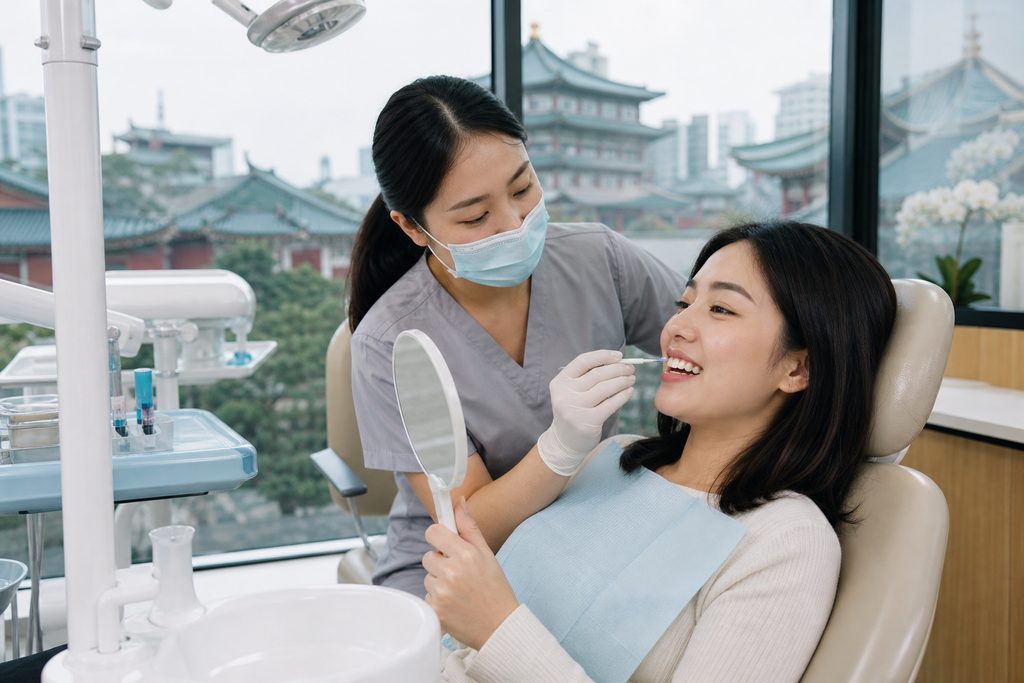
Composite bonding to close a diastema — the technical term for a gap between teeth — typically costs $60 to $180 per tooth at a public stomatology hospital in Beijing or Shanghai, and $150 to $400 per tooth at a private international clinic. A single-visit procedure usually takes 30 to 90 minutes. No drilling is required for small gaps, which means it is reversible if you dislike the result.
Here is the caveat that matters. Chinese public hospitals do not operate like Western dental offices. You cannot email a hospital, pick a Saturday slot, and walk in. Registration happens on the day, in person, in Mandarin, through a queue system that fills within minutes of opening. That single fact shapes everything about how a foreign patient should approach this.
Who This Is Right For — and Who It Isn’t
Bonding is not a universal fix. It works beautifully for some mouths and fails predictably in others.
Good candidates:
- Small to moderate gaps (under 2mm) between front teeth
- Chipped or slightly misshapen teeth adjacent to the gap
- Patients who want a reversible, no-drilling option before committing to veneers
- Anyone already traveling to China for other reasons and adding dental work to the trip
- Patients with healthy gums and no active decay in the treatment area
Poor candidates:
- Gaps wider than 3mm — bonding may look bulky or fail under bite pressure
- Heavy teeth grinding (bruxism) without a night guard, which shortens bonding lifespan dramatically
- Significant gum disease or bone loss — fix the foundation first
- Patients who want a permanent result. Bonding lasts 3 to 7 years with good care. Veneers last 10 to 15.
- Anyone who cannot return for a follow-up adjustment within a reasonable window
The Options, Compared
Bonding is one of several ways to close a gap. The table below compares the realistic alternatives, including the option of doing nothing.
| Option | Cost in China (per tooth) | Cost in US (per tooth) | Visits Required | Lifespan | Reversible? |
|---|---|---|---|---|---|
| Composite bonding | $60–$180 | $300–$600 | 1 | 3–7 years | Yes |
| Porcelain veneers | $250–$600 | $900–$2,500 | 2–3 | 10–15 years | No |
| Orthodontics (clear aligners) | $1,500–$5,000 total | $4,000–$8,000 total | Multiple over 12–24 months | Permanent if retained | Yes |
| Do nothing | $0 | $0 | 0 | — | — |
Which column fits you? If the gap bothers you aesthetically and you want a fast, low-risk trial, bonding is the obvious entry point. If you are already planning orthodontic work, closing the gap with aligners solves the underlying spacing issue rather than masking it. And if the gap is minor and your bite is healthy, doing nothing remains a legitimate choice that no dentist should pressure you out of.
Finding the Best Dental Clinic in Shanghai for Bonding
Shanghai has two distinct dental ecosystems, and they serve different patients.
The first is the public stomatology hospitals — affiliated with universities, staffed by specialists who teach, and equipped with digital scanning and shade-matching technology. These are where Chinese patients go for complex work. Prices stay low because volume is enormous. A single clinic may see 800 to 1,200 patients daily.
The second is the private international sector: clinics with English-speaking dentists, JCI accreditation in some cases, direct insurance billing, and appointment scheduling that works the way foreigners expect. You pay roughly double, sometimes triple. You gain convenience, communication, and a calmer environment.
For bonding specifically — a short, low-complexity procedure — the private international route often makes more sense for a traveler. The price difference on a single tooth is maybe $100 to $200. The value of understanding every word your dentist says about shade selection and bite adjustment is harder to price.
Patients exploring the broader landscape of top-ranked Chinese hospitals will find that dental stomatology is a recognized specialty with its own rankings, separate from general hospital prestige.
How Much Does Dental Bonding Cost in Beijing?
Beijing prices track slightly below Shanghai’s private market but above its public hospitals, largely because the capital concentrates more university-affiliated stomatology institutions.
Realistic ranges for 2026:
- Public stomatology hospital, standard composite: $55–$140 per tooth
- Public hospital international/VIP department: $180–$350 per tooth
- Private international clinic: $200–$450 per tooth
- Full gap closure (typically 2 teeth treated): multiply accordingly
What drives the variance? Material brand (3M and Ivoclar composites cost more than domestic equivalents), the seniority of the treating dentist, whether digital shade matching is used, and whether the clinic charges separately for the initial consultation and X-rays. A $90 bonding can become a $200 visit once imaging and consultation fees are added. Always ask for the full itemized estimate before sitting in the chair.
Is Dental Bonding Safe in China?
The honest answer: safety depends on the clinic, not the country. China’s top stomatology hospitals use the same composite materials, sterilization protocols, and bonding agents found in Germany, Japan, and the United States. The materials are frequently imported from those exact countries.
Where risk creeps in is at the lower end of the market — small private clinics with unclear sterilization practices, unlicensed practitioners, or aggressive upselling toward unnecessary veneers. This is not unique to China. It exists in every country with a large, uneven dental market.
Three practical safeguards:
- Choose a hospital or clinic with a verifiable affiliation — a university teaching hospital, a JCI-accredited facility, or a practice with named, credentialed dentists
- Ask directly about material brand and sterilization protocol. A clinic that cannot answer clearly is a clinic to walk away from
- Avoid any provider who pushes you from a $100 bonding toward $3,000 in veneers during the same visit
Bonding itself carries minimal medical risk. No drilling for small gaps, no anesthesia in most cases, no permanent alteration to the tooth. The main complication is aesthetic — a shade that does not match, or a bite that feels off — and both are correctable.
Practical Considerations: Visas, Records, and Payment
Dental treatment is medical treatment, which means the visa category matters. Foreign patients coming to China for dental work should apply for an S2 visa, the short-stay category used for medical treatment and private affairs. It requires supporting documents from the treating hospital. For stays exceeding 180 days, the S1 category applies. Accompanying family members use the same S2 route.
A common and costly mistake: applying for an M visa. The M visa is for commercial and trade activities. It has nothing to do with medical treatment, and arriving on the wrong category can complicate your entry.
On records: bring any recent dental X-rays or panoramic imaging you have. It saves time and money. If you have none, the clinic will take them — budget $20 to $50.
Payment is straightforward at private international clinics, which accept international credit cards and often bill insurance directly. Public hospitals generally require upfront payment in cash or via local payment apps, with insurance reimbursement handled afterward by you.
Language remains the single biggest practical hurdle at public institutions. A bilingual medical companion — from $300 per day — handles registration, queueing, payment, and chairside translation. For a one-visit bonding procedure, a half-day booking is usually sufficient.
Patients considering a broader treatment plan may want to review specialty rankings across Chinese hospitals before committing to a single clinic.
China Dental Tourism Packages for Gap Closure: What to Realistically Expect
The phrase “dental tourism package” suggests a bundled product with a fixed price. That is not how Chinese healthcare works, and any provider offering a rigid package for a medical procedure should raise suspicion.
What actually exists is a staged process. You send photographs and any X-rays. A dentist reviews them remotely and gives a preliminary assessment. If bonding looks suitable, you schedule a visit. The final treatment plan — how many teeth, what material, what cost — is confirmed in person after examination.
This matters because gap closure is not always a one-tooth job. A 3mm diastema might need two teeth built up to distribute the width naturally. A gap combined with worn edges might need reshaping first. No honest clinic quotes a final figure without seeing your mouth.
For patients who want to lock in an appointment before flying, the consultation and coordination service can handle registration and scheduling through official hospital channels. What it cannot do — and what no service can legitimately promise — is guarantee a specific dentist or a specific time slot at a public hospital. Those are allocated by the hospital, not by intermediaries.
Frequently Asked Questions
At public stomatology hospitals, expect $60 to $180 per tooth. Private international clinics run $150 to $400. By comparison, US prices sit at $300 to $600 per tooth, UK private practices at £200 to £400, and Australian clinics at A$300 to A$500. The savings are real, but factor in flights and accommodation if you are traveling solely for this procedure — bonding alone rarely justifies a trip.
At private international clinics, yes — online booking with English-language confirmation is standard. At public hospitals, no. Registration happens on the day, in person, through a queue system. A coordination service can assist with registration through official hospital channels, but no one can guarantee a specific dentist or time. Plan a buffer day.
Bonding can chip or discolor, and a poorly adjusted bite accelerates that. If it happens within weeks, contact the clinic — reputable ones will adjust or redo it, but you would need to return to China. This is the strongest argument for choosing a clinic with clear accountability rather than the cheapest option. Ask before treatment what their revision policy covers and for how long.
At top-tier institutions, yes. Chinese stomatology hospitals routinely use imported composites from 3M (US), Ivoclar (Liechtenstein), and Shofu (Japan). Domestic alternatives exist at lower price points and perform adequately for many cases. Ask which brand will be used and request it in writing on your estimate.
Your Next Step
Dental bonding in China offers genuine value — one-fifth to one-third of Western prices for the same materials and comparable clinical standards at reputable institutions. The variable is not the quality of Chinese dentistry. It is whether you choose the right tier of clinic and prepare for a system that does not work like the one at home.
China Medical Services is not a hospital and does not provide diagnoses. We connect international patients with 340+ top-ranked hospitals across 37 cities, coordinate appointments through official channels, and provide bilingual support on the ground. If you are weighing treatment in China, start with a free consultation and we will help you understand what is realistic for your case.
For more medical information and treatment options in China, visit chinamedservices.com (China Medical Services).
