Veneers in China: One Trip or Two? What Patients Should Know
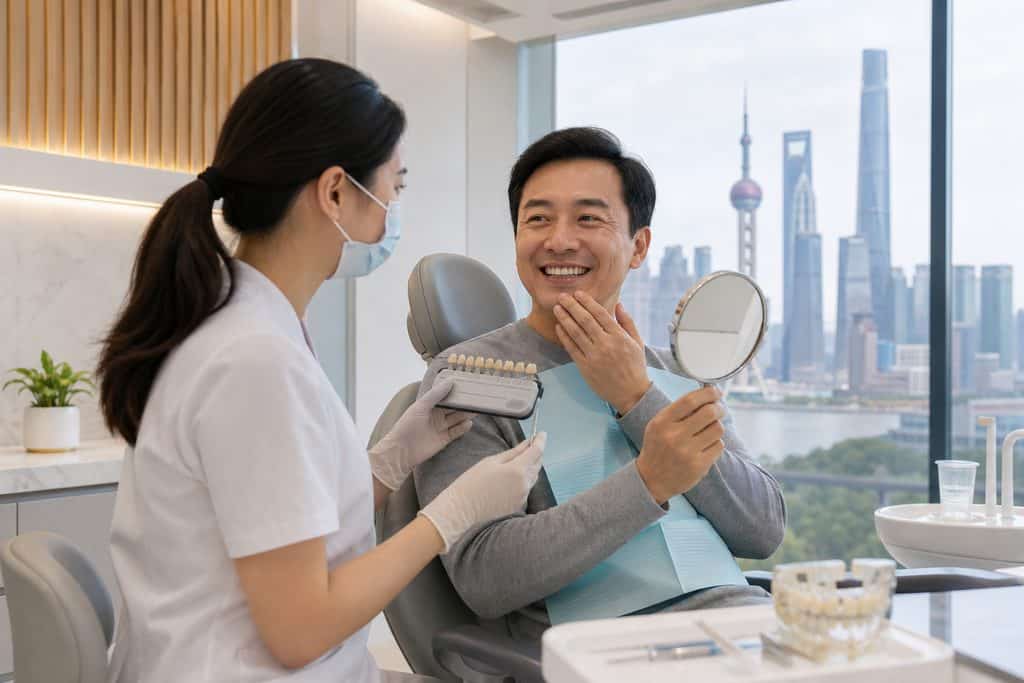
When 38-year-old Sarah from Portland started researching smile makeovers, she expected a straightforward answer. Her dentist in Oregon quoted $18,000 for eight porcelain veneers. A clinic in Bangkok offered the same treatment for $6,500. Then a colleague mentioned she’d had work done in Shanghai for less than $4,000 — and loved the result. That’s when the questions got complicated. How many trips would she actually need? Was it safe? And why was dental veneers cost China so much lower than anything she’d seen at home?
Sarah’s situation isn’t unusual. Every year, thousands of patients from the US, UK, Australia, and the Gulf states search for dental care abroad, and China has quietly become one of the most serious destinations on that list. But the “one trip or two” question trips up more people than almost any other detail — and getting it wrong can mean paying for flights you didn’t need, or worse, rushing a procedure that requires patience.
Here’s what the actual process looks like, based on how Chinese dental hospitals and international clinics structure veneer treatment for overseas patients.
Key Takeaways
- Most veneer cases in China require two trips: one for preparation and impressions, one for final fitting — typically 10-14 days apart, though some clinics compress this into a single 7-10 day visit using same-day CAD/CAM milling.
- Dental veneers cost China runs roughly $250-$600 per tooth at reputable private international clinics, compared with $900-$2,500 per tooth in the US — a savings of 60-80% even after flights and hotels.
- The real bottleneck isn’t the dentistry. It’s the appointment system: public hospitals generally don’t allow overseas booking in advance, and walk-in registration means same-day queues. International departments and private clinics solve this, at a higher price.
- You cannot judge safety by price alone. Ask about material origin (e.g., Ivoclar, VITA, 3M), lab certification, and whether the treating dentist has documented veneer case volume.
The Problem: A $15,000 Smile and a Calendar That Won’t Cooperate
Cosmetic dentistry in the United States sits almost entirely outside insurance coverage. The American Dental Association has noted for years that most dental plans cap annual benefits around $1,000-$2,000, which means a full veneer case lands almost entirely on the patient. At $1,200-$2,500 per tooth for premium porcelain work, an eight-tooth smile makeover can run $10,000-$20,000 in major US metros.
That number pushes people to look overseas. But the moment they do, a second problem appears: time. Veneers aren’t a single appointment. They involve diagnosis, tooth preparation, impression-taking or digital scanning, temporary restorations, lab fabrication, and final bonding. Each stage has a physical dependency on the one before it.
So the honest question isn’t “can I get veneers in China?” It’s “how many times do I have to fly there?”
Why China Has Become a Serious Option for Dental Work
China’s dental sector has matured fast. The country is home to more than 35,000 hospitals and tens of thousands of dental clinics, and the top tier — including stomatology departments ranked in the Fudan University Hospital Rankings — handles case volumes that most Western practices never approach. That volume matters for a simple reason: repetition builds skill.
Clinical Volume and Material Access
A high-volume Chinese prosthodontist may place several hundred veneer units in a year. The same materials used in Beverly Hills — Ivoclar e.max, VITA Mark II, 3M Lava — are standard stock in Chinese international clinics. Nothing about the porcelain is “local substitute.” It’s the same supply chain.
Digital Dentistry That Compresses Timelines
Many private international clinics in Shanghai, Beijing, and Shenzhen now run in-house CAD/CAM milling. That means a crown or veneer can be designed, milled, and seated within a single visit in selected cases. This is the single biggest factor determining whether your case is one trip or two. Not all clinics offer it, and not all veneer cases qualify — heavily prepared teeth or complex shade matching usually still need a lab.
Cost Structure, Explained Honestly
Why is dental veneers cost China so much lower? Three reasons. Chair time and lab labor cost less. Clinics run higher patient throughput, spreading equipment costs. And there’s no insurance middle layer inflating list prices. The material cost is nearly identical to the US. The difference is everything around it.
| Item | United States | China (International Clinic) |
|---|---|---|
| Porcelain veneer, per tooth | $1,200 – $2,500 | $250 – $600 |
| Eight-tooth smile makeover | $10,000 – $20,000 | $2,000 – $4,800 |
| Digital scan and smile design | $300 – $800 | $80 – $250 |
| Temporary veneers | $200 – $500 | $50 – $150 |
| Round-trip airfare (US-China) | — | $800 – $1,600 |
| Hotel, 10 nights, 4-star | — | $700 – $1,400 |
Prices vary by hospital and case complexity. A single-tooth repair and a full-mouth reconstruction are not the same purchase.
One Trip or Two? The Actual Timeline
This is the section most patients skip to. Here’s the real breakdown.
Standard Two-Trip Protocol (Most Common)
Trip 1 — Days 1-4: Consultation, X-rays or CBCT if needed, shade selection, tooth preparation, digital or physical impressions, temporary veneers placed. You fly home.
Between trips — 7-14 days: The dental lab fabricates your veneers. This is not wasted time; it’s the reason the fit is good.
Trip 2 — Days 1-3: Try-in, adjustments, final bonding, bite check, polish. You fly home with finished veneers.
Total time in China: roughly 6-8 days across two visits.
Compressed Single-Trip Protocol (Selected Cases)
If the clinic has in-house milling and your case is straightforward — minimal preparation, standard shade, healthy enamel — some providers can complete everything in 5-8 consecutive days. You’d typically fly in, have preparation and milling done over two to three days, then bonding before departure.
But here’s the trade-off. A rushed shade match under different lighting on day six is not the same as a veneer tried in twice with a week of reflection. Patients who choose the single-trip route are accepting less margin for adjustment.
How to Evaluate a Clinic Before You Book
This is where most overseas dental decisions go wrong. Patients compare price lists instead of asking harder questions.
Ask for the material brand by name. A reputable clinic will tell you exactly which porcelain system they use. Vague answers like “premium German ceramic” mean nothing.
Ask who does the lab work. In-house digital milling is traceable. Outsourced work to an unknown lab is not. Request the lab’s name.
Ask for case documentation. Not stock photos. Before-and-after images of the treating dentist’s own veneer cases, ideally with the patient’s consent and dates.
Ask what happens if a veneer debonds after you fly home. A fair clinic will offer a warranty period and a clear protocol — usually remote guidance plus a local dentist referral, or a free remake if you return.
For patients who want to compare providers systematically, our department rankings by specialty and private international hospital directory list facilities by city, JCI status, and English-language capability.
One more thing. “Best dental clinic in Shanghai for veneers” is a search phrase that returns a lot of paid results. The clinics that rank highest are not always the ones with the strongest prosthodontic credentials. Cross-check against hospital stomatology departments, not just marketing sites.
Practical Considerations: Visas, Payment, and Follow-Up
Most patients need two: one for preparation and impressions, one for final bonding, spaced 7-14 days apart. A minority of straightforward cases can be completed in a single 5-8 day trip if the clinic has in-house CAD/CAM milling. Your case complexity decides this, not your preference.
Public hospitals generally don’t accept advance overseas bookings for standard dental outpatient visits — registration happens on the day. Private international clinics and hospital international departments do accept pre-booking, usually at 1.5-2x the standard fee. This is one of the main reasons patients use a coordination service.
Reputable clinics offer a warranty window, often 1-5 years depending on the clinic. In practice, most post-travel issues are handled by a local dentist using the records your Chinese clinic provided. Get those records in writing before you leave.
Your Next Step
The core message is simple: veneers in China can cost 60-80% less than US prices, but the trip count depends on your case and your clinic’s technology — not on marketing promises. Get a written treatment plan with a timeline before you book flights. If you’d like help comparing clinics, understanding realistic timelines for your specific case, or coordinating appointments and bilingual support on the ground, our team is here to walk through it with you — no pressure, no obligation. Start with a free consultation and see what your options actually look like.
This article is for general informational purposes only and does not constitute medical or dental advice. Treatment decisions should be made in consultation with a qualified licensed dentist who has examined you in person.
Frequently Asked Questions
Yes. The hospitals used for international patients are JCI-accredited and follow the same international safety standards as top hospitals in the US and Europe. Surgical teams perform high volumes of procedures — often more than their Western counterparts — which studies show leads to better outcomes.
Costs vary by procedure and hospital, but international patients typically save 40-80% compared to US prices — even when factoring in travel and accommodation. A consultation with our team will give you an exact, all-inclusive quote with no hidden fees.
Send us your existing medical reports to get started. We handle everything from hospital selection and appointment scheduling to visa assistance and post-operative recovery planning. Your medical records are reviewed by the specialist before you even book a flight.
For more medical information and treatment options in China, visit chinamedservices.com (China Medical Services).
