Adult Braces in China: Is It Too Late at 40, and What Does It Cost?
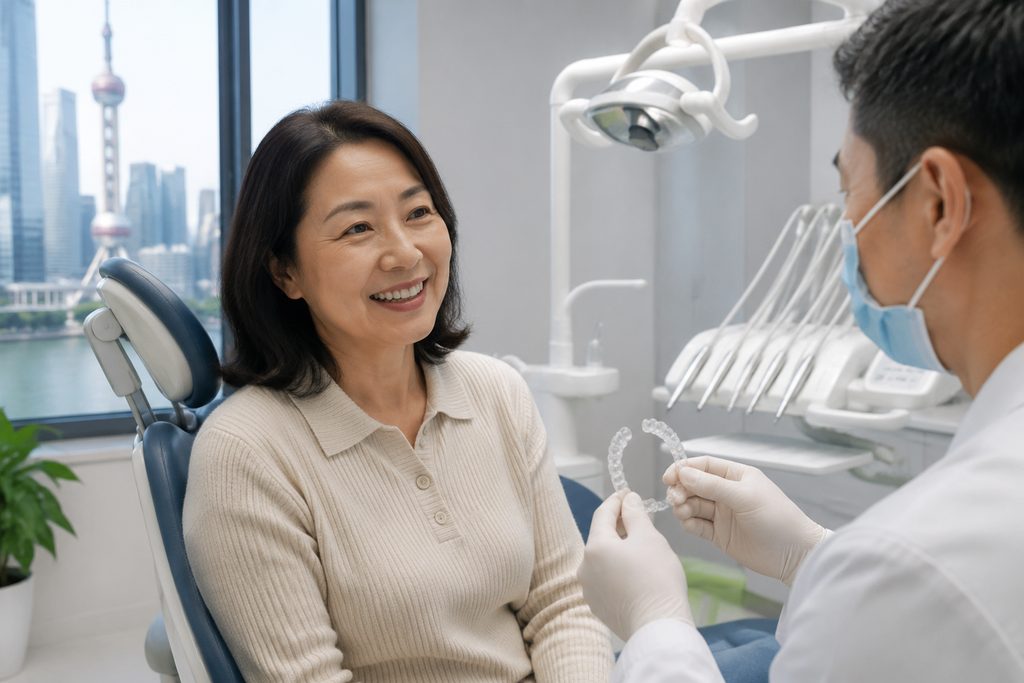
In the United States, a full adult orthodontic case averages $5,000 to $7,500 before insurance. In China, the same treatment at a top-ranked public hospital typically runs $1,200 to $3,500. That gap is why searches for adult braces cost China have climbed steadily among overseas patients — and why the second question almost always follows: is it too late for braces at 40?
Short answer: no. Age alone is not a disqualifier. What matters is your gum health, bone density around the roots, and whether you have untreated periodontal disease. A 52-year-old with healthy gums is often a better candidate than a 28-year-old with advanced bone loss.
But the honest version is messier. Adult orthodontics takes longer than teenage treatment, relapse risk is higher, and some cases need jaw surgery that braces alone cannot fix. Below is what we tell patients who ask us this every week.
Adult Braces in China: The Short Answer
Treatment is available, affordable, and technically excellent at China’s top dental hospitals. The catch is access. Public hospital orthodontics runs on a queue system, and you cannot book a specialist slot from overseas the way you would book a hotel.
Most public hospitals require an in-person first consultation before any treatment plan is issued. That means one trip for assessment, then a decision, then a treatment schedule that may stretch across 18 to 30 months. For patients flying in from abroad, this is the single biggest logistical hurdle — and it is solvable, but not by pretending it does not exist.
Key takeaway: China’s top orthodontic departments deliver Western-standard care at roughly one-fifth to one-third of U.S. prices. The constraint is not quality or cost — it is scheduling, language, and the number of in-person visits a full braces case requires.
Who This Is Right For — and Who It Isn’t
Orthodontics is not one treatment. It is a category. Being clear about fit saves everyone time and money.
Typically a good candidate:
- Adults with crowding, spacing, or mild-to-moderate bite problems and healthy gums
- Patients who need cosmetic alignment before a wedding, career change, or implant placement
- People already traveling to China for other reasons who can extend a trip for assessment
- Patients seeking clear aligners who want a second price quote against their home country
- Those willing to commit to retention wear for years after active treatment ends
Probably not the right fit:
- Active, untreated periodontal disease — braces on unstable gums can accelerate bone loss
- Severe skeletal discrepancies where orthognathic surgery is the real solution, not brackets
- Patients who cannot return for periodic adjustment visits and have no local orthodontist willing to co-manage
- Anyone expecting a fixed total price before a clinical exam — no ethical provider quotes blind
That last point matters. If a clinic gives you a firm all-in number from a photo, treat it as marketing, not medicine.
The Options, Compared
Here is how the main appliance types and markets stack up. Prices are ranges and vary by hospital and case complexity.
| Option | Typical Cost (USD) | Treatment Time | Visibility | Best For |
|---|---|---|---|---|
| Metal braces, China public hospital | $1,200 – $2,200 | 18 – 30 months | High | Complex cases, budget priority |
| Ceramic braces, China public hospital | $1,800 – $3,000 | 18 – 30 months | Moderate | Adults wanting less metal |
| Invisible aligners, China | $2,000 – $4,500 | 12 – 24 months | Near-invisible | Mild-to-moderate cases, professionals |
| Metal braces, U.S. private practice | $5,000 – $7,500 | 18 – 30 months | High | Local convenience |
| Invisible aligners, U.S. | $4,500 – $8,000 | 12 – 24 months | Near-invisible | Local convenience |
| Private international clinic, Shanghai | $4,000 – $8,000 | 18 – 30 months | Varies | English-first service, insurance billing |
Which column fits you depends on two things: how complex your case is, and how many trips you can realistically make. A patient living in Singapore can commute to Shanghai for adjustments. A patient in Toronto usually cannot.
Is It Too Late for Braces at 40? What the Evidence Says
The “too late” belief comes from a misunderstanding. Teeth are not fixed in bone. They sit in a periodontal ligament that remodels throughout life, which is why orthodontic movement works at 25, 45, and 65.
What changes with age is the surrounding environment. Gum recession, bone loss, and root resorption risk all rise. A 2021 review in the American Journal of Orthodontics and Dentofacial Orthopedics noted that adult patients require more careful periodontal monitoring, not exclusion from treatment.
Two practical differences for adults over 40:
- Slower movement. Bone turnover declines, so a case that takes 18 months at 22 may take 24 to 30 months at 45.
- Higher relapse risk. Adults need lifelong retention more reliably than teens. A fixed lingual wire plus a night retainer is standard.
If your gums are stable and your roots are healthy, age is a number, not a barrier.
How Long Do Adult Braces Take — and What Drives the Variance?
Most adult cases run 18 to 30 months of active treatment. Aligner cases for mild crowding can finish in 12. Complex extraction cases with bite correction can run 36.
Four factors move the timeline:
- Case complexity. Crowding only versus bite correction with extractions are different projects.
- Patient compliance. Aligners only work if worn 20 to 22 hours a day. Non-compliance doubles timelines.
- Adjustment frequency. Standard is every 4 to 8 weeks. Missed appointments extend treatment.
- Biological response. Some patients simply move faster. There is no reliable way to predict this in advance.
For overseas patients, we usually suggest a realistic structure: one assessment trip, then a decision on whether to do active treatment in China or start locally with a Chinese treatment plan. Both are legitimate paths.
Practical tip: Ask any clinic for a written treatment plan with an estimated number of visits before you commit. A plan that says “we’ll see” is not a plan.
Practical Considerations: Visits, Visas, and Payment
Orthodontics is a series of appointments, not a single procedure. That shapes everything about how you plan a China trip.
Records and documentation. Bring panoramic X-rays, cephalometric films if you have them, intraoral photos, and any prior treatment notes. Chinese specialists can take new imaging, but prior records save a visit.
Visas. For short medical visits, the S2 category is the applicable short-stay route used for medical treatment and private affairs, subject to the latest embassy or consulate requirements and supporting hospital documents. Accompanying family members typically apply under the same category. Note clearly: the M visa is for commercial and trade activities — it is not a medical visa. Anyone telling you otherwise is misinformed.
Payment. Public hospitals generally require prepayment, with insurance reimbursement handled afterward in your home country. Private international clinics in Shanghai and Beijing often bill insurers directly. Check your policy’s out-of-network dental and orthodontic terms before you travel.
Language. Top public dental hospitals are large, busy, and primarily Chinese-speaking. English is more common in international departments and private clinics. If your Mandarin is limited, plan for interpretation — this is exactly the kind of gap a bilingual medical companion is designed to close.
Follow-up after you return home. This is the part most patients underestimate. Retention checks need to continue for years. Line up a local orthodontist before you leave China, and ask your Chinese provider to prepare a transfer summary in English.
If you are weighing which city makes sense, our directory of top-ranked Chinese hospitals by city breaks down where the strongest dental and orthodontic departments sit, and the specialty rankings show which hospitals lead in each discipline.
Invisible Aligners Price China vs. Elsewhere
Clear aligners deserve their own section because the price gap is dramatic and the case-selection rules are strict.
In China, aligner treatment at a top public hospital generally runs $2,000 to $4,500. The same case in the U.S. frequently lands between $4,500 and $8,000. In the UK, private aligner treatment commonly runs £3,000 to £5,500.
But aligners are not a universal substitute for braces. They handle mild-to-moderate crowding and spacing well. They struggle with significant rotations, severe bite discrepancies, and cases needing extraction space closure. A clinic that offers aligners for every case is optimizing for revenue, not outcomes.
If you are specifically looking for the best orthodontist Shanghai for adults, the practical filter is not brand name — it is case volume and whether the department routinely handles adult complex cases. Ask directly.
Frequently Asked Questions
Yes. Foreign patients are treated at public hospital international departments and private international clinics. The main constraint is scheduling, since public hospital orthodontics typically requires an in-person first consultation before a treatment plan is issued. You cannot fully lock in a treatment start date from overseas without that step.
For a straightforward adult case at a public hospital, plan on $1,200 to $3,500 for the orthodontic fee, plus travel, accommodation, and imaging. Private international clinics run higher, roughly $4,000 to $8,000. Final pricing depends on case complexity, appliance type, and the number of visits required — no responsible provider quotes a fixed total before examination.
Active periodontal disease needs to be treated and stabilized first. Braces on unstable gums can worsen bone loss. Once gum health is controlled and maintained, orthodontic treatment is usually possible. This is a clinical judgment your periodontist and orthodontist make together, not something anyone can assess from a photo.
This is the real risk to plan around. A broken bracket, a lost aligner, or unexpected root resorption needs local attention. Before starting, identify a dentist or orthodontist in your home country willing to handle emergencies and retention. Get your Chinese provider to prepare an English-language treatment summary you can hand over. Patients who skip this step are the ones who struggle.
Short medical visits generally fall under the S2 category, used for medical treatment and private affairs, subject to current embassy or consulate requirements and supporting hospital documentation. Accompanying family members typically apply under the same category. The M visa is for business and trade — it is not a medical visa, despite what some outdated guides claim.
Your Next Step
Adult braces in China are neither too late nor too complicated — but they are a logistics problem as much as a clinical one. The treatment works. The prices are genuinely lower. The hard part is sequencing visits, records, language, and follow-up across two countries.
We are China Medical Services, a coordination team — not a hospital, and we do not diagnose or treat. We connect international patients with appropriate Chinese hospitals, arrange written second opinions and video consultations with specialty teams, and provide bilingual medical companions who handle registration, queuing, payment, and interpretation on the ground. If you want a clear picture of what your case would involve before committing to travel, start with a free consultation through our patient support page — no pressure, no obligation, just a straight assessment of your options.
This article is for general information only and is not medical advice. Orthodontic treatment suitability and outcomes vary by individual. Consult a qualified dentist or orthodontist before making treatment decisions.
For more medical information and treatment options in China, visit chinamedservices.com (China Medical Services).
