AV Fistula Surgery Cost in China: What International Patients Pay
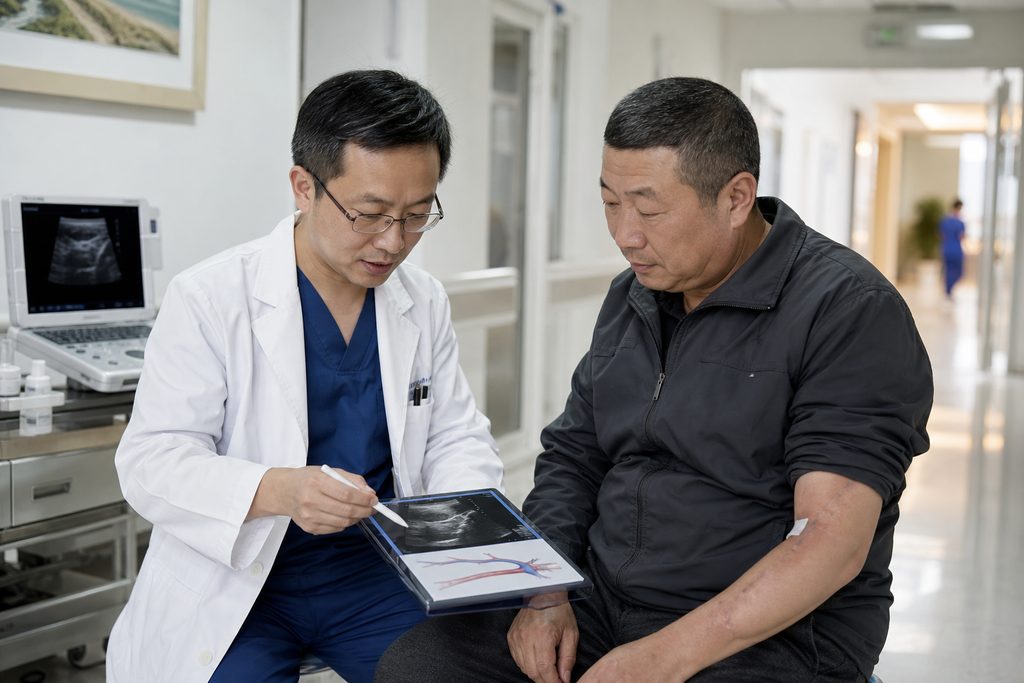
An arteriovenous fistula sounds intimidating. Strip away the jargon and it is a short operation that joins an artery to a nearby vein in your arm, usually at the wrist or elbow. That new connection makes the vein swell and strengthen. When it matures, roughly six to twelve weeks later, it becomes the access point a dialysis machine uses to clean your blood. It is the preferred long-term access for most hemodialysis patients, and it is a routine vascular procedure performed in thousands of Chinese hospitals every year.
So what does it cost? At a top-tier public hospital in China, AV fistula surgery cost typically lands between $2,500 and $7,000 for the procedure itself, depending on the city, the hospital tier, and whether you need imaging or a more complex revision. That same operation in the United States often bills $15,000 to $40,000 before insurance adjustments. The gap is real, and it is the reason patients from the US, the Middle East, and Southeast Asia ask us about dialysis access surgery in China.
But price is the easy part. The harder questions involve hospital selection, visa category, language, and what happens after you fly home. Let’s walk through all of it.
AV Fistula Surgery Cost in China: The Short Answer
For a straightforward radiocephalic fistula — the standard wrist connection — budget $2,500 to $5,000 at a major public hospital, or $5,000 to $9,000 at a private international hospital with English-speaking staff and direct insurance billing. Brachiocephalic fistulas at the elbow, or procedures requiring pre-operative vein mapping, sit toward the upper end.
Here is the caveat that complicates any single number: Chinese public hospitals quote in RMB, and the final bill depends on your specific vascular anatomy, whether the surgeon uses local or regional anesthesia, and how many follow-up visits your maturation monitoring requires. No honest provider can give you a fixed price before a surgeon has seen your veins. Anyone who does is guessing.
Who This Is Right For — and Who It Isn’t
Dialysis access planning is not a procedure you shop for casually. It fits a specific set of circumstances.
Typically a good fit:
- You are already on hemodialysis, or your nephrologist has told you that you will need it within the next six to twelve months.
- You live in a country where the wait for vascular surgery is long, or where the out-of-pocket cost is genuinely prohibitive.
- You are medically stable enough to fly — no active infection, no uncontrolled cardiac instability.
- You can stay in China for the procedure plus an initial recovery period of roughly one to two weeks before flying home.
Probably not a good fit:
- You need emergency dialysis access today. A fistula takes weeks to mature. If you need immediate access, a tunneled catheter is the answer, and that is a decision for the doctor in front of you, not a travel plan.
- You have severe peripheral vascular disease or a history of failed fistulas on both arms. Complex revision cases need a vascular surgeon who knows your history in person.
- You are on active anticoagulation that cannot be safely managed during travel.
- You have no confirmed dialysis plan at home. A fistula is useless if you cannot arrange dialysis sessions once you return.
Being blunt about this matters. A fistula is not a one-time fix. It is the start of a long relationship with a dialysis team, and that team should ideally be reachable.
The Options, Compared
Here is how the realistic paths stack up for an international patient. All figures are in USD and reflect typical ranges, not quotes.
| Option | Typical Cost | Wait Time | English Support | Best For |
|---|---|---|---|---|
| US hospital (insured) | $15,000–$40,000 billed; $3,000–$8,000 out-of-pocket with insurance | 2–8 weeks | Native | Patients with strong insurance and local nephrology care |
| US hospital (uninsured) | $15,000–$40,000 | 2–8 weeks | Native | Rarely viable; financial hardship programs exist |
| China top public hospital (standard channel) | $2,500–$5,000 | Days to 2 weeks after in-person consult | Limited; interpreter needed | Cost-conscious patients comfortable with a busy environment |
| China public hospital international/VIP department | $5,000–$9,000 | 1–2 weeks | Yes | Patients who want English service and faster scheduling |
| China private international hospital | $6,000–$12,000 | 1–2 weeks | Yes, Western-style | Patients prioritizing comfort and direct insurance billing |
| India or Turkey | $1,500–$4,000 | 1–3 weeks | Varies | Lower cost, but different regulatory and follow-up landscape |
Which column suits you depends on what you value. If you have solid insurance and a nephrologist you trust, staying home is usually the smartest call. If you are uninsured, facing a long wait, or paying entirely out of pocket, the Chinese public system offers a genuine middle path — high surgical volume, experienced vascular teams, and a price that does not require a second mortgage.
Dialysis Fistula Surgery Price in Shanghai vs. Beijing
City choice moves the number more than most patients expect. Dialysis fistula surgery price in Shanghai and Beijing sit at the top of the Chinese market because both cities concentrate the country’s highest-ranked hospitals, and both serve large international communities.
Beijing tends to run slightly higher for VIP and international department care. The city hosts the largest cluster of top-ranked public hospitals in the country, and demand for English-language service is intense. Expect $5,500 to $9,500 at an international department for a standard fistula with follow-up.
Shanghai is comparable, often marginally cheaper for the procedure itself but similar once you add imaging and maturation checks. The city’s private international hospitals — several carry JCI accreditation and bill insurance directly — quote $6,000 to $12,000 all-in. For patients who want a quieter, more Western-style experience, that premium buys real comfort.
Second-tier cities change the math. In Chengdu, Wuhan, or Xi’an, a top public hospital may perform the same procedure for $2,000 to $4,000. The trade-off is thinner English support and fewer international patient services. You can browse hospitals ranked in China’s top tier by city to see how the geography breaks down.
How Much Does AV Fistula Surgery Cost in Beijing — and What Drives the Variance
When patients ask how much does AV fistula surgery cost in Beijing, the honest answer is a range, because four variables move the price:
- Fistula type. A wrist (radiocephalic) fistula is the simplest and cheapest. An elbow (brachiocephalic) or a transposed basilic vein fistula takes longer and costs more.
- Anesthesia. Local anesthesia is inexpensive. Regional blocks or general anesthesia add cost and an anesthesiologist’s fee.
- Pre-operative mapping. Duplex ultrasound vein mapping is standard in good centers and adds a few hundred dollars. Skipping it raises failure risk — not a place to save.
- Hospital channel. The standard outpatient route versus the international/VIP route can differ by 1.5 to 2 times. You are paying for English service, faster scheduling, and a calmer environment, not for a better surgeon.
One more factor patients rarely anticipate: maturation failure. Between 20% and 60% of fistulas, depending on the study and patient population, fail to mature adequately and require a second intervention. Budget for the possibility of a follow-up procedure, and ask your surgeon what their revision rate looks like.
Is AV Fistula Surgery Safe in China?
This is the question that decides the trip, and it deserves a straight answer.
China’s top vascular surgery departments perform high volumes of dialysis access procedures. High volume correlates with better outcomes in vascular surgery, as it does in most surgical fields. The country’s leading hospitals — including those ranked in the Fudan composite list — run dedicated vascular surgery units with experienced teams and modern imaging.
Safety concerns for international patients usually come down to three things, none of them about surgical skill:
- Communication. If you cannot describe your symptoms or understand post-op instructions, safety suffers. This is the single strongest argument for bilingual support.
- Continuity. A fistula needs monitoring as it matures. If you fly home two days after surgery and never follow up, you lose the benefit of the operation.
- Records. Bring your full dialysis history, medication list, and prior vascular imaging. A surgeon working blind makes worse decisions.
The surgery itself is a well-established, low-mortality procedure worldwide. The risk profile in a Chinese top-tier hospital is broadly comparable to a good hospital anywhere. What varies is the wraparound care for someone who does not speak Mandarin.
Practical Considerations: Records, Visa, Payment, Follow-Up
Records and documentation. Gather your nephrology notes, recent blood work, medication list, prior access surgeries, and any vascular imaging. Have them translated into English or Chinese. This package is also what a Chinese specialist needs for a remote review before you commit to travel.
Visa category. For medical treatment in China, the applicable short-stay category is the S2 visa, which covers medical treatment and private affairs and typically requires supporting documents from the treating hospital. Stays beyond 180 days fall under S1. Accompanying family members apply under the same S2 category. Note carefully: the M visa is for commercial and trade activities and has nothing to do with medical treatment. Always confirm current requirements with the nearest Chinese embassy or consulate, since documentation rules change.
Payment. Chinese public hospitals generally require prepayment, and you settle the balance at discharge. International insurance is usually reimbursed after the fact rather than billed directly. Private international hospitals more often bill insurers directly. Confirm which model applies before you arrive.
Language. Top public hospitals are enormous — some see tens of thousands of outpatients a day. Signage and staff are overwhelmingly Chinese-speaking. A bilingual companion who handles registration, queuing, payment, and translation is not a luxury in this environment; it is the difference between a smooth week and a stressful one.
Follow-up after returning home. Line up a nephrologist and dialysis center at home before you travel. Ask your Chinese surgeon for a written operative note and maturation plan you can hand to that team.
Frequently Asked Questions
Not directly. Chinese public hospitals generally do not allow overseas patients to reserve a surgery slot before an in-person consultation. The realistic path is to send your records for a remote review, travel to China, attend an in-person consultation, and have surgery scheduled afterward — usually within days to two weeks. International and VIP departments can sometimes compress this timeline. If you want to lock in a specialist and a faster schedule, that is the channel to use.
A standard fistula at a top Chinese public hospital runs roughly $2,500 to $5,000, versus $15,000 to $40,000 billed in the US. Even accounting for flights, accommodation, and a companion, many uninsured or underinsured patients come out ahead. The savings shrink if you choose a private international hospital and a long stay.
It happens, and you should plan for it. Maturation failure rates vary widely by patient and study. If your fistula does not develop adequately, options include a revision procedure, a different access site, or a tunneled catheter as a bridge. Discuss the revision plan with your surgeon before you leave China, and make sure your home nephrology team knows the plan too.
For short-stay medical treatment, the S2 category is the applicable visa type, supported by hospital documentation. It is not the M visa, which is strictly for business. Requirements and supporting documents vary by consulate, so verify with your local Chinese embassy or consulate before applying. Approval is never guaranteed.
At a top-tier hospital with a dedicated vascular surgery department, the procedure itself carries a risk profile broadly similar to good hospitals elsewhere. The bigger variables are communication and follow-up. Bring complete records, arrange interpretation, and confirm your post-operative monitoring plan before you fly. No hospital or service can promise a specific outcome.
Your Next Step
The takeaway is simple: AV fistula surgery in China costs a fraction of US prices, and the country’s top vascular departments have the volume and experience to do it well. The real work is in the planning — choosing the right hospital tier, getting your records reviewed before you travel, securing the correct visa, and arranging follow-up at home.
We are China Medical Services, a coordination service, not a hospital. We do not diagnose or treat anyone. What we do is help international patients navigate the Chinese system: matching you with appropriate hospitals from our database of 340+ top-ranked facilities across 37 cities, arranging written second opinions and video consultations with Chinese specialists, coordinating appointments, and providing bilingual medical companions who handle the logistics on the ground. A written second opinion from a top hospital specialist typically runs $300 to $500, and any consultation fee is credited in full toward on-the-ground coordination if you decide to travel within 90 days.
If you are weighing dialysis access options, start with a conversation. Send us your records, tell us your situation, and we will help you understand what is realistic — including whether staying home is the better call. You can request a free consultation here, or explore specialty rankings for vascular and nephrology care to see which hospitals lead in this field.
This article is for general information only and is not medical advice. Treatment decisions should always be made with a qualified physician who has reviewed your individual case.
For more medical information and treatment options in China, visit chinamedservices.com (China Medical Services).
