Implant Overdenture in China: Full Coordination for Denture Wearers
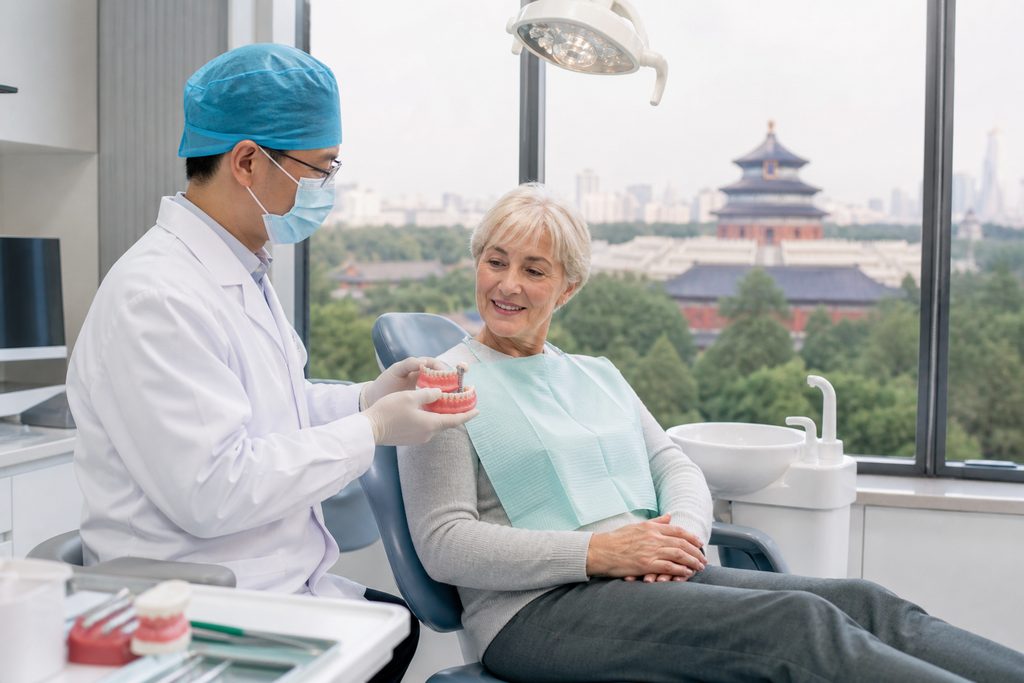
When 58-year-old Margaret from Manchester started researching alternatives to her slipping lower denture, she had already been quoted £14,000 at a private London clinic. She searched “implant overdenture cost China” at 2 a.m., found our page, and emailed us the next morning. Three months later, she flew home with four titanium implants and a snap-on prosthesis that finally stayed put during meals. Her total bill, including flights and a week in Shanghai, came to just under half the UK quote.
That is the short version. The longer version involves planning, honest trade-offs, and knowing exactly which clinic tier fits your case. This article walks through all of it.
Implant Overdenture in China: The Short Answer
An implant overdenture in China typically costs between $4,500 and $9,000 per arch, depending on the number of implants (usually 2 to 4), the prosthetic material, and whether you choose a public hospital dental department or a private international clinic. The procedure takes two visits: the first for implant placement (1–2 hours in the chair), and the second 3–6 months later for attaching the overdenture. For most international patients, the total timeline from first consultation to final fitting runs 4–7 months.
But here is what the price tag does not tell you. The China Medical Services team has coordinated enough dental cases to know that the implant itself is rarely the hard part. The hard part is sequencing: getting the CBCT scan read correctly, matching the right implant system to your bone quality, and making sure the lab that fabricates your overdenture actually communicates with the surgeon who placed the implants. That coordination gap is where treatment fails — or succeeds.
Who This Is Right For — and Who It Isn’t
Implant overdentures work brilliantly for a specific profile. You have been wearing a full lower denture (or full upper) for years. Your ridge has resorbed to the point where suction is unreliable. You are tired of adhesive pastes and soft-food diets. But you do not want — or cannot afford — a fixed full-arch bridge with 6–8 implants per jaw.
Good candidates typically share these traits:
- Enough bone height in the anterior mandible or maxilla for 2–4 standard implants (minimum 10–12 mm vertical bone, though shorter implants exist)
- No uncontrolled diabetes (HbA1c below 7.5%) and no active periodontal disease
- Non-smokers, or willing to quit for 8 weeks around surgery
- Realistic expectations: an overdenture is removable, not fixed. It clicks onto locator abutments but still comes out at night.
Who should think twice? If you have severe bruxism that has fractured previous prosthetics, a fixed hybrid may serve you better long-term. If you have had head and neck radiation therapy, your osteonecrosis risk requires a specialist evaluation before any implant surgery. And if you cannot commit to two separate trips to China within a 6-month window, the logistics may outweigh the savings.
The Options, Compared
Denture wearers researching “snap on denture implants price Beijing” or “best dental clinic for implant overdenture Shanghai” quickly discover that China is not one market. It is three distinct tiers, each with different pricing, service models, and trade-offs.
| Option | Implant Overdenture Cost (per arch) | Implant System | English Support | Typical Timeline |
|---|---|---|---|---|
| Public hospital dental department (Tier 3A, Shanghai/Beijing) | $4,500–$6,500 | Korean systems (Osstem, Dentium) or Chinese brands | Limited; bring interpreter | 2 visits, 5–7 months |
| Private international dental clinic (JCI-accredited or expat-focused) | $6,500–$9,000 | Swiss (Straumann) or German (Bego, Ankylos) | Fluent English, direct insurance billing | 2 visits, 4–6 months |
| Dental hospital international VIP department | $7,000–$10,000 | Straumann, Nobel Biocare | Dedicated English coordinator | 2 visits, 4–6 months |
Which column suits you? If budget is the dominant constraint and you are comfortable navigating language barriers with a companion, the public hospital route delivers solid surgical quality at the lowest price — but expect longer waits and less hand-holding. If you want Swiss implants, English-speaking staff, and insurance paperwork handled for you, the private international clinic tier is the pragmatic middle. The VIP department tier is for patients who want the top implant brands, a named senior surgeon, and zero friction — at roughly double the public hospital price.
Why “Full Coordination” Changes the Math
Here is what most articles about “implant overdenture cost China” miss. The surgical fee is only one line item. What determines whether your treatment actually works is the coordination layer around it. A patient who flies to Shanghai, walks into a public hospital dental department alone, and tries to book implant surgery on day one will hit a wall. Public hospitals in China generally require an in-person consultation before scheduling surgery. You cannot lock in a surgery date from overseas through the standard registration system.
That is where a coordination service changes the equation. We handle the pre-arrival steps: translating your panoramic X-rays and medical history, confirming which implant system the clinic actually stocks, and arranging an initial consultation slot through the hospital’s international department. You still meet the surgeon, you still approve the treatment plan, and you still pay the hospital directly. We simply remove the guesswork about whether the clinic you chose actually performs the procedure you need.
What It Costs — and What Drives the Variance
Let us break down a typical implant overdenture package in Shanghai or Beijing, using real 2025–2026 price bands.
- CBCT scan and diagnostic workup: $80–$150
- Implant placement surgery (2 implants, lower arch): $1,800–$3,200
- Implant placement surgery (4 implants, upper arch): $3,200–$5,500
- Locator abutments: $300–$600 per implant
- Overdenture prosthesis (acrylic base with metal reinforcement): $800–$1,800
- Premium overdenture (flexible framework, higher-end teeth): $1,800–$3,000
The biggest variance driver is implant count. A 2-implant lower overdenture costs meaningfully less than a 4-implant upper overdenture — but the upper arch typically needs 4 implants because maxillary bone is softer and the palate provides less retention. The second driver is the implant brand. Korean systems like Osstem run $400–$600 per implant; Swiss Straumann runs $800–$1,200. Both are clinically proven. The difference matters more for long-term parts availability than for osseointegration success.
How Long Does the Implant Overdenture Procedure Take?
The honest answer: longer than most clinics advertise. Here is the realistic week-by-week breakdown for international patients.
Visit 1 — Surgical placement (3–5 days in China): Day 1 is consultation, CBCT, and treatment planning. Day 2 or 3 is implant surgery — typically 60–90 minutes for 2 implants, up to 2 hours for 4. You fly home 2–3 days after surgery once the surgeon confirms no early complications. Sutures dissolve on their own.
Healing phase (3–6 months, at home): Osseointegration takes 3 months in the lower jaw and 4–6 months in the upper jaw. During this window, you wear your existing denture (relined with soft material) or a temporary prosthesis. No second trip is needed.
Visit 2 — Prosthesis attachment (3–4 days in China): The surgeon exposes the implants (if they were buried under gum tissue), attaches the locator abutments, and takes impressions. The lab fabricates your overdenture in 1–2 days. You leave with the final prosthesis fitted and adjusted.
Total chair time: roughly 4–5 hours across both visits. Total calendar time: 4–7 months. Anyone promising a complete implant overdenture in a single 2-week trip is either doing immediate-loading protocols (riskier for overdentures) or skipping the osseointegration waiting period entirely.
Is Implant Overdenture Safe in China?
The short answer: yes, when performed at a top-tier dental hospital or an international clinic with documented implant volumes. The longer answer requires context. China’s top dental hospitals — institutions like the dental departments within Fudan-ranked general hospitals — perform thousands of implant placements annually. The surgical technique itself is standardized globally. Implant survival rates for mandibular overdentures run 95–98% at five years across published international studies, and Chinese top-tier centers report comparable figures.
The safety question is less about surgical skill and more about system factors. Sterilization protocols at Tier 3A public hospitals are rigorous. The implant brands used — Osstem, Straumann, Nobel — are the same ones used in London or Sydney. What varies is communication. A patient who cannot communicate post-operative symptoms (persistent bleeding, nerve tingling, unusual pain) is at higher risk of complications going unaddressed. That is a coordination problem, not a clinical one.
Practical Considerations: Records, Visa, Payment, and Follow-Up
Implant failure within the first year is uncommon (2–5% for overdenture implants in healthy non-smokers) but not impossible. Most Chinese clinics include a one-year implant warranty covering replacement of the failed implant at no charge — but you must return to China for the replacement surgery. Some international private clinics have partner dentists in Western countries who can handle the surgical revision, but that is the exception, not the rule. Ask about the warranty terms in writing before your first surgery.
Yes, and many patients do. Adding a comprehensive health screening at the same hospital costs $200–$500 and takes one morning. It is a sensible use of the trip, particularly if you are over 50 and due for cardiovascular or cancer screening anyway. The coordination service can schedule both through the same hospital system, which saves you a second registration process.
At a private international clinic, no — the dentists and coordinators speak English. At a public hospital dental department, yes, unless you speak Mandarin. Even the surgical consent forms will be in Chinese. A bilingual medical companion costs from $300 per day and covers registration, queue management, interpretation during consultation, and payment logistics. For a 3–5 day surgical visit, that is a small line item against the total treatment cost.
Your Next Step
An implant overdenture in China is not the right choice for everyone. But for denture wearers who have been quoted five figures at home and are willing to plan two trips, the savings are substantial and the clinical quality at top-tier centers is comparable to any Western capital. The key is not finding the cheapest clinic. It is finding the right clinic for your specific bone condition and prosthetic needs — and coordinating the logistics so nothing falls through the cracks.
Our team at China Medical Services is not a hospital and does not provide diagnoses or treatment. We are a coordination partner: we match you with appropriate dental departments across our specialty hospital database, arrange consultations, and provide bilingual support on the ground. If you are considering an implant overdenture and want an honest assessment of whether China makes sense for your case, start with a free consultation. We will tell you plainly if it does not.
Frequently Asked Questions
Yes. The hospitals used for international patients are JCI-accredited and follow the same international safety standards as top hospitals in the US and Europe. Surgical teams perform high volumes of procedures — often more than their Western counterparts — which studies show leads to better outcomes.
Costs vary by procedure and hospital, but international patients typically save 40-80% compared to US prices — even when factoring in travel and accommodation. A consultation with our team will give you an exact, all-inclusive quote with no hidden fees.
Send us your existing medical reports to get started. We handle everything from hospital selection and appointment scheduling to visa assistance and post-operative recovery planning. Your medical records are reviewed by the specialist before you even book a flight.
For more medical information and treatment options in China, visit chinamedservices.com (China Medical Services).
