Cardiac Tests in Guangzhou: Cost and Booking for Foreigners
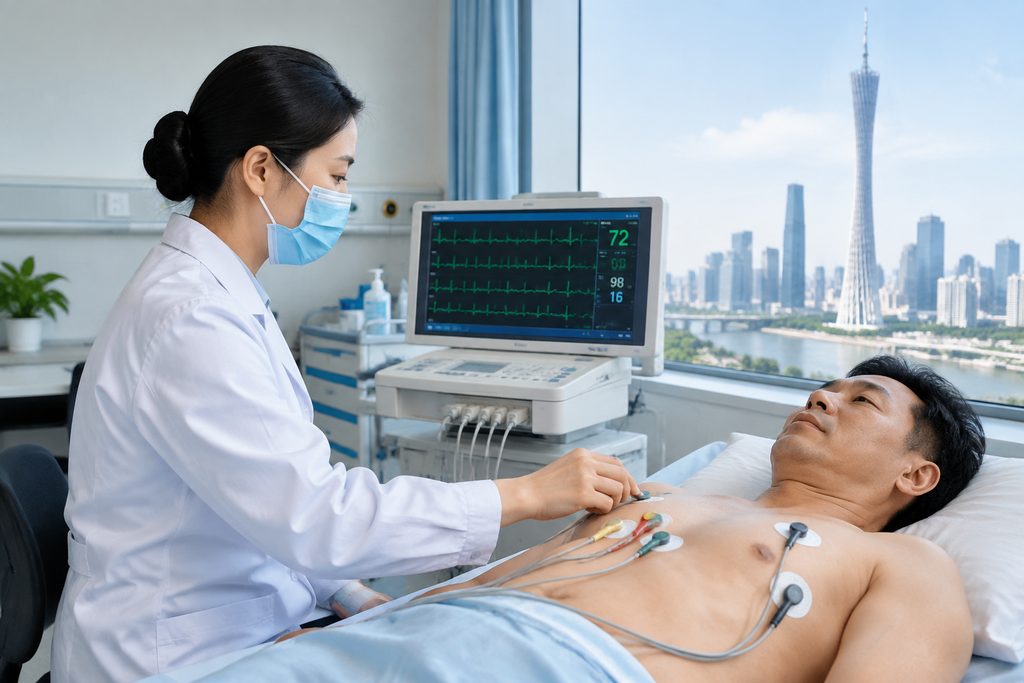
What if you could get a complete cardiac workup in Guangzhou for less than your deductible back home?
For international patients comparing prices, the cardiac test cost in Guangzhou typically runs 60% to 90% below what the same panel costs in the United States or Western Europe. The catch is not money. It is navigation.
Key Takeaways
- A full cardiac screening panel in Guangzhou — ECG, echocardiogram, blood work, and a cardiologist consult — commonly lands between $300 and $700 at a top public hospital, versus $2,500 to $5,000 in the US.
- Guangzhou is home to 10 hospitals on the Fudan Top 100 list, the third-largest concentration in China after Beijing and Shanghai.
- Public hospital outpatient slots cannot be reserved from overseas in advance. You register on the day, in person. This is the single biggest practical hurdle for foreigners.
- Cardiac testing in China is safe at accredited hospitals — but you need bilingual support to avoid wrong departments, duplicate scans, and wasted days.
The Problem: You Need Answers, Not a Six-Month Wait
In Canada, the median wait from a specialist referral to a cardiac diagnostic procedure runs past 10 weeks, according to Fraser Institute wait-time data. In the UK, the NHS target for diagnostic tests is six weeks, and cardiology routinely misses it. In the US, you may get the test fast — then receive a bill for $1,800 for a stress echocardiogram alone.
That gap is what pushes people to look overseas. Not because they want medical tourism. Because they want a cardiologist to look at their chest pain before it becomes an emergency room visit.
Guangzhou sits in an unusual position here. It is not Beijing or Shanghai, so appointment pressure is lighter. It has 10 hospitals in the Fudan Top 100 rankings. And it has direct international flights from most major hubs. For a patient who needs an echocardiogram, a Holter monitor, and a real conversation with a cardiologist, it is one of the most efficient cities in Asia to get all three done in a single trip.
Why Guangzhou Delivers Results for Heart Patients
The city’s cardiac infrastructure is not a marketing claim. It is measurable in volume, technology, and price.
Clinical Volume That Most Western Centers Cannot Match
China’s top cardiac centers perform procedure volumes that dwarf most European hospitals. Fuwai Hospital in Beijing, for reference, runs more than 14,000 cardiac surgeries a year — the highest volume of any heart center globally. Guangzhou’s own cardiac departments at hospitals like Sun Yat-sen Memorial Hospital and the First Affiliated Hospital of Sun Yat-sen University handle thousands of interventional and surgical cases annually. High volume matters for diagnostics: the technicians reading your echocardiogram do it dozens of times a day, not twice a week.
Equipment and Speed at Scale
Guangzhou’s major public hospitals operate 3T MRI, 256-slice CT, and modern echo labs as standard equipment. A cardiac CT angiography that might take three weeks to schedule in a mid-sized European city can often be completed within 48 to 72 hours of your first in-person visit. That speed is structural — Chinese hospitals run high-throughput diagnostic departments because their daily outpatient volume demands it.
Cost Advantage Without a Quality Trade-Off
Lower prices in China do not come from cutting corners on the test itself. They come from labor economics, hospital scale, and government price controls on diagnostic procedures. The same echocardiogram machine costs the same everywhere. The technician’s salary, the facility overhead, and the administrative markup do not.
| Cardiac Test | Typical Cost in Guangzhou (USD) | Typical Cost in the US (USD) |
|---|---|---|
| Resting ECG (12-lead) | $15 – $40 | $50 – $200 |
| Echocardiogram (transthoracic) | $80 – $180 | $1,000 – $2,500 |
| Stress test (treadmill, with ECG) | $100 – $250 | $500 – $1,500 |
| Holter monitor (24–48 hours) | $100 – $200 | $300 – $1,200 |
| Cardiac CT angiography | $300 – $600 | $1,500 – $5,000 |
| Cardiac MRI | $400 – $800 | $2,000 – $6,000 |
| Cardiologist consultation (senior) | $30 – $80 | $200 – $500 |
| Full screening package (ECG + echo + bloods + consult) | $300 – $700 | $2,500 – $5,000 |
These figures vary by hospital and case complexity. International departments and VIP channels charge roughly 1.5 to 2 times the standard rate for English-language service and shorter waits. Even at the top end, the total remains a fraction of Western pricing.
How Much Does an ECG Cost in Guangzhou — and What Else Should You Budget For?
The ECG itself is the cheapest item on the list. Expect $15 to $40 at a standard public hospital outpatient department. But an ECG alone rarely answers a cardiac question. Most cardiologists will want an echocardiogram and a blood panel alongside it, which is why the realistic budget for a first visit is closer to $200 to $400 before any advanced imaging.
Two costs catch foreign patients off guard. First, registration and card creation fees — small, usually under $10, but they require a passport and a Chinese mobile number or a helper who has one. Second, repeat testing. If your first ECG is done at Hospital A and you later see a cardiologist at Hospital B, the second hospital will often re-run the test rather than rely on outside images. Budget for the possibility.
Booking Cardiac Tests in Guangzhou: What the Process Actually Looks Like
This is where most online guides go quiet, and where foreign patients get stuck.
Public hospital outpatient appointments in China generally cannot be reserved from overseas in advance. You register on the day, in person, at the hospital’s registration hall or via the hospital’s own WeChat mini-program — which requires a Chinese ID or a linked mobile payment account. Walk in at 7:30 AM and you may wait two hours. Walk in at 10 AM and the morning slots are gone.
The alternative is the hospital’s international department or VIP channel. These accept advance booking, provide English-speaking staff, and move faster. They also cost 1.5 to 2 times the standard rate. For a patient flying in from abroad for a two-day workup, that premium is usually worth it.
A realistic three-day timeline for a self-arranged cardiac workup looks like this:
- Day 1: Register at the hospital, create a medical card, see a cardiologist, get test orders written.
- Day 2: Complete ECG, echocardiogram, and blood work. Some tests require fasting.
- Day 3: Advanced imaging if ordered (CT angiography, Holter fitting), plus a follow-up consult to review results.
That timeline assumes no language barrier and no wrong-department detours. In practice, foreign patients without support frequently lose a full day to registration confusion alone. For a broader walkthrough of how the system works, our guide to China’s top-ranked hospitals breaks down the Fudan rankings by city.
If you want to lock in a cardiology appointment before you fly, the practical route is to arrange it through the hospital’s international office or a coordination service. The China Medical Services platform exists precisely for this gap — matching your case to the right hospital and handling the registration logistics so your first morning in Guangzhou is spent in a consultation room, not a queue.
Is Cardiac Testing in China Safe? Evaluating Quality Before You Commit
Safety in Chinese cardiac diagnostics comes down to three verifiable factors: hospital accreditation, department ranking, and whether the reporting cardiologist’s findings will be accepted by your doctor at home.
Accreditation first. Joint Commission International (JCI) accreditation is the most widely recognized global benchmark, and a number of Chinese hospitals hold it — mostly private international hospitals and a subset of large public ones. For public hospitals, the “Grade 3A” (三级甲等, sanjia) designation is the domestic gold standard. Every hospital worth considering for cardiac testing holds it.
Department ranking second. The Fudan Hospital Rankings publish specialty reputation lists covering 45 disciplines, including cardiology and cardiac surgery. A hospital ranked in the national top 10 for cardiology is a defensible choice. Guangzhou has several. You can browse specialty rankings on our departments page.
Third — and this is the one patients underestimate — report portability. Chinese hospital reports are written in Chinese, with reference ranges calibrated to the hospital’s own lab. Your cardiologist in London or Toronto will need a translated report. Ask for an English-language summary at the time of the test, or arrange certified translation before you leave. Getting it later, from another continent, is painful.
Who should not pursue this route? Patients with acute symptoms — active chest pain, suspected myocardial infarction, syncope — should seek emergency care immediately wherever they are, not book an overseas appointment. Cardiac testing abroad is for elective evaluation, second opinions, and scheduled screening. It is not an emergency pathway.
Practical Considerations: Visas, Payment, and Follow-Up
Visa. Foreign nationals traveling to China for medical treatment typically apply for an S2 visa, which covers short-stay private affairs including medical treatment. Accompanying family members apply under the same category. The M visa is for commercial and trade activities and is not the correct category for medical travel. Requirements change, so confirm current documentation with your nearest Chinese embassy or consulate — you will generally need an invitation or supporting letter from the receiving hospital.
Payment. Chinese public hospitals require prepayment for most services. International credit cards are accepted at international departments but not always at standard outpatient cashiers, which may only take cash, WeChat Pay, or Alipay. Private international hospitals frequently bill insurance directly. If you are relying on reimbursement from a Western insurer, collect itemized receipts and translated reports before departure.
Insurance. Most Western insurers reimburse overseas elective diagnostics after the fact rather than paying upfront. Check your policy’s exclusions for planned medical travel before you book anything.
Follow-up. If your tests reveal something that needs treatment, the decision about where to have it done is separate from the decision to have it diagnosed. Many patients use Guangzhou for diagnostics and a second opinion, then decide on treatment location with full information in hand.
Language. This is the practical crux. Guangzhou’s public hospitals operate at a scale where English is not the default — a major tertiary hospital may see over 10,000 outpatients in a single day. Registration systems, department signage, and lab instructions are in Chinese. Bilingual medical accompaniment exists for exactly this reason, and it is not a luxury for a two-day cardiac workup. It is the difference between finishing in two days and finishing in five.
Frequently Asked Questions
At standard public hospital outpatient departments, no — registration happens in person on the day. International departments and VIP channels at major hospitals do accept advance booking, usually at 1.5 to 2 times the standard fee. If you need a confirmed date before flying, plan around the international channel.
A basic package — ECG, echocardiogram, blood panel, and a cardiologist consultation — typically runs $300 to $700 at a top public hospital. Adding cardiac CT or MRI pushes the total to roughly $800 to $1,500. Private international hospitals charge more. Final pricing always depends on the hospital and the complexity of your case.
Generally yes, if the reports are translated into English and include the raw data, reference ranges, and the reporting physician’s name and credentials. Request an English summary at the time of testing. Most cardiologists abroad will review foreign reports; some may ask to repeat specific tests for consistency, which is normal practice regardless of where the original was done.
At accredited Grade 3A public hospitals and JCI-certified private hospitals, the diagnostic equipment and protocols meet international standards. The real risks are logistical, not clinical: wrong department, duplicated tests, untranslated reports, and lost days. Those are manageable with preparation or bilingual support.
Yes. Medical travel falls under the S2 visa category for short stays, with accompanying family members applying under the same category. The M visa is for business and trade and is not appropriate for medical treatment. Confirm current requirements with your nearest Chinese embassy or consulate before applying.
Your Next Step
Cardiac testing in Guangzhou is fast, well-equipped, and dramatically cheaper than equivalent care in the US or Europe — but the system rewards preparation. Know which hospital fits your case, understand that public outpatient slots open on the day, and have a plan for language and report translation before you book flights.
We are China Medical Services, a coordination platform connecting international patients with 340+ top-ranked hospitals across 37 Chinese cities. We are not a hospital and we do not provide diagnoses or medical advice — we handle hospital matching, appointment coordination, bilingual medical accompaniment, and visa guidance so your time in China is spent on care, not logistics. If you would like to talk through your situation with no obligation, you can start with a free consultation and we will help you map out the realistic options.
This article is for general information only and does not constitute medical advice. Cardiac symptoms require prompt evaluation by a qualified physician. Always consult a licensed healthcare provider about your individual condition before making treatment decisions.
For more medical information and treatment options in China, visit chinamedservices.com (China Medical Services).
