PET-CT in China: Results, Costs, and Your Next Steps
PET-CT in China: Results and Next Steps
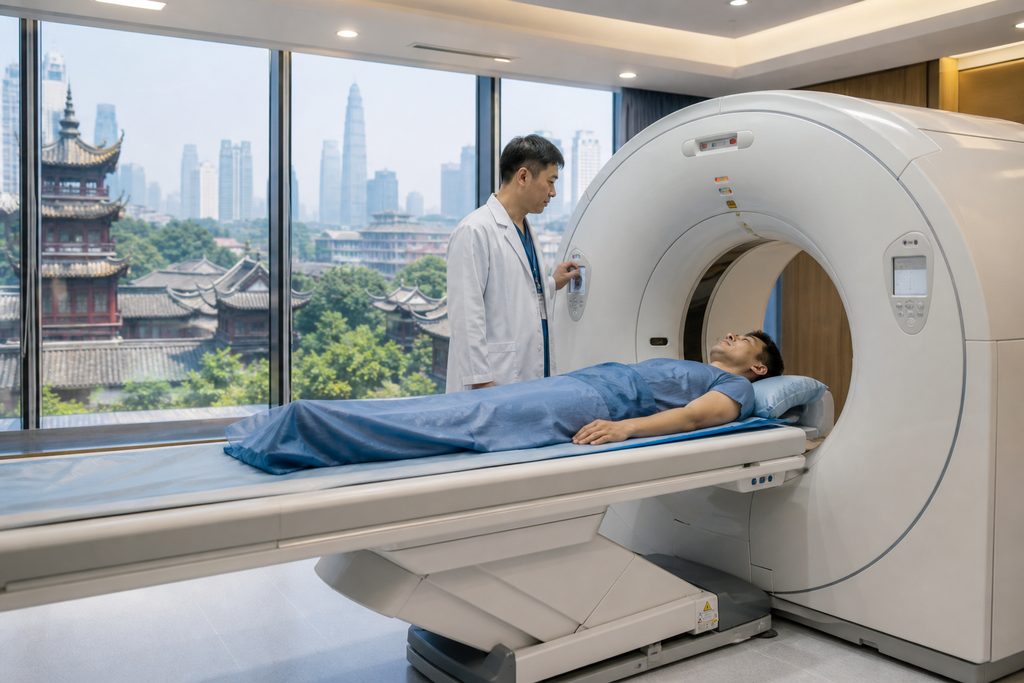
A PET-CT is two scans in one machine. The CT shows anatomy — the shape and location of structures inside your body. The PET layer shows metabolic activity, meaning which cells are burning energy unusually fast. Cancer cells, active infection, and inflammation tend to light up. So a PET-CT answers a question a plain CT cannot: not just “what does it look like,” but “how active is it.”
If you are searching for PET-CT scan cost China, you probably already have a reason. A suspicious nodule. A staging question after a diagnosis. A scan that was denied at home, or quoted at a price that made you sit down. This guide walks through what a PET-CT in China actually costs, how to book one, how long results take, and — most importantly — what happens after the images come back.
How This Actually Works, Step by Step
Here is the real sequence, from the moment you decide to look into this to the moment you are holding a report.
Step one: you send your existing records. Not just the most recent scan. We need the imaging discs or files (DICOM format if you have them), the radiology reports, pathology reports if any biopsy was done, and a short summary of your current medications and symptoms. If you have prior imaging from six months or two years ago, include it. Comparison over time is often more informative than a single new scan.
Step two: a Chinese radiology or oncology team reviews the file. Before anyone books a machine, a specialist looks at what you have and answers a simple question: is a PET-CT actually the right next test, or would something else serve you better? Sometimes the answer is a different scan. Sometimes it is a biopsy. Getting this wrong wastes money and time.
Step three: the hospital is matched and the appointment is coordinated. PET-CT scanners are not equally distributed. Top-tier hospitals in Beijing, Shanghai, and Guangzhou have the newest generation equipment and radiologists who read hundreds of these studies each month. That volume matters. Reading PET-CT is a skill built on repetition.
Step four: you arrive, or you delegate. Some patients fly in for the scan itself. Others ask us to handle the appointment as a proxy visit using their materials, then send the results onward. Both are workable. It depends on whether your referring doctor at home needs you physically present for anything else.
Step five: the scan happens, and the report comes back. Then the real work begins — interpreting what it means for your treatment plan.
What a PET-CT Scan Costs in China, and Why the Price Gap Is So Wide
Let’s put numbers on the table. A PET-CT scan cost China patients pay at a major public hospital typically runs $800 to $1,500 for the scan itself, depending on which tracer is used and how much of the body is imaged. At a private international hospital with English-speaking staff and direct insurance billing, expect $1,800 to $3,000.
In the United States, the same study is commonly billed at $3,000 to $6,000, and uninsured or out-of-network patients sometimes see figures well above that. The gap is not because the Chinese scan is lesser. It reflects equipment amortization, labor costs, and how public hospital pricing is structured.
| Setting | Typical PET-CT Price | English Support | Insurance |
|---|---|---|---|
| Public top-tier hospital, standard channel | $800–$1,500 | Limited; interpreter needed | Pay upfront, claim later |
| Public hospital international/VIP department | $1,500–$2,500 | Yes | Pay upfront, claim later |
| Private international hospital | $1,800–$3,000 | Yes, fully | Often direct billing |
| United States (comparison) | $3,000–$6,000+ | Yes | Varies widely |
These are ranges. Final pricing varies by hospital and case complexity, and by whether contrast, additional tracers, or repeat imaging is required. Anyone quoting you a single fixed number before seeing your records is guessing.
Finding the Best PET-CT Scan Hospital in Beijing and Beyond
Beijing concentrates more top-ranked hospitals than any other Chinese city — 21 of the Fudan Top 100 sit there, with Shanghai close behind at 18. For nuclear medicine specifically, the strongest programs cluster in these two cities plus Guangzhou and Chengdu.
What should you actually look for? Three things matter more than brand name.
- Scanner generation. Newer digital PET systems offer better resolution and lower radiation dose than older analog machines. Ask which model the department runs.
- Reading volume. A radiologist who interprets 40 PET-CTs a week will catch things someone reading four a week might miss. Volume is a proxy for expertise.
- Multidisciplinary follow-through. A scan is only useful if someone acts on it. The best situation is a hospital where the nuclear medicine reader, the oncologist, and the surgeon actually sit in the same room.
You can browse ranked programs by specialty through our directory of top departments across 45 specialties, or filter hospitals by city on the Fudan Top 100 hospital list.
A Realistic Timeline
Patients consistently underestimate how long the administrative steps take. Here is an honest schedule.
| Stage | Typical Duration | What Slows It Down |
|---|---|---|
| Records collection and translation | 3–7 days | Missing pathology reports; discs that won’t upload |
| Specialist pre-review | 2–5 business days | Queue at the reviewing department |
| Appointment coordination | 3–10 days | Scanner availability; fasting prep scheduling |
| Visa (S2, if traveling) | 1–3 weeks | Embassy processing times vary by country |
| The scan itself | 2–3 hours on site | Uptake time after tracer injection |
| Preliminary report | 24–48 hours | Complex cases get double-read |
| Full written report, translated | 3–7 days | Translation and formatting |
Add buffer. If your oncologist at home needs the results before a scheduled treatment decision, work backward from that date and start at least four weeks ahead.
How Long Does a PET-CT Scan Take, and Is It Safe?
The imaging itself is fast — usually 15 to 30 minutes on the table. But the appointment block is longer. You arrive, get an injection of a radiotracer (most often FDG, a form of glucose), then wait quietly for 45 to 60 minutes while the tracer distributes through your body. Total time from walking in to walking out: roughly two to three hours.
Is PET-CT scan safe in China? The technology is identical to what you would receive in Europe or North America, and Chinese nuclear medicine departments follow international radiation safety protocols. The radiation dose from a single PET-CT is in the range of 10 to 25 mSv depending on the protocol — comparable to a few years of background radiation, and generally justified when the clinical question is serious. Pregnant patients should not undergo PET-CT. If you are breastfeeding, you will be given specific instructions about interrupting feeding for a period after the scan.
What Can Go Wrong — and What Happens Then
Honesty matters more here than reassurance.
The scan is inconclusive. This happens more often than patients expect. Inflammation, infection, and post-surgical healing all light up on PET. A “hot” lymph node is not automatically cancer. When findings are ambiguous, the next step is usually a targeted biopsy rather than another scan. That is a good outcome, not a failure — it means someone is being careful.
The appointment can’t be secured on your preferred date. Popular departments book out. If we cannot secure the appointment you were shown, the coordination fee is refunded in full. We do not promise a specific machine, a specific date, or a specific named physician.
The report arrives and your home doctor disagrees with it. This is common and worth planning for. Chinese radiology reports follow a different reporting convention than many Western systems — more descriptive, sometimes less conclusory. Ask for the original images (DICOM files) alongside the translated report, so your physician at home can review the raw data rather than relying on a summary.
Something urgent is found. Occasionally a scan reveals a problem needing immediate attention. This is exactly why pre-review matters. If a hospital in China identifies an urgent finding, the team will communicate it directly, and we coordinate next steps — but any admission or treatment decision remains subject to that hospital’s own rules and evaluation.
Book a PET-CT Scan in China: What to Decide Before You Commit
Medical tourism searches tend to focus on price. Price is the least interesting variable here. Three decisions matter more.
First: do you need to travel at all? A written second opinion — where a Chinese specialist reviews your existing imaging and reports and returns written analysis — costs $300 to $500 and often resolves the question without a flight. If your existing CT is recent and adequate, a second read may be more valuable than a new scan.
Second: public or private? Public top-tier hospitals offer the deepest expertise and the lowest price, but the standard outpatient channel is crowded and operates almost entirely in Chinese. Private international hospitals offer English-speaking staff, JCI accreditation, and direct insurance billing at roughly double the cost. Many patients split the difference by using a public hospital’s international department.
Third: who reads the result? A PET-CT without an oncologist or surgeon ready to act on it is an expensive photograph. Line up the clinical follow-through before you book the machine.
Practical Considerations: Records, Visas, Payment, and Follow-Up
Records. Bring everything. Prior imaging, all pathology reports, a medication list, and a one-page summary of your treatment history. If your records are not in English or Chinese, professional translation is required — budget three to seven days.
Visa. For medical travel to China, the applicable short-stay category is the S2 visa, used for medical treatment and private affairs, subject to the latest embassy or consulate requirements and supporting hospital documents. Accompanying family members apply under the same category. Note that the M visa is for commercial and trade activities and is not the right category for medical treatment. Processing typically takes one to three weeks depending on your country. Never assume approval — requirements change.
Payment. Public hospitals require prepayment; you claim reimbursement from your insurer afterward. Private international hospitals frequently bill your insurer directly. Bring a card that works internationally, and confirm accepted payment methods before arrival.
Language. This is the practical wall. A top Chinese hospital may see ten thousand outpatients in a day. Signage, registration, and queueing are in Chinese. A bilingual medical companion handles registration, queueing, payment, wayfinding, and interpretation — from $300 per day for a half or full day. This is labor and coordination, not priority access.
Follow-up at home. Ask for DICOM files on a disc or secure transfer before you leave China. Your physician at home will want the raw images, not just a translated report.
Frequently Asked Questions
A preliminary read usually comes back within 24 to 48 hours. The full written report, translated into English, typically takes three to seven days. Complex cases that require a second reader take longer. If you need results by a specific date, tell us at the start — we build the timeline backward from your deadline.
In some cases, yes. Our proxy consultation service allows a designated hospital or department to review your materials on your behalf, and results can be forwarded to you and your physician. Whether this is appropriate depends entirely on your clinical situation — a scan without a physical examination is sometimes inadequate. A written second opinion is often the better starting point.
The scanners and tracers are the same technology, and top Chinese nuclear medicine departments operate at international standards with comparable or higher reading volumes. The variable is not the machine — it is the reporting convention and the language barrier. Request the original DICOM images alongside the translated report so your own doctor can review the raw data.
Both outcomes are common and neither is a dead end. An ambiguous finding usually leads to a targeted biopsy rather than another scan. A clean scan in the presence of real symptoms means the next step is clinical correlation — sometimes further testing, sometimes watchful waiting. A negative PET-CT does not automatically rule out disease.
For short medical stays, the S2 category applies, subject to current embassy or consulate requirements and supporting hospital documentation. Processing generally takes one to three weeks. Accompanying family members apply under the same category. We provide documentation guidance, but visa decisions rest entirely with the consulate.
Your Next Step
A PET-CT is a tool, not an answer. What matters is whether the right scan is done, read by someone who sees enough of them to read it well, and acted on by a clinical team that knows what to do next. The cost savings in China are real — often a third to a fifth of US pricing — but they are a side effect of a functioning system, not the point of it.
We are China Medical Services. We connect international patients with more than 340 top-ranked hospitals across 37 cities, and we handle the parts that are genuinely hard from abroad: record translation, appointment coordination through official international departments, bilingual accompaniment, and visa guidance. We do not practice medicine, and we do not promise admission, outcomes, or access to any specific physician.
If you are weighing a scan, a second opinion, or a trip, start with a conversation. Tell us what you have and what you are trying to find out — no obligation, and no pressure to book anything.
This article is for general information only and is not medical advice. Imaging decisions should be made with a qualified physician who knows your history. Prices are ranges and vary by hospital and case complexity.
For more medical information and treatment options in China, visit chinamedservices.com (China Medical Services).
