Same-Day CT Scan in China: Our Fast Diagnostics Service Explained
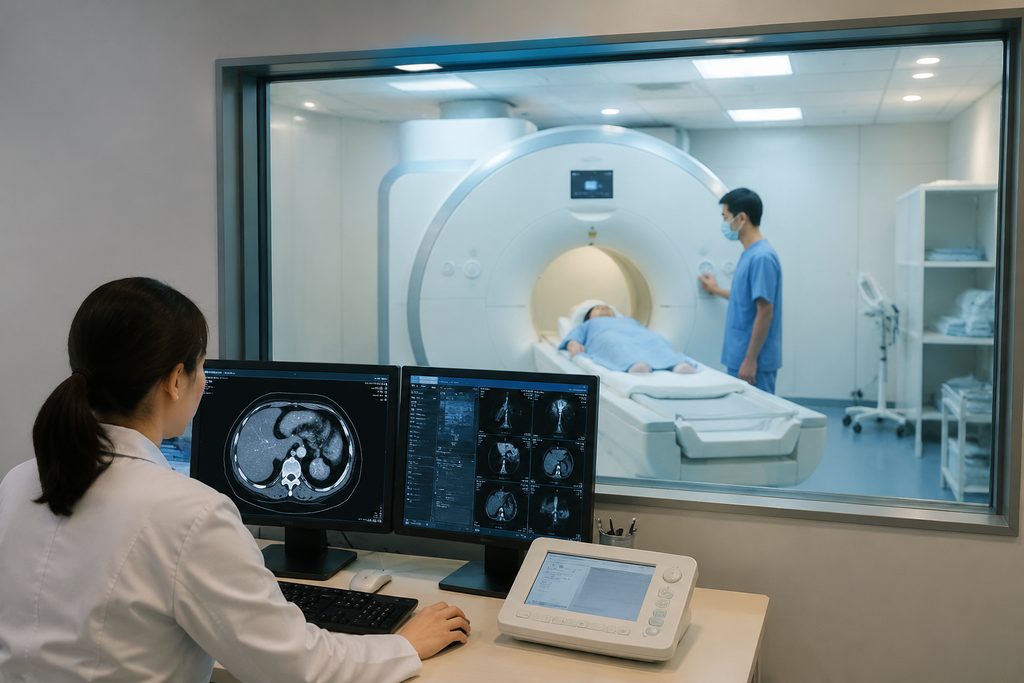
Getting a CT scan in your home country can mean waiting weeks. Sometimes months. You sit with a referral, a nagging symptom, and a phone that never rings. That anxiety has a cost all its own. In China, the model is different. A same-day CT scan is not a luxury add-on. It is the default workflow at most major hospitals. You walk in, you get scanned, you leave with images and a preliminary report. The question international patients actually ask us is not whether it is possible. It is how to navigate it without speaking Mandarin, and what the CT scan cost China really looks like when you factor in coordination, translation, and interpretation of results.
Our team at China Medical Services has guided patients through this exact sequence hundreds of times. The scan itself is fast. The preparation is where most people stumble. This article breaks down the real process, the prices, the safety standards, and the honest risks.
How This Actually Works, Step by Step
You do not need to fly to China just to book a scan. That would be backwards. Here is the sequence we walk patients through every week.
First, you send us your existing medical records. A referral note, a symptom summary, previous imaging if you have it. Our bilingual coordinators translate these into clinical Chinese and prepare a one-page case summary. This step takes one to two business days.
Second, we match your case to the right department. A chest CT belongs in pulmonology or thoracic surgery. A abdominal CT might go to gastroenterology or general surgery. We use our database of 340+ top-ranked hospitals across 37 cities to find the department with the right equipment and the shortest realistic queue. You can review options before committing to anything.
Third, we coordinate the appointment through the hospital’s international department or VIP channel. This is the critical step most foreigners miss. Public hospital walk-in counters in China do not accept overseas bookings. You cannot reserve a same-day slot from abroad without a local intermediary. The international department can. That is the channel we use.
Fourth, you arrive. Our bilingual medical companion meets you at the hospital entrance. They handle registration, payment, queue tickets, and escort you to the radiology suite. You drink the contrast agent if needed. You change into a gown. You lie still for five to ten minutes. Then it is done.
Fifth, you get the images. Most hospitals provide a CD or USB copy within two hours. The written radiology report typically follows within 24 hours for standard scans. Urgent cases get preliminary verbal reads sooner. We translate the report into English and arrange a follow-up consultation with the specialist who ordered the scan.
Same-Day CT Scan in China: What “Fast” Actually Means
Let us be precise about the phrase “same-day.” It does not mean you land at Beijing Capital Airport at 9 a.m. and have images by noon. It means that once you are at the hospital with a confirmed appointment, the scan itself happens that day. The lead-up requires coordination.
How fast can you get a CT scan in China? If you are already in the country and flexible about location, a private CT scan clinic Beijing same day is genuinely achievable. United Family, Jiahui, and Raffles hospitals in Beijing all offer walk-in or same-day imaging for self-pay patients. English-speaking staff, direct insurance billing, and no long queues. The trade-off is price. More on that below.
If you want a top-tier public hospital — a Fuwai or a Peking Union — the realistic window is two to five business days for the international department to confirm a slot. That is still dramatically faster than the four-to-eight-week waits common in Canada, the UK, or parts of the US.
So the honest answer: same-day is standard once you are in the system. Getting into the system takes a few days of preparation.
A Realistic Timeline
Here is what a typical international patient experiences from first inquiry to completed scan. This assumes no visa complications and a standard non-urgent case.
| Stage | What Happens | Duration |
|---|---|---|
| Day 1–2 | You send records. We translate and prepare your case summary. | 1–2 business days |
| Day 3–5 | We contact hospital international departments and confirm a slot. You review options and approve. | 2–3 business days |
| Day 6–14 | You apply for an S2 visa (short-stay, private affairs, medical treatment purpose). Processing varies by embassy. | 5–10 business days typical |
| Day 15 | You arrive in China. Airport transfer arranged if requested. | 1 day |
| Day 16 | Scan day. Registration, payment, imaging, image copy in hand. | Half day at hospital |
| Day 17–18 | Written report received. We translate it and arrange specialist review. | 1–2 days |
Urgent cases compress this. If you already hold a valid China visa and are flexible on city, the entire sequence can fit into one week. But do not plan around the optimistic number. Visa processing is the variable you cannot control.
CT Scan Cost China: Real Numbers, Not Estimates
The CT scan cost China depends on three things: the body region, the hospital tier, and whether contrast is used. Here is the honest range.
| Setting | CT Scan (No Contrast) | CT Scan (With Contrast) |
|---|---|---|
| Top-tier public hospital (Fuwai, PUMCH, Ruijin) | $80–150 | $150–300 |
| Public hospital international/VIP department | $150–300 | $300–600 |
| Private international hospital (United Family, Jiahui) | $300–600 | $600–1,200 |
For comparison, a chest CT without contrast in the United States averages $400–1,200. With contrast, $800–2,500. In the UK, private scans run £300–800. The same day CT scan Shanghai price at a public hospital international department typically falls in the $200–500 range including contrast and report. That is a fraction of Western private rates, with equivalent or newer equipment.
These prices are for the scan itself. Coordination, translation, and companion services are separate. Our bilingual medical companion starts from $300 per day. Hospital appointment coordination starts from $300. You can find full details on our patient services page.
Is It Safe to Get a CT Scan in China?
The short answer is yes, at the right hospitals. The longer answer requires nuance.
China’s top-tier public hospitals — the ones ranked in the Fudan Top 100 — use the same scanner models you would find at Johns Hopkins or Charité. Siemens, GE, Philips, Canon. The machines are not the issue. The variability is in protocol standardization and reporting quality across the 35,000+ hospitals in the country. That is why we only work with hospitals in the top 5% by Fudan and JCI criteria.
Radiation dose is a legitimate concern anywhere. A standard chest CT delivers roughly 5–7 mSv. A low-dose lung screening CT delivers under 2 mSv. Chinese radiology departments follow the same ALARA principle (as low as reasonably achievable) as Western ones, but enforcement varies. At accredited international departments, you can ask for a low-dose protocol and expect it to be honored. At a random county hospital, maybe not. Choose your facility deliberately.
Contrast reactions happen everywhere. Chinese hospitals stock the same emergency medications and follow similar protocols. The difference is language. If you do not speak Mandarin and you have a contrast reaction, you need someone in the room who can advocate for you. That is exactly what our companions do.
So: is it safe to get a CT scan in China? At a top-ranked hospital with proper coordination, yes. At an unvetted facility chosen by price alone, you are taking an unnecessary risk.
What Can Go Wrong — and What Happens Then
We would rather you know the failure modes before you book than discover them in a hallway in Shanghai.
The appointment shifts. Public hospitals in China are busy. A VIP slot confirmed for Tuesday can move to Wednesday if an emergency case takes priority. This is rare but real. Our coordinators monitor the schedule and notify you immediately. We rebook and adjust your companion’s schedule at no extra coordination fee.
The report is in Chinese. This is the default. Every public hospital issues reports in Mandarin. Private international hospitals issue bilingual reports. If you get a Chinese-only report, we translate it and arrange a video consultation with the reading radiologist or a specialist. Translation of a standard CT report takes one business day.
Your home doctor wants the raw DICOM files. The CD or USB you get at the hospital may contain a proprietary viewer. Some Western hospitals cannot open it. We can request DICOM-format files from the hospital’s PACS system. This usually takes one to three extra days. Ask for this before you leave China, not after.
The scan shows something unexpected. This is the hard one. A scan ordered for one question can reveal an incidental finding. In that case, the hospital’s radiology department will flag it in the report. We then connect you with the relevant specialist — often within the same hospital — for a follow-up consultation. You are not left alone with a confusing report. You have a path forward.
Visa delay. The S2 visa for medical treatment is generally straightforward, but embassies have their own timelines. If your scan window is tight, apply early. We provide the hospital confirmation letter and invitation documents that support your application. We never guarantee visa approval. No one can.
Book CT Scan Package China: Choosing the Right Option
You have three realistic paths to book CT scan package China. Each has a different profile.
Option one: the public hospital international department. Best balance of price and clinical quality. You get a top-tier radiologist, a modern scanner, and a report that carries weight internationally. The trade-off is less hand-holding. The international department staff speak English, but the radiology suite technicians may not. A companion solves this.
Option two: the private international hospital. Maximum convenience. English everywhere, direct insurance billing, same-day walk-in availability at most locations. A private CT scan clinic Beijing same day is genuinely easy to arrange. The trade-off is cost — typically two to four times the public hospital rate. For a single scan, that might be acceptable. For a full diagnostic workup, it adds up.
Option three: the public hospital standard channel. Cheapest, but not viable for most foreigners. You need Chinese language skills, a local phone number, and patience for queues. Without those, the savings evaporate in confusion and missed steps.
Our recommendation depends on your case. If you need a single scan and value speed, the private route works. If you need a comprehensive evaluation — scans, bloodwork, specialist consultation — the public hospital international department with our coordination delivers far better value.
Practical Considerations: Records, Payment, and Follow-Up
Bring everything. Previous scans on CD or USB, blood test results, referral letters, medication lists. All in original language plus English translation if you have it. We translate clinical documents as part of our coordination service.
Payment is upfront at Chinese public hospitals. Credit cards work at international departments. Cash or WeChat Pay for smaller fees. Private international hospitals accept major insurance directly. For public hospitals, you pay out of pocket and claim reimbursement from your insurer later. Keep every receipt.
Insurance is tricky. Some international policies cover diagnostics in China. Others exclude it. Check your policy before you book. We can provide itemized invoices and procedure codes to support your claim, but we cannot guarantee coverage.
Language is the silent cost. Every step — registration, payment, contrast consent, the scan itself, the report — involves Chinese. A bilingual companion turns a stressful half-day into a routine one. That is not a luxury. It is the difference between a clean diagnostic and a missed detail.
Follow-up at home matters. A CT scan is only as useful as the clinical interpretation that follows it. We always recommend a video consultation with the Chinese specialist who reviewed your images, plus a handoff to your home physician. You can read more about how we structure remote consultations on our services overview.
Frequently Asked Questions
Same-day scanning is standard once you are at the hospital with a confirmed appointment. The preparation — record translation, appointment confirmation, visa — takes one to two weeks for most patients. If you are already in China and flexible on location, same-day or next-day scanning is realistic at private international hospitals.
A standard chest or abdominal CT at a top-tier Chinese public hospital costs $80–300. With contrast, $150–600. The same scans in the US typically run $400–2,500. Private international hospitals in China charge $300–1,200, still below US rates but higher than Chinese public hospitals. Prices vary by hospital and case complexity.
At top-ranked hospitals using modern equipment and standardized protocols, yes. The key is choosing a facility in the top tier — Fudan-ranked or JCI-accredited — and having someone who speaks both languages in the room. Avoid unvetted facilities chosen by price alone.
Yes. Foreign nationals use an S2 visa for short-stay medical treatment and private affairs. The hospital provides a confirmation letter to support your application. Processing takes five to ten business days at most embassies. Apply early and do not book flights until the visa is approved.
Yes. Most hospitals provide a CD or USB copy within two hours of the scan. The written report follows within 24 hours. If your home doctor needs raw DICOM files, request them before you leave China — retrieval after departure is slower.
Your Next Step
A CT scan is a tool. Its value depends on the quality of the machine, the skill of the radiologist, and the clarity of the clinical follow-up. China offers world-class imaging at a fraction of Western prices, with wait times measured in days rather than months. But the system is not built for walk-in foreigners. It requires preparation, translation, and local navigation.
That is what we do. China Medical Services connects international patients with 340+ top-ranked hospitals across 37 cities. We do not practice medicine. We coordinate it — records, appointments, companions, translations, and specialist consultations. If you are considering a diagnostic scan in China, start with a conversation. Send us your case details and we will tell you honestly whether this makes sense for you, what it will cost, and how long it will take.
Get a free consultation at our patient services page. No pressure. Just clarity.
For more medical information and treatment options in China, visit chinamedservices.com (China Medical Services).
