Chest X-Ray in China: What to Expect, Costs & How to Book
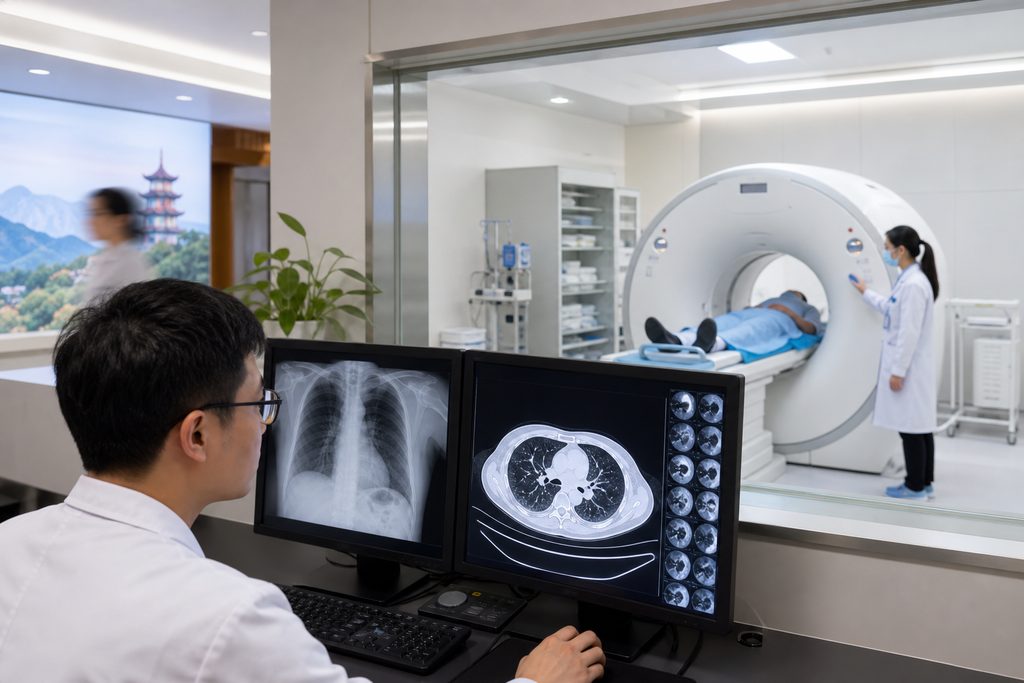
Key Takeaways
- A standard chest X-ray at a top-tier Chinese public hospital typically runs $30–$80, versus $200–$500 in the United States for the same plain film.
- Results are often ready the same day — sometimes within two hours — because imaging departments at major hospitals operate at very high daily volume.
- You cannot usually book a public hospital imaging slot from overseas in advance. Walk-in registration is the norm, and that is the single biggest friction point for foreign patients.
- Radiation dose for a standard two-view chest X-ray is low, roughly equivalent to a few days of natural background radiation, but every scan should be justified by a clinician.
What if the scan you have been waiting three weeks for could be done tomorrow morning — for the price of a nice dinner?
That is the reality many international patients discover when they look at a chest x-ray cost China hospitals quote. The image quality is comparable to what you would get in London or Los Angeles. The paperwork, however, is a different story.
The Problem: Long Waits and Opaque Pricing Back Home
In the United States, a routine chest X-ray without insurance can bill out between $200 and $500, and the price you are quoted often depends on which facility happens to be in your network. In Canada and the United Kingdom, the cost is hidden inside the public system — but so is the wait. Diagnostic imaging backlogs in several provincial and NHS trusts have stretched routine chest films to two to six weeks in some regions.
For a traveler, an expat, or someone managing a chronic respiratory condition abroad, that gap matters. A cough that will not quit, a pre-employment medical certificate, a follow-up after pneumonia — these are not emergencies, but they are not things you want to sit on for a month either.
And there is a second problem. Even when patients are willing to pay out of pocket, they often cannot figure out where to go. Chinese hospital websites are rarely built for English speakers, appointment portals require a local ID number in many cases, and the front desk of a 10,000-patient-per-day hospital is not designed for someone who does not speak Mandarin.
Why China Delivers Fast, Affordable Imaging
Volume Changes Everything
China’s top hospitals are enormous. A single major tertiary hospital may perform thousands of imaging studies every day across CT, MRI, ultrasound, and plain radiography. That throughput is why a chest film that takes a week to schedule elsewhere can often be done the same morning here. Radiology departments run extended hours, and reporting is frequently same-day.
Our network covers 340+ top-ranked hospitals across 37 cities — the top 5% of China’s 35,000+ hospitals, ranked by the Fudan University Hospital Ranking and JCI accreditation. These are the facilities where imaging infrastructure is strongest.
Equipment and Standards Are Not the Bottleneck
Digital radiography (DR) is standard at tertiary hospitals. Images are stored in PACS and can be exported on request. Many international departments will provide a written radiology report in English, though you should confirm this before your visit — it is not universal.
Cost Without Compromise
Here is the part that surprises people. Lower cost in China does not come from cutting corners on the machine or the radiographer. It comes from labor economics, high patient volume that spreads fixed costs, and a public pricing schedule set well below Western market rates.
| Location | Typical Chest X-Ray Price (USD) | Typical Wait for Routine Film |
|---|---|---|
| United States (self-pay) | $200–$500 | Same day to 1 week |
| United Kingdom (private) | $150–$350 | 3–14 days |
| China — public tertiary hospital | $30–$80 | Same day, often within hours |
| China — private international hospital | $80–$200 | Same day, English service included |
Prices vary by hospital and case complexity. A two-view PA/lateral study costs more than a single PA view, and any additional imaging ordered by the physician is billed separately.
Step by Step: How a Chest X-Ray Actually Works in a Chinese Hospital
This is the part most guides skip. Here is the real sequence at a public tertiary hospital.
Step 1 — Registration. You arrive, take a queue number, and register at the outpatient desk. You will need your passport. A hospital medical card is created on the spot. No appointment is required for imaging alone, but you generally need a physician’s order first.
Step 2 — See a physician. A clinician in the relevant department (respiratory, general internal medicine, or the international clinic) examines you and writes the imaging request. This is not optional. Chinese hospitals do not perform diagnostic imaging on self-referral the way some Western walk-in clinics do.
Step 3 — Payment. Public hospitals require prepayment. You pay at the cashier or via the hospital app before the exam. Keep every receipt — you will need them for any insurance reimbursement later.
Step 4 — The exam itself. Two views, standing, breath held. The whole thing takes under five minutes.
Step 5 — Results. At most tertiary hospitals, the report is available the same day. You collect the film and the written report, or download them through the hospital’s patient portal.
How Much Does a Chest X-Ray Cost in Beijing — and What Changes the Number
Patients searching for how much does a chest x-ray cost in Beijing often find wildly different figures online. Here is why.
A single-view PA film at a public hospital in Beijing may sit near the bottom of the $30–$80 band. Add a lateral view and you move up. Add a physician consultation fee, a registration fee, and a medical card deposit, and your total out-of-pocket for the visit lands somewhere between $50 and $150. At a private international hospital like United Family or Jiahui, the imaging itself might be $150–$250, with a consultation on top.
What does not change the price: your nationality. Foreign patients pay the same public schedule as Chinese citizens at public hospitals. What does change: whether you need a bilingual companion to navigate the queue, the payment system, and the report pickup.
For a broader look at how Chinese hospital pricing compares across specialties, see our department-by-department Top 10 hospital guide, which covers 45 specialties including respiratory medicine and oncology.
Is a Chest X-Ray Safe in China? Radiation, Standards, and Oversight
Is chest x-ray safe in China is a fair question, and the honest answer is: the radiation risk is the same as anywhere else, because the physics does not change by geography.
A standard two-view chest radiograph delivers roughly 0.1 mSv of effective dose. For context, natural background radiation exposes the average person to about 2.4 mSv per year. So a chest film is a small fraction of what you absorb just living on Earth.
What you should verify is the justification, not the geography. Chinese tertiary hospitals follow national radiation protection regulations administered by the Ministry of Ecology and Environment and health authorities. Lead shielding, dose monitoring, and equipment calibration are standard at accredited facilities. Private international hospitals with JCI accreditation apply the same international protocols you would see in Singapore or the United States.
Practical Considerations Before You Book
Visa. If imaging is part of a broader medical trip, foreign patients typically enter on an S2 visa, the short-stay category used for medical treatment and private affairs, subject to current embassy and consulate requirements and supporting hospital documentation. Stays beyond 180 days fall under S1. Family members accompanying a patient generally apply for S2 as well. Note that the M visa is for commercial and trade activity and has nothing to do with medical treatment.
Records. Bring any prior chest imaging on CD or as DICOM files, plus written reports. Chinese radiologists can compare against your baseline, which improves the value of the new study considerably.
Payment. Public hospitals take cash, Alipay, WeChat Pay, and increasingly foreign cards at international desks. Private international hospitals accept major credit cards and often bill insurers directly. Reimbursement from a Western insurer after the fact is possible but requires itemized receipts and the written report — ask for both at discharge.
Language. Outside international clinics, English is limited. Radiology technicians give instructions in Mandarin. “Take a deep breath and hold it” is not something you want to guess at while standing in front of an X-ray plate.
Follow-up. If you return home before results are finalized, arrange for the report and images to be sent digitally. Most tertiary hospitals can export DICOM files, but you must request this explicitly.
For patients weighing a full diagnostic trip rather than a single scan, our overview of private international hospitals with JCI accreditation and direct insurance billing is a useful starting point.
Frequently Asked Questions
Generally, no — not directly. Public hospital outpatient imaging runs on same-day registration, and surgery or specialist procedures require an in-person consultation first. What you can arrange in advance is a physician consultation at a hospital international department, which then generates the imaging order. That is the realistic path for a planned visit.
Most policies reimburse rather than pay upfront at public hospitals, so you pay first and file afterward with itemized receipts, the physician’s order, and the radiology report. Some international hospitals in China have direct billing agreements with major insurers, but coverage depends entirely on your specific plan. Call your insurer before you travel and confirm the reimbursement process in writing.
This is where planning matters. A same-day report is only useful if you have a clinician to interpret it. If you are in China short-term, arrange in advance for a follow-up consultation — ideally at the same hospital — so that any abnormal finding can be discussed and next steps ordered without a second trip. Our team can help coordinate that continuity, but the clinical decisions always rest with the treating physician.
You need a physician’s order, but not a formal referral from your home doctor. Any clinician at the hospital can write the imaging request after examining you. Bringing your home physician’s note is helpful context but not a requirement.
Your Next Step
A chest X-ray in China is fast, inexpensive, and technically sound — the challenge is almost never the imaging itself, it is the navigation around it. Registration queues, payment systems, physician orders, and report pickup all assume a level of local fluency that most foreign visitors simply do not have.
China Medical Services is a coordination service, not a hospital and not a provider of medical diagnoses. Our team handles hospital matching, appointment coordination, bilingual medical companionship, and visa guidance so that the clinical side can proceed without logistical friction. If you are planning imaging or a broader diagnostic visit, you can start with a free consultation through our patient support page — no obligation, just a conversation about what you actually need.
For more medical information and treatment options in China, visit chinamedservices.com (China Medical Services).
