Second Opinion in Nanjing: What International Patients Pay in 2026
Key Takeaways
- A written second opinion from a senior Chinese specialist typically runs $300–500, and a video consultation with a top-specialist team runs $500–800 — a fraction of what most Western hospitals charge for the same review.
- Nanjing is home to several hospitals inside the Fudan Top 100, including Nanjing Drum Tower Hospital and Jiangsu Province Hospital, both of which see international patients through dedicated channels.
- The hard part is not the fee. It is that public hospital outpatient slots cannot be booked from overseas in advance, and no foreigner walks a 10,000-patient-per-day campus without language support.
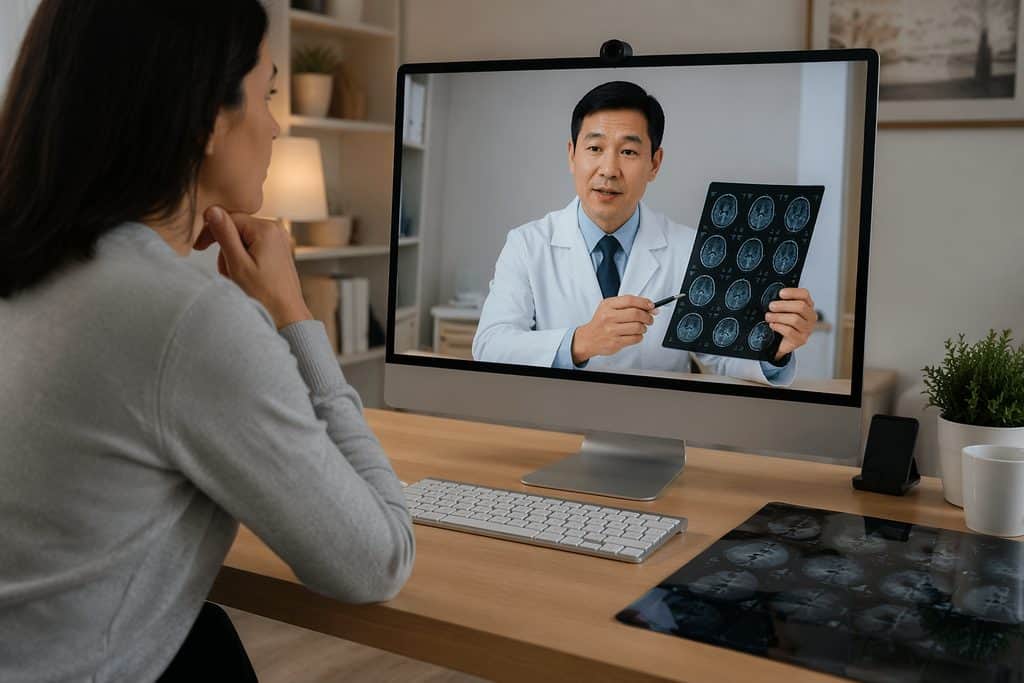
- You do not need to fly to China to get a second opinion. Records review and video consultation exist precisely so you can decide whether travel is worth it before you buy a ticket.
The Problem: When Your Diagnosis Arrives With Only One Plan
Roughly 1 in 2 cancer patients in the United States will receive at least one second opinion during their treatment journey, according to survey data published by Mayo Clinic researchers. And here is the uncomfortable part: in a substantial share of those reviews, the second physician disagreed with something in the first plan — the staging, the surgical approach, the drug sequence.
Now imagine the same scenario with a different constraint. You live somewhere the specialist says “surgery, six weeks from now,” and you have questions nobody local can answer. Or you have a quote for $120,000 and no way to know whether a $15,000 alternative in Asia is genuinely comparable or quietly inferior.
That is where most people start looking at China. Not because they have heard of a specific hospital, but because they have heard the numbers. And Nanjing — a city of over 9 million with a dense cluster of teaching hospitals — keeps appearing on their shortlist.
Why Nanjing Earns a Place on a Second-Opinion Shortlist
Nanjing Drum Tower Hospital, affiliated with Nanjing University Medical School, and Jiangsu Province Hospital are the two names that come up most often in our intake conversations. Both sit inside the Fudan Top 100, which ranks the top 100 of China’s 35,000+ hospitals across five tiers — A++++ down to A. There is no numeric rank inside that list, only a tier. Anyone who tells you a Nanjing hospital is “number 7 in China” is inventing a number.
What you can verify: the Fudan specialty reputation rankings publish a Top 10 for each of 45 specialties. If your case is hepatobiliary, nephrology, or respiratory, Nanjing hospitals appear in those specialty lists. That is the honest way to compare.
Volume you can actually feel
A senior surgeon at a major Nanjing teaching hospital may perform several hundred complex procedures a year. The average American surgeon doing the same operation performs a fraction of that. Volume correlates with proficiency in ways that are hard to argue with, particularly for high-difficulty surgery.
But volume also means crowds. Jiangsu Province Hospital handles tens of thousands of outpatient visits daily. There is no quiet, orderly waiting room. There is a number system, a queue, and a lot of Mandarin.
Cost structure, explained without hand-waving
Why is a cardiac bypass $12,000–20,000 at a top Chinese public hospital and $120,000+ in the United States? Three reasons, none of them mysterious. Physician salaries are lower in absolute terms. Hospitals run at very high throughput, spreading fixed costs across far more cases. And the drug and device supply chain is domestic for a growing share of products. None of that automatically means worse care — but it does mean you should verify outcomes for your specific procedure rather than assuming equivalence.
What a Second Opinion in Nanjing Actually Costs
This is the section most people scroll to first. Fair enough. The figures below are our published service ranges as of 2026. They are coordination and interpretation fees, not hospital charges. Hospital fees are quoted separately by the hospital, vary by case complexity, and are never bundled into the numbers below.
| Service | Typical Cost (USD) | What You Receive |
|---|---|---|
| Written second opinion (top hospital specialist) | $300–500 | Written analysis of your existing reports, treatment suggestions, and direction. Reference only — not a prescription. |
| Video consultation (general tertiary or private international department) | $100–300 | Live discussion with the specialty team; you explain symptoms and goals directly. |
| Top-specialist video consultation | $500–800 | Same format, senior specialist, usually with an interpreter on the line. |
| Multidisciplinary team (MDT) video consultation | $1,500–2,000 | Several departments review the case together and issue a joint opinion. |
| In-person top-specialist consultation coordination | $800–1,200 | Registration, medical card creation, and accompaniment for a face-to-face visit. |
| Bilingual medical companion | from $300/day | Queueing, registration, payment, wayfinding, interpretation. Half-day (4h) or full-day (8h). |
| Hospital appointment coordination | from $300 | Booking for checkups, outpatient visits, or admission. Full refund if the stated appointment cannot be secured. |
One mechanism worth knowing: any consultation fee is credited in full toward on-the-ground coordination if you travel to China within 90 days. It is a one-time credit applied to the coordination fee only — never to hospital treatment charges.
How to Get a Second Opinion in Nanjing for Cancer or Any Complex Diagnosis
The sequence matters more than most people realize, because the wrong first move costs weeks.
Step 1 — Assemble records properly. You need imaging on disc or in DICOM format, pathology slides or blocks if a biopsy was done, the full pathology report, lab panels, operative notes if you have had surgery, and a current medication list. Partial records produce partial opinions. This is the single most common failure point we see.
Step 2 — Get them translated. Chinese specialty teams read English reasonably well in academic settings, but pathology reports and operative notes are dense. A proper translation removes ambiguity and speeds review.
Step 3 — Route the case to the right department. Not the right hospital — the right department. A hepatobiliary case sent to a general oncology mailbox sits for days. Sent to the hepatobiliary surgery team, it moves.
Step 4 — Choose written review or video. Written is cheaper and asynchronous. Video lets you ask follow-up questions and hear the reasoning. For a first pass, written is usually enough. If the written opinion raises a real possibility of treatment in China, upgrade to video.
Step 5 — Decide about travel only after the opinion arrives. This is the whole point of the staged model. If the Nanjing team says your local plan is sound, you have spent $300–500 and saved a trip. If they propose something meaningfully different, you now have a concrete reason to travel.
The Barriers Nobody Mentions Until You Hit Them
Honesty here saves people real money.
You cannot book a standard public outpatient slot from overseas in advance. Registration happens on the day, in person, by queue. This is the norm across public tertiary hospitals, not a Nanjing quirk. If you want a confirmed appointment with a senior specialist before you fly, that runs through the hospital’s international or VIP channel, and pricing there is roughly 1.5–2× the standard channel.
Surgery cannot be scheduled from a records review alone. In nearly all cases, the patient must be seen in person before an operation is arranged. Anyone promising a surgical date based on emailed scans is promising something the hospital has not agreed to.
Payment works differently. Public hospitals require prepayment; insurance reimbursement happens afterward, in your home country, on your insurer’s terms. Private international hospitals in China more often bill insurers directly. Check your policy’s overseas treatment clause before assuming anything.
The visa category is S2, not M. Foreigners entering China for medical treatment apply under S2, the short-stay category covering medical treatment and private affairs, with accompanying family members applying under the same category. Stays beyond 180 days fall under S1. The M visa is for commercial and trade activity and has nothing to do with medical care. Requirements shift, so confirm current documentation with the nearest Chinese embassy or consulate and with the hospital issuing your invitation materials. Approval is never guaranteed.
Language is a genuine operational problem. Not a courtesy problem. Registration kiosks, payment terminals, pharmacy windows, and imaging desks operate in Chinese. A 10,000-visit-per-day campus is not navigable by gesture alone.
Frequently Asked Questions
Is it safe to get a second opinion in China?
Getting a second opinion is a review of your existing records — it carries no physical risk. The relevant question is whether the reviewing institution is credible. Stick to hospitals listed in the Fudan Top 100 or JCI-accredited private international hospitals, and treat any written opinion as advisory rather than as a prescription. Your treating physician at home remains the person who acts on it.
Can I book a second opinion in Nanjing China without traveling there?
Yes, and for most people that is the correct first step. Records review and video consultation are both remote. You send imaging, pathology, and lab reports; the specialty team reviews them and returns a written analysis or holds a live session. Travel only becomes relevant if the opinion identifies a treatment option worth pursuing in person.
What if the Nanjing specialists disagree with my doctor at home?
That happens, and it is useful either way. A disagreement tells you which specific question to raise with your local team — staging, surgical margins, drug sequencing, timing. Take the written opinion to your oncologist or surgeon and ask them to respond to it directly. A second opinion that confirms your current plan is not wasted money; it is confirmation you did not have before.
Does a second opinion guarantee I can be treated in Nanjing afterward?
No. A second opinion is an assessment, not an admission. Any subsequent treatment depends on the hospital’s own evaluation, bed availability, and the specialist’s judgment after seeing you in person. We coordinate and translate; we do not admit patients and cannot promise a surgical date, a specific surgeon, or a clinical outcome.
Your Next Step
The reasonable path is cheap and reversible: gather your records, get a written review, and let the opinion tell you whether Nanjing is worth a flight. That sequence protects you from spending five figures on a trip that a $400 review would have made unnecessary. Our team at China Medical Services matches cases to hospitals across 340+ top-ranked institutions in 37 cities, handles records translation and appointment coordination through official international departments, and provides bilingual accompaniment on the ground. We are a coordination service, not a hospital — we do not diagnose and we do not treat. If you want to see what a review of your own records would look like, start with a free consultation at our patient services page, and browse the Fudan Top 100 by city if you would rather compare options first.
This article is for general information only and does not constitute medical advice. Treatment decisions should be made with qualified physicians who have reviewed your individual case. Prices are indicative ranges and vary by hospital and case complexity.
For more medical information and treatment options in China, visit chinamedservices.com (China Medical Services).
