Food and Diet in a Chinese Hospital: What International Patients Eat
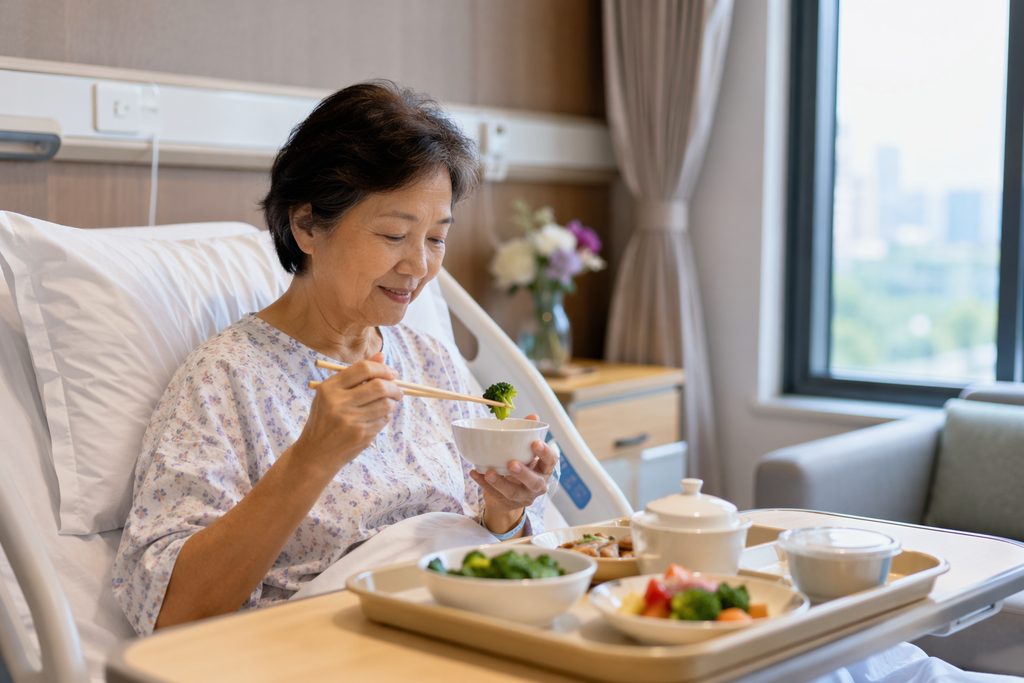
Key Takeaways
- Most top-tier Chinese hospitals do not offer Western menus as standard — but nearly all have a dietetics department that can adapt meals once a clinician writes the order.
- In VIP and international wards, English-language menus and room-service-style ordering are common. In standard wards, meals are usually fixed, low-salt, and built around rice or noodles.
- The biggest barrier is not the food itself. It is communication. If nobody on the ward speaks English, a dietary request never reaches the kitchen.
- Family-supplied food, delivered meals, and hospital-adjacent restaurants are all normal parts of Chinese inpatient life — and often the most practical solution.
The Problem: You Are Facing Surgery in a Country Where You Cannot Read the Menu
Picture a 58-year-old teacher from Oregon. She has just been admitted to a large public hospital in Shanghai for a spinal procedure. Her surgeon speaks reasonable English. The nurses are kind but rushed. At 5:30 p.m., a metal tray arrives. She lifts the lid and finds steamed white rice, a bowl of clear broth, braised greens, and a piece of fish with bones still in it. She has no idea what is in any of it, and she is on a low-sodium diet.
This is one of the most under-discussed parts of medical travel. Patients spend months researching surgeons, costs, and outcomes. Then they arrive and discover they cannot answer a simple question: what am I allowed to eat?
It matters more than most people expect. Nutrition affects wound healing, blood sugar control, bowel recovery after abdominal surgery, and how quickly someone gets back on their feet. A patient who eats almost nothing for four days because the food is unfamiliar is a patient whose recovery slows down.
What Hospital Food in China for International Patients Actually Looks Like
There is no single answer, because the experience splits sharply depending on which ward you are in.
Standard Public Ward
Meals are typically provided three times a day and included in the bed fee or billed at a nominal daily rate. The template is consistent across most of the country: rice or noodles, a vegetable dish, a small portion of protein, and soup. Flavors are lighter than restaurant Chinese food — hospitals deliberately reduce oil, chili, and salt. If you are used to heavily seasoned food, it will taste bland. That is intentional.
VIP and International Ward
This is a different world. Hospitals such as Peking Union Medical College Hospital, Zhongshan Hospital Fudan University, and the international departments at major tertiary centers generally offer menus with English translations, a choice of dishes, and sometimes Western options like toast, eggs, oatmeal, or sandwiches. Some private international hospitals — United Family, Jiahui, Parkway, Raffles — run something closer to hotel room service, with a dietitian who visits you and adjusts the plan to your preferences.
The trade-off is cost. International-department care typically runs about 1.5 to 2 times the price of the standard channel. You can compare options on our private international hospitals page.
Traditional Chinese Medicine Hospitals
If you are receiving care at a TCM hospital, food is often treated as part of the treatment. Practitioners may advise avoiding cold or raw foods after certain procedures, or recommend congee, steamed dishes, and warm soups. These recommendations are culturally grounded rather than universally evidence-based, but they are usually gentle and easy to follow. More detail is on our TCM hospitals page.
| Ward Type | Typical Meal Style | English Menu | Special Diet Requests | Relative Cost |
|---|---|---|---|---|
| Standard public ward | Rice/noodles, vegetables, light protein, soup | Rarely | Possible with clinician order | Baseline |
| VIP / international ward | Menu-based, some Western dishes | Usually | Routine | ~1.5–2x baseline |
| Private international hospital | Room-service style, dietitian-led | Yes | Standard practice | Highest |
| TCM hospital | Warm, steamed, congee-based | Varies | Often guided by TCM principles | Low to moderate |
Can I Get Western Food in a Chinese Hospital?
Yes — but the honest answer is that it depends on where you are, and you should not assume it.
In a private international hospital, asking for a Western breakfast is a routine request. In a VIP ward at a top public hospital, it is usually possible, though the menu may lean toward “international” rather than specifically American or European. In a standard public ward, the answer is almost always no from the kitchen — but you are free to have food brought in.
That last point is important. Chinese hospitals generally do not police what family members bring to a patient. Delivery apps are ubiquitous in Chinese cities, and hospital gates are crowded every evening with couriers handing over meals. If you can order through a translation app or ask a helper to do it, you can eat almost anything within your medical restrictions.
Chinese Hospital Meal Plans for Foreigners: How Special Diet Requests Actually Work
This is where most international patients run into trouble — not because hospitals refuse, but because the request never gets routed correctly.
Diet orders in Chinese hospitals follow a clinical pathway. A physician writes the order, a dietitian translates it into a meal plan, and the ward kitchen executes it. Common clinical diets include low-sodium, diabetic, low-purine (for gout), low-fat, soft or liquid, and post-operative progression diets that move from clear liquids to semi-liquid to solid food.
If you have celiac disease, a severe nut allergy, lactose intolerance, or you keep kosher or halal, say so early and say it repeatedly. Not every hospital kitchen can accommodate every requirement. Halal food is more available in cities with significant Muslim populations and at hospitals that regularly treat international patients. Gluten-free is harder — Chinese cuisine uses soy sauce widely, and standard soy sauce contains wheat.
The single most effective thing you can do is have your dietary requirement written into your admission record in Chinese before you arrive. That is a translation task, not a medical one, and it is exactly the kind of gap a bilingual coordinator closes.
Dietary Options for International Patients in China Hospitals: A Realistic Planning Checklist
Think of this as the practical layer that sits on top of the medical one.
- Confirm your ward type before you book. The food question is largely answered by whether you are in a standard or international ward. Ask specifically.
- Bring a small supply of safe staples. Instant oatmeal, protein bars, electrolyte packets, and familiar tea bags are lightweight and can bridge the first 48 hours when you are jet-lagged and unsure.
- Identify food near the hospital. Most large Chinese hospitals sit in dense neighborhoods with convenience stores and restaurants within a five-minute walk.
- Plan for the person accompanying you. A family member or companion can order, shop, and deliver — which is often faster than navigating the ward system.
- Do not skip meals to avoid awkwardness. Under-eating before or after surgery is a genuine clinical risk. If you cannot eat the tray, arrange something else the same day.
Worth knowing: many international patients find that the food issue resolves itself once they stop expecting the hospital to function like a Western one and start treating meals as a logistical problem with several workable solutions. The China Medical Services team sees this pattern constantly.
Frequently Asked Questions
In standard public wards, basic meals are usually included in the bed fee or billed at a very low daily rate — often the equivalent of a few dollars. In VIP and international wards, meals may be itemized separately, and à la carte or Western options cost more. Confirm this when you receive your cost estimate, because it varies by hospital.
Tell the hospital before admission, not after. Ask that the requirement be recorded in your chart in Chinese. Some hospitals can accommodate halal and vegetarian diets reliably; gluten-free and strict allergen-free diets are harder and may require family-supplied food. If your allergy is severe, carry your own epinephrine and make sure the ward nursing staff know where it is.
In most Chinese hospitals, yes. Bringing food for a patient is completely normal and widely practiced. The main constraint is your clinical diet order — if you are on a clear-liquid or low-sodium diet, that still applies regardless of who provides the food. Check with the nurse before introducing anything new.
Realistically, no — not in a standard public ward. If eating familiar food matters a great deal to you, that is a legitimate reason to consider an international or VIP ward, where menus are more flexible. Otherwise, plan on a mix of hospital meals, delivery, and food brought by your companion.
This is the crux of the problem. Written Chinese is far more reliable than spoken English in a busy ward. Have your restrictions translated in advance and shown to nursing staff. A bilingual companion present at mealtimes removes the friction almost entirely, because the request reaches the kitchen the same day rather than after three days of confusion.
Your Next Step
Food is a small detail that becomes a large one the moment you are lying in a hospital bed in a country where you do not speak the language. The good news is that it is solvable — with a clear diet order, a translated restriction list, and someone who can order a meal on your behalf.
We are a medical coordination service, not a hospital. We do not diagnose or treat anyone. What we do is help international patients match with appropriate Chinese hospitals, coordinate appointments and admission logistics, and provide bilingual support on the ground — including the ordinary, unglamorous tasks like making sure you get a meal you can actually eat. If you are planning treatment in China and want to talk through how the day-to-day works, you can start with a free consultation at our patient services page. No pressure, and no obligation.
This article is for general information only and does not constitute medical or dietary advice. Individual dietary requirements vary by condition, procedure, and medication. Always follow the instructions of your treating physician and hospital dietitian.
For more medical information and treatment options in China, visit chinamedservices.com (China Medical Services).
