A China Second Opinion for Rare Disease: When Your Diagnosis Hits a Wall
Key Takeaways
- A written second opinion from a top Chinese hospital typically runs $300–500, and video consultations with a specialty team range from $100–800 depending on seniority and format.
- China’s top hospitals see patient volumes that Western centers rarely match — Fuwai Hospital alone performs over 14,000 cardiac surgeries a year — which builds deep pattern recognition in unusual presentations.
- No Chinese hospital will diagnose or treat you from records alone. A remote opinion is a direction, not a prescription, and any treatment still requires in-person evaluation.
- Rare disease work is slow by nature. Expect weeks, not days, and plan for the possibility that the answer is “your current diagnosis is correct.”
You have probably been told that seeking a rare disease second opinion China cost calculation is a waste of time — that without flying there, no serious Chinese specialist will look at your file, and that anything you pay for remotely is a polite form letter. That belief is half right, and the half that is wrong matters enormously if you have spent two years collecting specialist letters that all say roughly the same unhelpful thing.
Here is the reality. Chinese tertiary hospitals do review overseas records, and they do it through defined channels. What they will not do is pretend a stack of PDFs equals an examination. Understanding that boundary — and pricing it honestly — is what separates a useful second opinion from an expensive PDF.
The Problem: When Rare Means Nobody Has Seen Enough Cases
Roughly 300 million people worldwide live with a rare disease, according to estimates cited by EURORDIS and Orphanet, and about 80 percent of rare diseases have a genetic origin. For an individual patient, that translates into something more brutal than a statistic: an average diagnostic odyssey of four to five years, often involving seven or more physicians before a name is put to the condition.
Why so long? Because rare disease expertise is unevenly distributed. A neurologist in a mid-sized city may see two cases of your condition in a career. A specialist at a national referral center may see forty a year. Same disease, radically different pattern recognition.
Then there is the treatment question. Even after a diagnosis, patients frequently face a second wall: the recommended therapy may be unavailable, unaffordable, or offered only under a clinical protocol their local system does not run. Families start searching internationally. And most of them start with the wrong question — “which country is cheapest” instead of “who has actually seen this before.”
Why a Chinese Tertiary Hospital Can Change the Picture
China’s hospital system is enormous — over 35,000 hospitals nationally — but the relevant fact for a rare disease patient is concentration. The top 5 percent, ranked by the Fudan Hospital Rankings and JCI accreditation, absorb a disproportionate share of complex referrals. Our own database covers 340+ top-ranked hospitals across 37 cities, and the Fudan Top 100 alone cluster heavily in Beijing (21 hospitals), Shanghai (18) and Guangzhou (10).
Volume creates diagnostic instinct
A department that handles thousands of complex admissions annually develops something no textbook delivers: familiarity with the atypical presentation. This matters most in rare disease, where the diagnostic signal is faint and easily missed. The Fudan specialty reputation rankings name a Top 10 for each of 45 specialties, so you can identify which hospitals are genuinely recognized in, say, neurology, hematology or pediatric genetics — rather than guessing from a general reputation.
The remote pathway is genuinely structured
China’s major hospitals operate international departments and VIP channels built specifically for overseas patients. These units handle English-language communication, coordinate record review, and schedule video sessions with the relevant specialty team. You do not need to navigate a Chinese-language registration queue to get a first read on your case. You can browse the specialty rankings on our department-by-department guide to China’s top-ranked hospitals to see which centers are recognized in your disease area.
Cost is a real factor, not the only one
A written second opinion from a top-hospital specialist typically costs $300–500. A video consultation with a senior specialist runs $500–800; a multidisciplinary team panel, where several departments review your case together, sits at $1,500–2,000. Compare that with the $5,000–15,000 some US academic centers charge for an equivalent out-of-network review, and the arithmetic is obvious. But the honest reason to consider China is not price alone. It is that a $400 review from a department that sees your condition weekly may be worth more than a $6,000 review from one that sees it twice a year.
What a Rare Disease Second Opinion From China Actually Looks Like
This is where most articles get vague. Here is the concrete sequence.
Step one — records assembly. You gather what you have: imaging on disc or DICOM files, pathology slides or reports, genetic panel results, discharge summaries, medication history, and a short written timeline in English. Incomplete records are the single most common reason a review comes back hedged. If your genetic testing was done two years ago, say so — the reviewer needs to know what has and has not been ruled out.
Step two — routing. The records go to the specialty that matches your presentation, not to a generalist. A suspected mitochondrial disorder goes to neurology or genetics; a suspected autoinflammatory syndrome goes to rheumatology or immunology. Getting this routing right is most of the value in the first week.
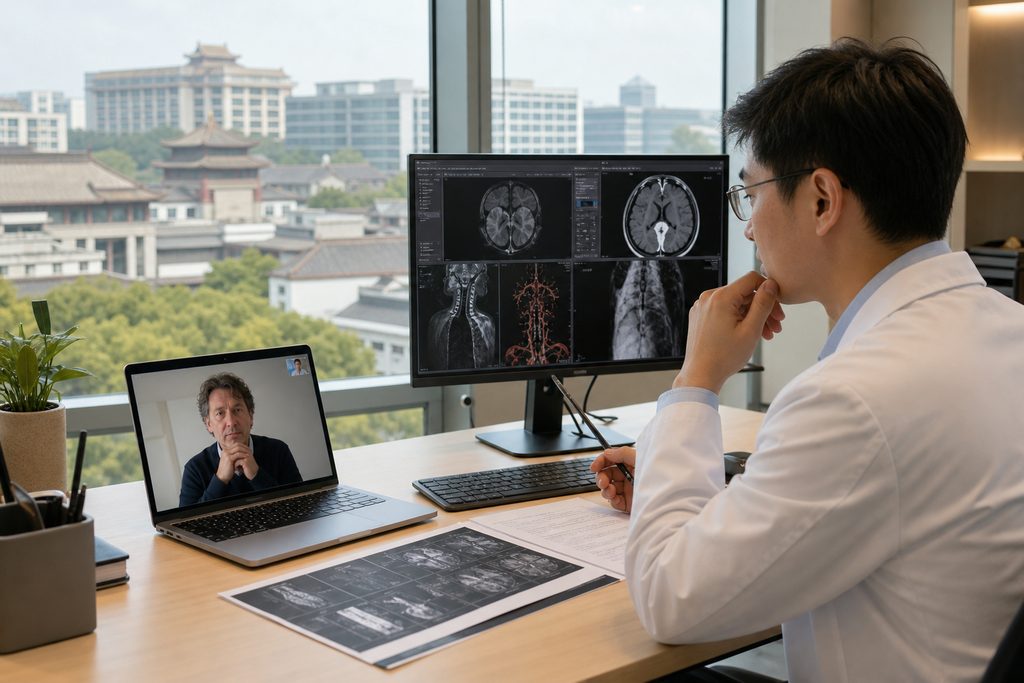
Step three — the written opinion. The specialist reviews the file and returns a written analysis: what the records support, what remains unclear, what additional testing would sharpen the picture, and what treatment directions are plausible. Turnaround varies by department and case complexity — often one to three weeks.
Step four — the conversation. If you want to hear the reasoning directly and ask questions, a video consultation adds that layer. Some families stop here. Others use it to decide whether traveling makes sense.
Step five — only if warranted, in-person evaluation. No reputable hospital admits a patient or schedules a procedure on records alone. If the remote review suggests a treatable path, the next stage is an in-person consultation in China, after which the hospital decides what it will offer. That decision belongs to the hospital, not to any intermediary.
A written second opinion is for reference and direction only. It is not a prescription, not a diagnosis of record, and not a guarantee that any treatment will be offered. Treat it as expert input into a decision you still own.
How to Judge Whether a China Rare Disease Expert Second Opinion Package Is Worth It
For the remote stages alone, most families spend between $300 and $800 — a written review, or a written review plus a video consultation. If an MDT panel is warranted, expect $1,500–2,000. Travel, visa, accommodation and accompaniment costs are separate and only arise if you decide to come in person. Every figure varies by hospital and case complexity, and no responsible provider quotes a treatment total before a hospital has evaluated you.
That is often exactly why people seek a second opinion, and it is a legitimate outcome. You would receive the reasoning in writing, including which findings support an alternative interpretation and what additional testing would clarify matters. Take that document to your treating physician. A disagreement between specialists is not a verdict — it is information, and it usually points toward the specific test that resolves the question.
Yes, for the consultation stage. Records-based written opinions and video consultations are designed precisely for patients who are not ready to travel. What cannot be arranged remotely is admission, surgery or a guaranteed treatment plan — those require in-person evaluation and remain entirely at the hospital’s discretion.
Your Next Step
A rare disease diagnosis is a long, exhausting road, and a second opinion is not a cure for that — it is a way of making sure nothing obvious has been missed before you commit to a treatment path. The most useful thing you can do this week is assemble your records properly and identify which specialty genuinely needs to see them. We are a medical coordination service, not a hospital and not a diagnostic provider; we help international patients route records to the right Chinese department, arrange reviews and consultations, and support travel logistics if it comes to that. If you would like an honest read on whether your case is a good fit for a remote review, start with a no-obligation conversation through our consultation request page — and if the answer is that a domestic referral serves you better, we will tell you that too.
Frequently Asked Questions
Yes. The hospitals used for international patients are JCI-accredited and follow the same international safety standards as top hospitals in the US and Europe. Surgical teams perform high volumes of procedures — often more than their Western counterparts — which studies show leads to better outcomes.
Costs vary by procedure and hospital, but international patients typically save 40-80% compared to US prices — even when factoring in travel and accommodation. A consultation with our team will give you an exact, all-inclusive quote with no hidden fees.
Send us your existing medical reports to get started. We handle everything from hospital selection and appointment scheduling to visa assistance and post-operative recovery planning. Your medical records are reviewed by the specialist before you even book a flight.
For more medical information and treatment options in China, visit chinamedservices.com (China Medical Services).
