Reapplying for a China Medical Visa: What to Do After a Rejection
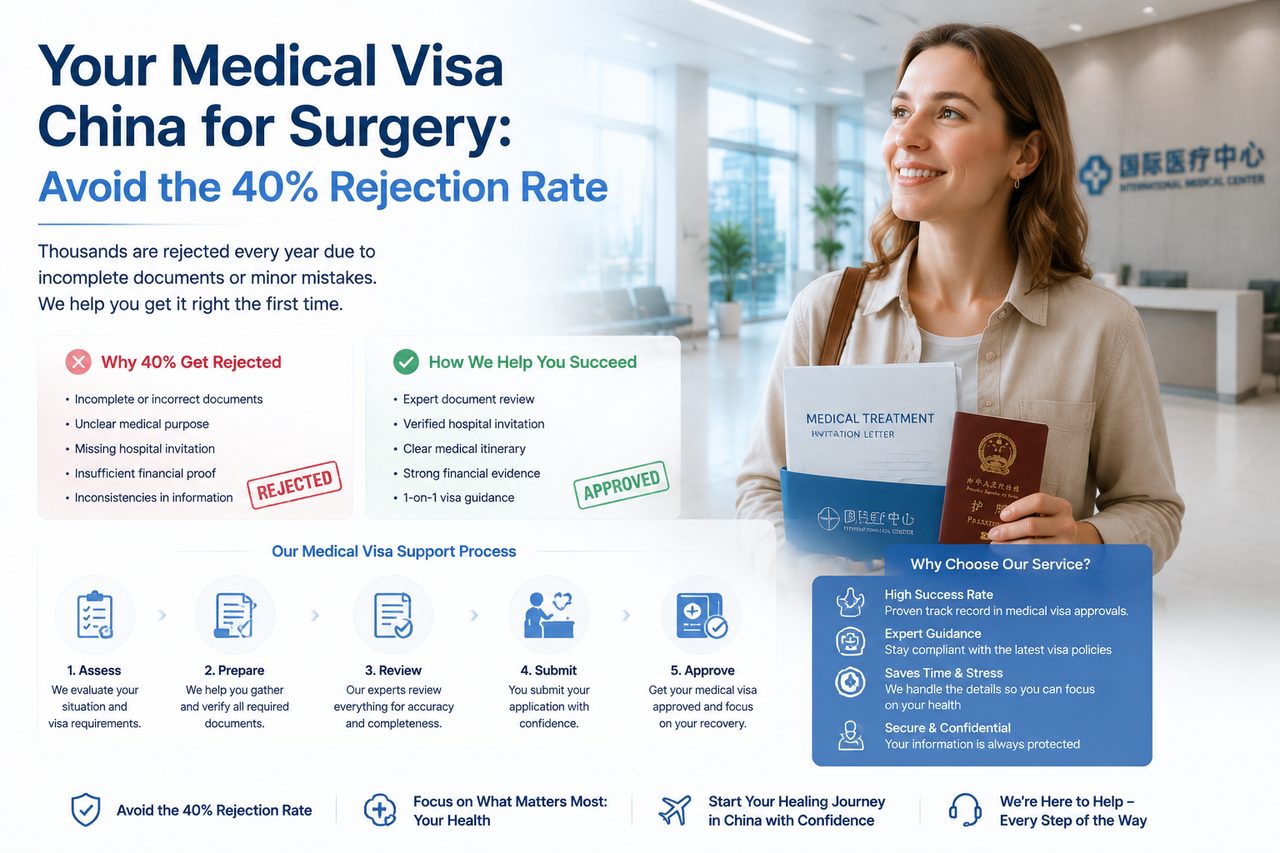
Reapplying for a China Medical Visa: What to Do After a Rejection
Can you reapply for a China medical visa after rejection? Yes — in most cases you can. There is no universal mandatory waiting period, but consulates typically expect you to wait at least 30 days, and a stronger application matters far more than a faster one. A refusal is not a permanent ban. It is usually a paperwork problem, not a verdict on you.
Here is the part most people miss. The refusal stamp is rarely about your health or your hospital. It is almost always about documentation, contradictions, or a weak invitation letter. Fix those, and the second attempt looks completely different to a visa officer.
Understanding the China Medical Visa: A Quick Reality Check
First, a term worth clearing up, because it causes more rejections than almost anything else. There is no visa category literally called a “China medical visa.” Foreign patients coming to China for treatment normally travel on the S2 visa, which covers short-term private affairs including medical treatment. Stays beyond 180 days fall under the S1. Accompanying family members apply for S2 as well.
And the M visa? That is for commercial and trade activity. It has nothing to do with treatment. If you applied for an M visa and mentioned a hospital, that mismatch alone can trigger a refusal.
Can I Reapply for China Medical Visa After Rejection? The Short Answer
Yes. A single refusal does not disqualify you. Chinese consulates assess each application on its own merits, and thousands of applicants are approved on a second or third attempt every year. The refusal is recorded, though — so the next officer will see the earlier decision and compare the two files.
That comparison is the whole game. If your second application is identical to the first, expect the same result. If it directly addresses what went wrong, your odds improve substantially.
Who This Is Right For — and Who It Isn’t
Reapplying makes sense for some patients and wastes time for others. Being honest about which group you fall into saves months.
Reapplying is usually worthwhile if you:
- Were refused for incomplete documents, a missing invitation letter, or a typo
- Applied under the wrong category (M instead of S2)
- Have a confirmed treatment plan and a hospital that can issue a proper invitation letter
- Can show stable finances and clear ties to your home country
Reapplying is probably not the right move yet if you:
- Have no confirmed hospital or department — a vague “I want treatment in China” plan invites refusal
- Are still gathering a diagnosis and could resolve it through a remote video consultation first
- Have an unresolved immigration violation or overstay from a previous trip
- Are seeking a solid-organ transplant; this is not a pathway we can support, and consulates scrutinize such applications heavily
The Options, Compared
Before you resubmit, understand what actually changed between attempt one and attempt two. This table maps the realistic paths.
| Path | Typical Wait | Best For | Main Risk |
|---|---|---|---|
| Reapply immediately, same documents | 0–14 days | Refusal was a clear clerical error | Repeat refusal, harder to reverse |
| Reapply after fixing documents | 30–60 days | Most applicants | Low, if the gap is explained |
| Reapply with a hospital invitation letter | 30–90 days | Patients with a confirmed plan | Requires real hospital coordination |
| Written second opinion first, then apply | 60–120 days | Patients still deciding on treatment | Slower, but far stronger file |
Most readers land in row two or three. Row four suits patients who are not yet sure they need to travel at all — and that uncertainty is worth resolving before you spend money on a visa.
China Medical Visa Reapplication Requirements: What Changes the Second Time
This is the section that decides your outcome. The China medical visa reapplication requirements are not dramatically different from a first application, but the burden of proof shifts. You now need to explain the earlier refusal, not just satisfy the checklist.
Expect to provide:
- A fresh application form, fully consistent with your first submission
- Passport with at least six months validity and blank pages
- A recent photo meeting the current specification
- A China medical visa invitation letter for treatment issued by the receiving hospital’s international department, stating the diagnosis, proposed treatment, and expected duration
- Proof of funds covering treatment and living costs
- Round-trip travel booking or a stated itinerary
- A short cover letter explaining what changed since the refusal
That cover letter is not required by every consulate. Submit it anyway. It is the single cheapest way to turn “same applicant, same problem” into “applicant who fixed the issue.”
How Long to Wait to Reapply China Medical Visa: Timing That Works
There is no published universal cooling-off period. Practice varies by consulate and by the reason for refusal. A 30-day gap is the common expectation, and 60 days is safer when the refusal cited fraud or misrepresentation.
Rushing back in a week with the same paperwork signals that nothing was learned. Waiting three months with no explanation also raises questions. The sweet spot is usually four to eight weeks — long enough to obtain a genuine hospital invitation letter, short enough to show the treatment need is real.
One practical note. Hospital invitation letters take time to produce. International departments often need your medical records translated and reviewed before they will issue one. Budget two to three weeks for that step alone, and start it the day you decide to reapply.
What It Costs: China Medical Visa Application Cost and Beyond
Not always required, but strongly advisable for medical travel. A letter from the hospital’s international department stating your diagnosis and proposed treatment converts a vague intention into a documented plan. Without it, the officer has to guess whether your trip is genuinely medical.
You can apply again, but the pattern starts to matter. At that point, stop and diagnose the root cause rather than resubmitting. Common culprits include inconsistent employment information, insufficient funds documentation, or an unclear treatment plan. A third attempt without a real change rarely succeeds.
Yes. Accompanying family members normally apply for S2 as well, and should reference your treatment and their role as a companion in their own application. Each person needs their own complete file — dependents are not automatically covered by your approval.
Your Next Step
A refused visa is a delay, not a dead end. The applicants who succeed on the second attempt are the ones who treat the refusal as diagnostic information and rebuild the file around it.
We are China Medical Services, a coordination service — not a hospital, and we do not diagnose or treat. Our team helps international patients obtain written second opinions, secure hospital invitation letters through official international departments, and prepare a coherent visa file. If you are unsure whether your case is ready to reapply, start with a free consultation and we will tell you honestly what is missing.
Take the next step when you are ready. There is no pressure, and no obligation to travel.
Frequently Asked Questions
Yes. The hospitals used for international patients are JCI-accredited and follow the same international safety standards as top hospitals in the US and Europe. Surgical teams perform high volumes of procedures — often more than their Western counterparts — which studies show leads to better outcomes.
Costs vary by procedure and hospital, but international patients typically save 40-80% compared to US prices — even when factoring in travel and accommodation. A consultation with our team will give you an exact, all-inclusive quote with no hidden fees.
Send us your existing medical reports to get started. We handle everything from hospital selection and appointment scheduling to visa assistance and post-operative recovery planning. Your medical records are reviewed by the specialist before you even book a flight.
For more medical information and treatment options in China, visit chinamedservices.com (China Medical Services).
