Language Support: China vs India for Medical Tourism Explained
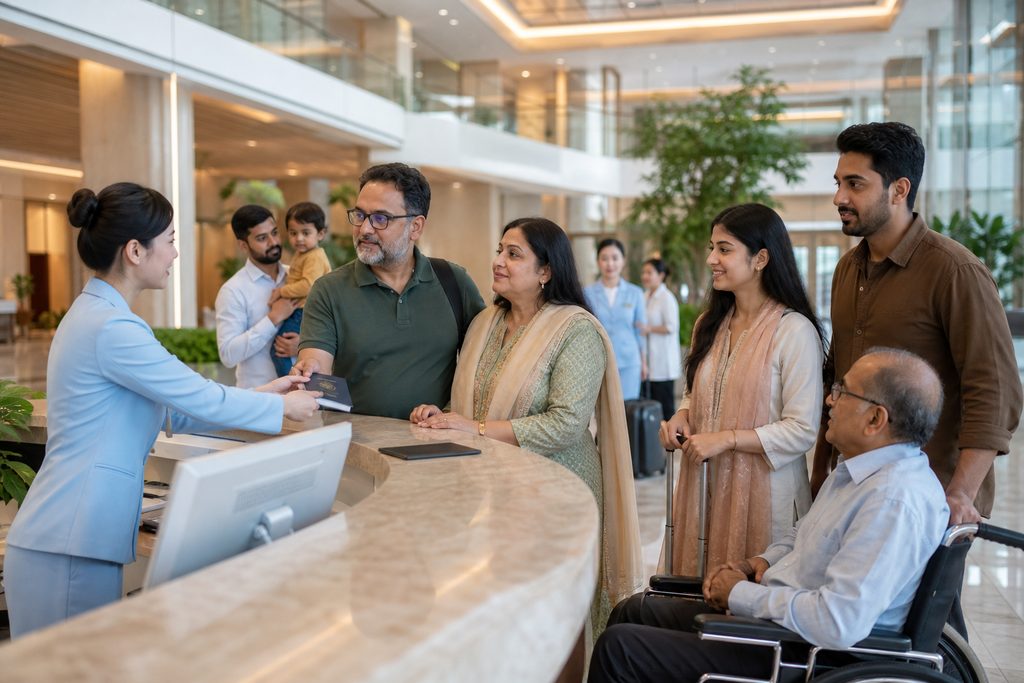
Language Support: China vs India — What International Patients Need to Know
Roughly 1 in 4 international patients who contact us about medical tourism China English speaking hospitals admits the same fear before anything else: “What if nobody understands me when it matters most?” It’s a fair worry. You can compare surgical outcomes and price tags all day, but if you can’t explain that your pain is sharp rather than dull, or that you’re allergic to a specific antibiotic, the whole trip falls apart. This guide breaks down how language support actually works in China versus India, where the gaps are, and how to plan around them.
Why Language Support Decides More Than You Think
Medical tourism marketing tends to lead with price. A hip replacement in India might run $7,000–$12,000 at a private hospital; the same procedure in China’s top public hospitals often lands between $8,000 and $15,000 depending on implant choice and city. Those numbers matter. But the number that quietly determines whether your treatment goes smoothly is how many people in the room can understand you without a translator fumbling the details.
India has a structural advantage here. English is an official language, and most private hospitals in Delhi, Mumbai, and Chennai operate in English by default. Doctors, nurses, and front-desk staff typically speak it fluently. That’s a real benefit, and we won’t pretend otherwise.
China’s situation is different, and it surprises people. English proficiency among the general public is low. Walk into a public tertiary hospital in Beijing on a Tuesday morning and you’ll see 10,000+ patients moving through a system designed entirely in Chinese. Signage, registration kiosks, lab slips — all Chinese. A doctor may read English medical literature fluently but still conduct a consultation in Mandarin because that’s how the department runs.
Does that make China a worse choice? Not necessarily. It makes it a different kind of choice, one where language support has to be arranged rather than assumed.
How Do Hospitals in China Handle Language Barriers for Foreigners?
There’s no single answer, because China’s hospital system splits into three tiers, and each handles foreign patients differently.
Public Tertiary Hospitals (the “Top 100”)
These are the giants — Fuwai Hospital in Beijing performs over 14,000 cardiac surgeries a year, more than any other single center globally. West China Hospital in Chengdu, Zhongshan Hospital in Shanghai, Peking Union Medical College Hospital — these names carry weight in global medicine. What they don’t always carry is an English-speaking front line.
Most of these hospitals have an International Department or VIP wing. That’s where English service concentrates. You’ll find bilingual coordinators, English-language consent forms, and staff trained to work with foreign patients. The trade-off is cost: international wings typically run 1.5 to 2 times the standard rate. You’re paying for access and communication, not just the procedure.
Outside those departments, you’re in a Chinese-language environment. Full stop.
Private International Hospitals
United Family Healthcare, Jiahui Health, Parkway, Raffles — these facilities were built with expatriates in mind. English-speaking staff, JCI accreditation, direct insurance billing, Western-style appointment scheduling. A consultation feels closer to what you’d experience in Singapore or Dubai.
The catch is scope. Private hospitals handle routine care, diagnostics, and many elective procedures well. For complex cardiac surgery or advanced oncology, the deepest expertise still sits in the public system. So patients often split their journey: diagnostics at a private hospital, surgery at a public one with a bilingual companion.
Traditional Chinese Medicine Hospitals
TCM hospitals present a unique language challenge. The vocabulary of acupuncture, herbal formulas, and meridian theory doesn’t translate cleanly. A practitioner explaining “qi stagnation” in English may lose nuance that matters to your treatment plan. Bilingual support here isn’t just helpful — it’s essential for informed consent.
A Realistic Timeline
Here’s what the process looks like when language support is built in from the start. Timelines vary by hospital and case complexity, but this reflects typical ranges.
| Stage | Timeframe | What Happens |
|---|---|---|
| Initial contact & records | Days 1–3 | You send existing reports, imaging, and a summary of your condition. Documents may need certified translation (add 2–5 days for non-English records). |
| Written second opinion | Days 4–10 | A Chinese specialist reviews your file and returns written analysis in English. Cost: $300–500. |
| Video consultation | Days 7–14 | You speak directly with the specialty team via interpreter. $100–300 for a standard hospital; $500–800 for a top specialist. |
| Visa application (S2) | 2–4 weeks | S2 is the correct category for medical treatment. Processing times vary by consulate and season. |
| Appointment coordination | 1–3 weeks | Public hospital outpatient slots can’t be pre-booked from abroad in the standard queue. International department channels allow earlier scheduling. |
| Arrival & in-person consultation | Day 1–3 after landing | Face-to-face exam. Surgery can only be scheduled after this step at public hospitals. |
| Treatment & recovery | Varies | Hospital stay, discharge planning, and follow-up scheduling. |
The step patients forget: document translation. If your MRI report is in German or Arabic, it needs certified English or Chinese translation before a specialist will review it properly. That alone can add a week.
What Can Go Wrong — and What Happens Then
Honest failure modes matter more than polished promises.
You arrive without language support and can’t navigate registration. Public hospitals require in-person queuing for standard outpatient slots. Without someone who reads Chinese, you may spend hours in the wrong line. The fix: arrange a bilingual medical companion before you fly, not after.
The interpreter isn’t medically trained. A general translator may not know that “stenosis” and “occlusion” mean different things to a cardiologist. Miscommunication here can affect treatment decisions. Always ask whether your interpreter has clinical vocabulary experience.
The hospital’s international department is fully booked. This happens during peak seasons. Recourse: we can coordinate with alternative hospitals in the same specialty tier — China has 340+ top-ranked hospitals across 37 cities, so options exist.
You need a procedure the private hospital doesn’t offer. Transferring to a public hospital mid-journey means new registration, new records, and potentially a new language environment. Planning the full sequence upfront avoids this.
No service can guarantee you’ll be admitted to a specific hospital or see a named specialist on a specific date. Any provider promising that is misrepresenting how the Chinese system works.
India vs China: Where Each System Wins on Language
India wins on baseline accessibility. English is everywhere in private healthcare. You can land in Chennai and function independently within a day.
China wins on depth of specialist infrastructure — if you have support. The country’s top hospitals handle volumes that few centers worldwide match. Fuwai’s cardiac surgery numbers, for instance, exceed most national programs. But that depth is locked behind a language barrier that requires deliberate navigation.
For patients weighing “is it safe to have surgery in China as a foreigner,” the honest answer is: the surgery itself is safe at accredited hospitals. The risk is logistical and communicative, and it’s manageable with the right preparation.
Cost comparison matters too. A hip replacement in China for international patients typically ranges from $8,000 to $15,000 at top public hospitals, versus $40,000–$65,000 in the United States. India often comes in lower, around $7,000–$12,000. But if your case is complex — revision surgery, rare complications, multi-specialty involvement — China’s tertiary hospital system offers resources that smaller Indian private facilities may not match.
Practical Considerations: Records, Visas, and Payment
Medical records. Bring everything: imaging CDs, pathology slides if relevant, medication lists, allergy documentation. Translated into English or Chinese.
Visa category. The S2 visa covers short-stay medical treatment. Family members accompanying you apply for S2 as well. Note: the M visa is for commercial and trade activities — it is not a medical visa, despite what some outdated guides claim. For stays exceeding 180 days, S1 applies. Requirements shift, so confirm with the latest embassy guidance.
Payment. Public hospitals require prepayment; insurance reimbursement happens afterward, often in your home country. Private international hospitals frequently bill insurance directly.
Follow-up at home. Ask for discharge summaries, operative notes, and imaging in English before you leave. Getting these later from overseas is slow and frustrating.
If you’re trying to book medical treatment in China with an English interpreter, start that conversation early — ideally before you’ve committed to dates or flights.
Frequently Asked Questions
For tourism, an app works. For medical consultations, it doesn’t. Treatment decisions hinge on precise language — dosage, duration, contraindications, informed consent. A mistranslated symptom can change a diagnosis. Professional bilingual medical companions exist precisely because apps fail in clinical settings.
At the international department level, yes. Hospitals like Peking Union Medical College Hospital and Fuwai maintain English-capable staff in their VIP and international wings. In the general outpatient system, no — expect Chinese-only communication. The distinction matters when you’re choosing which channel to enter through.
China’s top-ranked hospitals meet international safety and accreditation standards, and many hold JCI certification. The clinical care is not the concern. The concern is communication gaps, which is why bilingual support throughout the process — from records translation to post-operative instructions — is the single most important thing you can arrange.
Bilingual medical companion services start from around $300 per day. For a typical 7–10 day treatment trip, that’s a meaningful but manageable addition — especially compared to the $100,000+ you might save on a major surgery versus U.S. pricing.
Your Next Step
Language support isn’t a nice-to-have in medical travel. It’s the infrastructure that makes everything else work. India offers easier default English access; China offers deeper specialist resources that reward preparation. Whichever you choose, plan the communication layer before you book the flight.
At China Medical Services, we connect international patients with 340+ top-ranked hospitals across 37 cities. We don’t provide medical advice or guarantee outcomes — we coordinate records, appointments, and bilingual support so you can focus on your health. When you’re ready, start with a free consultation and we’ll map out what your journey could look like.
This article is for informational purposes only and does not constitute medical advice. Always consult a qualified healthcare provider regarding your specific condition and treatment options.
For more medical information and treatment options in China, visit chinamedservices.com (China Medical Services).
