Hospital Mail in China: A Guide to Receiving Packages During Your Stay
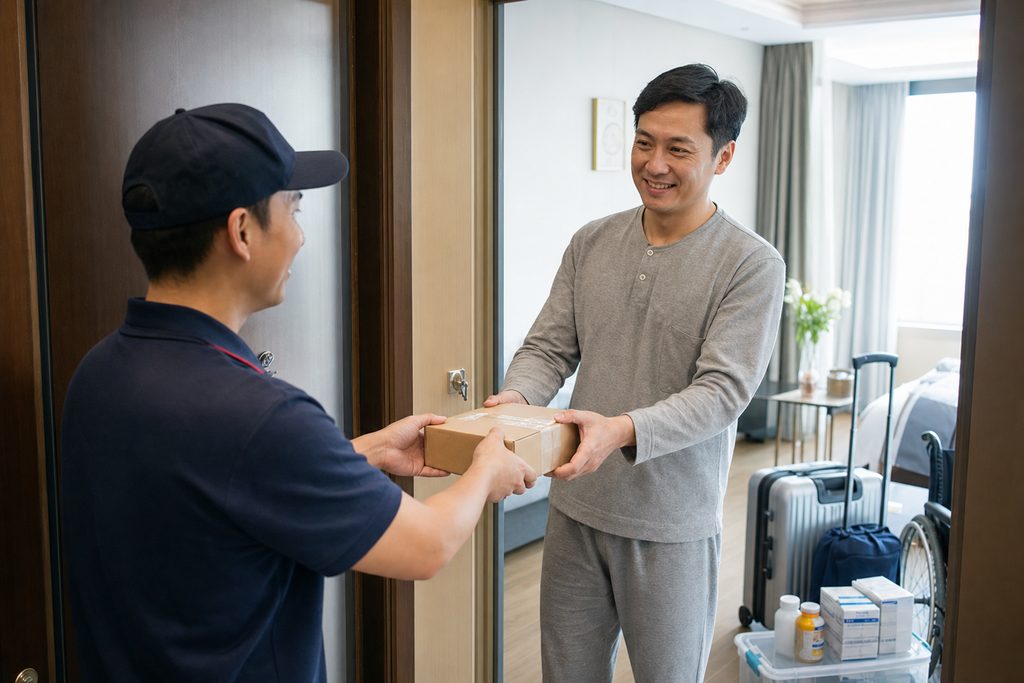
You’re halfway around the world, focused on a major medical procedure. And then a family member asks if they can send you something. A replacement bank card. A legal document that needs your signature. Maybe just a care package that reminds you of home. The question hits you: can I receive packages while in hospital in China? The short answer is yes, but the “how” is rarely obvious. China’s address system, language barriers, and hospital security protocols create friction that most travel guides never cover.
Our team has coordinated mail delivery for patients in wards across Beijing, Shanghai, and Guangzhou. The process is manageable once you know the three routes available, what they cost, and which one fits your specific situation. This article maps out exactly that.
How This Actually Works, Step by Step
Receiving a package during a hospital stay in China depends on one variable: whether your hospital has a dedicated international patient mail delivery hospital China desk, or whether you’re relying on the general mailroom. Top-tier hospitals with established international departments—Peking Union Medical College Hospital, Huashan Hospital, West China Hospital—have staff who handle this routinely. Smaller public hospitals may not.
Here is the sequence most patients follow.
First, confirm your exact ward address. This is not the hospital’s public address. You need the building name, floor, and ward number in Chinese characters. A bilingual medical companion can obtain this in minutes. Without one, you’ll need to ask a nurse and photograph the Chinese text—do not attempt to translate it yourself.
Second, identify who will sign for the package. Chinese couriers rarely leave parcels unattended. Someone must physically accept delivery. If you’re bedridden, that someone is either a family member, a hired companion, or a designated hospital staff member. Do not assume a nurse will do it. Nursing workloads in Chinese public hospitals are intense, and mail handling falls outside their duties.
Third, track the shipment obsessively. Domestic couriers in China—SF Express, ZTO, YTO—provide app-based tracking that updates in near real-time. International shipments via DHL, FedEx, or EMS offer similar visibility. The courier will call the recipient’s phone number upon arrival. If that number belongs to you and you don’t speak Chinese, the delivery fails. This is the most common breakdown point.
Fourth, have a backup plan. If the courier cannot reach anyone, the package goes to a nearby pickup point. For SF Express, this is often a Cainiao station or a Fengchao smart locker. Retrieving it requires a Chinese phone number and the ability to navigate a touchscreen in Mandarin.
That sequence might sound straightforward. Each step hides friction that a language barrier magnifies. Planning ahead is what makes the difference.
Three Routes for Getting Mail Delivered During Medical Treatment Abroad
Patients ask us how to get mail delivered during medical treatment abroad as if there’s one standard answer. There isn’t. Your choice depends on the item’s urgency, size, and whether you need it to reach your bedside or just reach the city.
Route 1: Direct-to-Ward Delivery via Courier
This works when the hospital’s international department or VIP ward has a mail handling protocol. You provide the sender with the ward address in Chinese, your bed number, and a local contact phone number. The courier delivers to the hospital’s mailroom or reception desk. A staff member signs and brings it to your room.
This route succeeds maybe 70% of the time, in our experience. The failure points: the courier arrives during a shift change and no one is at the desk; the ward address on the package doesn’t match the hospital’s internal naming system; the phone number provided rings unanswered. When it works, it’s seamless. When it fails, the package sits at a depot and you start making phone calls.
For international shipments, this route requires the sender to include your full name exactly as it appears on your passport. Chinese customs will hold items where the recipient name doesn’t match the hospital registration. We’ve seen packages delayed two weeks over a middle initial.
Route 2: Hotel or Service Apartment as Mail Drop
Many international patients stay at a nearby serviced apartment rather than in the hospital itself, especially during pre-operative evaluation or post-discharge recovery. Properties like Ascott, Somerset, or Fraser Suites in Shanghai and Beijing have front desks that accept packages. The address format is standardized, English-speaking staff are available, and the courier has a clear delivery point.
This is the most reliable option. The cost of mail handling during hospital stay Shanghai or Beijing essentially becomes zero beyond your accommodation cost. Family members staying at the apartment can bring items to the hospital during visiting hours.
The limitation is timing. If you need something delivered while you’re in the ICU or during a period when no visitors are permitted, this route doesn’t help. And it only works if you’ve booked accommodation with a proper front desk—an Airbnb or a local apartment rental may not offer the same reliability.
Route 3: Mail Forwarding Service for Hospital Patients China
This is the structured solution. A mail forwarding service for hospital patients China works as follows: the service provides a local Chinese address—typically an office in the same city as your hospital. Your mail or packages are sent there. Staff receive, log, and either courier the items to your ward or hold them for pickup. Some services open and scan documents, emailing you the contents within hours.
Several international medical concierge organizations offer this as part of a broader patient support package. Standalone mail forwarding companies also exist, though few specialize in hospital patients specifically. The cost varies by volume and frequency. Expect to pay from $50 to $150 per month for basic receipt and forwarding, with document scanning adding $5 to $10 per item.
This route solves the language problem, the address format problem, and the signature problem. It does not solve customs delays for international packages. Nothing solves that.
A Realistic Timeline
Mail delivery timelines in China are fast domestically and variable internationally. Here’s what to expect for a package sent to a hospital in a major city.
| Stage | Domestic (within China) | International (DHL/FedEx) | International (Standard Post) |
|---|---|---|---|
| Sender dispatches item | Day 0 | Day 0 | Day 0 |
| In transit to destination city | 1–2 days | 3–5 days | 7–14 days |
| Chinese customs clearance | N/A | 1–3 days | 2–7 days |
| Local courier receives and schedules delivery | Day 2–3 | Day 5–8 | Day 10–21 |
| Delivery attempt to hospital | Day 2–4 | Day 6–9 | Day 11–22 |
| If failed: held at depot (days before return) | 3 days | 5 days | 7 days |
Customs is the wildcard. A document envelope clears quickly. A package containing medication, supplements, or electronic devices may face additional scrutiny. Chinese customs authorities require a detailed contents declaration in Chinese for any item valued over RMB 1,000 (roughly $140). If the sender writes “gift” with no further description, expect delays.
One timing factor patients overlook: the hospital’s own internal mail distribution. Even after a package reaches the hospital mailroom, it may sit for half a day before someone walks it to your ward. In a large hospital campus—West China Hospital in Chengdu spans over 40 buildings—that walk can take an hour. Factor in at least one extra day from “delivered to hospital” to “in your hands.”
What Can Go Wrong—and What Happens Then
Honesty here matters more than reassurance. Here are the real failure modes we’ve seen, and the actual recourse for each.
The courier calls and no one answers. This is the most common failure. Chinese couriers make one, sometimes two attempts. If no one picks up, the package goes to a pickup point. You’ll receive a text message in Chinese with a pickup code and location. If you can’t read the message and can’t navigate to the pickup point, the package sits. After 3–7 days, it’s returned to sender. Recourse: have a Chinese-speaking contact listed as the recipient phone number from the start. A bilingual companion solves this.
Customs holds the package and demands additional documentation. This happens with items that look commercial, medical, or high-value. You’ll receive a notice—again, in Chinese—requiring you to provide invoices, personal use declarations, or in some cases, an import license. Recourse: work with a customs broker. Your medical concierge service can connect you with one. Expect fees from $50 to $200 and delays of 1–2 weeks.
The hospital refuses delivery outright. Some wards have a policy against accepting personal packages for patients. This is rare in international departments but more common in general wards. The courier arrives, the security desk turns them away, and the tracking status updates to “delivery failed—recipient refused.” Recourse: redirect the package to your hotel or a forwarding service address. You’ll need to call the courier’s customer service line—in Chinese—to arrange redirection. There is usually a small fee.
The item arrives damaged or opened. Chinese customs reserves the right to inspect incoming international mail. They will open packages, examine contents, and reseal with customs tape. This is legal and routine. If something is missing or broken, you can file a claim with the courier, but the process is slow and requires Chinese-language documentation. Recourse: for irreplaceable items, use a courier with strong insurance (DHL and FedEx offer declared-value coverage). For documents, send scans digitally as a backup.
None of these failure modes are catastrophic. Each has a workaround. But the workaround always requires either Chinese language ability or someone who has it. That’s the thread running through every scenario.
What a Hospital Mail Service for Medical Tourists China Should Include
If you’re evaluating a hospital mail service for medical tourists China—whether through a concierge organization or a standalone provider—here are the capabilities that separate a functional service from a frustrating one.
A competent service provides a local Chinese address in your hospital’s city. Not a PO box. A physical office where staff sign for packages during business hours. The address should be formatted correctly for Chinese couriers: province, city, district, street, building, room number—in that order.
Document scanning is non-negotiable if you’re receiving legal or financial paperwork. The service should open, scan, and email you a PDF within the same business day. This lets you review contents and decide whether the physical original needs to reach your bedside immediately or can wait.
Package forwarding to your ward should be same-day or next-day within the same city. In Shanghai, SF Express same-city delivery costs approximately RMB 12–20 ($2–$3) for documents and RMB 20–40 ($3–$6) for small parcels. A service marking this up to $15–$25 per forwarding is reasonable; one charging $50+ per forwarding is not.
Language handling is the core value. The service should be the contact phone number on the waybill, fielding calls from couriers in Chinese and coordinating delivery windows with your ward’s quiet hours. They should also handle customs inquiries for international shipments, though this is a premium feature that not all services offer.
One thing a service cannot do: override hospital policies. If your ward doesn’t accept packages, the forwarding service can hold items until you’re discharged or until a family member can retrieve them. They cannot force delivery through a locked ward door. Anyone claiming otherwise is overpromising.
Practical Considerations: Addresses, Payments, and Insurance
Getting mail during a hospital stay in China involves more than just the delivery logistics. Several practical details determine whether the whole process works smoothly or becomes a distraction you don’t need.
Address format. Chinese addresses run from largest to smallest unit. A correctly formatted hospital ward address looks like this:
上海市徐汇区枫林路180号
复旦大学附属中山医院
住院部3号楼 心外科 7层 12床
收件人:[Passport Name]
If your sender writes this in English or reverses the order, the courier’s sorting system may route it incorrectly. Always provide the address in Chinese characters. Always include your bed number. Always use your passport name exactly.
Payment for forwarding services. Most medical concierge organizations bundle mail handling into a broader package rather than billing it à la carte. Standalone forwarding services typically charge monthly retainers. Payment methods accepted are usually WeChat Pay, Alipay, or bank transfer—all of which require a Chinese bank account or a workaround for foreigners. If you’re paying from abroad, confirm that the service accepts international wire transfers or credit cards before you commit.
Insurance and liability. Ask what happens if a package is lost. Reputable services carry insurance for items in their custody and will provide a written liability policy. Less established operators may disclaim all responsibility. For high-value items—medication, legal documents, electronics—clarify the coverage limit in writing.
Medication shipments. This deserves its own warning. Shipping prescription medication into China is legally complex. Chinese customs classifies many common Western medications as controlled substances. A package of Adderall, certain painkillers, or even some antidepressants can be seized. Do not have medication mailed to you in China without first confirming its legal status with the hospital’s international department or a Chinese customs broker. This is not a mail logistics issue—it’s a legal one.
Follow-up at home. If you’ve redirected your home mail to a Chinese address during treatment, remember to reverse the process before you leave. Forwarding services typically hold mail for a defined period after your departure; after that, items are returned or discarded. Set a calendar reminder for the week before your discharge to update all your mailing addresses.
Frequently Asked Questions
You can, but you need a Chinese-speaking intermediary. The courier will call the phone number on the package. If you answer and can’t communicate, the delivery fails. List a bilingual companion, a hospital international department staff member, or a mail forwarding service as the contact number. Without that, the package almost certainly won’t reach you.
The cost of mail handling during hospital stay Shanghai ranges from zero—if you use your hotel front desk—to $50–$150 per month for a dedicated forwarding service. Per-package forwarding within Shanghai typically costs $3–$6 via local courier. International shipping costs depend entirely on the origin, weight, and courier. A DHL envelope from the US to Shanghai runs $40–$80 and takes 3–5 business days.
Generally, no. Chinese hospitals do not offer a mail forwarding service for discharged patients. Once you leave, any mail that arrives at the ward will be returned to sender or held briefly before disposal. Arrange for all mail to be redirected to your forwarding service or home address before your discharge date.
This is risky and often illegal. Chinese customs strictly controls pharmaceutical imports. Many medications available over the counter or by prescription abroad are regulated differently in China. Instead of mailing medication, speak with your attending physician at the Chinese hospital. Top-tier hospitals stock a broad range of international pharmaceuticals, and your doctor can prescribe local equivalents where appropriate. For specialized medications, the hospital pharmacy can often order them domestically faster and more safely than you can import them by mail.
Customs clearance delays can stretch beyond your hospital stay. If this happens, you have two options. Option one: authorize your mail forwarding service to act as your customs agent and receive the package on your behalf, then forward it to your home country. Option two: abandon the package. Unclaimed international packages are eventually returned to sender or destroyed. A forwarding service with customs brokerage capability is the only reliable way to recover a delayed package after you’ve left China.
Your Next Step
Receiving mail during a hospital stay in China is entirely feasible. The path that works depends on your specific situation: the hospital you’re in, the item you’re expecting, and whether you have someone on the ground who speaks the language. The patients who have the smoothest experience are those who set up a mail handling solution before they arrive, not after a package is already in transit.
Our team at China Medical ServicesFor more medical information and treatment options in China, visit chinamedservices.com (China Medical Services).
