Your First Visit in Shanghai: What to Expect at a Top Hospital
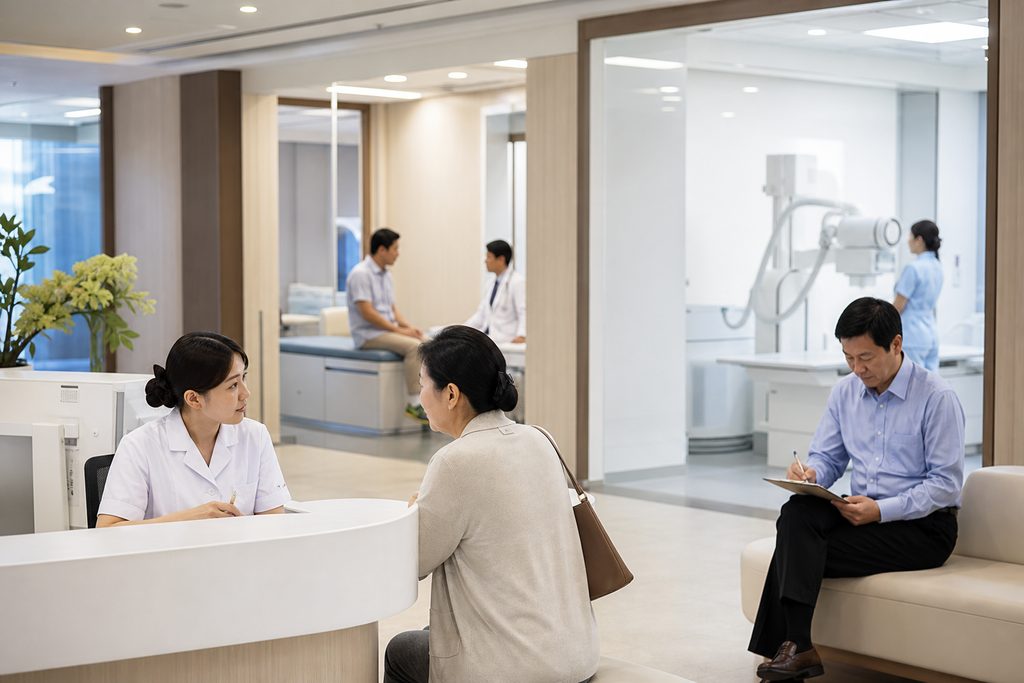
Key Takeaways
- Shanghai is home to 18 of China’s Fudan-ranked Top 100 hospitals — the second-highest concentration in the country after Beijing.
- Public hospital outpatient departments generally cannot be pre-booked from overseas; same-day registration is the norm, while international departments offer a bookable, English-speaking alternative.
- Language is the single biggest practical barrier. A 10,000-patient-per-day outpatient hall is not navigable without Mandarin or a bilingual companion.
- Understanding the difference between public and international-department pricing before you arrive prevents unpleasant surprises at the payment window.
When 54-year-old David from Portland first received his knee replacement recommendation, he did what most people do — he started searching. His surgeon in Oregon quoted him $38,000 for the procedure, his insurance covered part of it, and the wait for a surgical slot ran into the following spring. A friend mentioned that the same operation at a top Shanghai hospital might cost a fraction of that. David’s next question was the obvious one: what actually happens when you walk through the door?
That question — what to expect on a first visit to a Shanghai hospital — is the one we hear most often from international patients. The answer involves real differences in how Chinese hospitals operate compared to Western ones. Some of those differences work in your favor. Others require preparation. This guide walks through both, with the cost data and practical detail you need before booking a flight.
The Problem: A Hospital System That Works Differently
Here is the number that catches most Western patients off guard: Shanghai’s largest public hospitals see between 10,000 and 20,000 outpatient visits per day. A single hospital. Not a network — one building complex.
Compare that to a typical large US academic medical center, which might handle 1,500 to 3,000 outpatient encounters daily. The scale is a different order of magnitude, and the operational logic follows from it. Chinese public hospitals are built for volume. Registration opens early, queues form fast, and the system assumes you can read Chinese signage, navigate a self-service kiosk, and find your way to the correct floor of a building with multiple towers.
For a foreign patient, that environment is disorienting. Not dangerous — just genuinely hard to navigate without help. And the rules around booking add another layer: public hospital outpatient appointments generally cannot be reserved from abroad in advance. You register on the day, in person, or through a domestic app that requires a Chinese ID or residence permit.
So what does medical tourism China cost actually look like once you factor in these realities? The savings are real, but they only materialize if you understand the system before you arrive.
Why Shanghai Delivers Results for International Patients
Clinical Volume That Builds Surgical Expertise
Shanghai hosts 18 hospitals in the Fudan Top 100 ranking — a tiered list that groups the country’s best hospitals into five grades rather than assigning individual national ranks. That concentration matters because surgical outcomes correlate with volume. A cardiac surgeon at a high-volume center performs hundreds of complex procedures annually, not dozens.
Fuwai Hospital, for instance, performs over 14,000 cardiac surgeries per year — the highest volume of any single cardiac center globally. That kind of repetition builds institutional muscle memory that smaller programs simply cannot match.
Technology and Efficiency at Scale
Top-tier Chinese hospitals run advanced imaging, robotic surgery platforms, and integrated electronic records. What differs from the West is throughput. A CT scan that might take three weeks to schedule in a European public system can often be completed within 24 to 48 hours at a Shanghai tertiary hospital, sometimes the same day.
This efficiency is structural, not accidental. Hospitals are designed around rapid patient cycling. Blood work, imaging, and specialist consultations can frequently be compressed into a single visit — a pace that surprises patients accustomed to weeks of back-and-forth scheduling.
Cost Advantage Without Quality Compromise
The cost gap is the headline. A coronary artery bypass graft at a top Chinese public hospital runs approximately $12,000 to $20,000. The same procedure in the United States frequently exceeds $120,000. Hip replacement cost China pricing at leading public hospitals typically falls between $8,000 and $15,000, compared to $30,000 to $50,000 in the US.
Why the difference? Lower labor costs, higher patient throughput per bed, and a pharmaceutical supply chain that operates under domestic pricing pressure. The surgeons are not less trained — many completed fellowships in the US or Europe. The economics are simply different.
| Procedure | Shanghai Public Hospital (USD) | US Average (USD) | Typical Wait (Shanghai) |
|---|---|---|---|
| Coronary bypass surgery | $12,000 – $20,000 | $120,000+ | 1–3 weeks |
| Hip replacement | $8,000 – $15,000 | $30,000 – $50,000 | 1–2 weeks |
| Spinal fusion | $10,000 – $18,000 | $50,000 – $90,000 | 1–3 weeks |
| Comprehensive health checkup | $300 – $1,500 | $2,000 – $5,000 | Same day |
These figures vary by hospital and case complexity. They are reference ranges, not quotes. Final pricing depends on the specific hospital, the surgeon, implant selection, and length of stay.
What Actually Happens on Day One: A Step-by-Step Walkthrough
Understanding the sequence removes most of the anxiety. Here is how a typical first visit unfolds at a major Shanghai public hospital.
Step 1 — Registration (挂号). You arrive early. Registration desks or self-service kiosks open around 7:00 to 7:30 AM. You present your passport, and a hospital card is created. Without a Chinese ID, this step usually requires staff assistance.
Step 2 — Department assignment. You are directed to the relevant outpatient department. This is where knowing which department handles your condition matters — Chinese hospitals organize by specialty, and choosing the wrong one means starting over.
Step 3 — The consultation. Specialist consultations in the public stream are brief. Five to ten minutes is common. You present your records, the doctor reviews them, and a decision is made about further testing or admission. This is the stage where a bilingual companion earns their keep — nuance gets lost fast in a rushed exchange.
Step 4 — Tests and results. If imaging or labs are ordered, payment happens first at a cashier window, then you proceed to the testing area. Results may come the same day or within 48 hours.
Step 5 — Admission decision. Surgery cannot be scheduled without an in-person consultation first. If the doctor recommends a procedure, the admission process begins — but the date depends on bed availability and the surgical schedule.
Public vs. International Department: Choosing Your Path
This decision shapes your entire experience, so it deserves careful thought.
The public stream is the affordable option. You get access to the same senior specialists, the same operating rooms, and the same clinical standards. What you give up is convenience: no advance booking, shorter consultations, and a waiting environment that can feel chaotic.
The international department — sometimes called the VIP or special needs channel — offers scheduled appointments, English-speaking coordinators, shorter queues, and private consultation rooms. The trade-off is cost. A consultation that costs $15 in the public stream might run $80 to $150 in the international department.
Which is right for you? It depends on your budget, your language ability, and how much uncertainty you can tolerate. For complex surgical cases where clear communication matters most, many international patients find the premium worthwhile. For a straightforward health checkup, the public stream is perfectly adequate.
If you are exploring the best international hospital Shanghai offers, our guide to private and international hospitals covers the JCI-accredited options with direct insurance billing and Western-style care.
Practical Considerations: Visa, Payment, and Records
Visa. Foreign patients traveling to China for medical treatment typically apply for the S2 visa, which covers short-stay private affairs including medical treatment. Stays exceeding 180 days generally require the S1 category. Accompanying family members apply under the same category. Requirements are set by the relevant Chinese embassy or consulate and can change — always confirm current documentation requirements with the mission handling your application. Note that the M visa is for commercial and trade activities and is not the appropriate category for medical travel.
Payment. Chinese public hospitals require prepayment for most services. International credit cards are accepted at some locations but not all — UnionPay and cash remain common. Private international hospitals more often accept international cards and offer direct billing to certain insurance plans. Confirm payment methods before your visit.
Medical records. Bring printed copies of your relevant history, imaging, and lab results, ideally with a Chinese translation. Digital files on a USB drive are helpful but not always readable by hospital systems. A written second opinion service can review your existing records remotely before you travel, which often clarifies whether the trip is worthwhile.
Insurance. Most international insurance policies reimburse after the fact for treatment received in China. Direct settlement arrangements exist at some private hospitals. Check with your insurer about pre-authorization requirements before committing to any procedure.
Language. This is the barrier that trips up the most patients. A bilingual medical companion can handle registration, queuing, payment, wayfinding, and translation — the practical mechanics that consume most of a first visit. Our patient consultation page explains how this works. Companion services start from $300 per day.
For a broader view of how hospital selection works across the country, our directory of Fudan-ranked hospitals by city groups the top 100 by location and grade.
Frequently Asked Questions
China’s top-tier hospitals maintain clinical standards comparable to major Western academic centers. Many hold JCI accreditation, and surgical outcomes at high-volume centers are well documented. The genuine risks are logistical rather than clinical: communication gaps, unfamiliar processes, and the absence of a support network if complications arise. Planning for those practical risks is what makes the difference.
Not directly through the public outpatient stream. Chinese public hospitals require an in-person consultation before scheduling any procedure. The workaround is the international department or VIP channel, where appointments can be arranged in advance — though even then, the final surgical date depends on the specialist’s assessment and bed availability. A written second opinion or video consultation can clarify feasibility before you book flights.
This is a fair concern, and it deserves a straight answer. Follow-up care after returning home is not automatically arranged by the Chinese hospital. You should request complete operative notes, imaging, and discharge summaries in English before departure, and share them with your local physician. Some patients arrange a follow-up video consultation with their Chinese surgical team. We recommend discussing the follow-up plan with your home doctor before traveling.
A standard specialist consultation in the public stream runs roughly $15 to $40. International department consultations range from $80 to $150. Add diagnostic imaging if ordered — an MRI might cost $150 to $400. A comprehensive health checkup package at a top hospital typically falls between $300 and $1,500 depending on the depth of screening. These are reference figures; actual costs vary by hospital and case complexity.
Your Next Step
A first visit to a Shanghai hospital is manageable with the right preparation. The system is large and unfamiliar, but the clinical expertise is genuine and the cost savings are substantial. Knowing the sequence — registration, consultation, testing, admission decision — removes most of the uncertainty.
We are China Medical Services, a coordination service that helps international patients navigate Chinese healthcare. We are not a hospital and we do not provide diagnoses or medical advice. What we do is connect you with the right department, arrange written second opinions or video consultations with Chinese specialists, and provide bilingual support on the ground when you arrive. If you would like to talk through your situation, you can request a free consultation — no obligation, just a conversation about whether China is a sensible option for your case.
This article is for informational purposes only and does not constitute medical advice. Treatment decisions should always be made in consultation with a qualified physician who has reviewed your individual medical history.
For more medical information and treatment options in China, visit chinamedservices.com (China Medical Services).
