Remote Medical Reports from China: Is the Genuine Second Opinion Worth the Cost?
Remote Medical Reports from China: Is the Genuine Second Opinion Worth Your Trust?
According to the Center for Medical Tourism Research, over 300,000 international patients traveled to China for medical care in 2023. But before booking a flight, many start with something simpler: a remote report. You send your scans and records. A Chinese specialist reviews them. You get a written analysis back. The question that stops most people cold is whether that report is genuine. Who actually wrote it? Is it a real hospital opinion or a marketing document? And does the medical tourism China cost justify starting with a remote review at all? We will walk through exactly how these reports work, what they cost, how to verify them, and where they fit in your decision.
Short answer: yes, remote reports from reputable Chinese hospitals are genuine clinical documents. But only when you go through the right channel. The difference between a real second opinion and a polished sales brochure comes down to three things: the issuing department, the credentials of the reviewing physician, and the paper trail.
How This Actually Works, Step by Step
You do not book a remote report like a hotel room. There is a sequence, and skipping steps is how patients end up with generic advice they cannot use.
First, you gather everything: imaging files (CT, MRI, PET scans in DICOM format ideally), pathology slides if relevant, lab results, current medication list, and a summary of your diagnosis and treatment history. We help translate these into Chinese where needed, because most public hospital specialists review records in Chinese.
Second, we identify the right department. This is not a random match. If you have a lung nodule, the report should come from a thoracic surgery or respiratory oncology team at a hospital with a documented case volume in that area. Our specialty rankings database covers 45 clinical departments across China’s top hospitals, which is where we start the matching process.
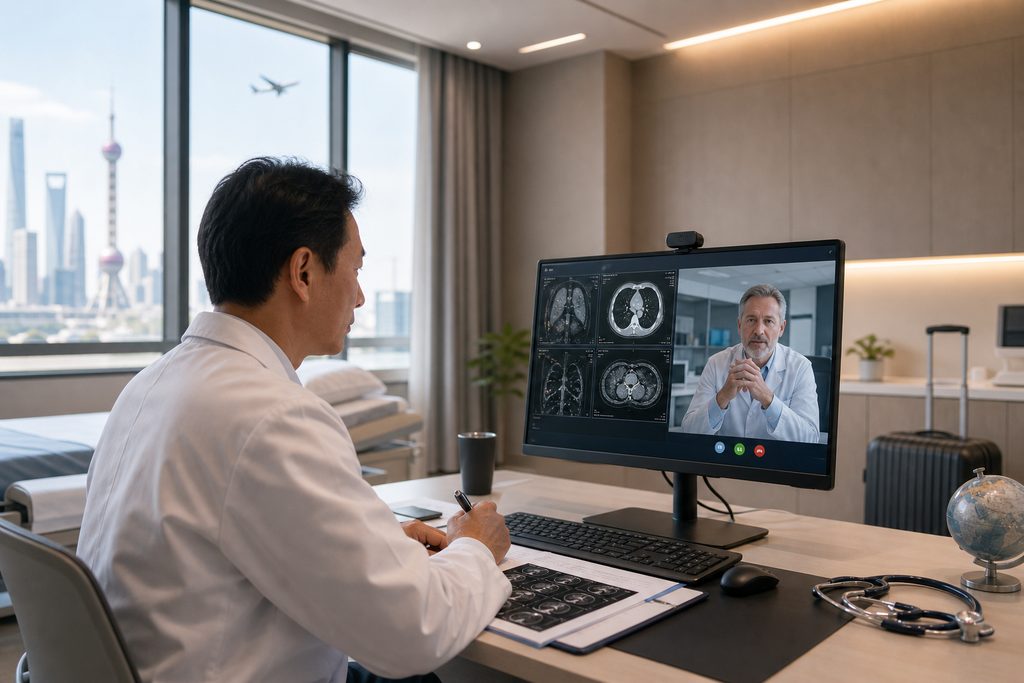
Third, the materials go to the hospital’s international department or a designated specialist. The reviewing physician examines your files, writes an assessment, and signs it. The report typically includes: a summary of what they see in your imaging, their interpretation, whether they agree or disagree with your current diagnosis or treatment plan, and what they would recommend next. It is not a prescription. It is a clinical opinion for you and your home physician to consider.
Fourth, you receive the document. Depending on the hospital, it may be in Chinese with an English translation, or prepared directly in English. Some hospitals stamp it with the official department seal. Others issue it on hospital letterhead with the physician’s name and registration number. Both are legitimate formats.
The whole process, from sending records to receiving the report, typically takes 5 to 10 business days. Faster if the materials are complete and well organized. Slower if the hospital needs to request additional imaging or clarification.
What Makes a Remote Report Genuine — and How to Spot a Fake
This is the part most people never ask about, and it is the part that matters most. A genuine remote report has identifiable, verifiable features. A marketing document does not.
A real report names the reviewing physician. Not “our expert team” or “senior specialists.” A name. You should be able to search that name and find their hospital affiliation, department, and publication history. Chinese physicians working at top-tier public hospitals publish in indexed journals. If the doctor named on your report has no traceable academic or clinical footprint, that is a red flag.
A real report references your actual imaging. It says things like “the 2.3 cm nodule in the right upper lobe shows spiculated margins on the March CT.” A fake report stays vague: “there is a lesion that requires further evaluation.” Specificity is the signature of genuine clinical work.
A real report has limits. It will say what cannot be determined from the materials provided. It may ask for additional tests. A marketing report promises clarity and solutions for everything. That should make you suspicious.
How do you verify a hospital in China before you send anything? Start with the Fudan University hospital rankings, which group China’s top 100 hospitals into tiers. Then check whether the hospital has JCI accreditation. The top hospitals in China for foreigners are disproportionately clustered in Beijing, Shanghai, and Guangzhou, and most have international departments that handle remote consultations routinely. If a hospital claims to offer remote reports but has no international department, no published ranking, and no verifiable address, walk away.
And if you are asking is medical tourism in China safe, the remote report is actually one of the safety mechanisms. It lets you test the hospital’s communication quality, clinical rigor, and responsiveness before you commit to travel. A hospital that produces a sloppy remote report will not suddenly become organized when you arrive in person.
What a Remote Report Costs — and What It Does Not Cost
Let us talk numbers, because the medical tourism China cost question starts long before you board a plane.
| Service | Typical Cost (USD) | What You Receive |
|---|---|---|
| Written second opinion, standard specialist | $300–$500 | Signed written analysis of your records, treatment suggestions, next-step direction |
| Video consultation, international department | $100–$300 | Live discussion with the reviewing team, Q&A, immediate feedback |
| Video consultation, top-tier specialist | $500–$800 | Direct online consultation with a senior specialist in a specific subspecialty |
| Multidisciplinary team video review | $1,500–$2,000 | Coordinated review by multiple specialists (e.g., oncology, radiology, surgery) |
These are starting ranges, and final pricing varies by hospital and case complexity. A complex oncology case requiring review of 400 imaging slices costs more than a straightforward orthopedic question.
Here is the part few patients know: if you later decide to come to China for treatment, many coordination services apply your remote consultation fee as a credit toward the on-the-ground coordination service. That means the remote report is not a sunk cost. It is a down payment on a more informed decision. The credit applies to the coordination fee only, never to hospital treatment charges, and it is a one-time credit. But it changes the economics of starting remote.
Compare that to the cost of flying to Shanghai, staying in a hotel for a week, and discovering that the hospital’s approach does not match your expectations. A $400 written report is dramatically cheaper than a $6,000 speculative trip. That is the real value proposition of remote evaluation.
A Realistic Timeline
People underestimate how long the pre-travel phase takes. Here is what actually happens, with realistic ranges.
| Stage | Duration | What Happens |
|---|---|---|
| Record gathering and translation | 3–7 days | You collect imaging, labs, pathology. We translate key documents into Chinese for the reviewing physician. |
| Department matching and hospital confirmation | 2–5 days | We identify the right specialty team, confirm availability, and submit your materials through the hospital’s international channel. |
| Specialist review | 5–10 days | The physician reviews your records, consults colleagues if needed, and drafts the report. |
| Report delivery and translation | 1–3 days | You receive the signed report, translated into English if it was prepared in Chinese. |
| Optional: video consultation follow-up | 3–7 days to schedule | If you want to discuss the written report live, we coordinate a video session with the same team. |
| S2 visa processing (if you decide to travel) | 2–6 weeks | Medical treatment in China uses the S2 visa category. Processing times vary by embassy and country. |
Total time from first contact to holding a written report: roughly two to three weeks. From first contact to sitting in a Chinese hospital for surgery: typically two to three months, when you factor in visa processing, scheduling, and the hospital’s own admission workflow.
And here is a fact that surprises most Western patients: public hospitals in China generally do not allow you to book surgery from abroad. You must be seen in person first. The remote report is what makes that in-person visit efficient. You arrive already knowing which department to visit, what additional tests will likely be ordered, and whether the hospital’s approach aligns with your goals.
What Can Go Wrong — and What Happens Then
Remote reports are not magic. Things go wrong, and you should know the failure modes before you pay.
The most common problem: incomplete records. You send a CT report but not the actual DICOM image files. The specialist can read the radiologist’s summary but cannot see the scan themselves. The resulting report is thinner than it should be. The fix is simple: send the full imaging files, not just the written reports. If the hospital asks for additional materials, provide them quickly.
Translation errors happen. A pathology term gets mistranslated. A medication name is confused. The reviewing physician bases their opinion on slightly wrong information. This is why professional medical translation matters, and why we handle document translation internally rather than relying on machine translation.
Sometimes the specialist disagrees with your home physician. That is not a failure — that is the point of a second opinion. But it can create anxiety. You now have two different recommendations. The remote report is not a court ruling. It is additional evidence for you and your primary doctor to weigh.
Occasionally, a hospital declines the remote review. This happens when the case is too complex for a records-only assessment, or when the department is at capacity. The recourse is straightforward: switch to a video consultation, or select a different hospital from our database of 340+ ranked institutions across 37 cities.
And if you pay for a report and the hospital cannot deliver it — which does happen, rarely, due to scheduling conflicts — the coordination fee is refunded in full. That is the standard we hold ourselves to, and it is a standard you should demand from any intermediary.
How to Evaluate a Remote Report Provider
Not all intermediaries are equal. Some are legitimate medical coordination services. Some are marketing agencies with a website. Here is how to tell the difference before you send your medical records to a stranger.
Ask who reviews your case. A legitimate provider will tell you the department and, once assigned, the physician’s name. A marketing agency will say “our team of experts.” That is not an answer.
Ask whether the report comes from a hospital or from a company. If the report will be issued by “Beijing Medical Consulting Group” rather than by a named hospital department, that is a different product. It may still have value, but it is not a hospital opinion. Know the difference.
Ask about the hospital’s credentials. Is it on the Fudan ranking? Does it have JCI accreditation? The JCI accredited hospitals China list is a useful reference point, though many excellent public hospitals in China are not JCI accredited because JCI is an international standard that Chinese public hospitals adopt selectively. Fudan ranking tier is often the better signal for public institutions.
Ask what happens if the report is delayed or cannot be delivered. A legitimate provider has a clear refund policy. A marketing agency will dodge the question.
And pay attention to how the provider talks about outcomes. If they promise that the remote report will get you faster surgery, or that the specialist will “take over your case,” be skeptical. A remote report is a clinical opinion. It is not a booking guarantee. Public hospitals in China operate under strict admission rules. No intermediary can promise you a specific surgeon or a specific surgery date. Anyone who does is not being honest with you.
Practical Considerations: Records, Visas, Payment, and Follow-Up
Before you request a remote report, get your records in order. The quality of the report depends on the quality of what you send.
Imaging: send the actual DICOM files on a CD, USB drive, or via secure upload. Not just the written radiology report. The reviewing physician needs to see the scan.
Pathology: if your case involves cancer, send the pathology slides or at minimum the full pathology report with staining details. Some hospitals will want to re-review the slides themselves.
History: a concise timeline of your diagnosis, treatments received, surgeries, and current medications. Include your current treating physician’s contact information if you want the Chinese specialist to communicate with them directly.
Visa: if the remote report leads to a decision to travel, you will need an S2 visa for medical treatment. Processing takes two to six weeks depending on your home country’s Chinese embassy. The hospital will provide an invitation letter and treatment confirmation, which are required supporting documents. Family members accompanying you also apply for S2 visas.
Payment: remote reports are paid in advance. The fee covers the specialist’s time and the coordination work. Hospital treatment costs are separate and are paid to the hospital directly, typically on a prepaid basis for public institutions.
Follow-up at home: after you receive the report, share it with your primary physician. A good remote report is designed to be read by your doctor at home, not just by you. If the Chinese specialist recommends a treatment path that differs from your current plan, your home physician needs to be part of that conversation.
Frequently Asked Questions
Check the physician’s name against the hospital’s official website and their publication record. Chinese specialists at top hospitals publish in indexed journals. You should be able to find their name, department, and hospital affiliation in public databases. If the report does not name a specific physician, treat it as a general educational document, not a clinical opinion.
Generally no. If you get a remote report from Hospital A and then decide to have surgery at Hospital B, Hospital B will want to do its own assessment. The remote report is useful for your decision-making, but it does not transfer between hospitals. Choose the hospital for your remote report carefully — ideally the same one where you would consider treatment.
No. Public hospitals in China require an in-person consultation before surgery or admission. The written report helps you decide whether to make the trip and which department to visit, but it does not replace the face-to-face evaluation. Think of it as a filter, not a shortcut.
That is often the reason patients pursue care in China. Some procedures, particularly in areas like minimally invasive cardiac surgery or certain oncology protocols, are more accessible or more affordable in China. The report gives you a clinical basis for exploring treatment abroad. Share it with your home physician and discuss the risks and benefits of traveling for care.
The remote report itself costs $300 to $2,000 depending on the format and specialist level. If you decide to travel, the total medical tourism China cost depends entirely on your procedure. As a reference point, a cardiac bypass that costs $120,000 or more in the United States typically runs $12,000 to $20,000 at a top Chinese public hospital. Add travel, accommodation, and coordination services, and you are still often at a fraction of Western prices.
Your Next Step
A remote medical report from China is a genuine clinical document when it comes from a named physician at a verifiable hospital. It is a low-cost way to test the waters before committing to international travel. It will not replace an in-person visit, and it will not guarantee surgery dates or specific specialists. But it gives you something more valuable: an informed basis for a major decision.
We are China Medical Services, and we coordinate remote written second opinions, video consultations, and on-the-ground support for international patients across China’s top-tier hospital network. We do not sell access, and we do not promise outcomes. We handle records, translation, hospital communication, and logistics so you can make a clear-eyed decision. If you are considering a remote report, start by telling us about your case. We will tell you honestly whether a remote review makes sense for your situation, and what it would cost.
For more medical information and treatment options in China, visit chinamedservices.com (China Medical Services).
