Joint Revision Surgery in China Explained: Costs, Top Hospitals, Recovery
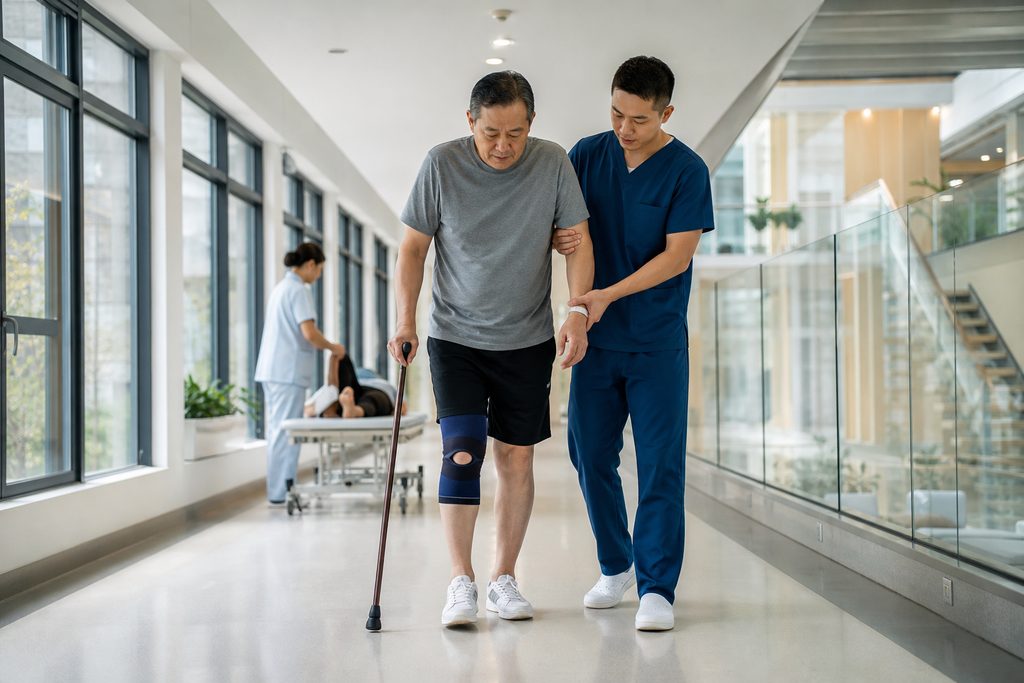
While patients in Canada wait a median 28.6 weeks for orthopedic surgery, according to the Canadian Institute for Health Information, surgeons at Beijing Jishuitan Hospital routinely perform over 300 joint replacements per month. That gap matters most for one group in particular: people whose first knee or hip implant has already failed. When a prosthesis loosens, wears, or becomes infected, waiting is not neutral. Bone loss progresses. Options narrow.
Joint revision surgery in China has become a genuine option for international patients facing long waits, six-figure US quotes, or both. But it is also a procedure where the wrong hospital choice is expensive in ways that go beyond money. Here is what the landscape actually looks like.
Key Takeaways
- Revision surgery in China’s top public hospitals typically runs $12,000–$25,000 all-in, against $40,000–$100,000+ in the US for comparable complexity.
- China’s highest-volume orthopedic centers handle complex revisions routinely — volume that most Western hospitals see only in specialized units.
- The real barrier is logistics, not quality: public hospitals generally cannot be booked from overseas without going through an international department or VIP channel, and prices there run roughly 1.5–2x the standard rate.
- No outcome is guaranteed anywhere. Revision surgery carries higher risks than a first replacement, and any plan should be confirmed by a qualified surgeon after reviewing your actual imaging.
The Problem: A Failed Implant and a System That Moves Slowly
Roughly 1 in 5 knee replacement patients report persistent pain or functional limitation years after surgery, and implant revision rates hover around 7–10% at 10–15 years for knee replacements depending on registry data. That is millions of people worldwide who eventually need a second operation.
In single-payer systems, that second operation goes to the back of a queue that is already long. In the US, it comes with a bill that can exceed the original surgery — revision is technically harder, takes longer, and often requires bone grafting or specialized implants. A patient in Texas quoted $85,000 for a revision has few obvious alternatives. A patient in Ontario facing a 10-month wait has even fewer.
And a failed implant is not stable. Loosening accelerates. Infection spreads. What could have been a straightforward revision becomes a two-stage reconstruction with an antibiotic spacer in between. Time is a clinical variable here, not just an inconvenience.
Why China Delivers Results in Complex Orthopedic Revision
The case for China is not that it is cheap. It is that a handful of Chinese hospitals do revision work at a volume and concentration that few places in the world match.
Clinical Volume Changes What a Surgeon Can Do
A senior surgeon at a top Chinese orthopedic center may perform 200–500 joint procedures annually, and a meaningful share of those are revisions. That matters because revision surgery is a skill built on repetition — managing bone defects, choosing between constrained and hinged implants, deciding when a two-stage approach is safer than a single operation. Western surgeons at general hospitals often see a handful of revisions per year.
Beijing Jishuitan Hospital, referenced in the orthopedics specialty rankings, is one of the highest-volume musculoskeletal centers in the world. Shanghai’s Ruijin Hospital and Sixth People’s Hospital, along with West China Hospital in Chengdu, sit in the same tier. These are not boutique facilities. They are large public institutions where complex joint reconstruction is routine work.
Technology Without the Marketing Layer
Navigation systems, patient-specific instrumentation, 3D-printed titanium augments and cones — the tools used in difficult revisions are present at China’s top centers. What differs is throughput. A hospital running thousands of joint procedures a year has its imaging, sterilization, implant inventory and post-op protocols tuned for exactly this kind of case. The operating room does not improvise.
One practical consequence: implant availability. Revision often requires specific modular systems that smaller hospitals do not stock. High-volume Chinese centers keep them on hand because they use them weekly.
Cost Advantage That Reflects Structure, Not Shortcuts
Why is the price a fraction of the US figure? Surgeon fees in China’s public system are administratively set and low. Hospital overhead is lower. Implant procurement runs through national volume-based purchasing, which in recent years cut joint implant prices dramatically. None of that changes the surgeon’s training or the sterilization standards.
What it does mean is that a $15,000 revision in China and an $85,000 revision in the US are not automatically different in clinical quality. They are different in how the two systems price labor, devices and infrastructure.
What Joint Revision Surgery Actually Costs in China
Prices vary by hospital tier, implant type, whether the case is one-stage or two-stage, and how much bone reconstruction is needed. The ranges below reflect typical all-in figures at top public hospitals including hospital stay, surgery, implants and basic rehabilitation. International department or VIP channel pricing runs higher.
| Procedure | China (top public hospital) | United States | Western Europe |
|---|---|---|---|
| Knee revision (one-stage) | $12,000–$20,000 | $45,000–$90,000 | $30,000–$55,000 |
| Hip revision (one-stage) | $13,000–$22,000 | $50,000–$100,000+ | $32,000–$60,000 |
| Two-stage revision with antibiotic spacer | $20,000–$35,000 (both stages) | $90,000–$150,000+ | $60,000–$95,000 |
| Pre-op imaging and labs | $400–$1,200 | $2,000–$5,000 | $1,500–$3,500 |
| Inpatient rehabilitation (2 weeks) | $1,500–$4,000 | $15,000–$40,000 | $8,000–$20,000 |
These are reference ranges, not quotes. Final pricing depends on hospital and case complexity, and the only reliable number comes after a surgeon reviews your imaging. International department pricing at the same hospitals typically runs 1.5–2x the standard rate — still well below Western figures.
Is Joint Revision Surgery Safe in China? Reading the Evidence Honestly
This is the question that decides most cases, and it deserves a straight answer rather than reassurance.
Revision surgery carries higher complication rates than primary replacement everywhere — dislocation, infection, nerve injury, and the possibility of further revision. A 2021 analysis in the Journal of Arthroplasty and multiple national registries put revision infection rates in the 2–5% range for knees and slightly higher for complex hips, with wide variation by center. China’s top orthopedic hospitals publish outcomes in line with international benchmarks, but “top hospitals” is doing real work in that sentence.
What separates a good decision from a bad one here is not the country. It is the specific hospital, the specific surgeon’s revision volume, and whether the case is properly evaluated before anyone books a flight.
What to Verify Before Committing
- Whether the surgeon performs revisions regularly, not occasionally — ask for annual revision case volume, not total joint volume
- Whether the hospital can handle a two-stage protocol if infection is confirmed
- Whether your imaging has been reviewed by the operating surgeon, not just a coordinator
- What the plan is if the revision fails or infection recurs after you return home
How Long Is Recovery After Joint Revision Surgery?
Recovery is slower than a first replacement, and patients who expect otherwise tend to be disappointed. Typical timelines at high-volume centers look like this:
- Days 1–3: Mobilization with a walker or crutches, usually starting within 24 hours. Pain management and wound checks.
- Weeks 1–2: Hospital discharge typically between day 4 and day 10 depending on complexity. Supervised physiotherapy begins.
- Weeks 3–6: Progressive weight-bearing. Most patients move from walker to cane in this window. Sutures or staples out around week 2–3.
- Months 2–3: Return to most daily activities. Driving depends on which joint and which side.
- Months 6–12: Full functional recovery. Strength and range of motion often continue improving past the one-year mark.
Two-stage revisions reset this clock — the spacer period between surgeries typically lasts 6–12 weeks, and the patient is often on IV or oral antibiotics throughout.
How to Book Joint Revision Surgery in Shanghai or Beijing
Here is the part most international patients do not expect. China’s top public hospitals generally do not allow overseas patients to book a specialist appointment directly from abroad through the standard queue. Registration for regular outpatient clinics happens on the day, in person, and surgery can only be scheduled after an in-person consultation.
There are two realistic paths around this:
The international department or VIP channel. Most top hospitals maintain a separate international medical department with English-speaking staff, streamlined scheduling and shorter waits. The trade-off is price — roughly 1.5–2x the standard rate. This is the path most foreign patients use for procedures like revision, where advance scheduling matters.
Written second opinion first, then travel. Send existing X-rays, CT scans and operative notes to the relevant orthopedic specialty for a written review before booking anything. This is not a substitute for an in-person exam, but it clarifies whether revision is even the right next step, which implant strategy is likely, and whether the case is a good fit for a specific hospital.
For a city-by-city view of where revision-capable hospitals sit, the Fudan-ranked hospital directory groups them by location, and the Beijing and Shanghai pages cover the two largest orthopedic hubs.
Practical Considerations: Visas, Payment, Language and Follow-Up
Visa. Medical treatment in China falls under the S2 visa category for short stays, with accompanying family members applying under the same category. Stays beyond 180 days require S1. Requirements are set by the relevant Chinese embassy or consulate and change periodically — confirm current documentation with the consulate handling your application, and expect to submit a hospital-issued invitation or treatment confirmation letter. The M visa is for commercial and trade activity and is not the correct category for medical treatment.
Payment. Public hospitals require prepayment before scheduled surgery. International credit cards are accepted at international departments; standard counters may require UnionPay or cash. Private international hospitals often bill insurers directly. If you plan to claim reimbursement from a Western insurer, request itemized invoices and operative reports in English before you leave the hospital — getting them later is difficult.
Language. Top Chinese hospitals see tens of thousands of outpatients daily. Signage, registration systems and ward communication are overwhelmingly in Chinese. Even patients with some Mandarin find the surgical consent and post-op instruction process hard to navigate alone. A bilingual medical companion covers registration, queueing, payment, wayfinding, and translation during consults and ward rounds.
Follow-up after returning home. Arrange a handover plan before you fly. Ask for your operative note, implant details including manufacturer and lot numbers, imaging on a USB drive, and a written rehab protocol your local physiotherapist can follow. Your home surgeon will want all of it.
Frequently Asked Questions
At high-volume orthopedic centers, published complication rates are broadly in line with international benchmarks, and these hospitals perform complex revisions routinely. Safety depends far more on the specific surgeon’s revision experience and your individual case than on the country. Anyone promising a guaranteed outcome is not giving you a medical opinion.
You can get a meaningful range, but not a firm quote. Hospitals typically provide a cost estimate after reviewing imaging and confirming the surgical plan, and the final figure can shift if the procedure turns out to be two-stage or requires extensive bone reconstruction. Treat any pre-imaging number as a planning figure only.
This is the hardest question and it deserves planning, not optimism. Before surgery, confirm who at the Chinese hospital will be reachable for questions, obtain complete records in English, and identify a local orthopedic surgeon willing to take over follow-up. Revision complications can require urgent care, and having a home-side plan in place is not optional.
Not necessarily. Some patients arrange everything independently, particularly those with Mandarin fluency or family in China. Others use coordination services for hospital matching, international department scheduling, interpretation and logistics. Neither path changes the medical decision — that belongs to you and the surgeon.
Your Next Step
Revision surgery is a decision that rewards preparation over speed. The two things that matter most are an honest assessment of whether revision is the right next step, and a clear-eyed view of which hospital and surgeon has the volume to handle your specific case. We are China Medical Services — a coordination team, not a hospital and not a source of medical advice. We help international patients obtain written second opinions from Chinese specialty teams, coordinate appointments through official international departments, and provide bilingual support on the ground. If you would like to start with a records review before making any travel plans, you can reach our team here.
For more medical information and treatment options in China, visit chinamedservices.com (China Medical Services).
