Recurrent Cancer MDT Review in China: When First-Line Treatment Fails
You have probably been told that cancer recurrence means fewer options. The protocols have been exhausted. The conversation shifts to managing symptoms rather than targeting the disease.
That narrative is incomplete.
Recurrence is a fork in the road, not the end of it. For many patients, the real question is not whether treatment exists. It is whether their current medical team has the bandwidth, the sub-specialization, or the institutional experience to design a genuinely novel approach. When first-line chemotherapy, radiation, or targeted therapy stops working, the biology of the tumor has changed. A fresh set of eyes on a resistant cancer is not a luxury. It is a clinical necessity. And increasingly, patients from North America, Europe, the Middle East, and Southeast Asia are finding those eyes in China.
Key Takeaways
- China’s top-tier cancer centers now run structured MDT reviews for recurrent cases, with costs starting at $1,500–2,000 for a full multidisciplinary video consultation.
- Oncologists at Fudan-ranked hospitals manage patient volumes that create deep, pattern-level expertise in treatment-resistant cancers rarely seen in lower-volume Western centers.
- Navigating China’s hospital system independently is genuinely difficult — language barriers, visa requirements, and appointment systems demand local coordination.
- A recurrent cancer MDT review is not a treatment guarantee; it is a rigorous re-examination of your pathology, imaging, and clinical history by a fresh team of sub-specialists.
The Problem: When Standard Protocols Stop Working
Approximately 20% to 30% of patients with early-stage breast cancer will eventually develop metastatic recurrence, according to data from the American Cancer Society. For colorectal cancer, recurrence rates after curative surgery hover around 30% to 40%, with most relapses occurring within the first three years. These are not rare edge cases. They are the lived reality for hundreds of thousands of families every year.
What happens next depends heavily on where you are treated. A community oncologist in a regional hospital may see a handful of recurrent, treatment-resistant cases each year. A sub-specialist at a high-volume academic center may see dozens. The difference in pattern recognition alone can alter the treatment trajectory.
But here is the structural problem. In many Western healthcare systems, multidisciplinary tumor boards meet weekly to review complex cases. These meetings are time-boxed. They prioritize newly diagnosed patients. A recurrent case that has already failed two lines of therapy may get fifteen minutes of discussion — if it gets discussed at all. The patient waits. The disease does not.
That waiting period is where anxiety compounds. You know the cancer is adapting. You know the window for intervention is finite. And you are not sure whether the quiet is a sign of careful deliberation or institutional gridlock.
Who We Are
We are not a hospital. We do not provide medical treatment, prescribe therapies, or offer clinical diagnoses. Our team functions as your logistical architects — we connect international patients with China’s top-tier medical institutions and ensure that language, scheduling, and cultural barriers do not stand between you and a thorough clinical review. We maintain a database of 340+ top-ranked hospitals across 37 cities, all vetted against Fudan University’s national hospital rankings and JCI accreditation standards. When you contact us, you are not buying access to a specific doctor. You are engaging a case management team that translates your medical history, identifies appropriate oncology departments with documented expertise in your cancer subtype, and coordinates a structured MDT review through official hospital international channels.
Why a Recurrent Cancer MDT Review Service in China Delivers Fresh Clinical Perspective
Volume Creates Sub-Specialization That Most Western Centers Cannot Match
China’s top oncology departments operate at a scale that reshapes clinical expertise. A single thoracic oncology department at a Fudan-ranked hospital may evaluate over 15,000 new lung cancer cases annually. A comparable department at a major US cancer center might see 3,000 to 5,000. This is not a statement about quality — it is a statement about exposure frequency. When you see a rare EGFR exon 20 insertion mutation thirty times a year instead of three, your clinical intuition for resistance patterns sharpens.
For recurrent cancers, this matters enormously. Treatment-resistant tumors do not follow textbook patterns. They evolve. An oncologist who has managed hundreds of post-first-line progressions in a specific molecular subtype brings a different level of diagnostic aggression to the table. They ask different questions about re-biopsy timing. They consider clinical trial eligibility through a wider lens. The oncology departments in China’s top-tier hospitals are organized around sub-specialization — you are not seeing a general medical oncologist. You are seeing someone whose entire practice focuses on, say, HER2-positive gastric cancer that has progressed beyond second-line therapy.
MDT Review Is Structured, Not Ad-Hoc
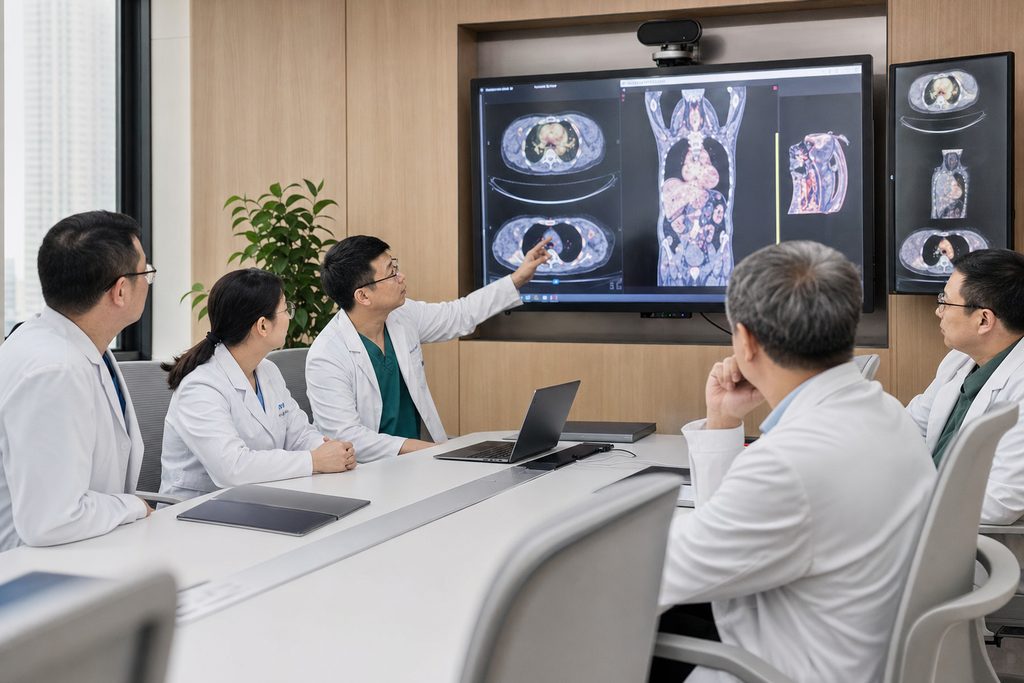
Many patients misunderstand what an MDT review actually entails. It is not a single doctor glancing at your file and offering an opinion. A proper MDT review convenes medical oncology, radiation oncology, surgical oncology, pathology, and radiology in one session — either physically or via a coordinated video consultation. Each specialist reviews your original pathology slides, your most recent imaging, and your full treatment history before the meeting. The discussion is structured around specific questions: Is re-biopsy indicated? Has the tumor biology shifted? Are there locoregional treatment options that were previously dismissed? Is there a clinical trial with a matching molecular target?
This is what the recurrent cancer treatment cost China question really funds. You are not paying for a single opinion. You are paying for a coordinated, documented, multi-specialist review that produces a written report — often within 7 to 10 business days of submitting your complete medical records. For patients who have been waiting weeks or months for their home-country tumor board to reconvene, that timeline changes the calculus entirely.
Cost Structure Reflects System Efficiency, Not Quality Tradeoffs
Let us address the obvious concern directly. A second opinion oncology China price that falls between $300 and $500 for a written review from a top-tier specialist — or $1,500 to $2,000 for a full multidisciplinary team video consultation — can sound suspiciously low to patients accustomed to US billing. The skepticism is reasonable. But the cost difference is structural, not qualitative.
China’s top public hospitals operate on a high-volume, lower-margin model. Physician salaries are not tethered to procedure-based billing in the same way they are in fee-for-service Western systems. Hospital infrastructure is built for throughput. The same thoracic surgeon who performs 400 lung resections annually in Shanghai might earn a fraction of what a US surgeon earning on 80 annual resections takes home — without any corresponding drop in surgical outcomes. Published data from Fuwai Hospital, which performs over 14,000 cardiac surgeries annually, shows mortality rates comparable to or better than top US centers. The economics of scale translate directly to the patient’s bill without translating to clinical compromise.
Also worth noting: any video consultation or written second opinion fee you pay through our coordination service is fully credited toward on-the-ground coordination if you later decide to travel to China for treatment. That credit applies within 90 days. It is a one-time credit against our coordination fee — it never applies to hospital treatment charges — but it means the initial MDT review can function as a low-risk diagnostic step rather than a sunk cost.
What Is MDT Review for Cancer in China — And What It Is Not
That is a hard outcome, but it is not a wasted process. An honest, multi-specialist assessment that further systemic therapy offers more harm than benefit is clinically valuable. It can spare you months of toxic treatment with marginal upside and help you and your family make clear-eyed decisions about palliative care, clinical trial enrollment, or quality-of-life prioritization. We would rather you receive that clarity from a rigorous MDT than from a single rushed consultation. The fee is for the review, not for a specific answer.
In most cases, yes — but the timeline depends on the hospital’s admission schedule and your visa processing speed. Once you have the MDT report and decide to proceed with treatment, we initiate the hospital invitation letter for your S2 visa application. Visa processing at your local Chinese consulate typically takes 5 to 10 business days, though this varies by country. Hospital admission is usually scheduled within one to three weeks of visa issuance. We coordinate both tracks simultaneously to compress the total waiting period as much as possible.
No. The MDT review fee covers the multi-specialist consultation, the written report, and our coordination and translation services. Actual treatment costs — surgery, chemotherapy, radiation, hospitalization — are paid directly to the hospital and vary significantly by case complexity. As a reference point, a course of chemotherapy in a top-tier Chinese public hospital might cost $3,000 to $8,000 per cycle, compared to $15,000 to $30,000 in the US. But these are estimates. Your final costs depend on the specific regimen, the duration of hospitalization, and whether you are treated through the hospital’s international department or standard inpatient ward.
You are under no obligation to follow it. The MDT report is a consultative document, not a treatment order. Some patients use it to pressure-test their home oncologist’s plan. Others use it to identify clinical trials they had not previously considered. A few decide the recommendation does not align with their goals and pursue a different path entirely. The report is yours. What you do with it is your decision, made in consultation with your treating physician.
Your Next Step
Cancer recurrence after first-line treatment failure is a disorienting experience. The ground shifts. The protocol that was supposed to work did not, and the path forward is less clearly marked. A recurrent cancer MDT review in China is not a miracle solution. It is a structured, evidence-based process that brings fresh sub-specialist eyes to a resistant case — often faster and at a fraction of the cost of comparable reviews in Western systems. If you are facing this crossroads and want to understand whether a Chinese oncology team might see something your current team has not, our team is here to walk you through the
Frequently Asked Questions
Yes. The hospitals used for international patients are JCI-accredited or major Grade 3A tertiary centres and follow the same international safety standards as top hospitals in the US and Europe. Surgical teams perform high volumes of procedures — often more than their Western counterparts — which studies show leads to better outcomes.
Costs vary by procedure and hospital, but international patients typically save 40-80% compared to US prices — even when factoring in travel and accommodation. A consultation with our team will give you an exact, all-inclusive quote with no hidden fees.
Send us your existing medical reports. The relevant specialty reviews them and gives you a written opinion, including treatment direction and options, before you commit to any travel. From there you can add a video consultation with the doctor, or have us attend an appointment on your behalf.
For more medical information and treatment options in China, visit chinamedservices.com (China Medical Services).
