China vs Thailand: Technology and Equipment in Top Hospitals
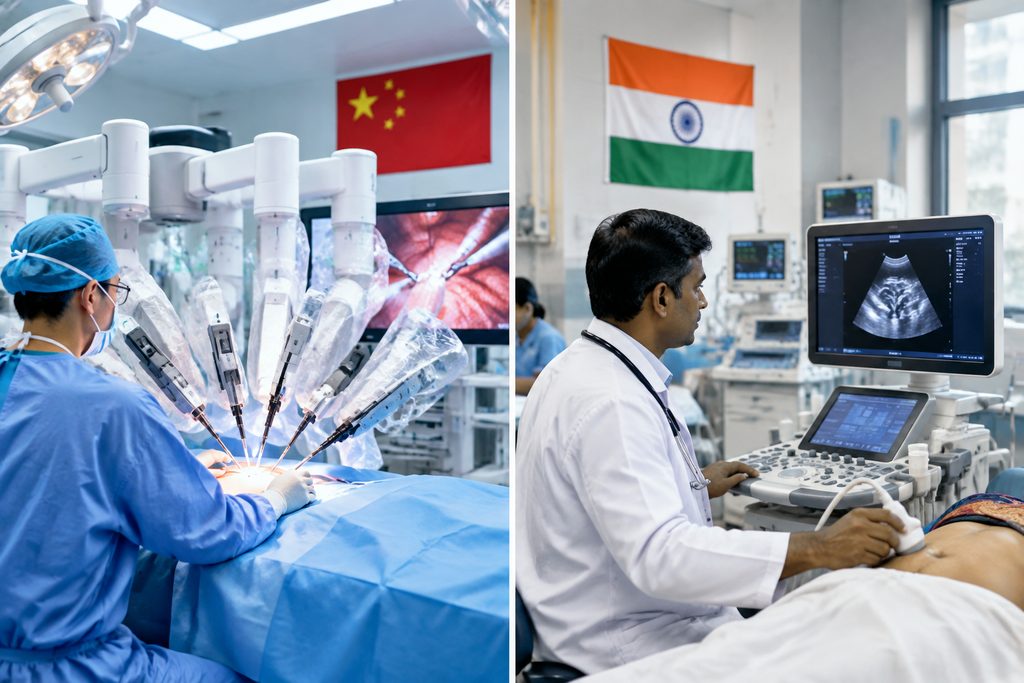
China vs Thailand: Technology and Equipment in Top Hospitals
If you are weighing medical travel options in Asia, the question of medical equipment quality China vs Thailand is probably at the top of your list. Both countries attract international patients. Both advertise modern facilities. But the technology behind the headlines is not the same, and the gap matters when your diagnosis is serious.
Thailand built its reputation on hospitality, short wait times, and English-speaking staff at private hospitals like Bumrungrad and Bangkok Hospital. China built something different: enormous public academic medical centers that treat millions of patients a year and invest accordingly. Understanding that difference is the whole point of this comparison.
Key Takeaways
- China’s top hospitals sit in the Fudan Top 100 — the top 5% of 35,000+ hospitals — and many run robotic surgical programs with annual case volumes that private Thai hospitals rarely match.
- Thailand wins on service familiarity: shorter queues, smoother English service, and a mature medical tourism pipeline built over 30 years.
- China’s honest barrier is logistics. Public outpatient registration cannot be booked from overseas, and top hospitals handle 10,000+ outpatient visits a day. Without language support, the system is hard to navigate.
- Equipment alone does not determine outcomes. Surgeon volume, team experience, and follow-up care matter just as much — so compare programs, not brochures.
The Problem: A Machine Is Only as Good as the Team Behind It
Here is a number that should reframe how you compare hospitals. A single top-tier Chinese academic hospital may perform more than 14,000 cardiac surgeries a year. Fuwai Hospital in Beijing, part of the Chinese Academy of Medical Sciences, is widely cited as the highest-volume heart surgery center in the world at that scale.
Now compare that with the average medical tourist experience. You land in Bangkok, you are seen within a day, the room looks like a hotel. Nothing about that is wrong. But volume is what sharpens a surgical team, and volume is where the two systems diverge most.
International patients searching for the best hospitals in China for international patients technology often start with equipment spec sheets — da Vinci robots, PET-CT scanners, proton therapy. Those specs are real. They are also nearly identical across upper-tier hospitals in both countries. The differentiator is how often the machine runs, who operates it, and what happens when something goes wrong at 2 a.m.
Why China’s Top Tier Delivers Different Results
China’s healthcare system is not uniformly excellent. That is worth saying plainly. The 35,000+ hospitals range from world-class to under-resourced. The relevant comparison is between Thailand’s best private hospitals and China’s top 5% — the institutions tracked in the Fudan Hospital Ranking and accredited by JCI.
Clinical Volume That Compounds Expertise
A high-volume center does not just perform more operations. It sees more complications, more rare presentations, more edge cases. That experience gets folded back into protocols.
China’s national referral system concentrates the hardest cases at the top. Zhongshan Hospital Fudan University, Peking Union Medical College Hospital, and West China Hospital in Chengdu each draw patients from across a population of 1.4 billion. Thai private hospitals serve a smaller domestic base plus medical tourists, and their case mix skews toward elective and lower-acuity procedures.
Technology and Efficiency at Scale
Walk into a major Chinese hospital and the operational tempo is immediately visible. Registration halls, imaging departments, and operating suites run on industrial schedules. A 3T MRI may run 16 hours a day. Robotic surgery platforms are booked in tight blocks.
That intensity has a downside — it can feel overwhelming, and it is not built around foreign patients. But it produces throughput that keeps equipment current. Hospitals replacing imaging fleets every few years are not unusual at the top tier, because the capital investment is justified by volume.
Cost Advantage Without Quality Compromise
Robotic surgery cost China vs Thailand is a question worth answering with real numbers. A robotic-assisted prostatectomy at a top Chinese public hospital typically runs $15,000–25,000. At a leading Thai private hospital, the same procedure commonly lands between $25,000 and $40,000. In the United States, it frequently exceeds $100,000.
Why is China cheaper than Thailand despite heavier technology investment? Labor economics, domestic equipment manufacturing, and public hospital pricing structures. Physician salaries are lower, and Chinese hospitals negotiate imaging and device contracts at national scale. Lower price here reflects system structure, not corner-cutting.
Head-to-Head: Technology, Access, and Cost Compared
The table below reflects typical patterns, not quotes. Actual figures vary by hospital and case complexity.
| Factor | China (Top 5% Hospitals) | Thailand (Leading Private Hospitals) |
|---|---|---|
| Robotic surgery programs | Widespread at Fudan Top 100 centers | Available at major private hospitals |
| Annual surgical volume | Very high; national referral hubs | Moderate; tourism-weighted case mix |
| Robotic prostatectomy cost | $15,000–25,000 | $25,000–40,000 |
| English-language service | International departments and VIP channels | Standard across private sector |
| Booking from overseas | Limited for public outpatient; international departments assist | Generally straightforward |
| Insurance billing | Mostly prepay, then reimburse | Direct billing common at private hospitals |
| Complex case capacity | Very high | Moderate |
China Hospital Technology Ranking for Foreigners: How to Read It
There is no single global league table that ranks hospitals by equipment. The closest proxy is the Fudan Hospital Ranking, published annually by the Institute of Hospital Management at Fudan University. Its general list places the top 100 hospitals into tiers — A++++ down to A — rather than numbered positions. Its specialty reputation lists do rank the top 10 hospitals in each of 45 specialties.
So when you see a claim like “ranked among China’s top 10 for oncology,” that phrasing traces back to a real specialty list. When you see “number three hospital in China,” treat it with suspicion. That number does not exist in the official ranking.
For foreigners evaluating technology specifically, three signals carry weight:
- Fudan specialty placement — a top-10 specialty ranking implies concentrated expertise and equipment investment in that field.
- JCI accreditation — signals international patient safety standards, though it says little about surgical volume.
- Procedure volume disclosures — hospitals that publish annual case counts are usually proud of them for good reason.
You can browse hospitals by specialty through our department directory, which maps all 45 Fudan specialties to their leading centers.
Practical Considerations: What Actually Trips People Up
Technology is the easy part of the decision. Logistics is where plans fall apart.
Visa category. For medical treatment in China, the applicable short-stay category is the S2 visa, issued for medical treatment and private affairs. Family members accompanying a patient apply under the same category. Requirements shift, so confirm current rules with the nearest Chinese embassy or consulate and bring supporting hospital documents. The M visa is for commercial and trade activity and has nothing to do with medical care.
Appointment reality. Public hospital outpatient registration generally cannot be reserved from abroad. You register on the day, in person. Surgery follows an in-person consultation — no exceptions at most public hospitals. If you need a confirmed specialist appointment before you fly, the international or VIP department is the realistic route, and pricing there runs roughly 1.5 to 2 times the standard channel.
Payment. Public hospitals expect prepayment; insurance reimbursement happens afterward, back home. Private international hospitals in China increasingly offer direct billing, similar to Thailand.
Language. This is the single biggest practical gap. A top Chinese hospital can see over 10,000 outpatients in a day. Signage, registration systems, and most staff operate in Chinese. Bilingual medical companions exist precisely because of this — not as a luxury, but as the difference between a workable visit and a chaotic one.
Frequently Asked Questions
At the top tier, yes — particularly for complex surgery. China’s leading academic hospitals run higher case volumes and invest more heavily in robotic and advanced imaging platforms. Thailand’s advantage is service design, not equipment superiority. For straightforward elective procedures, both are capable.
Partially. Public hospital outpatient slots usually cannot be reserved remotely, but international and VIP departments can often arrange appointments in advance for a premium. A written second opinion or video consultation is a practical first step before committing to travel.
Typically yes. Robotic-assisted procedures at top Chinese public hospitals often cost 30–50% less than at leading Thai private hospitals. Final pricing depends on hospital tier, surgeon, and case complexity, so treat any figure as a range, not a quote.
Top Chinese hospitals handle high-acuity complications routinely — it is part of their daily caseload. The real risk is communication, not capability. Having a bilingual companion or a coordinated support channel in place is what protects you when a fast decision is needed.
At private international hospitals, no. At top public hospitals, realistically yes, or you need someone beside you. This is the most common reason international patients struggle with an otherwise excellent system.
Your Next Step
The honest summary: China’s top hospitals hold a genuine technology and volume edge, Thailand holds a genuine service and convenience edge, and the right answer depends on your diagnosis and how much support you need. Neither system is uniformly better.
China Medical Services is a coordination service, not a hospital. We do not diagnose or treat anyone. What we do is help international patients understand their options across 340+ top-ranked hospitals in 37 cities, arrange written second opinions and video consultations, and support the practical side of a visit if you decide to travel. If you want a clear picture of what your case would look like in China, you can start with a free consultation through our patient support page — no obligation, and no pressure.
This article is for general information only and is not medical advice. Treatment decisions should always be made with a qualified physician who has reviewed your individual case.
For more medical information and treatment options in China, visit chinamedservices.com (China Medical Services).
