Airport Transfer Support in China: What Medical Travelers Actually Pay
Key Takeaways
- A dedicated airport transfer service to a China hospital typically runs about $200 round-trip — a fraction of what a week of unplanned taxi chaos can cost you in stress.
- Most “medical tourism packages” do not bundle airport pickup. It is usually a separate line item, so ask before you assume it is covered.
- The real barrier is not the ride. It is the language gap, the terminal layout, and the fact that your hospital may be 90 minutes from the airport in traffic.
- Before you book anything, confirm three things: who meets you, what happens if your flight is delayed, and whether the driver speaks English.
An airport transfer service to a China hospital is exactly what it sounds like: a pre-arranged ride that collects you at the terminal and delivers you — and your luggage, and your medical records — to the hospital or your hotel near it. No hailing, no haggling, no pointing at a phone screen while a driver shakes his head.
That sounds simple. It rarely is.
China’s major airports are among the busiest on earth. Beijing Capital and Shanghai Pudong each handle tens of millions of passengers a year, and the signage that guides you from baggage claim to ground transport assumes you read Chinese. For a patient arriving for surgery — tired, possibly in pain, possibly traveling with a spouse who is just as lost — that first hour sets the tone for everything that follows.
The Problem: The First Mile Is the Hardest Mile
Here is a number worth sitting with. A single top-tier Chinese public hospital can see more than 10,000 outpatient visits in one day. The logistics of moving that many people through a building are formidable — and you are arriving at that building from another country, often after a 12-hour flight, with no ability to read the signs.
Now add the geography. Fudan’s Top 100 hospitals are spread across 23 cities. Beijing alone hosts 21 of them; Shanghai has 18; Guangzhou, 10. If you are flying into Shanghai Pudong International Airport and your target hospital is in the city center, you are looking at roughly 45 to 60 minutes by car in normal traffic — and considerably longer during the morning and evening peaks. Land at Pudong and head for a hospital in the Pudong medical cluster and it is shorter. Land at Pudong and need to reach a hospital across the river, and the drive can stretch past 90 minutes.
None of that is dangerous. All of it is exhausting when you do not speak the language.
The taxi alternative exists, and it works. Metered taxis from Shanghai Pudong to central districts generally run in the range of 160 to 220 RMB (roughly $22 to $30), depending on distance and time of day. Ride-hailing apps function at major airports, though pickup zones can be confusing and drivers rarely speak English. If you are mobile, unencumbered, and comfortable navigating a foreign city, you can absolutely do this yourself.
But “mobile, unencumbered, and comfortable” describes very few people flying in for surgery.
What Airport Transfer Support Actually Covers
The phrase gets used loosely, so let’s be precise. A genuine transfer service for medical travelers usually includes four things, and the good ones include a fifth.
- Meet-and-greet at arrivals. A driver or coordinator waits past customs with your name on a sign — which matters enormously if your phone does not work on Chinese networks yet.
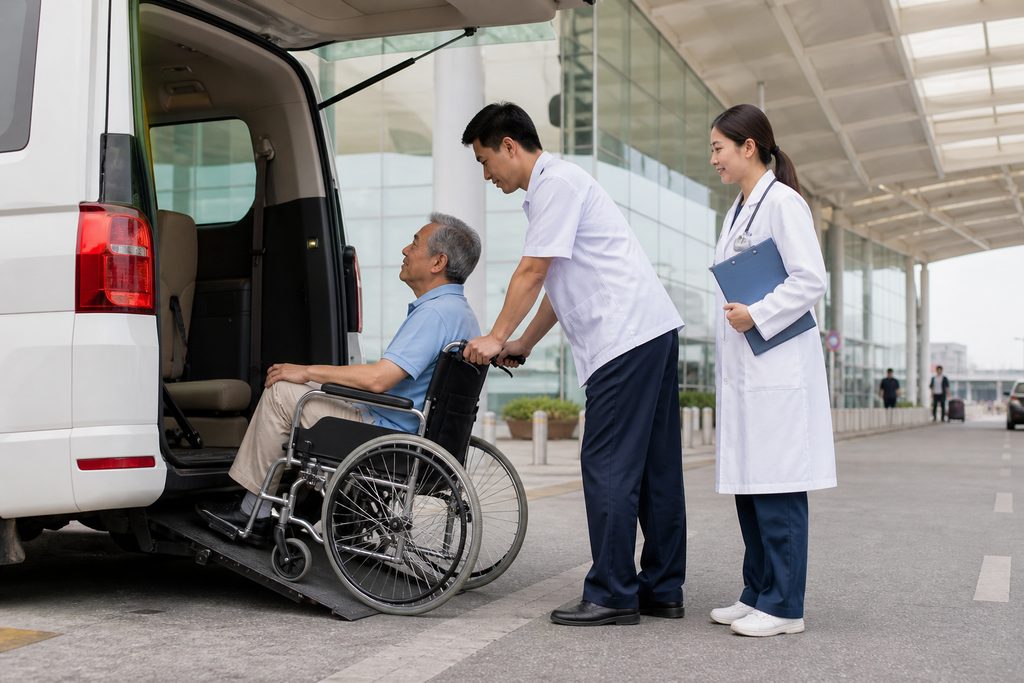
- Vehicle appropriate to your condition. A patient who cannot sit upright for an hour needs more than a standard sedan. Ask specifically.
- Luggage handling. Medical travelers often arrive with more bags than tourists — records, imaging discs, comfort items, a companion’s belongings.
- Direct drop to the right entrance. Large Chinese hospitals have multiple gates, and the international department is frequently not at the main entrance.
- Flight monitoring. The best operators track your arrival time and adjust. This is the difference between a service and a taxi with a nicer car.
Cost of Airport Pickup for Medical Tourists in China
Let’s put real numbers on the table. Pricing varies by city, distance, vehicle type, and whether you need a coordinator rather than just a driver — but the following ranges reflect what the market generally looks like in 2026.
| Option | Typical Cost | English Support | Best For |
|---|---|---|---|
| Metered taxi | $22–35 one way | Rarely | Mobile, independent travelers |
| Ride-hailing app | $20–40 one way | No | Those with a working Chinese payment method |
| Hotel-arranged car | $50–90 one way | Sometimes | Simple point-to-point, no medical needs |
| Dedicated medical transfer | from $200 round-trip | Yes | Patients with mobility limits or companions |
Those figures are indicative and vary by hospital and case complexity — a transfer to a hospital 120 kilometers outside the city costs more than one to a downtown address. Always confirm the final quote in writing before you fly.
Is airport transfer included in medical tourism packages in China? Usually, no. Most Chinese hospitals do not sell bundled packages the way some clinics in Turkey or Thailand do. What they offer is treatment. The logistics around it — visa guidance, translation, transport, accompaniment — are handled separately, either by the patient or by a coordination service. That is a structural difference worth understanding before you budget.
How to Get From Shanghai Airport to Your Hospital: A Worked Example
Concrete beats abstract. Suppose you are flying into Shanghai Pudong for a consultation at a hospital in the Xuhui or Jing’an district.
Before you land. You have your S2 visa in your passport — the short-stay category used for medical treatment and private affairs, subject to the latest embassy or consulate requirements and supporting hospital documents. You have a printed confirmation with your driver’s name, mobile number, and the exact meeting point. You have the hospital’s Chinese name and address written down, because your driver may not read English.
On arrival. You clear immigration and customs, which at Pudong can take anywhere from 30 minutes to well over an hour depending on the hour and the volume of international arrivals. Your driver is waiting in the arrivals hall. If you have arranged a bilingual medical companion, that person is with the driver — and this is where the value shows up, because they can call the hospital, confirm your appointment slot, and handle anything that comes up en route.
The drive. Forty-five to sixty minutes in normal conditions. Your companion can use that time productively: reviewing your appointment details, explaining what happens when you arrive, translating your existing reports if that has not been done yet.
Arrival at the hospital. Here is the part that surprises most foreign patients. You generally cannot simply walk into a Chinese public hospital and see a specialist the same day. Standard outpatient registration happens on the day, in person, and surgical scheduling follows an in-person consultation. The exception is the hospital’s international or VIP department, which offers English-speaking staff and advance scheduling — at roughly 1.5 to 2 times the standard-channel price.
Knowing which door to walk through is worth more than the ride itself.
How to Book Airport Transfer for Surgery in Beijing — and What to Watch For
Beijing adds its own wrinkles. The city has two major international airports, and they are not close to each other. Capital International sits northeast of the city; Daxing sits far to the south. Arriving at the wrong one for your hospital can double your transfer time.
Three mistakes come up again and again.
Booking a transfer without confirming the hospital entrance. A driver who drops you at the main gate of a 5,000-bed hospital has not finished the job. Confirm the specific building and, ideally, the international department’s address.
Assuming your companion is included. If your spouse is traveling with you, the vehicle needs to fit both of you plus luggage. A sedan booked for one often cannot.
Not asking about the return trip. You will need to get back to the airport after discharge or between appointments. Round-trip pricing is usually better than two one-way bookings, and it locks in a driver who already knows your situation.
One more thing. If your treatment plan is not yet confirmed, booking flights and transfers early can be premature. Many patients now start with a written second opinion or a video consultation, get a clearer picture of whether travel makes sense, and only then commit to dates. That sequencing saves money and, occasionally, an unnecessary trip. You can read more about how we structure that staged approach on our consultation and coordination page.
Practical Considerations Before You Fly
Documentation first. Your S2 visa requires supporting documents from the receiving hospital, and processing timelines vary by consulate. Apply early. Accompanying family members apply under the same category.
Payment. Chinese public hospitals generally require prepayment, with insurance reimbursement handled afterward in your home country. Private international hospitals more often bill insurers directly. For transfers, expect to pay by bank transfer in advance or in cash on arrival — many independent drivers do not accept foreign credit cards.
Connectivity. Arrange a working phone before you land, or make sure your transfer confirmation includes a driver contact who can be reached by your companion’s phone. A driver holding a sign is your backup; a phone number is your primary.
Records. Bring printed copies of your imaging, pathology, and lab reports, ideally with Chinese translation. If you want to explore which hospitals handle your condition, our department-by-department rankings show which facilities rank in China’s top 10 for 45 specialties, and the Top 100 hospital directory organizes them by city.
And be honest with yourself about your mobility. If you cannot walk 500 meters unaided, say so when booking. It changes the vehicle, the meeting point, and possibly whether you need a wheelchair arranged in advance.
Frequently Asked Questions
You can take a taxi, and many people do. Metered fares from major airports to central districts generally fall between $22 and $35. The trade-off is language, luggage, and the fact that taxi drivers will not know which entrance of a sprawling hospital you need. If you are traveling alone for a serious procedure, the extra cost buys real peace of mind.
Rarely. Chinese hospitals sell treatment, not vacation-style bundles. Transport, translation, and accompaniment are typically arranged separately. Some coordination services fold airport pickup into a broader package, so ask directly rather than assuming either way.
This is exactly why flight monitoring matters. A driver who tracks your arrival adjusts automatically. A driver who does not may leave, and you will be rebooking at midnight in an unfamiliar terminal. Confirm the delay policy in writing before you pay.
Some can. A bilingual medical companion, for instance, can ride with you, help with check-in at the hospital, assist with registration and payment queues, and translate during your first appointment. That is a separate service from the transfer itself, typically priced from $300 per day, and it is often the more valuable of the two.
A week is usually comfortable for a standard transfer. If you need a specific vehicle type, a wheelchair-accessible car, or a companion who speaks a particular language, give it two weeks or more. Peak travel periods around Chinese public holidays tighten availability considerably.
Your Next Step
Getting from the airport to the hospital is a small piece of a much larger puzzle — but it is the piece that determines whether your first day in China feels managed or chaotic. Plan it the way you would plan the medical side: in advance, with specifics confirmed in writing.
We are China Medical Services, a coordination team that helps international patients navigate Chinese hospitals. We are not a hospital and we do not provide diagnoses or medical advice. What we do is handle the logistics around your care — hospital matching, appointment coordination, bilingual accompaniment, and yes, arrival support — so you can focus on the reason you came. If you would like to talk through your situation, start with a free consultation. No pressure, no obligation. Just a clearer picture of what your journey would actually look like.
This article is for general information only and does not constitute medical advice. Treatment decisions should always be made with a qualified physician who has reviewed your individual case.
For more medical information and treatment options in China, visit chinamedservices.com (China Medical Services).
