Who Treats Large Liver Tumors in China: Top Hospitals & Costs
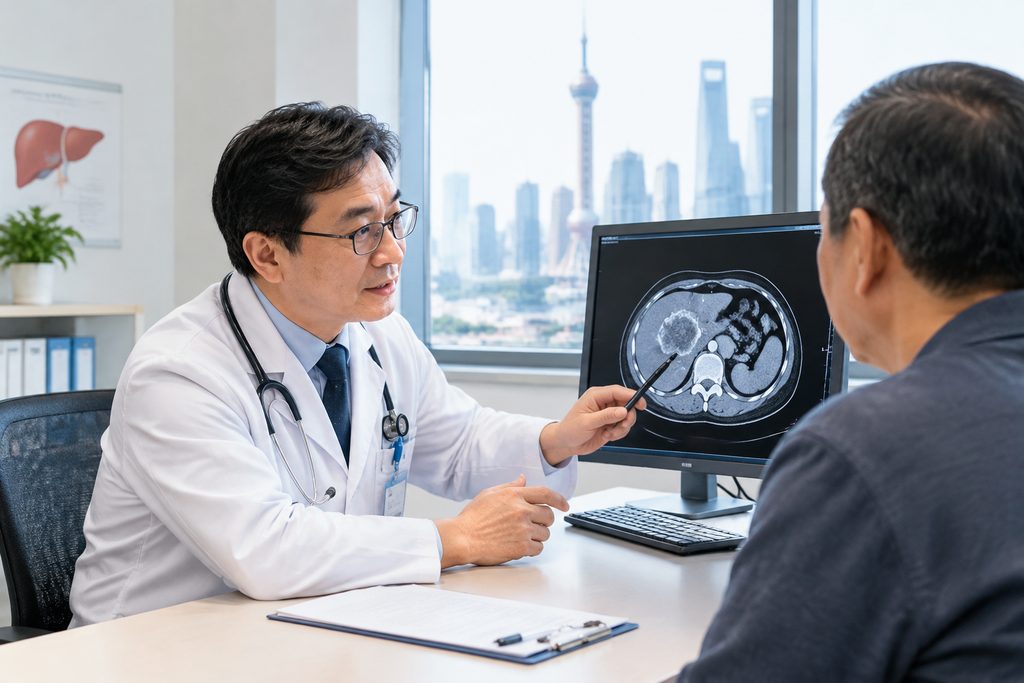
Where do you go when a liver tumor is too large for your local hospital to touch? For a growing number of international patients, the answer is a Chinese tertiary hospital — and the reasoning behind that choice is more practical than you might expect.
Key Takeaways
- China’s top-ranked hospitals handle liver cancer at a scale few systems can match, with high-volume hepatobiliary surgery units concentrated in Beijing, Shanghai, and Guangzhou.
- Complex liver tumor surgery in China’s leading public hospitals typically runs $15,000–$35,000, compared with $100,000–$200,000 or more in the United States.
- The hard part is not the medicine. It is access: public hospital outpatient slots cannot be booked from overseas in advance, and without a Chinese-speaking coordinator the process stalls fast.
- Nothing should be decided before a written second opinion or video consultation confirms that your case is genuinely treatable in China — and that the trip is worth it.
The Problem: When “Large” Means “We Can’t Operate”
Liver cancer is the sixth most common cancer worldwide and the third leading cause of cancer death, according to the World Health Organization’s GLOBOCAN estimates. Roughly 70 to 80 percent of cases are diagnosed at an intermediate or advanced stage, when the tumor has already grown beyond the point where straightforward surgical removal is possible.
That word — “large” — changes everything. A tumor under 3 centimeters in a patient with good liver function is a relatively contained surgical problem. A tumor of 10 centimeters, or one that has grown into a major hepatic vein, is not. It requires a hepatobiliary team that performs this kind of resection weekly, not annually. It requires imaging that can map the future liver remnant to within a few percent. And it often requires a combination approach: portal vein embolization to grow the healthy side of the liver first, then resection weeks later.
In many countries, that expertise exists in exactly one or two centers — and the wait to reach them can run three to six months. For a liver tumor, three months is not a delay. It is a different disease.
Why China’s Top Liver Centers Deliver Results
China carries an outsized share of the global liver cancer burden, and its leading hospitals have built their hepatobiliary programs around that reality. Volume, in liver surgery, is not a marketing claim. It is the single strongest predictor of whether a complex resection goes well.
Surgical Volume You Cannot Find Elsewhere
The hepatobiliary surgery departments at China’s top-ranked hospitals perform hundreds of liver resections annually — figures that place them among the highest-volume units in the world. A surgeon who performs 200 or more major liver resections a year has seen every variation of vascular anatomy, every awkward tumor position, every intraoperative surprise. That pattern recognition is what separates a good outcome from a complication.
China’s 340+ top-ranked hospitals — the top 5 percent of the country’s 35,000+ hospitals, ranked by the Fudan Hospital Ranking and JCI accreditation — include several with dedicated liver cancer centers. You can browse them by specialty through our Fudan specialist rankings by department, where oncology and hepatobiliary surgery are listed with their top-ranked institutions.
Technology That Matches the Volume
Large liver tumors are rarely treated with surgery alone. The standard pathway at a high-level Chinese center typically involves multidisciplinary team review — interventional radiology, medical oncology, hepatobiliary surgery, and pathology sitting in the same room. What comes out of that meeting is a sequenced plan: transarterial chemoembolization (TACE) to shrink the tumor, immunotherapy or targeted therapy to control systemic disease, portal vein embolization to hypertrophy the future liver remnant, then resection.
That kind of sequencing is not exotic. It is routine at a top-tier Chinese center. The difference is how quickly it moves. A patient who arrives with complete imaging and pathology can have an MDT review within days, not months.
Cost Without the Quality Trade-Off
Here is the objection every patient raises: if it costs one-fifth as much, is it one-fifth as good? The structural answer is straightforward. Chinese public hospital fees are set by government pricing schedules that do not include the malpractice insurance premiums, administrative overhead, and pharmaceutical markup that inflate US hospital bills. Surgeon salaries are lower. Hospital construction was amortized decades ago.
What is not lower is the surgical skill or the imaging equipment. The 3.0T MRI and dual-source CT scanners in a top Chinese hospital are the same machines used in Boston or Heidelberg.
| Cost Component | China (Top Public Hospital) | United States |
|---|---|---|
| Liver resection (partial hepatectomy) | $15,000–$35,000 | $100,000–$200,000+ |
| TACE procedure (per session) | $3,000–$6,000 | $15,000–$30,000 |
| Liver transplant evaluation | Subject to hospital rules and organ allocation law | $15,000–$30,000 (evaluation only) |
| Immunotherapy (per cycle) | $1,500–$3,500 | $8,000–$15,000 |
| Hospital stay (per day, ward) | $100–$300 | $2,000–$5,000 |
All figures are estimates and vary by hospital, city, tumor complexity, and length of stay. They are not quotes and do not include travel, accommodation, or companion services.
A note on liver transplantation: Organ allocation in China follows national law and applies to registered residents under a regulated system. Foreign patients should not expect access to a donor organ, and no service can promise, expedite, or arrange one. If transplantation is part of your question, discuss it directly with a hospital’s international department and expect a candid answer.
Which Hospitals Actually Treat Large Liver Tumors in China
This is the question you came here to ask. The honest answer is that the right hospital depends on what your tumor needs — surgery, interventional radiology, systemic therapy, or a combination — and on whether you need an English-speaking international department.
Several institutions appear consistently at the top of the Fudan specialist reputation rankings for hepatobiliary surgery and oncology. Among the names international patients encounter most:
- Zhongshan Hospital, Fudan University (Shanghai) — its liver cancer program is one of the most frequently cited in Chinese clinical literature, with a dedicated liver cancer institute.
- Peking Union Medical College Hospital (Beijing) — broad tertiary referral center with a strong hepatobiliary surgery department.
- West China Hospital, Sichuan University (Chengdu) — among the largest single-site hospitals in the world, with high surgical volume.
- Ruijin Hospital (Shanghai) — long-established hepatobiliary and minimally invasive surgery programs.
- Sun Yat-sen University Cancer Center (Guangzhou) — a dedicated cancer hospital with a large liver cancer caseload.
Beijing alone hosts 21 of the Fudan Top 100 hospitals, Shanghai 18, and Guangzhou 10. You can filter by city through our directory of Fudan Top 100 hospitals by city, or look at hospitals in Beijing and hospitals in Shanghai if you already know which city you prefer.
One caution: a hospital’s overall reputation and its suitability for your specific case are two different things. A center that is world-class in transplant may not be the best choice if your tumor needs downstaging with TACE first. The match has to be case-specific.
Common Mistakes International Patients Make With Large Liver Tumors
Most of the failures we see are not clinical. They are logistical, and they are avoidable.
Booking a flight before confirming treatability. Patients arrive in Shanghai having assumed that a large tumor means immediate surgery. Often it does not — the plan may be weeks of downstaging first. Arriving early means paying for hotels and companions while waiting for a treatment sequence to begin.
Bringing incomplete imaging. A Chinese hepatobiliary surgeon needs thin-slice contrast-enhanced CT or MRI, not a radiology report summary. If your images are on a disc or a hospital portal, get them in DICOM format before you travel. Reports alone will send you back for repeat scans.
Assuming the public outpatient system works like home. It does not. Standard public hospital outpatient appointments generally cannot be reserved from overseas in advance — registration happens on the day, in person. To lock in a specialist consultation and a hospital bed ahead of arrival, patients typically go through the hospital’s international or VIP department, which costs roughly 1.5 to 2 times the standard channel and provides English-language service.
Confusing the M visa with a medical visa. It happens constantly. The M visa is for commercial and trade activity. It has nothing to do with medical treatment. Medical travel to China uses the S2 visa, annotated for medical treatment and private affairs, with S1 for stays exceeding 180 days. Accompanying family members apply for S2 as well. Requirements change, so verify current rules with your nearest Chinese embassy or consulate and bring the hospital’s supporting documents.
Practical Considerations: Records, Visas, Payment, and Follow-Up
Start with records. You will need: recent contrast-enhanced liver imaging in DICOM format, biopsy pathology slides and reports if a biopsy was done, blood tests including liver function and tumor markers (AFP, PIVKA-II), and a summary of any prior treatment. Translated into English or Chinese, these documents are what make a remote evaluation possible.
On visas, the S2 application generally requires an invitation or supporting letter from the receiving hospital, proof of the medical appointment, financial documentation, and standard application materials. Processing times vary by consulate — plan for at least two to four weeks, longer in peak periods.
Payment is where expectations often break. Chinese public hospitals require prepayment for major procedures; international insurance is typically reimbursed after the fact rather than billed directly. Some private international hospitals in China do offer direct billing with certain insurers, and they are worth considering if you carry international coverage — see our guide to private international hospitals in China for how that works.
Plan your follow-up before you leave. Ask your Chinese surgical team for a written post-operative plan in English, including imaging intervals, medication schedules, and warning signs. Your local oncologist will need it, and getting it later from overseas is far harder than getting it in person.
Frequently Asked Questions
Yes, foreign patients are treated at Chinese hospitals, most commonly through international or VIP departments that provide English-language coordination. The practical limits are real, though: standard public outpatient slots usually cannot be reserved from abroad, and complex cases require a confirmed treatment plan before travel makes sense.
Major liver resection at a top Chinese public hospital typically runs $15,000–$35,000, against $100,000–$200,000 or more in the US. Costs vary widely by hospital, city, tumor complexity, and length of stay. These are estimates, not quotes — final pricing is confirmed by the hospital after reviewing your case.
This is the question worth asking. Complex liver surgery carries genuine risk of complications — bleeding, bile leak, liver failure — anywhere in the world, and no hospital or coordinator can promise an outcome. What you can control is preparation: choose a high-volume center, confirm the plan in writing before you commit, and make sure you have a documented follow-up pathway with your home physician. Ask the hospital directly about their complication management protocols and ICU capacity.
Your Next Step
A large liver tumor narrows your options, but it does not eliminate them. The right sequence is almost always the same: get your records organized, obtain a specialist opinion on whether your case is treatable, and only then plan travel.
China Medical Services is not a hospital and does not provide diagnoses or treatment. We connect international patients with Chinese hospitals — written second opinions, video consultations, appointment coordination, and bilingual medical companions who handle registration, queuing, payment, and translation on the ground. If you would like to understand what is realistically possible for your case before booking anything, start with a free consultation. No pressure, no obligation.
This article is for general information only and is not medical advice. Treatment decisions should be made with qualified physicians who have reviewed your individual case.
For more medical information and treatment options in China, visit chinamedservices.com (China Medical Services).
