Intractable Epilepsy Second Opinion in China: Cost, Top Centers, and How to Start
Key Takeaways
- A written second opinion from a top-tier Chinese hospital typically runs $300–500, and video consultations range from $100 to $800 depending on the specialist tier.
- China’s highest-volume epilepsy centers evaluate far more drug-resistant cases annually than most Western hospitals, which shapes how their teams read an EEG and an MRI.
- No Chinese public hospital lets you book surgery from overseas. You must be seen in person first — that is a national rule, not a bureaucratic quirk.
- Any consultation fee you pay is credited in full toward on-the-ground coordination if you travel to China within 90 days.
The Problem: When the Third Drug Fails, the Answers Run Out
Roughly one in three people with epilepsy keeps having seizures after trying two or three appropriately chosen anti-seizure medications. That is not a rare corner of neurology. It is a defined clinical category — drug-resistant, or intractable, epilepsy — and it affects an estimated 1.2 million people in the United States alone.
Here is what usually happens next. Your neurologist adds a fourth drug. Then a fifth. Each one brings fatigue, brain fog, or mood changes, and the seizures continue. Meanwhile, the question that actually matters — am I a surgical candidate, and would surgery stop this? — sits unanswered for months, sometimes years.
The reason is rarely negligence. It is capacity. A comprehensive epilepsy center needs video-EEG monitoring beds, epilepsy-trained neuroradiologists, neuropsychologists, and a surgical team that does these cases weekly rather than occasionally. In the UK, referral to a specialist epilepsy surgery program can take many months from the initial request. In parts of the US, the wait for a surgical evaluation at a high-volume center often stretches past half a year.
So families do what families do. They start searching. They read about laser ablation, responsive neurostimulation, and resective surgery. They join forums. And increasingly, they ask a question that would have sounded strange a decade ago: what if we got a second opinion from a Chinese hospital?
Why a Second Opinion From China Is Worth Taking Seriously
You have probably heard that care in China means compromising on quality. In epilepsy, the reality runs closer to the opposite.
Volume changes how a team reads your scans
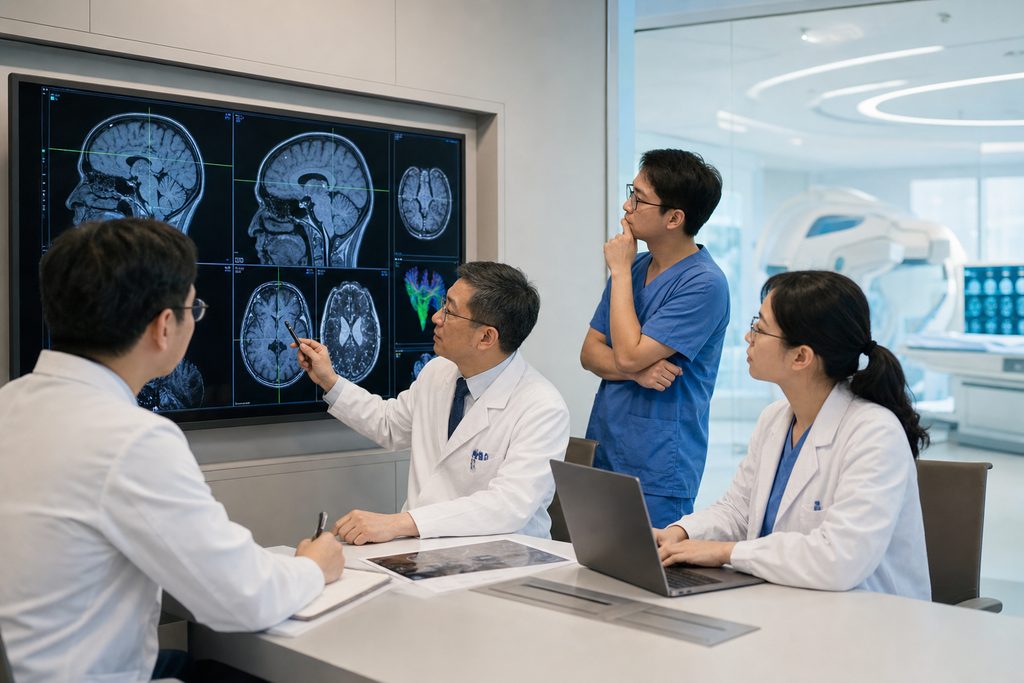
China’s top neurology and neurosurgery departments operate at a scale Western hospitals rarely match. A single major center may run multiple video-EEG monitoring units continuously, reviewing hundreds of drug-resistant cases each year. Volume matters in epilepsy specifically, because the hard part is not the surgery — it is localization. Finding the seizure onset zone in a patient whose MRI looks “normal” is a skill built on repetition.
Several Chinese hospitals appear in the Fudan University Hospital Rankings, which scores 45 specialties including neurology and neurosurgery. The rankings publish tier grades (A++++ down to A) for the overall Top 100, and ranked Top 10 lists for each specialty. That gives you a defensible way to shortlist centers rather than relying on marketing.
The cost gap is real, and it is structural
Equal-quality surgery costs less in China for reasons that have nothing to do with cutting corners: physician salaries, hospital operating economics, and sheer procedure volume. Intractable epilepsy surgery in China — evaluation, monitoring, and resection — commonly falls in the $15,000–35,000 range depending on hospital tier and complexity. The same pathway in the US frequently exceeds $100,000 before rehabilitation.
That gap is why the phrase intractable epilepsy second opinion China cost gets searched at all. A remote review costs a few hundred dollars. A full surgical evaluation costs a fraction of the Western equivalent. Neither requires you to commit to anything.
Remote review exists as a real, staged service
You do not have to fly anywhere to get a Chinese specialist’s read on your case. The workable model is staged:
- Written second opinion. You send existing EEG reports, MRI films, medication history, and seizure diary. A specialty team reviews them and returns written analysis and treatment direction.
- Video consultation. Same records, plus a live conversation with the Chinese team to explain symptoms and goals and hear their recommendations directly.
- Proxy consultation. You designate a city, hospital, department, or specialist. A representative visits in person with your materials, handles registration, and creates the hospital medical card.
- Treatment in China. Only after remote evaluation clarifies a feasible plan and you agree does travel make sense.
That last point is the one to hold onto. Nothing about a second opinion obliges you to travel.
How to Get a Second Opinion for Intractable Epilepsy in China
The process is more procedural than most patients expect. Here is the sequence, with realistic timing.
| Step | What Happens | Typical Timeframe |
|---|---|---|
| 1. Records assembly | EEG reports, MRI/CT on disc, medication list with dosages and dates, seizure diary, prior surgical opinions | 1–2 weeks (patient-side) |
| 2. Records translation | Clinical summary translated into Chinese for the reviewing team | 2–5 business days |
| 3. Written second opinion | Specialty team reviews and returns written analysis and direction | 5–10 business days |
| 4. Video consultation | Live discussion with the team; questions answered directly | Scheduled within 1–3 weeks |
| 5. In-person decision | If surgery is plausible, plan an in-person evaluation trip | Patient’s choice |
Two things trip people up. First, imaging must be sent as original DICOM files, not screenshots or PDF printouts — epilepsy localization depends on thin-slice data. Second, the seizure diary matters more than most patients realize. A precise record of seizure types, frequencies, and triggers in the months before review gives the team far more to work with than a vague description.
Is Epilepsy Surgery in China Safe for Foreigners?
Written opinions typically run $300–500. Video consultations range from $100 to $800 depending on specialist tier, with multidisciplinary reviews at $1,500–2,000. If you travel to China within 90 days, the consultation fee is credited in full toward on-the-ground coordination — a one-time credit applied to coordination only, never to hospital treatment charges.
Leading Chinese neurosurgical centers perform epilepsy surgery at internationally recognized standards, and several private international hospitals hold JCI accreditation with English-speaking staff. The genuine difficulty is navigation, not surgical quality — top public hospitals are enormous and operate almost entirely in Chinese. No provider can guarantee admission, a specific surgeon, or an outcome.
The S2 category covers short-stay medical treatment, with family members applying under the same category; stays over 180 days fall under S1. Requirements are set by the latest embassy and consulate guidance and typically require supporting hospital documents. Confirm current rules before applying.
That is a legitimate and useful outcome. A review may conclude that further medication adjustment, neuromodulation, or continued monitoring is the better path — information worth having regardless of where you ultimately receive care. A second opinion that rules something out has still done its job.
Your Next Step
A second opinion costs a few hundred dollars and a folder of records. It does not require a flight, a deposit, or a commitment to treatment. For families who have spent years cycling through medications without a clear answer, that is a low-risk way to find out whether anyone has a different plan.
Our team at China Medical Services connects international patients with 340+ top-ranked hospitals across 37 cities, handles records translation and appointment coordination through official international departments, and provides bilingual medical companion support on the ground. We are not a hospital and we do not diagnose or treat anyone — the medical judgment always belongs to the clinical team. If you would like to understand what a review of your case would involve, start with a free consultation and we will walk you through the options.
This article is for general information only and does not constitute medical advice. Treatment decisions for intractable epilepsy should always be made with a qualified physician who has reviewed your individual case.
Frequently Asked Questions
Yes. The hospitals used for international patients are JCI-accredited and follow the same international safety standards as top hospitals in the US and Europe. Surgical teams perform high volumes of procedures — often more than their Western counterparts — which studies show leads to better outcomes.
Costs vary by procedure and hospital, but international patients typically save 40-80% compared to US prices — even when factoring in travel and accommodation. A consultation with our team will give you an exact, all-inclusive quote with no hidden fees.
Send us your existing medical reports to get started. We handle everything from hospital selection and appointment scheduling to visa assistance and post-operative recovery planning. Your medical records are reviewed by the specialist before you even book a flight.
For more medical information and treatment options in China, visit chinamedservices.com (China Medical Services).
