Deep Vein Screening in China: Booking Guide for Foreign Patients
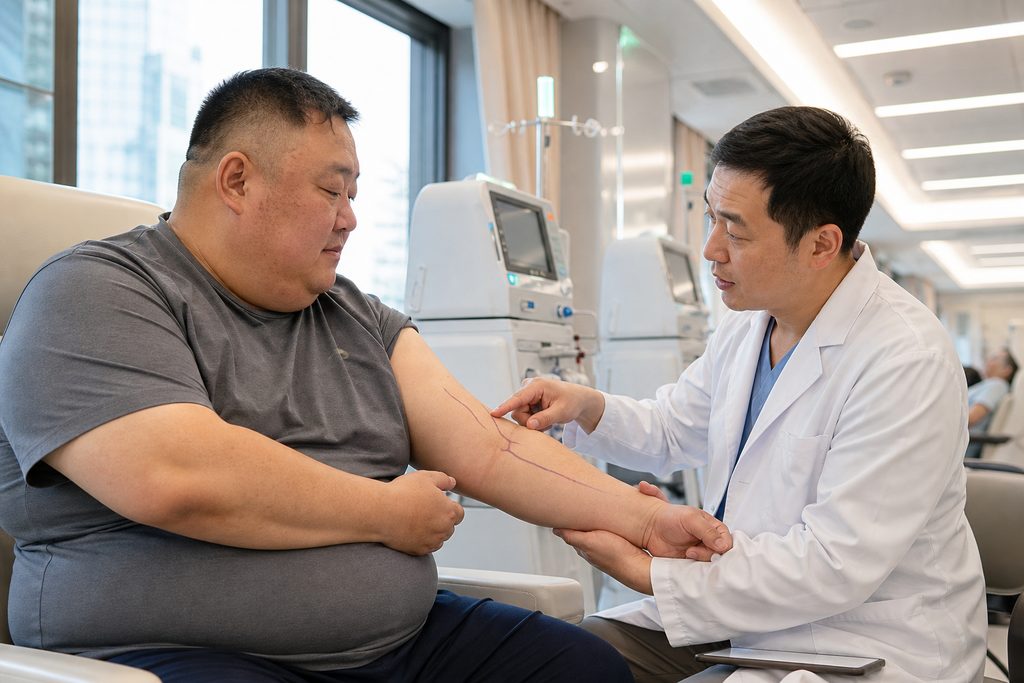
When 54-year-old David stepped off a fourteen-hour flight from Los Angeles to Shanghai, his left calf was swollen to nearly twice its normal size. He had booked a business trip two weeks after knee surgery — against his physiotherapist’s advice. By the time he reached his hotel in Jing’an, the pain had shifted from a dull ache to something sharp and hot. He did what most travelers do: he opened his phone and started searching. Deep vein screening in China wasn’t something he had planned for. Within eighteen hours, he had a Doppler ultrasound at a top Shanghai hospital, a confirmed diagnosis of distal deep vein thrombosis, and a treatment plan from a vascular specialist who spoke fluent English. The total bill came to less than $400.
That story is not unusual. Every year, thousands of international visitors, expatriates and medical travelers in China need vascular imaging — sometimes urgently, sometimes as a scheduled follow-up. What trips most of them up is not the medicine. It is the booking process, which works very differently from what they know at home.
Key Takeaways
- Deep vein screening cost China typically runs $150–$600 for a duplex ultrasound at a top-tier public hospital, versus $1,000–$3,500 in the United States for the same study.
- China’s largest hospitals see enormous vascular imaging volumes — the country’s leading centers perform thousands of venous Doppler studies annually, which supports fast scheduling and experienced readers.
- The real barrier is navigation, not quality. Public hospital outpatient registration generally cannot be reserved from overseas in advance, and same-day walk-in registration is effectively impossible without Mandarin.
- Before committing to any travel, understand the difference between a screening (no symptoms, risk-factor driven) and a diagnostic scan (symptoms present) — the second is a medical matter that needs a physician’s evaluation, not a shopping decision.
The Problem: Why Getting a Simple Vein Scan Abroad Feels Impossible
In the United States, a venous duplex ultrasound ordered by a primary care physician is usually scheduled within one to three weeks. That sounds reasonable — until you look at the bill. A 2023 analysis of commercial claims data published in the journal Circulation: Cardiovascular Quality and Outcomes found that the average allowed charge for a lower-extremity venous duplex study in the US exceeded $1,500, with wide geographic variation and patient cost-sharing that often lands between $200 and $600 even with insurance.
Now add a second problem. Waiting lists for non-urgent vascular imaging in parts of Canada and the UK routinely stretch past eight weeks. In the UK’s National Health Service, diagnostic waiting times have repeatedly breached the six-week standard for ultrasound studies, according to NHS England’s own monthly diagnostics statistics.
So the patient sits between two walls. Pay a lot, or wait a long time. And if you happen to be traveling or living in Asia when symptoms appear, the question becomes sharper: where do you go, and how do you get in?
That is the gap China fills for a growing number of international patients. But the booking mechanics are genuinely different, and nobody explains them well.
Why China Delivers Results for Vascular Imaging
Volume Creates Diagnostic Depth
China’s top hospitals are not small operations. Fuwai Hospital in Beijing performs more than 14,000 cardiac surgeries a year — the highest volume of any single cardiac center globally. That kind of throughput exists across the vascular and cardiovascular specialties too. When a sonographer reads forty venous Doppler studies a day instead of four, pattern recognition improves. This is not marketing language; it is a well-documented principle in diagnostic imaging, where reader experience correlates directly with sensitivity for thrombus detection.
Our database covers 340+ top-ranked hospitals across 37 cities — the top 5% of China’s 35,000+ hospitals, ranked by the Fudan Hospital Ranking and JCI accreditation. Vascular imaging is available at essentially all of them.
Equipment Is Not the Bottleneck
Any hospital that appears on the Fudan Top 100 list operates current-generation color Doppler ultrasound systems. The equipment at Shanghai’s Ruijin Hospital or Beijing’s Peking Union Medical College Hospital is the same class of machinery you would find at a major American academic medical center. There is no “older machines” discount happening here.
Cost Structure, Explained Honestly
Why does the same ultrasound cost a fraction of the US price? Three structural reasons. Physician and technologist salaries in China are lower in absolute terms. Hospital overhead — real estate, administration, malpractice insurance — is dramatically lower. And volume spreads fixed equipment costs across far more studies. None of those factors touch image quality.
| Study | China (top public hospital) | United States | United Kingdom (private) |
|---|---|---|---|
| Lower-extremity venous duplex | $150–$400 | $1,000–$3,500 | £350–£700 |
| Upper-extremity venous duplex | $150–$400 | $900–$2,800 | £300–£650 |
| Full bilateral venous mapping | $250–$600 | $1,800–$4,500 | £500–£900 |
| Vascular specialist consultation | $30–$120 | $250–$600 | £150–£300 |
Prices vary by hospital and case complexity. Private international hospitals in China — United Family, Jiahui, Parkway — charge more, typically 1.5 to 2 times the public hospital rate, but offer direct insurance billing and English-speaking staff throughout.
How the Booking Process Actually Works, Step by Step
This is where most guides go quiet. Here is the real sequence.
Step 1 — Decide what you actually need. A screening ultrasound for someone with no symptoms but risk factors (recent surgery, long-haul flight, family history, oral contraceptive use) is a different request from a diagnostic scan for a swollen, painful leg. The second is potentially an emergency. If you have unilateral leg swelling, pain, warmth or shortness of breath, seek immediate medical evaluation — do not shop for a package.
Step 2 — Choose your channel. Public hospitals have two doors. The standard outpatient door requires same-day registration, in person, in Mandarin, starting early morning. The international department or VIP channel allows advance scheduling, English service, and a higher price. For a visitor with limited time, the international channel is usually the practical choice.
Step 3 — Prepare your records. Bring any prior imaging, operative notes, medication list, and a summary of your history. If you have had a DVT before, that changes the protocol.
Step 4 — Registration and payment. Public hospitals require prepayment; you settle and then claim reimbursement from your insurer afterward. Private international hospitals often bill your insurer directly if there is a partnership.
Step 5 — The scan itself. A duplex ultrasound takes 20 to 45 minutes. Results at most large hospitals are available the same day or within 24 hours. A vascular specialist reviews and explains them.
One honest caveat: a standard public hospital outpatient appointment generally cannot be locked in from overseas before you arrive. That is a real constraint, and it is the single biggest reason international patients use a coordination service rather than going it alone.
Evaluating Safety and Choosing the Right Hospital
The question “is deep vein screening in China safe” comes up constantly, and it deserves a direct answer. Venous duplex ultrasound is non-invasive, uses no radiation, and carries no procedural risk. The safety question is really about diagnostic accuracy and clinical follow-through — whether the person reading your scan knows what they are looking at, and whether someone acts on the result.
Three criteria matter most when selecting where to go.
- Specialty ranking, not just hospital ranking. The Fudan specialist reputation rankings list the top 10 hospitals in 45 specialties. For vascular surgery and cardiovascular medicine, look at those specific lists rather than the general hospital tier. You can browse specialty rankings on our departments page.
- Volume in the relevant specialty. A hospital that does 5,000 vascular studies a year will read yours with more confidence than one that does 200.
- Language and continuity. If you do not speak Mandarin, the international department is not a luxury — it is the difference between understanding your result and guessing at it.
For a broader look at which institutions lead in cardiovascular and vascular care, our Fudan Top 100 hospital directory groups centers by city and tier. Beijing and Shanghai dominate, but excellent vascular programs exist in Guangzhou, Chengdu, Wuhan and Hangzhou as well.
Practical Considerations: Visas, Payments and Follow-Up
If you are traveling to China specifically for medical evaluation, the correct visa category is S2 — the short-stay visa used for medical treatment and private affairs, subject to the latest requirements from your local Chinese embassy or consulate. You will typically need an appointment letter or supporting documentation from the receiving hospital. Accompanying family members apply under the same category. Note that the M visa is for commercial and trade activities only and has nothing to do with medical travel.
For stays exceeding 180 days, S1 applies instead.
On payment: Chinese public hospitals accept international credit cards at most large facilities, but smaller ones may not. Cash in yuan is still widely used. Foreign debit cards sometimes fail at hospital terminals. Plan to have a backup. Private international hospitals are more reliably card-friendly and often handle insurance claims directly.
Insurance reimbursement after the fact is possible with most international policies, but you will need itemized invoices and, in many cases, a translated medical report. Request both before you leave the hospital — chasing documents remotely is far harder.
Follow-up matters too. If a scan finds something, you will want the images and report in a format your home physician can read. Ask for DICOM files on a USB drive and a written report in English. Most top-tier hospitals can provide this; not all volunteer it.
Frequently Asked Questions
At a top public hospital in Shanghai, a lower-extremity venous duplex typically runs $150 to $400, with a specialist consultation adding $30 to $120. Private international hospitals such as Jiahui or United Family charge roughly 1.5 to 2 times that. Final pricing depends on the hospital and the complexity of your case.
At a standard public hospital outpatient clinic, generally no — registration happens on the day, in person. Advance scheduling is realistic through a hospital’s international department or VIP channel, which is also where you will find English-speaking staff. This is the main practical difference between the two doors.
The ultrasound procedure itself is non-invasive and carries no risk. Reliability depends on the hospital and the reader. Centers on the Fudan Top 100 list operate current-generation Doppler equipment and perform high volumes of vascular studies. Choose by specialty ranking, not just general reputation.
A confirmed DVT requires prompt treatment, usually anticoagulation, and sometimes further evaluation. Chinese vascular specialists manage DVT routinely. If you are diagnosed while traveling, you should discuss with the treating physician whether it is safe to fly, and how to hand off care to a physician at home. Do not delay treatment to continue a trip.
For a short visit focused on evaluation or treatment, S2 is the applicable category, subject to your local Chinese embassy’s current requirements and supporting hospital documents. Approval is never guaranteed and requirements vary by country. For longer stays, S1 applies.
Your Next Step
Getting a vein scan in China is not complicated medicine — it is complicated logistics. The imaging is fast, the equipment is current, and the cost is a fraction of what you would pay in the US or Western Europe. What most international patients need help with is the front end: which hospital, which department, how to get an appointment that fits a travel schedule, and how to make sure the result is explained in a language you understand.
We are China Medical Services, a coordination service — not a hospital, and we do not provide diagnoses or medical advice. Our team helps international patients match with appropriate hospitals, arrange appointments through official international departments, and provides bilingual medical companions who handle registration, queuing, payment and translation on the day. You can start with a free consultation at our patient services page — no obligation, and no pressure. If you would rather research further first, our main hospital database is open to browse.
Whatever you decide, get the scan. A swollen leg is not something to wait out.
This article is for general information only and does not constitute medical advice. If you have symptoms of deep vein thrombosis — unilateral leg swelling, pain, warmth, redness, or shortness of breath — seek immediate medical attention. Treatment decisions should always be made with a qualified physician.
For more medical information and treatment options in China, visit chinamedservices.com (China Medical Services).
