Bone Density in China: English Reports for Foreign Patients
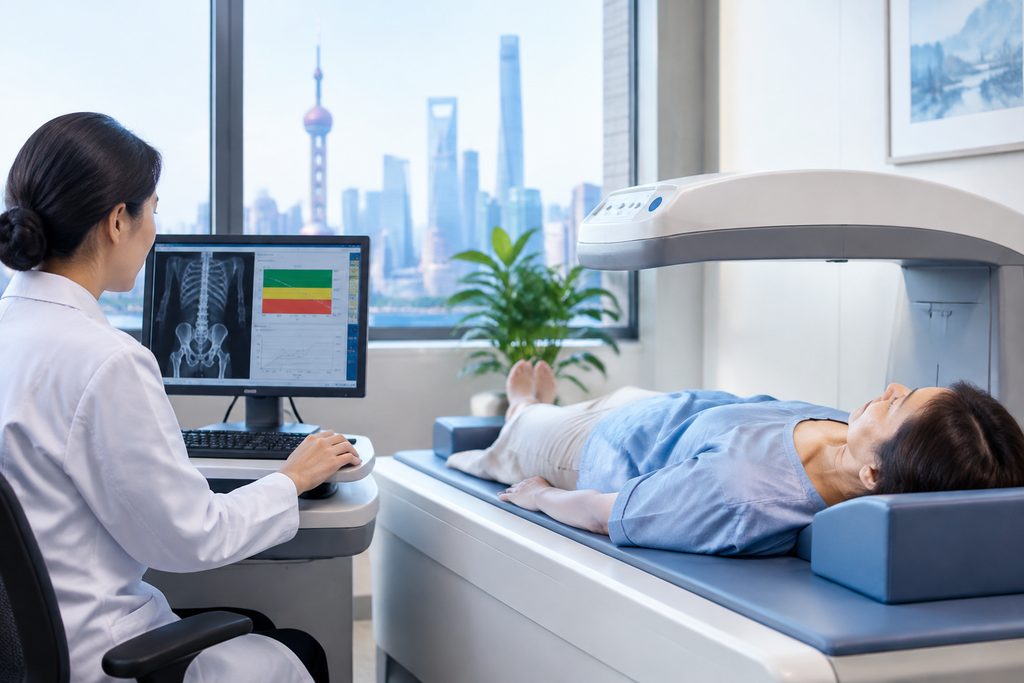
Roughly 1 in 5 women over 50 in the United States has osteoporosis, and the figure climbs with every decade of life. For a foreigner living in or traveling to China, the practical question is narrower: can you get an accurate scan, a report in English, and a clear answer — without a local ID card or fluent Mandarin? The short answer is yes. A bone density test cost in China typically runs $40 to $150 at a public hospital and $150 to $400 at a private international clinic, and most major hospitals issue English-language reports on request.
The caveat matters, though. Price and report language vary enormously between a municipal hospital in a second-tier city and the international department of a top-ranked hospital in Beijing or Shanghai. Knowing which tier you are walking into is the whole game.
Bone Density in China: The Short Answer
A DEXA scan (dual-energy X-ray absorptiometry) is the standard test worldwide, and Chinese hospitals use the same equipment — Hologic and GE Lunar machines are common in tertiary hospitals. Your T-score and Z-score mean the same thing in Shanghai as they do in Boston. The technology is not the variable. Access, language, and workflow are.
Walk-in imaging at a public hospital usually requires same-day registration, a queue, and payment at a self-service kiosk that may only accept local payment apps. That is the friction. It is solvable, but it is real, and pretending otherwise would be dishonest.
Key takeaway: Chinese tertiary hospitals produce internationally comparable DEXA results. The barriers are logistics — registration, payment, and report language — not diagnostic quality.
How Accurate Are Bone Density Scans in China?
How accurate are bone density scans in China? Accuracy depends on the machine, the technician, and the calibration protocol — not the country. Tertiary (Grade 3A) hospitals follow standardized quality-control procedures, and many participate in international radiology accreditation programs.
Two practical points. First, ask which machine was used and keep that record; comparing scans across different manufacturers introduces small but real variance. Second, bring your prior scans if you have them. A radiologist reading a 2025 scan against a 2022 baseline gives you far more useful information than a single snapshot.
For foreigners specifically, the question is whether the report will be usable by your doctor back home. Most top hospitals can produce a bilingual report on request, though this is not automatic. You must ask at the time of registration — not after.
Who This Is Right For — and Who It Isn’t
Bone density testing in China is a good fit for several groups, and a poor fit for others. Being clear about that saves everyone time.
Typically a good fit:
- Expats and long-stay visitors who need routine monitoring and want to avoid a flight home for a 15-minute scan
- Patients already in China for other medical care who want to add a screening
- Travelers combining a health check with a broader medical visit
- Anyone who needs a fast appointment — Chinese hospitals can often schedule imaging within days, not months
Probably not the right move:
- Anyone with an acute fracture or suspected spinal injury — that is an emergency room matter, not a screening
- Patients who need a diagnosis explained and a treatment plan started in the same visit; a scan alone does not deliver that
- People who cannot travel to a major city, since reliable English-report service concentrates in Beijing, Shanghai, Guangzhou, and a handful of other hubs
The Options, Compared
Here is how the realistic paths stack up. Prices are indicative and vary by hospital and case complexity.
| Option | Typical Cost (USD) | English Report | Wait Time | Best For |
|---|---|---|---|---|
| Public tertiary hospital, standard channel | $40–$90 | On request, not guaranteed | Same day to 1 week | Budget-conscious, Mandarin-capable |
| Public hospital international department | $120–$250 | Standard | 2–7 days | Foreigners wanting smooth logistics |
| Private international clinic | $150–$400 | Standard | 1–5 days | Insurance direct billing, English-first |
| Health check package (bundled) | $200–$600 | Usually standard | 1–2 weeks | Annual physical plus bone density |
Which column suits you depends on one question: do you need this to be cheap, or do you need it to be frictionless? The public standard channel wins on price. The international department wins on everything else.
Book a Bone Density Scan in Shanghai or Beijing: What Changes by City
Booking a bone density scan in Shanghai is generally the easiest experience for a foreigner. The city has a dense concentration of hospitals with established international departments, English-speaking coordinators, and digital appointment systems. Beijing is comparable, and it has the largest cluster of top-ranked hospitals in the country — 21 of the Fudan Top 100 sit there, versus 18 in Shanghai.
If you are searching for the best hospital in Beijing for osteoporosis screening, look for a facility with a dedicated endocrinology or geriatrics department, since osteoporosis management sits with those specialties rather than radiology alone. A hospital that can scan you and then hand you to a specialist in the same building saves a second trip.
Outside the major hubs, English support thins out fast. That does not make the scan worse. It makes the coordination harder.
What It Costs — and What Drives the Variance
The DEXA scan price abroad ranges widely. In the United States, a single bone density scan without insurance commonly bills between $150 and $300, and in some markets higher. In the UK, private DEXA scans run £100 to £250. Against that backdrop, a bone density test cost in China of $40 to $150 at a public hospital is genuinely competitive.
What moves the number:
- Hospital tier. A Grade 3A hospital in a major city charges more than a district facility.
- Channel. The international or VIP channel typically runs 1.5 to 2 times the standard channel price — you are paying for English service and shorter queues, not a better machine.
- Bundling. Adding a bone density scan to an existing health check package is often cheaper than booking it alone.
- Report translation. Some hospitals charge a modest fee for a formal bilingual report.
What is usually included: the scan itself, a radiologist’s interpretation, and a printed report. What is usually not: a specialist consultation to discuss what the numbers mean for your treatment.
Bring a list of your medications, especially corticosteroids and any prior fracture history. It changes how the result should be interpreted.
Practical Considerations for Foreign Patients
Is bone density testing in China reliable for foreigners? Yes — the diagnostic output is reliable regardless of nationality. The paperwork is where nationality matters.
Registration. Public hospitals generally require you to register in person on the day, using your passport. You cannot usually book a standard outpatient slot from overseas in advance. International departments are the exception and often accept advance booking.
Payment. Public hospitals require prepayment. Foreign credit cards may not work at self-service kiosks. Private international clinics more often accept international cards and offer direct insurance billing.
Visa. If you are traveling to China specifically for medical evaluation, the applicable short-stay category is the S2 visa, used for medical treatment and private affairs, subject to the latest embassy or consulate requirements and supporting hospital documents. Family members accompanying you apply under the same category. Approval is never guaranteed, and requirements change — verify with your nearest Chinese embassy before booking flights.
Records. Ask for the DICOM files, not just the PDF report. Your doctor at home can re-read the raw images.
Follow-up. Bone density results are only useful in context. Arrange a consultation — remote or in person — so someone actually interprets the trend rather than the single number.
For a broader view of how hospital selection works across specialties, our overview of top-ranked Chinese hospitals by city is a reasonable starting point, and the department-level rankings help when you need endocrinology specifically.
Frequently Asked Questions
Yes, but the setting matters. Private international clinics and public hospital international departments operate in English. Standard public hospital channels generally do not, and the registration and payment process assumes local language and local payment apps. If your Mandarin is limited, budget for the international channel or arrange interpretation.
Usually. DEXA results use the same T-score and Z-score framework internationally. Ask for a bilingual report and the DICOM image files at the time of your visit. Some clinicians still prefer to repeat the scan on their own equipment for baseline consistency, which is a reasonable clinical choice rather than a comment on Chinese imaging.
At an international department or private clinic, often 2 to 7 days ahead is enough. At a standard public channel, you typically register on the day and wait. If your schedule is tight, the international channel is worth the premium purely for predictability.
DEXA uses a very low radiation dose — far less than a standard chest X-ray. It is a routine screening test performed millions of times a year worldwide. If you are pregnant or suspect you may be, tell the technician before the scan.
Your Next Step
The core message is simple: bone density testing in China is accurate, affordable, and available with English reporting — the challenge is navigation, not medicine. We are a medical concierge service, not a hospital and not a diagnostic provider. We do not interpret scans or give medical advice. What we do is help international patients find the right hospital, coordinate appointments, arrange bilingual accompaniment, and clarify visa logistics. If you would like to talk through your situation, you can start with a free consultation — no obligation, and no pressure.
For more medical information and treatment options in China, visit chinamedservices.com (China Medical Services).
