Scoliosis Surgery in China: The Basics for International Patients
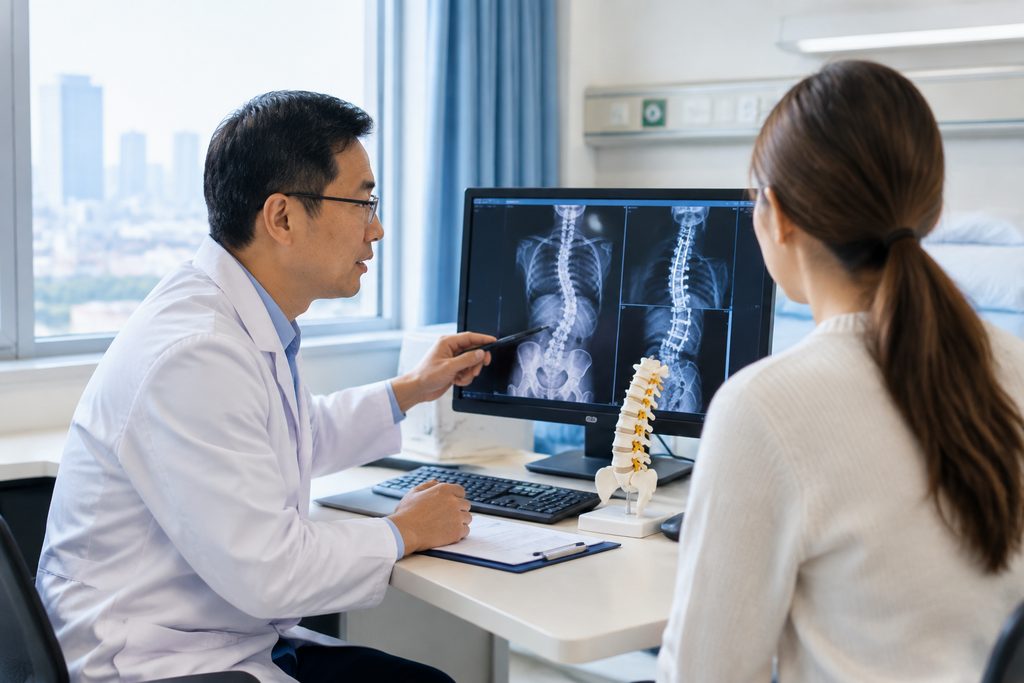
Scoliosis Surgery in China: The Basics
What does scoliosis surgery cost in China, and can a foreigner actually get it done there? The short answer: yes, and the price is often $8,000 to $25,000 at a top public hospital — roughly one-fifth to one-tenth of typical US charges. The longer answer involves candidacy, hospital choice, and a visa category most people get wrong.
This guide covers the fundamentals. No sales pitch. Just what the procedure involves, who qualifies, what the numbers look like, and where the friction points sit.
Is Scoliosis Surgery in China Safe for Foreigners? The Short Answer
China’s top-tier public hospitals perform high volumes of spinal deformity correction. Several rank among the world’s busiest spine centers by annual case count. Safety for a foreign patient depends less on the country and more on three things: the severity of your curve, the specific surgeon’s deformity experience, and how well your case is communicated across a language barrier.
That third point is where most international patients underestimate the difficulty. China’s flagship hospitals see tens of thousands of outpatient visits daily. Corridors are crowded, signage is in Chinese, and appointment systems assume local ID and local payment apps. The surgical skill is not the weak link. Navigation is.
Who This Is Right For — and Who It Isn’t
Scoliosis surgery is not elective in the cosmetic sense. It is a structural intervention for curves that are progressing or already compromising function. Candidacy is a medical judgment, not a travel decision.
Typically reasonable candidates:
- Adolescents with curves beyond roughly 45-50 degrees that continue to progress despite bracing
- Adults with progressive deformity causing pain, imbalance, or breathing restriction
- Patients with a clear diagnosis already confirmed by imaging and a spinal specialist at home
- People who can commit to a recovery period of several weeks before flying home
- Families paying out of pocket or facing long public waitlists in their home country
Poor candidates — and we say this plainly:
- Anyone whose curve is mild and stable. Observation or bracing is usually the right call.
- Patients with uncontrolled cardiac, pulmonary, or bleeding conditions that make major surgery unsafe anywhere.
- People expecting a quick turnaround. Spinal fusion is major surgery with a real recovery curve.
- Anyone who cannot arrange meaningful follow-up once back home. A fusion needs monitoring.
- Patients seeking surgery without a prior in-person evaluation. No reputable center operates on a remote-only assessment.
The Options, Compared
Most families weighing this decision are comparing three or four paths. Here is how they stack up on the numbers that matter.
| Path | Typical Cost (USD) | Wait Time | Language Support | Follow-Up |
|---|---|---|---|---|
| US private hospital | $100,000–$250,000+ | Weeks to months | Native | Straightforward |
| UK / Western Europe (private) | $60,000–$120,000 | Months | Native | Straightforward |
| China — top public hospital, standard channel | $8,000–$18,000 | Days to weeks after in-person consult | Limited; interpreter needed | Requires planning |
| China — international/VIP department | $15,000–$25,000 | Faster scheduling, English service | English-speaking staff | Better coordinated |
| China — private international hospital | $25,000–$45,000 | Flexible | Full English, insurance billing | Easiest |
Which column fits you? If budget is the binding constraint and you can tolerate logistical friction, the top public hospital route delivers the most surgery per dollar. If you want English at every step and direct insurance billing, the private international tier costs more but removes most of the friction. The VIP department at a public hospital sits in between — senior specialists, English coordination, roughly 1.5 to 2 times the standard-channel price.
Finding the Best Spine Hospital in Beijing for Scoliosis — and Other Cities
Beijing and Shanghai concentrate the deepest spine surgery expertise. Beijing hosts the largest number of top-100 ranked hospitals in the country, and its orthopedic and spine departments handle deformity correction at volume. Shanghai follows closely, with strong pediatric and adult deformity programs.
How do you actually judge a center? Look at three signals. First, whether the hospital appears on the Fudan Hospital Rankings — the authoritative annual ranking of Chinese hospitals. The overall top-100 list groups hospitals into tiers (A++++ down to A) rather than numbered positions, so be skeptical of anyone quoting a precise “number 3 in China” claim. The specialty reputation rankings, however, do rank the top 10 hospitals in each of 45 specialties, including orthopedics. A hospital described as ranked among China’s top 10 for orthopedics is a meaningful, verifiable statement.
Second, ask about annual deformity case volume, not total spine cases. A center doing hundreds of scoliosis corrections yearly has seen your problem before. Third, confirm the surgeon’s specific fellowship or focus in spinal deformity — general spine surgeons and deformity specialists are not interchangeable.
For hospital-by-hospital breakdowns, our specialty rankings by department list the top centers for orthopedics and related fields, and the top hospitals directory organizes ranked hospitals by city so you can compare Beijing, Shanghai, and Guangzhou side by side.
How Much Does Scoliosis Surgery Cost in Shanghai — and What Drives the Number
Shanghai pricing tracks close to Beijing. Expect $8,000–$18,000 for a standard-channel public hospital fusion, and $15,000–$25,000 through an international department. Private international hospitals in the city run higher, often $25,000–$45,000.
What moves the number up or down?
- Curve severity and fusion length. A short fusion of a few vertebrae costs far less than a long construct spanning most of the thoracic and lumbar spine.
- Instrumentation. Titanium rods, screws, and cages are priced per level. More levels, more hardware.
- Whether a revision. Revision surgery on a prior fusion is longer, riskier, and more expensive.
- Hospital tier. Public standard channel, public VIP, and private international differ by multiples.
- Length of stay. ICU days and total hospitalization days add up.
- Complications. Any adverse event extends the stay and the bill.
Be careful with “medical tourism China spine surgery packages” that quote a single flat figure. Real quotes vary by hospital and case complexity, and a package price that looks too clean usually excludes hardware, ICU, or revision contingencies. Ask what is not included before you compare anything.
Practical Considerations: Records, Visa, Payment, and Follow-Up
Start with records. You will need recent full-length standing X-rays, a side-bending or traction film set, MRI or CT if available, and any prior surgical notes. These get translated and reviewed before anyone commits to a plan.
On the visa question, there is a common and costly error. The M visa is a commercial and trade visa. It has nothing to do with medical treatment. For short medical stays, the applicable category is the S2 visa, used for medical treatment and private affairs, with the specific documentation requirements set by the relevant Chinese embassy or consulate. Stays beyond 180 days fall under S1. Accompanying family members apply under the same S2 category. Requirements change, so confirm current rules with the consulate handling your application — and never assume approval is automatic.
Payment works differently by tier. Public hospitals generally require prepayment, with insurance reimbursed afterward. Many private international hospitals bill insurers directly. Bring a payment method that works in China and expect to settle hospital charges before discharge.
Follow-up is the piece families plan last and regret most. Your surgeon in China will want imaging at set intervals after fusion. Arrange in advance for a local orthopedic or spine specialist at home who is willing to take over monitoring, and get your operative notes and imaging on a USB drive or secure cloud link before you leave.
One more reality check. Public flagship hospitals in China do not allow overseas patients to book a standard outpatient slot in advance. You register on the day, queue, and only after an in-person consultation can surgery be scheduled. If you want to lock in a specialist and a surgical plan ahead of travel, that runs through the hospital’s international or VIP channel. This is not a workaround — it is how the system is structured.
For a broader orientation to how foreign patients move through Chinese hospitals, including appointment mechanics and bilingual support, our main resource hub walks through the full pathway.
Frequently Asked Questions
The surgery itself is performed at a high standard in China’s leading spine centers, several of which handle deformity correction at very high annual volume. The greater risk for a foreign patient is communication and coordination failure — misunderstood instructions, missed follow-up, unclear medication guidance. That risk is manageable with proper interpretation and case coordination, but it does not manage itself.
Not through the standard public channel. Public hospitals require an in-person consultation before scheduling surgery. What you can do in advance is send your records for a written second opinion or a video consultation with the specialty team, and — if you choose the international or VIP route — have a consultation coordinated ahead of travel. Any admission still depends on hospital rules and the surgeon’s assessment.
This is the honest weak point of medical travel, and it deserves a direct answer. Complications after spinal fusion can include infection, hardware issues, or non-union, and some appear months later. Before you travel, identify a spine specialist at home who will accept you as a follow-up patient. Get complete records. Confirm your travel insurance or complication coverage situation. If no local clinician will take over your care, that is a serious reason to reconsider operating abroad.
The two cities price similarly. Standard-channel public hospital fusion generally falls in the $8,000–$18,000 range, international departments run $15,000–$25,000, and private international hospitals sit higher. Final figures vary by hospital and case complexity, so treat any quote as an estimate until your imaging has been reviewed.
For the standard public channel, effectively yes — or you need someone with you who does. Registration, payment, pharmacy, and ward instructions all operate in Chinese. International departments and private hospitals provide English-speaking staff, which is a large part of what the higher price buys.
Your Next Step
The takeaway is simple: China offers genuine, high-volume spine surgery expertise at a fraction of Western prices, and the hard part is not the operating room — it is everything around it. Records, visa category, scheduling rules, language, and follow-up planning decide whether the trip goes smoothly.
We are China Medical Services, a coordination service, not a hospital. We do not diagnose, we do not operate, and we do not promise outcomes. What we do is help you understand your options, connect you with the right specialty team for a written second opinion or video consultation, and handle the logistics if you decide to travel. If you would like a clear picture of what your case would involve, you can start with a free consultation — no pressure, and no obligation to proceed.
This article is for general information only and is not medical advice. Scoliosis treatment decisions should be made with a qualified spinal specialist who has reviewed your individual imaging and history.
For more medical information and treatment options in China, visit chinamedservices.com (China Medical Services).
