Vascular Malformation Care in China: A Guide for International Patients
Key Takeaways
- Vascular malformations are a group of congenital vessel anomalies — not tumors — and they are frequently misdiagnosed, which is why imaging review by a specialized center matters more than speed of travel.
- China’s top-tier public hospitals treat very high volumes of complex vascular cases, and surgical fees at those institutions typically run a fraction of US list prices.
- The hard part is not the surgery. It is the process: public hospital outpatient registration cannot be booked from abroad, so an in-person visit is required before any procedure is scheduled. International departments and VIP channels are the workaround.
- Never book flights before a written second opinion or video consultation confirms that travel is even the right next step.
Vascular malformation care in China is a realistic option for international patients — but only if you understand what the term actually means and how the Chinese hospital system works. A vascular malformation is a tangle or enlargement of blood vessels that a person is born with. It is not cancer. It does not spread. It grows slowly, if at all, and it can sit quietly for decades before causing pain, swelling, bleeding, or a visible mass. The umbrella covers several distinct conditions: arteriovenous malformations (AVMs), venous malformations, lymphatic malformations, and mixed lesions.
That distinction matters enormously. A venous malformation in a child’s cheek and an AVM in an adult’s brain are different diseases with different specialists, different imaging, and different treatment goals. Getting the label right is the first clinical decision. Everything else — hospital, surgeon, cost, visa — follows from it.
The Problem: Rare Disease, Long Diagnostic Odds
Vascular anomalies affect roughly 1 in 10,000 births, according to estimates published in the International Society for the Study of Vascular Anomalies (ISSVA) classification literature. Rare enough that most general practitioners see a handful in a career. Rare enough that the average patient consults three to five physicians before receiving an accurate diagnosis.
In the United States and Western Europe, that diagnostic delay is frustrating but usually survivable. The real bottleneck comes after diagnosis. Specialized vascular anomaly centers are concentrated in a small number of academic hospitals. A patient in Denver, Dublin, or Dubai may wait months for an initial appointment and longer for multidisciplinary review. For a lesion compressing a nerve or threatening vision, months are not neutral time.
Cost compounds the problem. Complex embolization or resection procedures in the US routinely exceed $50,000, and staged treatments — which many vascular malformations require — multiply that figure. Insurance may cover part of it. It rarely covers all of it. And for patients outside the US, the arithmetic looks worse: no domestic specialist, no domestic coverage, and a long flight to somewhere that has both.
Why China Delivers Results for Complex Vascular Cases
China’s top hospitals are not a budget substitute for Western care. They are high-volume academic centers that treat a patient population large enough to build genuine subspecialty depth. Here is what that means in practice.
Volume Creates Subspecialists, Not Generalists
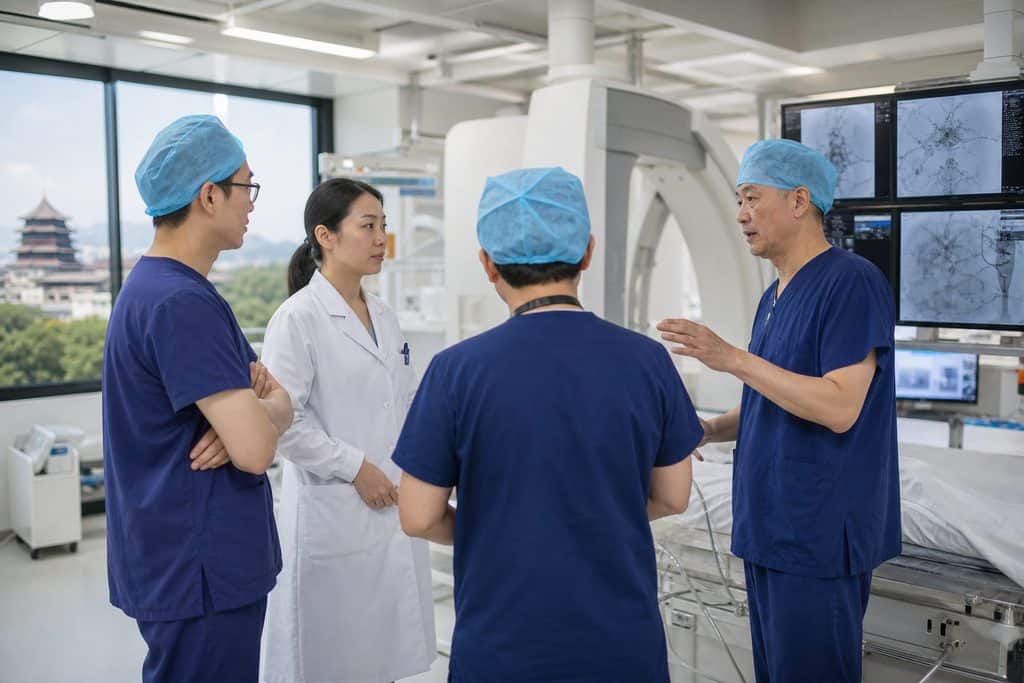
A hospital that performs thousands of vascular interventions a year does not assign them to whoever is on call. It builds teams. Interventional radiology, vascular surgery, plastic surgery, and dermatology work the same cases together, week after week. That repetition is what produces judgment — knowing when to embolize, when to observe, and when to operate.
Our hospital network spans 340+ top-ranked hospitals across 37 cities, drawn from the top 5% of China’s 35,000+ hospitals by Fudan University rankings and JCI accreditation. The Fudan specialist reputation rankings list the top 10 hospitals in 45 individual specialties, so you can see which institutions are recognized for a given field rather than trusting a general reputation score. You can browse the specialty breakdowns on our departments page.
Imaging and Intervention Capacity at Scale
Vascular malformation management is imaging-dependent. Diagnosis rests on MRI, contrast-enhanced MRA, Doppler ultrasound, and often catheter angiography. Treatment frequently means sclerotherapy, embolization, or staged resection — all of which require interventional suites, experienced anesthesia teams, and post-procedure monitoring beds.
Large Chinese tertiary hospitals run these resources continuously. A single day’s caseload at a major center can exceed what a regional Western hospital handles in a month. That is not automatically better care. But it does mean the team has seen your variant before, and probably several times this year.
Cost Structure Without a Quality Trade-Off
Lower prices in Chinese public hospitals come from structural economics, not from cutting corners. Physician salaries, facility overhead, and device procurement costs are all lower than in the US. Hospitals also operate at volumes that spread fixed costs across far more patients.
| Procedure / Service | Typical Range in China (Top Public Hospital) | Typical Range in the US |
|---|---|---|
| Sclerotherapy session (venous/lymphatic malformation) | $1,500 – $4,000 | $8,000 – $25,000 |
| Endovascular embolization (AVM) | $8,000 – $20,000 | $40,000 – $120,000 |
| Surgical resection (complex, soft tissue) | $10,000 – $25,000 | $50,000 – $150,000+ |
| Diagnostic MRI / MRA | $300 – $800 | $2,000 – $6,000 |
| International department consultation | $150 – $500 | $400 – $1,200 |
These are ranges, not quotes. Final pricing varies by hospital and case complexity, and multi-stage treatment plans change the total substantially. Treat the table as a planning tool, not a bill.
What the Evaluation Process Actually Looks Like, Step by Step
This is the part most guides skip, and it is the part that determines whether your trip is worthwhile.
Step 1 — Gather your records. You need your most recent MRI or MRA on DICOM files (not just the radiology report), any prior angiography, operative notes, pathology if a biopsy was done, and a current medication list. DICOM files matter. A Chinese specialist reviewing a written report alone is working half-blind.
Step 2 — Written second opinion. A relevant Chinese specialty reviews your existing reports and returns written analysis, treatment suggestions, and direction. This typically takes several business days and costs $300–500 at a top hospital. It answers one question: is there a plausible treatment path here, and is it worth traveling for?
Step 3 — Video consultation. If the written opinion suggests a path forward, a video consultation ($100–300 at a standard international department, $500–800 with a top specialist) lets you speak directly with the clinical team, describe symptoms and goals, and hear their recommendations. For genuinely complex lesions, a multidisciplinary team consultation ($1,500–2,000) brings several specialties into one session.
Step 4 — Appointment coordination and travel. Once a plan is clear, registration, hospital card creation, and scheduling are handled through the hospital’s international or VIP channel. This is where the S2 visa comes in.
Step 5 — In-person consultation, then treatment. Chinese public hospitals require an in-person outpatient visit before scheduling any procedure. There is no way around this. Plan for it.
Choosing a Hospital Without Getting It Wrong
The most common mistake international patients make is choosing a hospital by city preference or by a general reputation ranking. Vascular malformations sit at the intersection of several specialties, and the right department depends on your specific lesion type.
Start with the specialty, not the city. Venous and lymphatic malformations are often managed by interventional radiology or vascular surgery. Craniofacial lesions may involve plastic surgery. Intracranial AVMs belong to neurosurgery or neurointervention. Ask which department would own your case before you ask which hospital is “best.”
A second common error: assuming a private international hospital is automatically the right choice. Private international hospitals in China — United Family, Jiahui, Parkway, Raffles among them — offer English-speaking staff, JCI accreditation, direct insurance billing, and Western-style service. They are excellent for diagnostics, second opinions, and straightforward procedures. For rare, high-complexity vascular intervention, the deepest subspecialty expertise usually sits in the large public tertiary hospitals, accessed through their international departments.
Who is this not suitable for? Patients with an acutely unstable lesion, active hemorrhage, or a condition requiring emergency intervention should seek care at the nearest qualified facility immediately. Medical travel is a planned pathway. It is not an emergency pathway.
Practical Considerations: Visas, Payment, and Follow-Up
Visa. International patients traveling to China for medical treatment use the S2 visa, which covers short-stay private affairs including medical treatment. Stays exceeding 180 days require the S1 category. Accompanying family members apply under S2 as well. Requirements and supporting documents are set by the relevant Chinese embassy or consulate and change periodically — confirm current rules with your local mission and allow several weeks for processing. Note that the M visa is for commercial and trade activity and has nothing to do with medical treatment.
Payment. Chinese public hospitals require prepayment for scheduled procedures. International insurance is generally reimbursed after the fact rather than billed directly, though some private international hospitals do offer direct billing arrangements with selected insurers. Confirm your coverage in writing before you travel.
Language. A major Chinese tertiary hospital may see 10,000+ outpatients in a single day. Signage, registration systems, and pharmacy counters operate in Chinese. Outside international departments, English support is limited. Bilingual medical companions handle registration, queuing, payment, wayfinding, and interpretation — from $300 per day for a half or full day.
Follow-up. Ask your Chinese treatment team for a written discharge summary and imaging in a format your home physician can open. Arrange a follow-up imaging schedule before you leave. Vascular malformations often need surveillance over years, and continuity matters.
Frequently Asked Questions
No. Public hospitals in China require an in-person outpatient consultation before any procedure is scheduled. What you can do from abroad is obtain a written second opinion or video consultation to confirm whether traveling makes sense. Skipping that step risks arriving to find that treatment is not indicated.
It depends heavily on lesion type and staging. A single sclerotherapy session may run $1,500–4,000, while complex embolization or resection can reach $10,000–25,000. Prices vary by hospital and case complexity, and multi-stage plans cost more. Request a written estimate after your records are reviewed — not before.
This is the right question to ask, and no responsible provider will promise a specific outcome. Before committing, ask your treating hospital about its complication management protocols, ICU availability, and what follow-up care is included. Also confirm what your travel insurance and any medical evacuation coverage will handle. A good plan includes a plan for things going wrong.
Your Next Step
Vascular malformation care in China offers real depth, real volume, and real cost advantages — but the value depends on matching your specific lesion to the right specialty, and confirming that travel is warranted before you book anything. Start with your imaging, not your flight schedule.
We are China Medical Services, a coordination service — not a hospital, and we do not provide diagnoses or medical advice. Our team helps international patients obtain written second opinions, arrange video consultations, coordinate hospital appointments through official international channels, and navigate the S2 visa and arrival logistics. You can browse our ranked hospital directory or start with a free, no-obligation conversation about your case through our consultation page.
This article is for general information only and does not constitute medical advice. Always consult a qualified physician about your individual condition before making treatment decisions.
For more medical information and treatment options in China, visit chinamedservices.com (China Medical Services).
