Cold vs Sedated Gastroscopy in China: Cost, Safety, and How to Book
Key Takeaways
- A gastroscopy in China typically runs $150–$600 depending on hospital tier and sedation — often a fraction of US pricing, where the same procedure can exceed $2,500.
- Sedated gastroscopy adds roughly $80–$200 to the base fee but dramatically improves comfort and completion rates; it is standard at international departments.
- Public hospitals do not let overseas patients pre-book a general clinic slot — you must register in person on the day, which is why international or VIP channels exist.
- No procedure is risk-free. Sedation carries its own considerations, and you should discuss your full medical history with a qualified physician before deciding.
You have probably heard that getting a gastroscopy in China means long queues, language barriers, and uncertainty about quality. The reality is more nuanced — and often far better than expected. For international patients weighing a cold vs sedated gastroscopy in China, the real questions are simpler: what does it cost, is it safe, how long does it take, and how do I actually book it?
This guide answers those questions directly. We are not doctors, and nothing here replaces individualized medical advice. What we can do is explain how the system works, what the numbers look like, and where the friction points are — so you can make an informed decision with your own physician.
The Problem: Why So Many Patients Delay This Test
Top Chinese hospitals use the same Olympus and Fujifilm endoscopy platforms found in US academic centers. High-definition scopes, narrow-band imaging, and chromoendoscopy are standard at major gastroenterology departments. The difference is workflow. A hospital like Zhongshan Hospital Fudan University may run multiple endoscopy suites simultaneously, with results and pathology turnaround measured in days rather than weeks.
Here is the objection we hear most: “If it’s cheaper, something must be missing.” That logic does not hold for endoscopy. The cost gap comes from structural factors — lower labor costs, high patient throughput, and no insurance-negotiated facility fees layered on top. The scope, the sedative, and the physician’s training are comparable. What differs is the billing model.
| Procedure Type | Typical Cost in China (USD) | Typical Cost in US (USD) | Notes |
|---|---|---|---|
| Cold (unsedated) gastroscopy | $150–$350 | $1,200–$2,000 | Patient fully awake; faster recovery |
| Sedated gastroscopy | $250–$600 | $2,000–$3,500 | Includes anesthesia and monitoring |
| Gastroscopy + colonoscopy | $500–$1,000 | $3,500–$6,000 | Combined session, one sedation |
| Biopsy + pathology | $50–$150 | $300–$800 | Per specimen; varies by lab |
Prices vary by hospital and case complexity. Private international hospitals sit at the higher end; top public hospitals at the lower end. For a full breakdown of what different hospital tiers charge, our guide to China’s top-ranked hospitals is a useful starting point.
Cold vs Sedated Gastroscopy: What Actually Happens
The core decision is whether to undergo the procedure awake or with sedation. Each has real trade-offs.
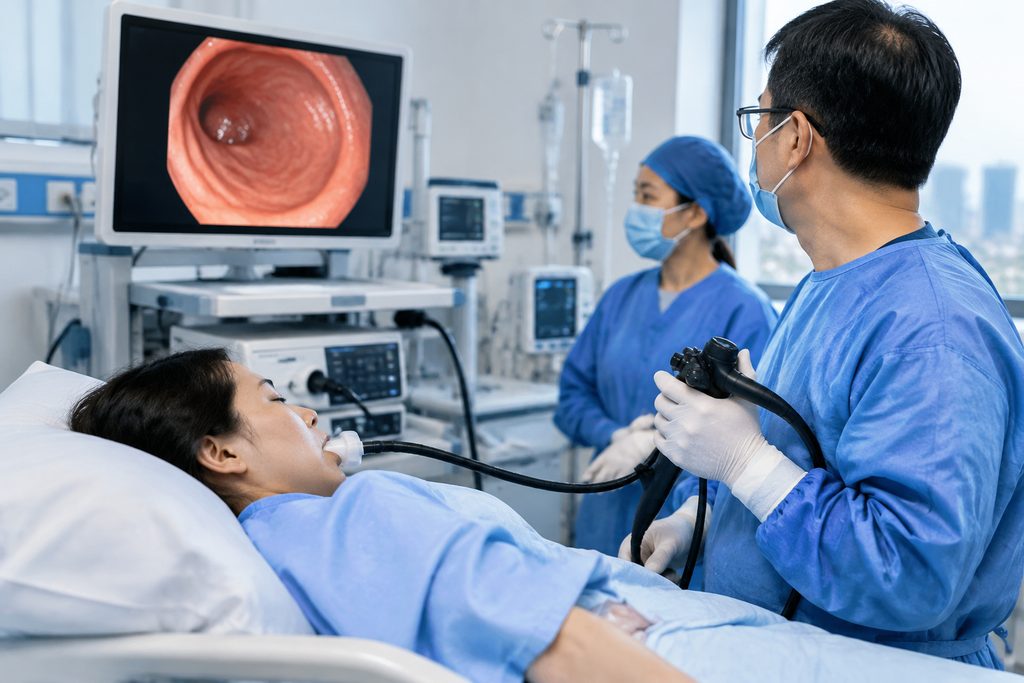
Cold gastroscopy means a topical anesthetic is sprayed on your throat, and the endoscope passes while you are fully conscious. It takes 5–10 minutes. You can drive yourself home. The downside is gagging, retching, and discomfort — and some patients tense up so much the doctor struggles to get clear images.
Sedated gastroscopy uses intravenous midazolam or propofol, often administered by an anesthesiologist. You drift into a light sleep and typically remember nothing. The procedure itself still takes 5–15 minutes, but total room time — including preparation and recovery — runs 45–90 minutes. You cannot drive afterward and need someone to accompany you.
How Long Does a Sedated Gastroscopy Take — and What the Day Looks Like
Patients often ask how long a sedated gastroscopy takes. The honest answer: the scope itself is quick, but the appointment is not. Here is a realistic timeline at a major Chinese hospital.
- Arrival and registration: 30–60 minutes at a public hospital; 15–30 minutes at an international department
- Pre-procedure assessment: 15–30 minutes, including vitals and anesthesia review
- Procedure room: 15–20 minutes total
- Recovery and observation: 30–60 minutes until sedation wears off
- Results discussion: Same day for visual findings; biopsy results in 3–7 days
Plan for half a day. If you are booking through an international department, the schedule is tighter and English-speaking staff guide you through each step.
Is Gastroscopy Safe in China? Evaluating Providers
Is gastroscopy safe in China? For diagnostic upper endoscopy, complication rates at accredited hospitals are low — perforation occurs in roughly 1 in 10,000 to 1 in 20,000 procedures, and significant bleeding is similarly rare. These figures are consistent with international benchmarks.
Safety depends less on the country and more on the specific facility. When evaluating a provider, look for:
- JCI accreditation — a global standard for patient safety and quality
- Dedicated anesthesia team — not a nurse-monitored sedation protocol
- Pathology turnaround time — a hospital that reports biopsy results in 3 days is running a tight lab
- English-language documentation — critical for follow-up with your home physician
Private international hospitals such as United Family, Jiahui, and Parkway meet these criteria and offer direct insurance billing. Top public hospitals offer equivalent clinical quality at lower cost but with less English support. Our overview of private international hospitals in China covers the differences in detail.
How to Book a Gastroscopy in China as a Foreign Patient
This is where most international patients hit a wall. Public hospitals in China generally do not allow overseas patients to pre-book a general gastroenterology clinic slot. You register in person on the day, take a queue number, and wait. Surgery or sedated procedures require an in-person consultation first.
There are two workable paths:
International or VIP department. These channels allow advance scheduling, provide English-speaking staff, and bundle the consultation, procedure, and follow-up. Expect to pay roughly 1.5–2 times the standard public rate — still far below US pricing.
Private international hospital. The simplest route for a straightforward diagnostic gastroscopy. You book online, arrive, and the entire visit is conducted in English. Costs sit at the upper end of the range but include coordination and documentation.
For patients who want a top public hospital specialist but need help navigating registration, medical card creation, and interpretation, a proxy or companion service bridges the gap. That is the model we work with — not buying access, but handling the logistics so the clinical team can focus on your care.
Practical Considerations: Visas, Payment, and Follow-Up
For a short diagnostic trip, most international patients use an S2 visa, which covers short-stay medical treatment and private affairs. Accompanying family members apply under the same category. Requirements shift, so confirm current rules with your nearest Chinese embassy or consulate and bring supporting documents from the hospital.
The M visa is for commercial and trade activities — it is not a medical visa and should not be used for treatment purposes.
Payment at public hospitals is upfront; you pay out of pocket and seek reimbursement from your insurer afterward. Private international hospitals often bill insurance directly. Bring a credit card that works internationally, and confirm whether the hospital accepts your card network before arrival.
After the procedure, ask for a written report in English, including images and pathology results. This document matters for continuity of care when you return home. If you are considering a broader health check while in China, our medical travel resource hub outlines how to combine diagnostics efficiently.
Frequently Asked Questions
Can I choose sedation, or does the hospital decide?
In most international departments and private hospitals, you choose. The anesthesiologist will review your history and confirm suitability. At busy public clinics, sedation availability may depend on staffing that day, so confirm when you book.
What if the biopsy shows something serious?
Pathology results typically return within 3–7 days. If findings require follow-up, the hospital will schedule a consultation. For complex cases, a multidisciplinary review at a top-tier center gives you a clearer picture before deciding on next steps. This is a conversation to have with a qualified physician, not something to resolve alone.
Do I need a companion or translator?
At private international hospitals, no — English is standard. At top public hospitals, yes. Registration, payment, and pharmacy steps are almost entirely in Mandarin, and the physical layout of a hospital seeing 10,000+ outpatients daily is difficult to navigate without help.
How far in advance should I book?
Private hospitals can often accommodate within 1–2 weeks. International departments at public hospitals vary; some offer slots within days, others need 2–4 weeks. Build in buffer time for visa processing if you are traveling specifically for the procedure.
Your Next Step
The gap between cold and sedated gastroscopy is smaller than most patients expect — a few hundred dollars, a slightly longer appointment, and a much more comfortable experience. What matters more is choosing a facility with the right accreditation, anesthesia support, and English-language documentation for your home doctor.
We are China Medical Services, a patient coordination team — not a hospital, and we do not provide diagnoses or medical advice. If you would like help understanding your options, matching with an appropriate hospital, or planning the logistics, you can start with a free consultation. No pressure, no obligation — just a clearer path forward.
For more medical information and treatment options in China, visit chinamedservices.com (China Medical Services).
