Pituitary MRI in China: Cost, Prep, and Booking Guide
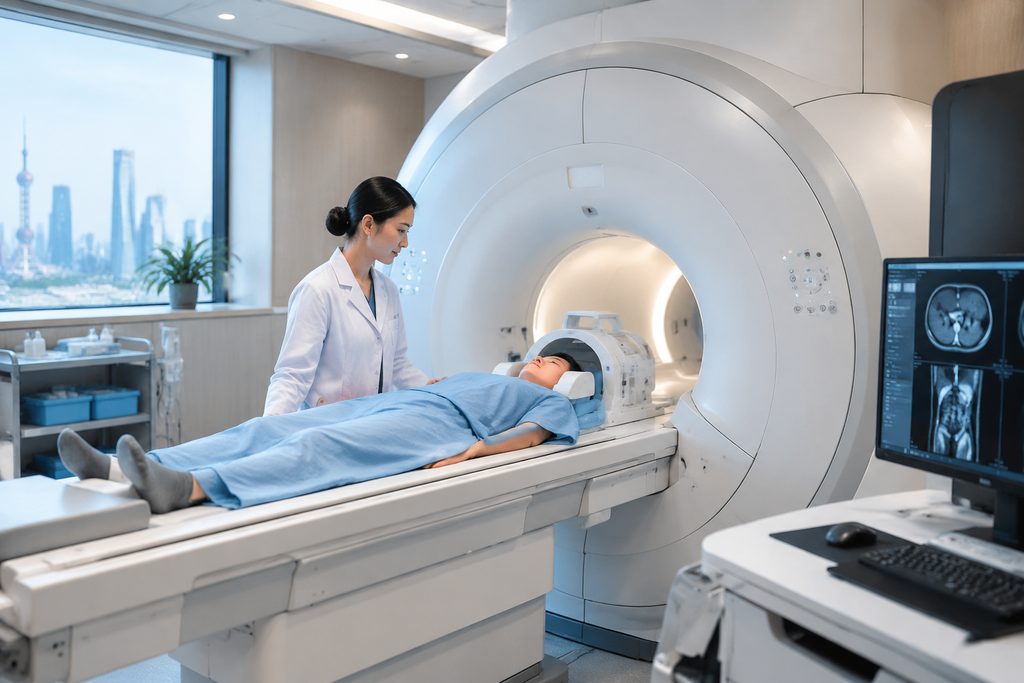
You have probably heard that getting advanced imaging abroad means gambling on quality. Here is the uncomfortable truth: a pituitary MRI at a top Chinese hospital often costs less than your insurance co-pay for the same scan in the United States — and the equipment is frequently newer. A 3.0 Tesla scanner at a major Shanghai or Beijing hospital runs roughly $150 to $700 depending on contrast use and hospital tier. The same study in a US hospital bills $1,500 to $4,000 before insurance. That gap is real. So is the friction of navigating a system built for 1.4 billion people. This guide walks through the pituitary MRI cost in China, what preparation involves, and how foreign patients actually book one.
Pituitary MRI Cost China: The Short Answer
Expect to pay between $150 and $700 for a pituitary MRI in China, all-in. That range covers a standard non-contrast scan at a public tertiary hospital on the low end, and a contrast-enhanced dynamic protocol with 3.0T imaging at a private international clinic on the high end.
The caveat: “all-in” depends on what your doctor ordered. A pituitary protocol is not a generic brain MRI. It requires thin-slice sequences through the sella turcica, and usually dynamic contrast imaging to catch microadenomas. If your referring physician wants those sequences, the price moves toward the middle of the range. Skip them and you may fly home with a scan that answers nothing.
Key takeaway: The scan itself is cheap by Western standards. The value — and the risk — sits in whether the correct protocol is ordered and whether the radiologist reads it with pituitary expertise.
Who This Is Right For — and Who It Isn’t
Medical travel for imaging is not for everyone. Here is the honest split.
Typically a good fit:
- You have an abnormal hormone panel (elevated prolactin, ACTH, or growth hormone) and need a dedicated pituitary protocol.
- You are uninsured or underinsured in your home country, and a $2,000–$4,000 quote is out of reach.
- You already plan to be in China for work, family, or another treatment.
- You want a second read on a scan done elsewhere, with a Chinese endocrinology or neurosurgery team reviewing the images.
- You need follow-up imaging on a schedule — annual surveillance of a known microadenoma, for instance — and the cumulative cost at home is unsustainable.
Probably not a good fit:
- You have an acute emergency. Sudden vision loss, severe headache with cranial nerve palsy, or suspected pituitary apoplexy needs the nearest emergency department, not a flight.
- You cannot travel without a companion and have no one available.
- You need the result interpreted and acted on within 48 hours by a physician who knows your full history. Continuity of care matters, and a one-off scan abroad can fragment it.
- You have a contraindication to MRI — certain pacemakers, cochlear implants, or metallic ocular foreign bodies. This applies everywhere, not just China.
The Options, Compared
Where you get the scan changes the price and the experience more than almost anything else. Here is how the main routes stack up.
| Option | Typical Price (USD) | Wait Time | English Support | Best For |
|---|---|---|---|---|
| Public tertiary hospital, standard queue | $150–$350 | Days to 2 weeks | Limited | Budget-conscious patients with a Chinese-speaking companion |
| Public hospital international/VIP department | $350–$600 | Often within days | Yes | Patients who want speed and English service without private pricing |
| Private international hospital (JCI-accredited) | $400–$700 | Usually 1–5 days | Yes, native-level | Patients prioritizing comfort, direct insurance billing, and clear communication |
| US hospital, for comparison | $1,500–$4,000 | Weeks | Yes | — |
If your priority is raw price, the standard public queue wins. If your priority is walking in, speaking English, and walking out with a disc and a report you understand, the private international route is worth the extra few hundred dollars. The middle option — a public hospital’s international department — is where most of our patients land. You get senior radiologists and 3.0T equipment at roughly half the private price.
Why Pituitary Imaging Is Different From a Routine Brain Scan
This is the part most cost-comparison articles skip, and it is the part that matters most.
The pituitary gland is roughly the size of a pea. It sits in a bony saddle at the base of the skull. A standard brain MRI uses slices 5 millimeters thick — fine for spotting a tumor the size of a golf ball, useless for finding a 4-millimeter microadenoma. A proper pituitary protocol uses 2–3 millimeter slices, focused views of the sella, and dynamic contrast sequences timed to catch the gland’s enhancement pattern.
Get this wrong and you pay for a scan that misses the thing you came to find. So when you compare quotes, do not just ask “how much for a brain MRI.” Ask for a dedicated pituitary protocol with dynamic contrast. The price difference is small. The diagnostic difference is not.
Practical tip: Ask your referring doctor to write the exact protocol on the requisition — “pituitary protocol, thin-slice, dynamic contrast-enhanced, 3.0T.” Hand that to the Chinese hospital. It removes ambiguity at the registration desk.
How Much Does a Pituitary MRI Cost in China — and What Drives the Variance
Four factors move the number.
Contrast agent. Gadolinium adds roughly $50–$120. For pituitary work, it is usually not optional.
Field strength. A 1.5T scanner is cheaper; a 3.0T gives better resolution for small lesions. Most top-tier hospitals now run 3.0T as standard.
Hospital tier and city. A scan at a Fudan-ranked hospital in Beijing or Shanghai costs more than the same scan in a smaller city. The pituitary MRI price in Shanghai at a top public hospital typically lands between $250 and $500 with contrast. Beijing is similar. Second-tier cities can be 30–40 percent cheaper.
Public vs. private. Private international hospitals charge a premium for English service and shorter waits. That premium is real, and for many patients it is worth it.
What is usually included: the scan, the contrast agent, a written radiology report, and a disc or digital copy. What is often not included: the specialist consultation to interpret the results in context, and any follow-up bloodwork. Budget for a separate endocrinology or neurosurgery consult if you want the images read by someone who treats pituitary disease daily.
Practical Considerations: Booking, Prep, and Safety
Here is where the logistics live.
How to book pituitary MRI in China. Public hospitals generally do not accept overseas self-booking for standard outpatient imaging. You either need someone on the ground to register on your behalf, or you go through the hospital’s international department. This is the single biggest friction point for foreign patients, and it is why many use a coordination service.
Preparation. Most pituitary protocols require fasting for 4–6 hours if contrast is used. Metal objects — jewelry, hair clips, watches, hearing aids — come off. Tell the technologist about any implant, even if you think it is MRI-safe. If you are claustrophobic, ask about an open or short-bore scanner in advance; not every hospital has one.
Is pituitary MRI safe in China? MRI itself carries no ionizing radiation, and the safety profile is the same as anywhere. The main risk is gadolinium contrast, which is generally well tolerated but can cause reactions in a small number of patients, and is used cautiously in people with severe kidney impairment. Chinese tertiary hospitals follow international contrast-safety guidelines. If you have a history of contrast reaction, say so before the scan.
Visa. For medical treatment in China, the applicable short-stay category is the S2 visa, which covers medical treatment and private affairs. Accompanying family members apply under the same category. Requirements shift, so confirm current rules with the nearest Chinese embassy or consulate and bring your hospital’s supporting documents. Do not book travel before your visa is in hand.
Payment and insurance. Public hospitals require prepayment; you claim reimbursement from your insurer afterward. Private international hospitals often bill insurers directly. Bring a card that works in China, and carry a backup.
After you go home. Get the DICOM images on a disc or USB drive, plus the written report in English if available. Your home physician will want both. A scan without the raw images is only half useful.
If you want to compare hospital options before committing, our directory of Fudan-ranked hospitals by city is a reasonable starting point, and the specialty rankings help you find centers with deep pituitary and endocrine expertise.
Frequently Asked Questions
Between $150 and $700, depending on hospital tier, city, and whether contrast is used. A standard public hospital scan with contrast typically runs $250–$500. Private international hospitals sit at the top of the range. None of this includes the specialist consultation to interpret the result.
Rarely directly. Most public hospitals require in-person registration or a local representative. International departments and private hospitals are more flexible. If you cannot be on the ground in advance, plan for someone to register on your behalf or use a coordination service.
At a top-tier Chinese hospital, yes. Many run 3.0T scanners and pituitary protocols that match Western standards. The variable is not the machine — it is whether the correct protocol is ordered and whether a radiologist with pituitary experience reads it. Insist on both.
That is the scenario worth planning for before you fly. A Chinese hospital can give you the images and a report, and can discuss treatment options. Whether you pursue treatment in China or at home is a separate decision that depends on your diagnosis, your insurance, and your support network. Do not assume you must decide in advance.
Your Next Step
The pituitary MRI cost in China is genuinely low, and the imaging quality at top hospitals is genuinely high. The hard part is not the price — it is the booking, the protocol, and the language. Get those right and the rest follows.
We are China Medical Services. We are not a hospital and we do not diagnose or treat anyone. What we do is connect international patients with the right Chinese hospitals, coordinate appointments and imaging, and provide bilingual support on the ground. Our free consultation is a conversation, not a commitment — tell us what you need and we will tell you honestly whether China is the right answer for your case.
For more medical information and treatment options in China, visit chinamedservices.com (China Medical Services).
