Dental CT in China: What It Is For and What It Costs
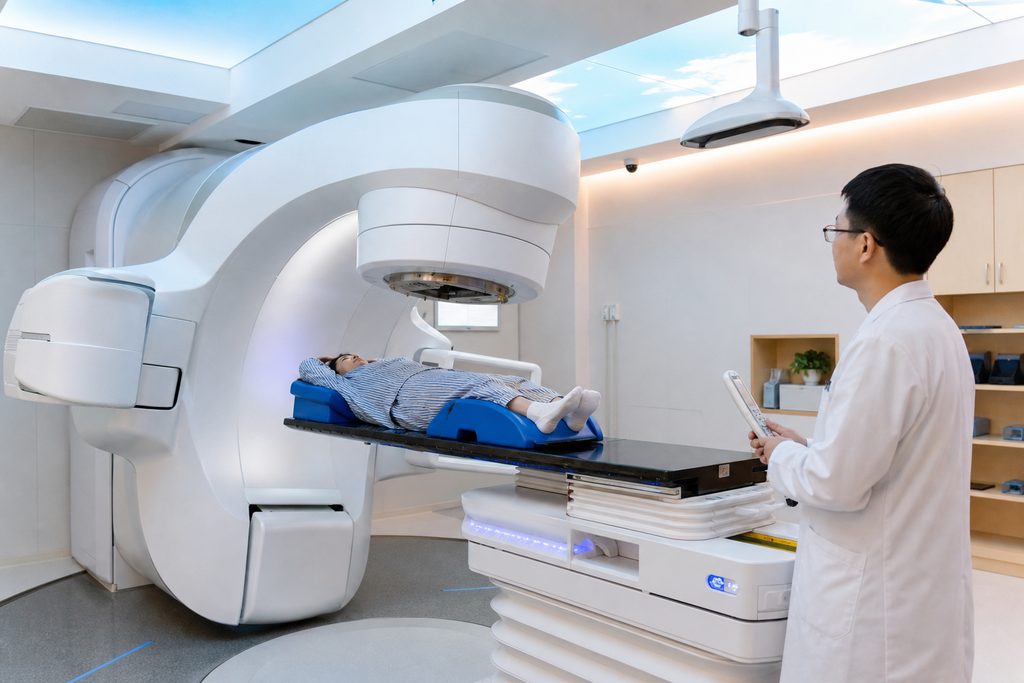
Dental CT in China: What It Is For
A dental CT is not a bigger, scarier X-ray. Think of it as a three-dimensional map of your jaw, teeth, nerves and sinuses — built from a few hundred flat images stacked into one model a dentist can rotate on screen. In China, this scan is usually called CBCT, short for cone-beam computed tomography. It takes about ten to twenty seconds. And for many international patients, the dental CT scan cost China hospitals quote is a fraction of what the same study runs at home.
So what is a dental CT actually used for? Mostly for planning. Implants, wisdom teeth, root canals, bone grafts, orthodontic anchorage — anything where a two-dimensional X-ray leaves the surgeon guessing about depth, angle or proximity to a nerve. If your dentist back home said “we need a cone beam before we go further,” this article explains what happens next in China.
How This Actually Works, Step by Step
Here is the real sequence, from your first email to the moment you hold the images in your hand.
Step one: you send what you already have. Panoramic X-rays, old CBCT files if they exist, photos of your teeth, and a short note about your goal — implant, extraction, second opinion on a treatment plan. Digital files travel fine. Physical films need to be photographed clearly or shipped.
Step two: a Chinese dental specialty reviews the material. Not a call center. A clinician at a hospital’s international department or a private international clinic looks at your records and tells you whether a new scan is genuinely needed, or whether your existing images are sufficient. This matters. Plenty of patients arrive expecting a scan and are told they do not need one.
Step three: you get a written opinion or a video consultation. The written second opinion comes back as a document — findings, suggested direction, and what imaging would be required before any procedure. A video consultation adds a live conversation, usually with an English-speaking coordinator present.
Step four: the scan itself. If you travel, the CBCT is typically done in the same building as the consultation. You sit in a chair, bite gently on a positioning guide, and stay still. No contrast dye. No fasting. You walk out and have lunch.
Step five: the reading. A radiologist or the treating dentist reviews the volume slice by slice, measures bone height and width, traces the inferior alveolar nerve, checks the sinus floor. The report and the DICOM files are yours. Take them home on a USB drive or as a download link.
What a Dental CT Shows That a Plain X-Ray Cannot
A panoramic X-ray is a single flat shadow. It flattens a curved jaw onto one plane, which means everything overlaps. A CBCT resolves that overlap into separate layers.
- Bone volume in three dimensions. An implant needs a certain height and width of bone. A pano can suggest there is enough. A CBCT measures it. The difference decides whether you need a graft.
- Nerve position. The inferior alveolar nerve runs through the lower jaw. Nicking it can leave permanent numbness in the lip or chin. CBCT shows exactly how much clearance exists between the nerve canal and the planned implant site.
- Root fractures and hidden infection. Cracked roots and small abscesses hide behind dense bone on 2D films. They show up on cross-sections.
- Sinus anatomy. For upper back teeth, the maxillary sinus sits directly above the roots. Implants there can perforate into the sinus if the floor is thin.
- Impacted teeth. Wisdom teeth near the mandibular canal, or supernumerary teeth in children, get mapped before anyone picks up an elevator.
This is why “what is dental CT used for” has a short answer and a long one. Short: surgical planning. Long: it is the difference between a plan drawn on an estimate and a plan drawn on measurements.
A Realistic Timeline
Durations below assume you are coordinating from abroad. Domestic patients move faster.
| Stage | What Happens | Typical Duration |
|---|---|---|
| Records gathering | You collect X-rays, photos, prior reports | 2–7 days |
| Record translation and review | Chinese specialty reads your file | 2–5 business days |
| Written second opinion returned | Findings plus imaging recommendation | 3–7 business days |
| Video consultation (optional) | Live discussion with the dental team | Scheduled 3–10 days out |
| Appointment coordination | Slot confirmed at hospital or clinic | 3–14 days, longer for senior specialists |
| Visa (S2, short stay) | Application with hospital supporting documents | 1–4 weeks depending on consulate |
| Travel and scan | Consultation and CBCT, often same day | 1 day on the ground |
| Report and DICOM handover | Files released to you | Same day to 48 hours |
Total, from first email to scan in hand: roughly three to eight weeks if you travel. If you only want a remote reading of existing images, it can be under two weeks.
What Can Go Wrong — and What Happens Then
Honest failure modes, because you deserve them before you book a flight.
The scan was unnecessary. It happens. You arrive, the dentist looks at your existing pano and says the CBCT adds nothing. You have spent money on imaging you did not need. The recourse is simple: ask up front, in writing, what specific clinical question the scan is meant to answer. A vague answer is a warning sign.
The scan reveals a bigger problem. This is the most common surprise. A patient comes in for one implant and the CBCT shows insufficient bone, an untreated infection, or a sinus issue. The plan changes. Costs change. Timelines change. Nobody did anything wrong — the imaging did its job. But budget for the possibility.
Language gaps at the imaging stage. Radiology reports are written in Chinese. Without translation, you hold a document you cannot read and a set of images you cannot interpret. This is where a bilingual medical companion earns their fee — not for the scan itself, which is quick, but for everything around it.
Appointment slippage. Public tertiary hospitals in China do not hold slots for overseas patients the way a Western private practice does. Same-day walk-in imaging is normal for local patients but not something you can assume as a visitor. If a specific date matters to your trip, that needs to be coordinated in advance through the hospital’s international department or a private international clinic.
What the Numbers Mean, and How to Judge a Quote
Dental imaging prices in China vary widely by city, by hospital tier, and by whether you are in the general queue or the international department. A CBCT at a public tertiary hospital in a mid-sized city and the same scan at a private international clinic in Shanghai are not the same product, even if the machine is identical.
What drives the price:
- Field of view. A small-volume scan of two teeth costs less than a full-arch or full-skull volume. Ask which one you are getting.
- Machine and resolution. Newer units with smaller voxel sizes produce sharper images. They cost more to run.
- Who reads it. A scan read by the treating implantologist is different from a scan read by a dedicated oral and maxillofacial radiologist. The second is more thorough and priced accordingly.
- Channel. International departments and VIP pathways in Chinese public hospitals typically run about 1.5 to 2 times the standard-channel price. You are paying for English service, shorter waits and a named specialist.
For a broader sense of how Chinese hospital pricing compares internationally, our overview of top-ranked Chinese hospitals by city shows which institutions handle the highest volumes and where international departments operate.
Practical Considerations: Records, Visa, Payment, Follow-Up
Records. Bring your existing imaging on a physical medium if you have it, plus a cloud link. Chinese hospitals can usually read standard DICOM from a USB drive. Do not rely on a phone photo of a screen.
Visa. For medical treatment in China, the applicable short-stay category is the S2 visa, issued for medical treatment and private affairs, and it requires supporting documents from the treating hospital. Accompanying family members apply under the same category. Rules and documentation requirements change, so confirm current requirements with the relevant Chinese embassy or consulate before applying. Approval is never guaranteed, and no single visa type fits every case.
Payment. Public hospitals generally require prepayment, with insurance reimbursement handled afterward in your home country. Private international hospitals in China frequently bill insurance directly and accept international cards. Get the payment method in writing before you arrive.
Insurance. Most Western insurers treat dental imaging as a diagnostic benefit, not a dental procedure, which sometimes means better coverage than you expect. Check whether your policy covers treatment abroad and what documentation it requires.
Follow-up at home. The DICOM files are portable. Your dentist at home can plan the actual surgery from a scan taken in China, provided the scan is recent enough and covers the right region. Ask for the files in an unlocked format.
If you want to compare dental care with other specialties while you are researching, our department-by-department rankings cover the top hospitals for each clinical area.
Frequently Asked Questions
Yes. CBCT uses a much lower radiation dose than a medical CT — typically a fraction of a standard head CT — and the equipment in Chinese tertiary hospitals and international clinics is comparable to what you would find in Europe or North America. If you are pregnant or think you might be, tell the clinician before the scan so they can advise you properly. That is standard practice everywhere, not a China-specific caution.
At private international clinics, yes — English-speaking staff handle scheduling directly. At public tertiary hospitals, the international department or VIP pathway can arrange it, but the general outpatient channel is not set up for overseas bookings and requires queuing on the day. If you want a specific date locked in advance, plan around the international pathway or a private clinic.
It varies by hospital tier, field of view and whether a specialist radiologist reads the study. Public tertiary hospitals in the standard channel are the least expensive; international departments and private clinics cost more but include English service and shorter waits. Because pricing changes and depends on your specific case, we do not publish fixed figures — request a current quote for the hospital you are considering, and expect the final number to vary by hospital and case complexity.
For a straightforward implant or extraction assessment, arriving first and scanning on site is common and often cheaper than scanning at home. For a complex case — prior failed implants, bone grafting, nerve involvement — a remote written second opinion based on your existing records is usually the smarter first move. It tells you whether the trip is worth making before you book anything.
Usually yes, if it is recent and in standard DICOM format. Older panoramic films are still useful for a first read. What Chinese clinicians will not do is plan an implant from a two-dimensional image alone — they will want cross-sectional imaging, either yours or a new scan. Send your files first so the specialty can tell you which situation applies to you.
Your Next Step
A dental CT is a planning tool, not a treatment. It answers a specific question about bone, nerves and anatomy, and it is worth getting when a real decision depends on the answer. The dental CT scan China medical tourism angle is genuinely favorable — the technology is current, the turnaround is fast, and the cost sits well below Western private-practice rates. What is not simple is the logistics around it: appointments, language, records, visa timing.
China Medical Services connects international patients with more than 340 top-ranked hospitals across 37 cities, and we handle the parts that are hard from abroad — record translation, appointment coordination through hospital international departments, bilingual medical companions, and visa guidance. We are not a clinic and we do not provide medical care or treatment advice. If you want to know whether a scan is worth planning a trip around, send us your existing records and we will help you find out. A free consultation is the place to start.
This article is for general information only and is not medical advice. Imaging and treatment decisions should be made with a qualified clinician who has reviewed your individual records.
For more medical information and treatment options in China, visit chinamedservices.com (China Medical Services).
