Getting a CT Scan in China as a Foreigner: Costs, Safety, and Booking
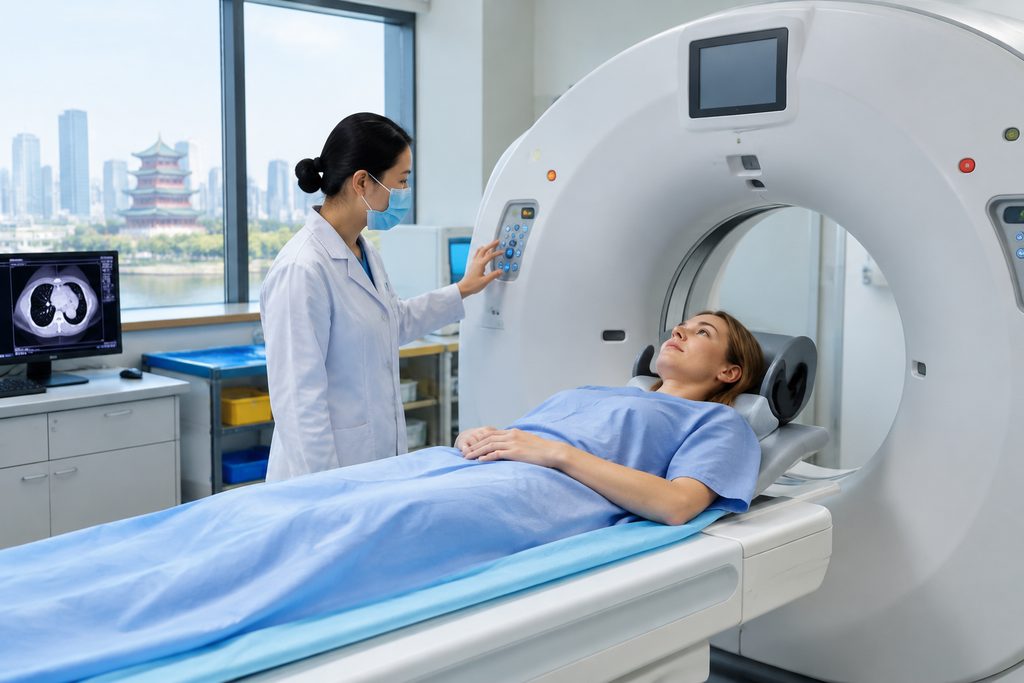
CT Scan Cost China: The Short Answer
You have probably heard that getting medical care in China means sacrificing quality or navigating a system that was never designed for outsiders. The reality is closer to the opposite. A CT scan at a top-tier Chinese hospital typically costs $80 to $400 depending on the body part, whether contrast dye is used, and whether you choose a public hospital or a private international one. That is a fraction of what the same scan runs in the United States, where a single abdominal CT can bill out at $1,200 or more.
The catch is not the price. It is the process. Booking, paying, and understanding your results as a foreigner requires navigation that most first-time visitors underestimate.
Who This Is Right For — and Who It Isn’t
Not every traveler should head to a Chinese imaging department. Here is an honest breakdown.
You are likely a good fit if:
- You are already in China or planning a trip and need imaging for a known or suspected condition
- You are uninsured or underinsured at home and facing a $1,000+ quote for a scan
- You want a second read on imaging done elsewhere, or you need a scan before a consultation at a Chinese specialty hospital
- You are combining a health check with travel and want comprehensive imaging done efficiently
You should probably not pursue this if:
- You need emergency imaging — go to the nearest emergency department wherever you are
- You have a known contrast allergy and cannot obtain premedication or an alternative plan
- You require a specific radiologist your home physician insists on, or your insurance will only reimburse at home
- You are pregnant or may be pregnant and the scan is not medically urgent — radiation exposure requires a real conversation with a physician first
The Options, Compared
Where you get scanned changes the price, the wait, and the experience dramatically. Here is how the main routes stack up.
| Route | Typical Cost (USD) | Wait Time | English Support | Insurance Billing |
|---|---|---|---|---|
| Public tertiary hospital — standard outpatient | $80–$250 | Same day to 3 days | Limited | Pay upfront, claim later |
| Public hospital — international/VIP department | $200–$500 | 1–3 days, often scheduled | Yes | Pay upfront, claim later |
| Private international hospital | $400–$1,200 | Same day to 48 hours | Yes, full service | Direct billing with many insurers |
| United States (for comparison) | $1,200–$5,000+ | Days to weeks | Yes | Insurance-dependent |
If cost is your primary driver and you are comfortable with a bit of navigation, the public hospital route delivers excellent imaging equipment at a remarkably low price. If you value a calm, English-speaking environment and direct insurance billing, the private international route is worth the premium. The middle option — a public hospital’s international department — often gives you the best of both.
Is It Safe to Get a CT Scan in China?
This is the question that stops most people before they even start researching. “Is it safe to get a CT scan in China” is a fair concern, and the honest answer is: yes, at accredited hospitals, the equipment and safety standards are comparable to what you would find in Europe or North America.
China’s top hospitals operate modern multi-slice CT scanners from the same manufacturers used worldwide — Siemens, GE, Philips, Canon. Many flagship facilities run 256-slice or 320-slice machines capable of low-dose protocols. Radiology departments at major tertiary hospitals follow standardized contrast protocols, and radiologists are trained to international reporting conventions.
What varies is not the machine. It is the surrounding experience. In a busy public hospital, outpatient imaging departments can process hundreds of patients a day. The scan itself is quick — often under ten minutes. The waiting, registration, and payment steps are where a foreigner without Mandarin can feel lost.
Radiation dose deserves a straight word. A single CT delivers more radiation than a chest X-ray. Modern low-dose protocols reduce this significantly, but the decision to scan should always be clinically justified. Ask your referring physician whether CT is the right modality, or whether ultrasound or MRI would answer the same question without ionizing radiation.
How Much Does a CT Scan Cost in Shanghai?
Shanghai is one of the most popular entry points for international patients, and its pricing reflects a mature private-hospital market alongside world-class public institutions.
At a major public hospital in Shanghai, a non-contrast head CT might run $80–$150. A contrast-enhanced abdominal CT could reach $200–$350. At a private international facility such as those in the Jiahui or United Family network, expect $500–$1,200 for the same study, with English-speaking staff and often direct insurance billing.
Beijing prices sit in a similar range. Guangzhou, Chengdu, and Hangzhou tend to be slightly lower at public hospitals, though private international pricing stays broadly consistent across major cities.
What drives the variance? Contrast dye adds cost. Multiple body regions add cost. A three-phase liver protocol costs more than a single-phase scan. And the hospital tier — public standard, public VIP, or private — is the single biggest multiplier.
For a fuller picture of how hospital selection affects total cost, our guide to top-ranked Chinese hospitals by city breaks down the tiers and what each offers international patients.
Booking a CT Scan Appointment at a Beijing Hospital
Here is where expectations need adjusting. At most Chinese public hospitals, you cannot book an outpatient CT scan from overseas weeks in advance the way you might at a Western clinic. The standard flow is: register on the day, see a physician, obtain an imaging order, pay, then queue for the scan.
That means “book CT scan appointment Beijing hospital” usually translates to booking a consultation first. The physician orders the scan, and it often happens the same day or within a few days.
There is an exception. Hospital international departments and VIP wings can sometimes pre-arrange imaging for foreign patients, particularly when there is a referral or a scheduled procedure. This is also where English-speaking coordinators are available. The trade-off is cost — roughly 1.5 to 2 times the standard public rate.
Private international hospitals operate more like Western clinics. You can often call or email, explain what you need, and get a scheduled appointment within a day or two. If predictability matters more to you than price, this is the smoother path.
Do Hospitals in China Accept International Insurance for CT Scans?
This depends entirely on the hospital type. Public hospitals in China generally require upfront payment. You pay out of pocket, collect itemized receipts and the imaging report, then submit a claim to your insurer after returning home. Reimbursement depends on your policy’s coverage for overseas care.
Private international hospitals frequently have direct billing arrangements with major international insurers — Cigna, Allianz, Bupa, and others. If direct billing matters to you, confirm with the specific hospital before your visit, and check whether your plan requires pre-authorization for imaging.
Travel insurance is a separate matter. Most standard travel policies cover emergency imaging but not elective or diagnostic scans. Read the fine print before assuming you are covered.
For patients weighing public versus private routes, our overview of private international hospitals with direct insurance billing lays out which facilities work with which insurers.
Practical Considerations for Foreigners Getting Scanned
Your passport is your medical card. At public hospitals, you will register using your passport. Keep it with you. Some hospitals now issue a temporary patient number tied to your passport — hold onto that slip, because you will need it for payment and to collect results.
Payment methods. Public hospitals increasingly accept international credit cards at international departments, but standard outpatient counters may only take local payment apps or cash. Carry some RMB as a backup. Private hospitals accept major cards without issue.
Language. Outside international departments, English signage and English-speaking staff are limited. This is the single biggest practical barrier. A bilingual companion who handles registration, payment, queueing, and instructions can turn a stressful half-day into a manageable one.
Results turnaround. A radiologist’s report at a public hospital is often ready within hours to a day. Films or digital copies can be collected or accessed via the hospital’s app, though app interfaces are usually in Chinese.
Follow-up after you leave. If you return home before a follow-up scan is needed, arrange to have your imaging exported in DICOM format. Most hospitals can provide this on a USB drive or via a download link on request.
Frequently Asked Questions
At public hospitals, you generally need to register and see a physician first, who then orders the scan. Walk-in imaging without a doctor’s order is not standard. Private international hospitals are more flexible and may schedule imaging directly.
Yes, at public hospitals. A scan that bills $1,200–$5,000 in the US often costs $80–$350 in China. Private international hospitals narrow that gap but still typically undercut US pricing substantially. Final cost varies by hospital, body region, and contrast use.
You will receive a written radiology report, usually within a day. From there, you would consult a specialist — either locally or after returning home. Having your imaging in DICOM format ensures any physician anywhere can review it. We do not provide diagnoses, but we can help coordinate a specialist consultation.
If you are traveling to China specifically for medical treatment, the S2 visa is the applicable short-stay category, subject to current embassy requirements and supporting hospital documents. A standard tourist visa may cover a simple scan during an existing trip, but medical-purpose travel should be declared accurately. Requirements change, so verify with the nearest Chinese embassy or consulate.
Your Next Step
Getting a CT scan in China is genuinely affordable and, at accredited hospitals, technically excellent. The friction is logistical, not clinical — registration, language, payment, and knowing which hospital fits your situation. That is the gap we exist to close. China Medical Services is not a hospital and does not provide medical care or diagnoses; we are a coordination service that helps international patients match with appropriate hospitals, prepare records, and navigate appointments. If you would like a straightforward conversation about your options, you can start with a free consultation — no pressure, no obligation, just clarity before you decide.
For more medical information and treatment options in China, visit chinamedservices.com (China Medical Services).
