How Foreigners Access Dental Implants in China: Costs, Clinics, and Safety
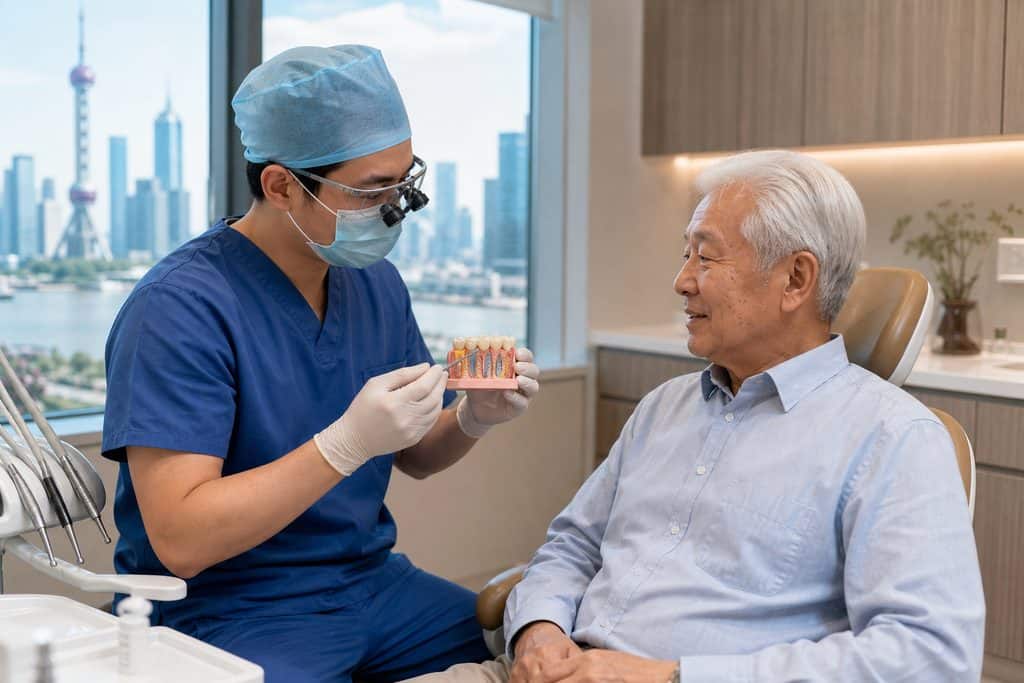
Key Takeaways
- Dental implants cost China‘s top-tier hospitals $1,200–$2,500 per implant, versus $3,000–$6,000 in the United States — a gap driven by lower overhead and high procedure volume, not lower quality.
- Shanghai and Beijing have dedicated international dental departments with English-speaking staff, digital imaging, and imported implant systems from Straumann, Nobel Biocare, and Osstem.
- The hard part isn’t the surgery — it’s the logistics. Public hospital dental clinics don’t accept overseas bookings in advance, and the full implant process takes 3–6 months from first consultation to final crown.
- Anyone considering treatment abroad needs to understand the staged nature of implant dentistry, the visa category that applies, and what follow-up looks like after returning home.
The Problem: Why Patients Start Looking Abroad
A single dental implant in the United States costs between $3,000 and $6,000 before insurance. Full-arch restoration can run $20,000 to $50,000 per jaw. For the roughly 120 million Americans missing at least one tooth — and the millions more in the UK, Canada, and Australia facing similar price structures — those numbers aren’t abstract. They’re the reason people delay treatment for years.
The delay has consequences. Bone resorption begins within months of tooth loss. What starts as a straightforward implant placement can become a bone grafting procedure requiring additional surgery, additional cost, and additional healing time. Waiting doesn’t save money. It usually costs more.
So patients search for alternatives. Mexico, Turkey, Thailand, Hungary — and increasingly, China. But China raises questions that other destinations don’t. Is the quality comparable? Can foreigners actually access the good clinics? And how does the process work when you don’t speak Mandarin?
Why China Delivers Results for Dental Implant Patients
China’s 35,000+ hospitals include some of the largest dental departments in the world. The top 5% — the 340+ hospitals in our database — are ranked by Fudan University’s hospital index and JCI accreditation. Their oral and maxillofacial surgery departments handle complex implant cases daily: zygomatic implants, All-on-4 protocols, immediate-load restorations. A senior implantologist at a top Shanghai hospital may place 500 or more implants per year. That’s not a marketing figure — it reflects the patient volume flowing through these institutions.
For comparison, the average US general dentist places roughly 50–100 implants annually. High-volume experience matters in implant dentistry because surgical precision improves with repetition.
Implant Systems and Materials
Top Chinese hospitals use the same implant brands as Western clinics: Straumann (Switzerland), Nobel Biocare (Sweden), Dentsply Sirona (US), and Osstem (South Korea). These are not generics. They carry the same FDA and CE markings, the same surface treatments, the same warranty structures. The difference is what the hospital charges for placement and restoration — not what goes into your jaw.
Cost Structure: Why Lower Prices Don’t Mean Lower Quality
Dental implants cost China’s top hospitals 60–80% less than equivalent US treatment. The reasons are structural. Chinese hospital salaries are lower. Real estate and operational costs at public hospitals are subsidized. And the patient volume means equipment and materials are purchased at scale.
None of that affects the implant itself. A Straumann BLX implant placed in Shanghai is the same implant placed in Chicago. The surgeon’s training may differ — but at the top-tier hospitals we work with, implantologists typically hold advanced degrees and have completed fellowships, often including training abroad.
| Procedure | China (Top Hospital) | United States | United Kingdom |
|---|---|---|---|
| Single implant + abutment + crown | $1,200–$2,500 | $3,000–$6,000 | £2,000–£3,500 |
| All-on-4 (per arch) | $8,000–$15,000 | $20,000–$30,000 | £12,000–£20,000 |
| Bone grafting (per site) | $400–$900 | $800–$2,500 | £500–£1,500 |
| Sinus lift | $800–$1,500 | $1,500–$3,000 | £1,000–£2,000 |
Prices vary by hospital and case complexity. A straightforward single implant at a private international clinic in Shanghai will cost more than the same procedure at a public hospital’s dental department — but the private clinic will offer English-speaking staff, direct insurance billing, and shorter wait times.
How the Dental Implant Process Actually Works in China
Implant dentistry is not a single appointment. It’s a staged process that typically spans 3–6 months. Understanding each stage matters — especially when you’re coordinating travel from another country.
Stage 1: Remote Evaluation (Before You Travel)
You send existing dental records — panoramic X-rays, CBCT scans if available, photos of the affected area. A Chinese dental specialist reviews them and provides a written assessment: how many implants are needed, whether bone grafting is required, what the estimated timeline looks like. This is where a written second opinion ($300–$500 through our service) or a video consultation ($100–$300) can clarify whether the trip makes sense before you book flights.
Stage 2: In-Person Consultation and Imaging (Day 1–2 in China)
You arrive, visit the hospital, and undergo a physical examination. The surgeon takes fresh CBCT imaging — Chinese hospitals require their own scans regardless of what you bring. This is non-negotiable. The consultation confirms the treatment plan and sets the surgical date.
Stage 3: Implant Placement (Day 3–7)
The surgery itself takes 30–60 minutes per implant under local anesthesia. Most patients return to their hotel the same day. Swelling peaks at 48 hours and subsides within a week. If you’re receiving multiple implants or All-on-4, the surgical time extends but the recovery pattern is similar.
Stage 4: Healing and Osseointegration (3–6 Months)
This is where the implant fuses with the jawbone. You return home during this period. The healing happens on its own — no appointments required. Some patients choose to stay in China for the duration; most don’t need to.
Stage 5: Abutment and Crown Placement (Return Trip)
After osseointegration is confirmed via X-ray, the abutment is attached and the final crown is fabricated and placed. This requires a second trip to China, typically 5–10 days. Some hospitals offer a temporary crown during Stage 3 so you’re not without a tooth in the interim.
Choosing the Best Dental Implant Clinic in Shanghai and Beyond
Shanghai has the densest concentration of international dental services in China. Hospitals like Shanghai Ninth People’s Hospital (affiliated with Shanghai Jiao Tong University School of Medicine) have oral implantology departments that treat international patients regularly. Beijing, Guangzhou, and Chengdu also have strong options.
But “best” depends on what you need. A few decision criteria:
- Complexity of your case. Single implant with adequate bone? Most top-tier hospitals handle this well. Full-arch restoration with severe bone loss? You want a department with maxillofacial surgery backup.
- Language support. Public hospital dental departments may have limited English capacity. Private international clinics (United Family, Jiahui, Parkway) have English-speaking dentists but charge 1.5–2x public hospital rates.
- Number of trips you can make. If you can only travel once, some clinics offer “same-day” protocols — but these aren’t suitable for every case and require careful pre-evaluation.
- Follow-up plan. Who handles the crown placement if you return home? Who manages complications? Get this in writing before you commit.
Our department directory lists top-ranked hospitals by specialty, including dentistry and oral surgery. You can also browse Shanghai and Beijing hospital listings for city-specific options.
Is Dental Implant Safe in China? Addressing the Real Concerns
The safety question usually breaks into three parts: sterilization, implant quality, and surgical competence.
Sterilization. Top-tier Chinese hospitals follow standard protocols — autoclave sterilization, single-use surgical kits, sterile draping. JCI-accredited hospitals meet international standards by definition. If you’re considering a smaller clinic, ask directly about their sterilization procedures. A reputable clinic will answer without hesitation.
Implant quality. As noted, the major brands are the same globally. Counterfeit implants exist in every market, including the US and Europe. The safeguard is the same everywhere: ask to see the implant packaging and verify the serial number with the manufacturer.
Surgical competence. This is where hospital selection matters most. A surgeon who places 500 implants a year has seen more complications, handled more edge cases, and developed more refined technique than one who places 50. Volume isn’t everything, but in implant dentistry, it correlates strongly with outcomes.
Practical Considerations: Visa, Payment, and Aftercare
Visa. Medical treatment in China requires an S2 visa (short-stay, under 180 days) with a medical treatment annotation. The S2 also covers accompanying family members. You’ll need an invitation letter or appointment confirmation from the hospital. The M visa is for commercial and trade activities — it does not apply to medical treatment. Requirements change; check with the nearest Chinese embassy or consulate for current documentation.
Payment. Public hospitals require prepayment for treatment. International credit cards are accepted at larger hospitals, but smaller ones may require cash or domestic payment methods. Private international clinics often bill insurance directly. If you’re using travel insurance or a health plan with international coverage, confirm reimbursement terms before treatment.
Aftercare. Once you return home, you’ll need a local dentist for routine follow-up — cleaning, crown checks, and any adjustments. Before you leave China, ask the treating hospital for complete records: implant brand, lot number, placement date, torque values, and post-operative imaging. Your home dentist will need these.
Language. Hospital dental visits involve consent forms, post-operative instructions, and medication guidance. If you don’t speak Mandarin, a bilingual medical companion (from $300/day) can handle registration, translation, and coordination during your visit. For patients navigating a large public hospital for the first time, this is often the difference between a smooth experience and a stressful one.
Frequently Asked Questions
How long do dental implants take in China?
The full process — from first consultation to final crown — typically takes 3–6 months. The implant placement surgery itself is done in one appointment (30–60 minutes per implant). The healing period, during which the implant fuses with bone, accounts for most of the timeline. Some cases qualify for accelerated protocols, but these depend on bone quality and implant location.
Is dental implant safe in China for foreign patients?
At top-tier hospitals using internationally branded implants, safety standards are comparable to Western clinics. The variables are the same everywhere: surgeon experience, sterilization protocols, and patient health factors. What matters is choosing a hospital with a high-volume implantology department and verifying the implant brand before surgery.
Can I book dental implant surgery in China before I arrive?
Public hospital dental departments generally don’t accept advance bookings from overseas patients — you register in person on the day of your visit. Private international clinics may offer pre-booking. A common approach is to arrange a written second opinion or video consultation first, then coordinate the in-person visit through a hospital’s international department. This confirms the treatment plan before you travel.
What does a medical tourism dental implants China package typically include?
Packages vary widely. A hospital-based package usually covers consultation, imaging, surgery, and the implant fixture. It may or may not include the abutment, crown, bone grafting, or follow-up visits. Always ask for an itemized quote — the “package price” often excludes components that add up quickly. Our service doesn’t sell packages; we coordinate hospital appointments and provide bilingual support, with pricing confirmed after the hospital reviews your case.
Your Next Step
Dental implants in China offer a genuine cost advantage — often 60–80% below US prices — without compromising on implant quality or surgical standards at top-tier hospitals. But the process requires planning: remote evaluation, two potential trips, visa logistics, and a clear aftercare plan. It’s not complicated, but it’s not a walk-in either.
We’re China Medical Services — a coordination service, not a hospital. We don’t provide diagnoses or treatment. What we do is help you understand your options, connect you with appropriate hospitals, and handle the logistics so you can focus on your health. If you’d like to explore whether treatment in China makes sense for your situation, start with a free consultation. No pressure, no obligation — just a conversation about what’s possible.
This article is for informational purposes only and does not constitute medical advice. Treatment decisions should be made in consultation with a qualified dental professional. Individual results vary based on case complexity, patient health, and other factors.
For more medical information and treatment options in China, visit chinamedservices.com (China Medical Services).
