Low-Dose CT in China: Who Should Get One — and What It Costs
Low-Dose CT in China: Who Should Get One
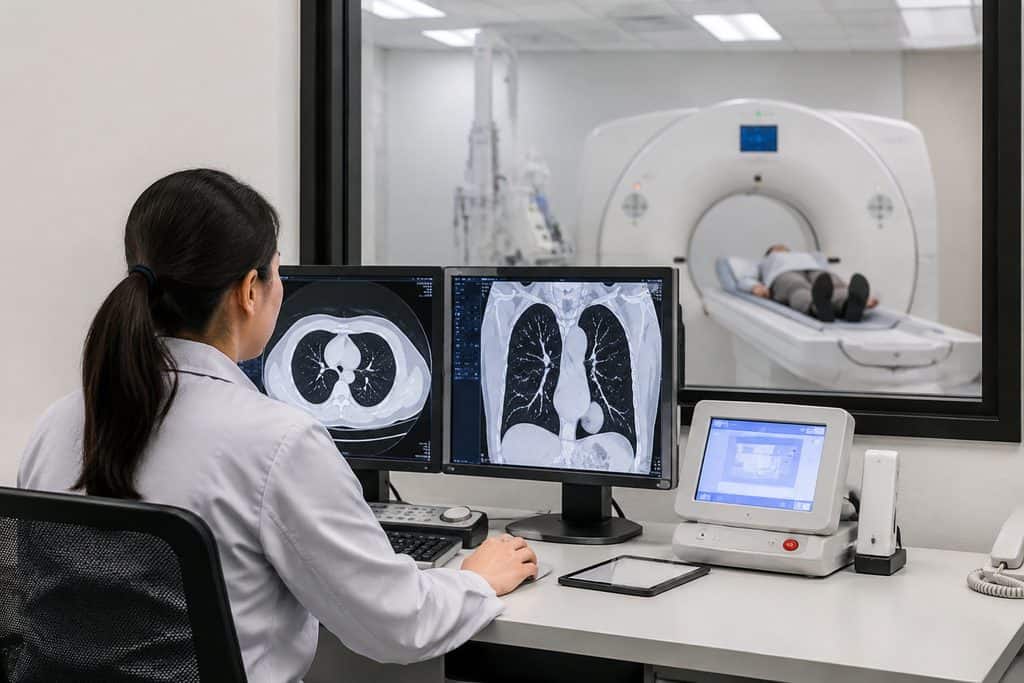
A low-dose CT scan is a lung imaging test that uses roughly one-fifth to one-tenth the radiation of a standard chest CT. It takes about ten minutes. You lie still, hold your breath twice, and you’re done. No contrast dye, no needle, no recovery time. The reason it matters is simple: it finds lung cancer early, when surgery can still cure it. And the reason people search for the low dose CT scan cost in China is that the same scan billed at $1,200 in the United States often runs a fraction of that at a Chinese tertiary hospital.
But a cheap scan is worthless if it’s the wrong scan, done at the wrong time, read by someone who misses a 6-millimeter nodule. So let’s talk about who genuinely benefits, who doesn’t, and how the logistics actually work.
What Low-Dose CT Actually Is, in Plain Language
Think of a standard CT as a high-resolution camera that captures everything in fine detail, radiation included. A low-dose CT turns down the power. You lose a little sharpness in the soft tissues, but the lungs are mostly air, and air shows up beautifully on low radiation settings. That’s why the technique works for lung screening specifically and not for, say, abdominal imaging.
The test is sometimes called LDCT or “low-dose spiral CT.” Same thing. It does not diagnose cancer by itself. It flags something that needs a closer look, and the closer look might be a repeat scan in three months, a PET scan, or a biopsy.
Who Should Actually Get One
The evidence base here is not vague. The U.S. Preventive Services Task Force recommends annual screening for adults aged 50 to 80 who have a 20 pack-year smoking history and currently smoke, or quit within the past 15 years. A “pack-year” means one pack per day for a year. Twenty pack-years could be one pack daily for 20 years, or two packs daily for 10.
Outside that group, the calculus changes. If you’re 42, never smoked, and have no family history, a low-dose CT is unlikely to find anything and may find a harmless nodule that triggers six months of anxiety and repeat scans. That’s called overdiagnosis, and it’s a real harm, not a theoretical one.
There’s a middle zone worth naming. People with a first-degree relative who had lung cancer, people with significant secondhand smoke exposure, and people with occupational exposure to asbestos, radon, or diesel exhaust may reasonably discuss screening with a physician even if they fall outside the formal criteria. The decision belongs to a doctor who knows your history, not to a website.
Is a Low-Dose CT Scan Safe for Smokers?
This is the question we hear most, and the answer is a qualified yes. The radiation dose from one low-dose CT is roughly 1.5 millisieverts, compared with about 7 millisieverts for a standard chest CT and 2.4 millisieverts of natural background radiation a person absorbs annually just by existing. For a current smoker at elevated risk, the benefit of catching a tumor at stage I substantially outweighs that exposure.
The qualification: repeated scanning matters. If you’re getting annual low-dose CTs for 20 years, cumulative dose becomes a conversation worth having with your physician. Serial screening is a long-term strategy, not a one-off purchase.
How Accurate Is Low-Dose CT for Lung Cancer?
Accuracy depends on what you’re measuring. For detecting nodules, sensitivity is high — above 90% in most published series. For distinguishing benign from malignant nodules on the first scan alone, accuracy drops considerably, which is why follow-up protocols exist.
The number that changed clinical practice comes from the National Lung Screening Trial, published in 2011. Participants screened with low-dose CT had a 20% reduction in lung cancer mortality compared with those screened with chest X-ray. That’s a large effect for a screening test.
What accuracy also depends on is the radiologist. A 4-millimeter nodule in the upper lobe requires a trained eye and a standardized reporting system, usually Lung-RADS. This is where hospital selection stops being an abstract question. Volume matters. A center that reads 200 lung screens a week sees patterns that a general radiology department reading 200 a year simply does not.
What a Low-Dose CT Costs in China
Here’s the practical picture. Pricing varies by hospital tier, city, and whether you go through the standard outpatient channel or an international department.
| Setting | Typical Scan Price (USD) | Notes |
|---|---|---|
| Standard outpatient, top-tier public hospital | $80 – $200 | Requires same-day registration; Chinese-language queue |
| International / VIP department, public hospital | $250 – $500 | English service, appointment coordination, faster throughput |
| Private international hospital | $400 – $800 | Direct insurance billing often available |
| United States, comparison | $300 – $1,200+ | Cash price varies enormously by facility |
So the low dose CT scan cost in China lands well below Western pricing, and the gap widens once you add physician consultation and follow-up. But the scan fee is only part of the equation. If you’re flying in, add airfare, accommodation, and interpretation. A $150 scan does not justify a $3,000 trip on its own. It justifies the trip when it’s bundled with a broader health assessment, a specialist consultation, or a second opinion on an existing diagnosis.
How This Actually Works, Step by Step
Here’s the real sequence, without the marketing gloss.
Step one: you send records. Your existing imaging, prior CT reports, smoking history, and any relevant lab work go to the hospital’s international office for pre-review. This is where a radiologist or pulmonologist decides whether a low-dose CT is even the right test for you, or whether you need something else entirely — a contrast CT, a PET scan, or nothing at all.
Step two: you get a written opinion. A Chinese specialty team reviews your materials and returns a written assessment. This is the stage most people skip, and it’s the stage that saves the most money. If screening isn’t indicated, you find out before booking a flight.
Step three: appointment coordination. Once the plan is clear, the hospital’s international department registers you. Standard public hospital outpatient clinics in China generally cannot be pre-booked from overseas — you queue on the day. International and VIP channels can be scheduled in advance, at roughly 1.5 to 2 times the standard fee.
Step four: the scan itself. You arrive, register, pay, and complete the imaging. Results typically return within 24 to 72 hours for a screening study, though complex cases take longer.
Step five: interpretation and next steps. A radiologist reads the scan using Lung-RADS criteria. If a nodule is found, you get a follow-up interval — three months, six months, twelve months — or a referral for further workup.
Choosing Where to Get Scanned
For lung cancer screening specifically, the best hospital in Shanghai for lung cancer screening is usually one attached to a major academic center with a high-volume thoracic oncology program. Shanghai Chest Hospital and Fudan University Shanghai Cancer Center both sit in that category. In Beijing, the Chinese Academy of Medical Sciences Cancer Hospital and Peking Union Medical College Hospital are the names that come up repeatedly.
But hospital prestige is not the whole decision. Three practical filters matter more than reputation for a screening scan:
- Does the facility use Lung-RADS standardized reporting, or does it hand you a free-text report?
- Is there a thoracic surgery or pulmonology department on site, so a suspicious finding can be worked up without a second trip?
- Can you get your images on a disc or portal in a format your home physician can read?
That third point gets overlooked constantly. A scan you can’t share with your doctor back home is a scan you’ll pay to repeat.
A Realistic Timeline
| Stage | Typical Duration | What Slows It Down |
|---|---|---|
| Record collection and translation | 3 – 7 days | Incomplete prior imaging; radiology reports in a language the hospital can’t parse |
| Written second opinion returned | 5 – 10 business days | Specialist availability; need for multidisciplinary review |
| Appointment coordination | 1 – 3 weeks | Peak demand periods; international department scheduling windows |
| S2 visa processing | 1 – 3 weeks | Consulate backlog; missing hospital invitation documents |
| Travel and scan | 2 – 4 days on the ground | Jet lag; same-day registration queues at standard clinics |
| Results and follow-up plan | 24 – 72 hours post-scan | Complex nodules requiring additional review |
Realistically, from first contact to scan in hand, plan on four to eight weeks. Anyone promising a scan next week is either selling a private hospital slot at a premium or glossing over the visa step.
What Can Go Wrong — and What Happens Then
Honest failure modes, and the recourse for each.
You get scanned, and nothing is found, but you’re no better off. This happens when screening wasn’t indicated in the first place. The recourse is prevention: a proper pre-review before booking. If a hospital’s international office tells you the scan isn’t warranted, believe them. That conversation costs nothing.
A nodule is found and you’re told to “come back in six months.” For a patient who flew in from abroad, that’s a logistical problem, not a medical one. The solution is to arrange remote follow-up review — you send the new scan to the same team from home, and they compare. Ask about this before you leave.
You can’t get your images in a usable format. It happens more than it should. Request DICOM files on a disc or a secure download link at the time of the scan, not three weeks later.
The scan reveals something requiring surgery, and you’re not prepared to stay. This is the scenario nobody plans for. Chinese public hospitals require prepayment, and surgical scheduling follows an in-person consultation, not a phone call. If you’re not ready to extend your trip, you’ll be flying home with a diagnosis and starting over.
Practical Considerations: Records, Visas, Payment, and Follow-Up
Records. Bring prior imaging on disc, not just reports. Comparison with an older scan is often what separates a benign nodule from a suspicious one.
Visa. Foreign nationals traveling to China for medical treatment typically apply under the S2 category, which covers short-stay medical treatment and private affairs. Accompanying family members apply under the same category. Requirements shift, so confirm current documentation with the nearest Chinese embassy or consulate. Note that the M visa is for commercial and trade activity and has nothing to do with medical travel.
Payment. Public hospitals require prepayment, with insurance reimbursement handled afterward in your home country. Private international hospitals frequently bill insurers directly. Confirm which model applies before you arrive.
Language. China’s top hospitals handle outpatient volumes in the thousands per day. Wayfinding, registration, and payment are conducted in Chinese. This is not a minor inconvenience — it’s the single most common reason foreign patients miss appointments or misunderstand instructions. A bilingual medical companion handles registration, queueing, payment, and interpretation for the duration of your visit.
Follow-up at home. Get your images and a written report in English before you leave China. Your physician at home will need both.
Frequently Asked Questions
At a private international hospital, generally yes — English-speaking staff handle the entire process. At a top public hospital, you’ll need either an international department booking or a bilingual companion to manage registration, payment, and queueing. Standard outpatient clinics do not offer English-language walk-in service.
Possibly, depending on your pack-year history and age. The formal screening criteria extend to people who quit within the past 15 years, provided they have a 20 pack-year history and are between 50 and 80. If you fall outside those parameters, a physician should assess your individual risk before you book anything.
It detects nodules with sensitivity above 90%, but it cannot tell you on the first scan whether a nodule is cancer. That’s why follow-up intervals exist. The mortality benefit is well documented — a 20% reduction in lung cancer deaths versus chest X-ray screening in the National Lung Screening Trial — but the test works as part of a protocol, not as a standalone answer.
On the scan alone, yes — a low-dose CT in China typically costs $80 to $500 depending on the channel, versus $300 to $1,200 or more in the U.S. Whether a full trip saves money depends on what else you combine it with. A scan plus specialist consultation plus a broader health assessment often does. A scan alone usually doesn’t justify international travel.
Your Next Step
Low-dose CT screening is one of the few cancer tests where the evidence is genuinely strong, the procedure is quick, and the cost in China is a fraction of Western pricing. The catch is that it only helps if it’s the right test for you, done at a center that reads enough of them to interpret the result confidently.
We’re China Medical Services. Our team connects international patients with more than 340 top-ranked hospitals across 37 cities, and we coordinate written second opinions, video consultations, appointment scheduling, and bilingual medical companions on the ground. We don’t diagnose, and we don’t promise outcomes — the medical decisions belong to the physicians treating you. What we do is remove the language, logistics, and navigation barriers that make Chinese healthcare hard to access from abroad. If you’re weighing a screening scan, start with a free consultation and we’ll help you figure out whether it’s worth the trip.
This article is for general information only and is not medical advice. Screening decisions should be made with a qualified physician who knows your personal and family history.
For more medical information and treatment options in China, visit chinamedservices.com (China Medical Services).
