Shoulder Surgery China UK: Rotator Cuff Repair Without the Wait
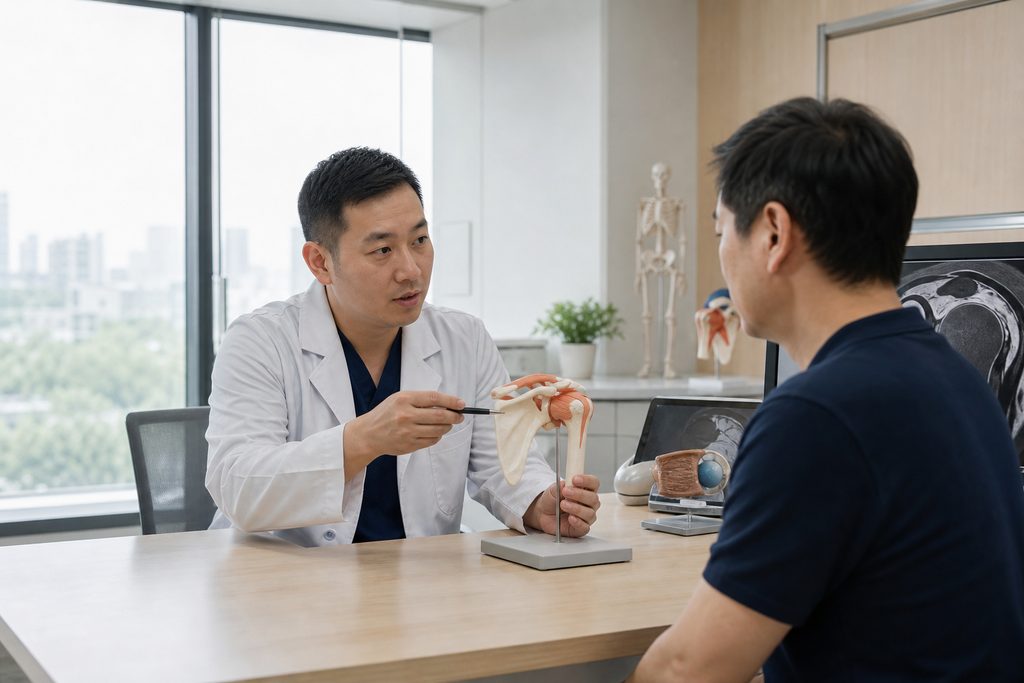
What “Immediate Access” Actually Means for a Rotator Cuff Tear
You wake up, and your shoulder screams. Pulling on a shirt hurts. Reaching for a coffee cup sends a jolt through your arm. The MRI confirms what you already suspected — a full-thickness supraspinatus tear. Your UK consultant is excellent. But then comes the news: the NHS waiting list for your rotator cuff surgery cost China patients often explore as an alternative stretches 12 to 18 months. Private care in London moves faster, but the quote lands at £9,000 to £14,000. You are in pain now. Not next year.
We see this exact scenario every week. UK patients, scans in hand, searching for a path that does not involve living on codeine while their muscle atrophies past the point of easy repair. “Immediate access” in the Chinese hospital system does not mean you land at 6 a.m. and enter theatre by noon. That is not how surgery works anywhere. What it means is this: from the moment you decide to move forward, the timeline to surgery is measured in weeks, not seasons. The bottleneck is not the surgeon’s availability. It is your own logistics — visa processing, travel arrangements, and the mandatory pre-operative evaluation once you arrive.
China’s top orthopedic centers perform thousands of arthroscopic shoulder procedures annually. A surgeon in Shanghai might complete 300 rotator cuff repairs in a year. Repetition builds speed. It also builds precision. That volume, combined with a hospital infrastructure designed for throughput, collapses the waiting period that UK patients have come to dread. You are not jumping a queue. You are entering a different queue entirely — one with significantly more operating room capacity.
How This Actually Works, Step by Step
The sequence is straightforward, but each step has hard dependencies. Skip one, and the timeline unravels.
Step 1: You send us your records. Not just the MRI report — the actual DICOM files on a CD or uploaded via a secure portal. Also your GP summary, any previous shoulder surgery notes, and a list of current medications. We translate these into clinical Chinese. This takes 48 hours.
Step 2: A written second opinion lands in your inbox. A shoulder specialist at a hospital like Huashan Hospital Fudan University or Peking University Third Hospital reviews your imaging and history. They confirm the tear is repairable, suggest a technique — single-row, double-row, or suture bridge — and flag any concerns. This report costs from $300 and arrives within 3 to 5 working days. It is for reference only, not a prescription. But it tells you whether flying to China makes medical sense.
Step 3: You decide, and we coordinate the date. This is where the top orthopedic departments differ from UK scheduling. Once you confirm, we work through the hospital’s international patient center to reserve a surgical slot. The hospital will want to see you in person for a face-to-face consultation and fresh pre-op labs before the actual procedure. That consultation typically happens 2 to 3 days before surgery. We handle the appointment coordination — from $300, and if we cannot secure the slot, it is fully refunded.
Step 4: You travel. Your S2 visa application requires an invitation letter from the hospital, which we help obtain. Processing at the visa center in London, Manchester, or Edinburgh takes roughly 4 to 8 working days. You fly to Shanghai, Beijing, or another city where your chosen hospital is located. We arrange airport pickup — $200 round-trip.
Step 5: Pre-op, surgery, and early recovery. You meet your surgeon. You undergo blood work, an ECG, and a chest X-ray. If everything is clear, surgery happens the following morning. You stay in the hospital for 2 to 4 nights. A bilingual medical companion — from $200 per day — sits with you through admission, translates the consent forms, and makes sure you understand the post-op instructions before discharge.
Step 6: You go home — but not immediately. Surgeons want you nearby for at least 10 to 14 days post-op for wound checks and suture removal. You rest in a nearby hotel or serviced apartment. Then you fly back to the UK and transition into NHS or private physiotherapy with a detailed rehab protocol in English.
Rotator Cuff Surgery Cost China vs UK: The Numbers That Matter
The rotator cuff surgery cost China patients pay varies by hospital tier, tear complexity, and implant choice. A straight arthroscopic repair using double-row anchors at a top public hospital’s international department runs from $8,000 to $14,000 all-inclusive — surgeon fees, anesthesia, implants, and a 3-night private room. The same procedure at a private international hospital like Jiahui or United Family trends higher, from $16,000 to $22,000, reflecting JCI accreditation and Western-style hospitality.
Compare that to the UK private sector, where the surgeon’s fee alone can hit £2,500, the hospital charges £4,000 to £6,000, and the anesthetist bills separately. A total of £9,000 to £14,000 — roughly $11,500 to $18,000. The cost gap narrows at the high end but widens considerably when you factor in the waiting time. An NHS repair costs you nothing at point of care, but the hidden price is 12 to 18 months of lost function, progressive fatty infiltration of the rotator cuff muscles, and a tear that may retract beyond repair. Some tears become irreparable while patients wait. That is not a cost saving. That is a permanent disability.
| Cost Factor | UK Private | China Public Hospital (Int’l Dept) | China Private International |
|---|---|---|---|
| Surgeon + Hospital Package | £9,000 – £14,000 | $8,000 – $14,000 | $16,000 – $22,000 |
| Implants (Anchors, Sutures) | Included | Included | Included |
| Pre-Op Evaluation | Included | $300 – $500 | Included |
| Bilingual Companion (3 days) | N/A | From $600 | Often included |
| Typical Wait to Surgery | 2 – 6 weeks | 2 – 4 weeks | 1 – 3 weeks |
These numbers vary by hospital and case complexity. A massive tear requiring a latissimus dorsi transfer or superior capsular reconstruction will cost more. But for the standard arthroscopic repair that makes up 80% of cases, the figures above hold. And here is something worth knowing: any consultation fee you pay for a remote video or written second opinion is credited in full toward our coordination service if you proceed within 90 days. It is a one-time credit applied to the coordination fee only, never to hospital treatment charges.
How Long Is the Wait for Rotator Cuff Surgery UK vs China? A Realistic Timeline
The question how long is the wait for rotator cuff surgery UK vs China is not rhetorical. It is measurable. And the answer depends on where in the UK you are and which pathway you are on.
NHS England’s referral-to-treatment data shows that trauma and orthopedics consistently has one of the longest waiting lists of any specialty. As of early 2025, over 40% of patients waited more than 18 weeks from referral to treatment. For non-urgent shoulder arthroscopy, the real-world wait in many trusts stretches to 12 months or beyond. Scotland and Wales fare slightly better on median waits but still measure in months, not weeks. Private UK care shortens this to 2 to 6 weeks — if you can pay and if your chosen surgeon has a slot.
China’s timeline looks different. Not because the surgeons are less busy — they are busier. But because the system allocates operating room time differently. A top orthopedic department runs multiple arthroscopy suites simultaneously, six days a week. The constraint is not theatre availability. It is how fast you, the international patient, can complete the pre-arrival steps.
| Stage | UK NHS | UK Private | China (Int’l Patient) |
|---|---|---|---|
| GP referral to specialist consult | 12 – 26 weeks | 1 – 2 weeks | N/A (self-referral) |
| MRI to surgical decision | 4 – 12 weeks | 1 – 2 weeks | 3 – 5 days (remote second opinion) |
| Decision to surgery date | 12 – 52 weeks | 2 – 6 weeks | 2 – 4 weeks (post visa) |
| S2 visa processing | N/A | N/A | 4 – 8 working days |
| Arrival to surgery | N/A | N/A | 2 – 4 days (pre-op workup) |
| Total: Decision to Surgery | 12 – 52 weeks | 2 – 6 weeks | 3 – 6 weeks |
The numbers tell a clear story. China does not beat UK private care on raw speed — a determined patient with cash in London can get surgery in two weeks. But it matches or beats the private timeline at roughly half the cost. And it absolutely demolishes the NHS wait. For a patient with a retracting tear, those months matter. Muscle atrophy is not reversible. The window for a simple repair closes.
Can I Get Immediate Rotator Cuff Repair in China? The Honest Answer
When someone asks can I get immediate rotator cuff repair in China, we hear the desperation behind the question. The shoulder has been hurting for months. Physiotherapy did not work. The cortisone injection wore off after six weeks. Sleep is impossible. And the UK system has told them to wait.
Here is the honest answer: no ethical surgeon anywhere will operate on you the day you step off a plane. And you should not want them to. A rotator cuff repair is not an emergency. It is a planned procedure that requires a fresh pre-operative assessment — blood work to rule out infection or clotting disorders, an ECG to clear you for anesthesia, and a physical examination by the surgeon who will hold the arthroscope. Skipping these steps is dangerous. Every reputable hospital in China insists on them.
What you can get is the fastest possible path to a safe surgery. That means the pre-op workup happens on day 2 after arrival, and surgery happens on day 3 or 4. That is “immediate” in any meaningful sense — roughly 72 to 96 hours from landing to the operating table. The surgeons who make this possible are not mysterious figures. They are the same doctors publishing in the Journal of Shoulder and Elbow Surgery and the American Journal of Sports Medicine. Shanghai’s top orthopedic hospitals attract patients from across Asia for complex shoulder reconstruction. Their case volume is what makes rapid scheduling feasible — they are not squeezing you into a packed diary. They are adding you to a system built for throughput.
But let us be clear about one thing. No one can promise you a specific surgeon or an exact surgical date before you have completed the remote evaluation and the hospital has reviewed your case. Anyone who does is lying. Our commitment is simpler: we coordinate with the hospital’s international department, we confirm the earliest medically appropriate slot, and if we cannot deliver what we promised, you get your coordination fee back in full.
What Can Go Wrong — and What Happens Then
Cross-border surgery carries risks that a local procedure does not. Pretending otherwise would be irresponsible. Here are the failure modes and the actual recourse for each.
The tear is worse than the MRI suggested. You fly to Shanghai expecting a 45-minute arthroscopic repair. The surgeon looks inside and finds a massive retracted tear with significant fatty infiltration — Goutallier grade 3 or 4. The repair is still possible but requires a longer, more complex procedure with a higher failure rate. The surgeon calls a pause, photographs the findings, and discusses options with you through an interpreter. You may need a patch-augmented repair or a tendon transfer. The hospital adjusts the surgical plan and the cost. This happens in roughly 5% to 10% of cases. The remote second opinion reduces this risk but cannot eliminate it — MRI sensitivity for tear size is high but not perfect.
You develop a post-operative complication. Stiffness, infection, and re-tear are the three common problems after any rotator cuff repair. China’s top hospitals have infection rates comparable to Western benchmarks — below 1% for arthroscopic shoulder surgery. But if an infection develops after you return to the UK, the Chinese hospital cannot manage it remotely. You will need to present to your GP or local A&E. This is why we insist on a clear handover letter and a detailed rehab protocol before you leave. The NHS is obligated to treat you for any acute complication, regardless of where the original surgery was performed.
Your visa is delayed. The S2 visa is typically straightforward with a hospital invitation letter, but processing times can spike during Chinese holiday periods — particularly Chinese New Year and the first week of October. If your visa is stuck, we push the surgical date back. The hospital understands this. You are not the first international patient to face a paperwork delay.
You are not a surgical candidate after all. The in-person pre-op workup reveals an uncontrolled medical problem — poorly managed diabetes, undiagnosed cardiac arrhythmia, a clotting disorder. The anesthesiologist cancels the case. This is rare but real. You go home without surgery. The hospital charges for the pre-op evaluation only. Our coordination fee is non-refundable in this scenario because the service was delivered — we got you to the point of a safe clinical decision. This is the hardest outcome to accept, but it is also the one that may save your life.
How to Choose a Shoulder Surgeon and Hospital in China
The question best shoulder surgeon Shanghai leads many patients down the wrong path. There is no single “best” surgeon. There are surgeons with specific expertise — massive cuff tears, revision repairs, instability, arthroplasty — and the right choice depends on your pathology.
Start with the hospital, not the individual. The Fudan University Hospital Ranking publishes a specialty reputation list for orthopedics. Hospitals consistently ranked in the top 10 include Peking University Third Hospital, Huashan Hospital Fudan University in Shanghai, and West China Hospital in Chengdu. These are high-volume academic centers where shoulder surgery is a defined subspecialty, not something a general orthopedist does on Tuesdays. Their surgeons publish, teach, and see the full spectrum of pathology.
Then look at the surgeon’s specific practice. At a center like Huashan, you will find surgeons who perform over 200 arthroscopic cuff repairs annually. Ask for their re-tear rate — good surgeons track this and will share it. A single-row repair in a 70-year-old with a large tear has a re-tear rate around 20% to 30%. A double-row or suture-bridge repair in a 55-year-old with a small tear drops that below 10%. The surgeon should discuss which technique they recommend and why. If they cannot explain this in terms you understand through an interpreter, keep looking.
Private international hospitals like Jiahui and United Family offer a different value proposition: English-speaking surgeons, JCI accreditation, direct insurance billing, and a care experience that feels familiar to a UK patient. Their orthopedic teams are smaller but carefully recruited — many trained in the US, UK, or Australia. The cost is higher, but the communication friction drops to near zero.
Avoid the temptation to book surgery based on a single impressive credential. A professor who spends 80% of their time on spinal deformity surgery is not the right person for your shoulder, no matter how famous they are. Ask how many rotator cuff repairs they do per month. The number should be at least 10 to 15. Volume matters more than titles.
Practical Considerations: Records, Visa, Payment, and Follow-Up
You cannot book a shoulder surgery package China for UK patients like you book a holiday. But you can assemble the pieces methodically.
Medical records. You need a recent MRI — within 3 months is ideal,
Frequently Asked Questions
Yes. The hospitals used for international patients are JCI-accredited and follow the same international safety standards as top hospitals in the US and Europe. Surgical teams perform high volumes of procedures — often more than their Western counterparts — which studies show leads to better outcomes.
Costs vary by procedure and hospital, but international patients typically save 40-80% compared to US prices — even when factoring in travel and accommodation. A consultation with our team will give you an exact, all-inclusive quote with no hidden fees.
Send us your existing medical reports to get started. We handle everything from hospital selection and appointment scheduling to visa assistance and post-operative recovery planning. Your medical records are reviewed by the specialist before you even book a flight.
For more medical information and treatment options in China, visit chinamedservices.com (China Medical Services).
