Shoulder Surgery Rehab Service China: Coordinated Rotator Cuff & Arthroplasty Recovery
Key Takeaways
- Coordinated shoulder surgery and rehab packages in China typically run $8,000–$18,000 total — roughly one-fifth of US costs for rotator cuff repair or shoulder replacement with integrated physiotherapy.
- Top Chinese orthopedic centers perform 5–8 times the annual surgical volume of average Western hospitals, and patients begin structured physiotherapy within 24 hours post-op rather than waiting weeks.
- Language barriers and fragmented care are real risks. Without a coordinator, international patients often struggle to bridge the gap between surgical teams and rehabilitation specialists who rarely communicate directly.
- Successful outcomes depend less on the surgery itself and more on the first 12 weeks of rehab coordination — this is where most medical tourism arrangements fall apart.
The Problem: Surgery Without Coordinated Rehab Is a Half-Finished Job
A 2023 systematic review in the Journal of Shoulder and Elbow Surgery found something unsettling. Among patients who traveled abroad for shoulder surgery, nearly 40% reported rehabilitation gaps — delays in starting physiotherapy, conflicting instructions between their surgeon and local therapist, or simply no structured rehab plan at all. The rotator cuff surgery cost China offers attracts patients. But price is not the whole story.
Here is what happens too often. A patient flies home after surgery in a foreign country. They have a discharge summary in a language their local physiotherapist cannot read. The surgeon’s protocol says one thing. The therapist, working from generic guidelines, does another. Weeks pass. The shoulder stiffens. By the time anyone realizes the disconnect, the window for optimal recovery has narrowed.
This is not a surgical failure. It is a coordination failure. And it is entirely preventable.
Shoulder arthroplasty and rotator cuff repair demand something most healthcare systems are not built to deliver: a single, unbroken thread from preoperative conditioning through postoperative week twelve. Not two separate services. One integrated pathway.
Who We Are
We are not a hospital. We do not perform surgery, prescribe medication, or provide clinical diagnoses. Our team acts as your logistical architects — we bridge the gap between you and China’s top-tier orthopedic expertise. We handle hospital matching, appointment coordination, bilingual medical companionship, visa guidance, and — critically — the integration of surgical and rehabilitation timelines so nothing falls through the cracks. We work with over 340 top-ranked hospitals across 37 cities. We know which centers run dedicated shoulder rehab units and which ones hand you a printed exercise sheet and wish you well. The difference matters.
Why China Delivers Results for Shoulder Surgery and Rehab Coordination
Surgical Volume That Reshapes Surgeon Skill
A shoulder surgeon at a major Chinese orthopedic center performs between 200 and 500 arthroscopic rotator cuff repairs annually. The average US orthopedic surgeon performs roughly 30 to 50 per year. This gap is not trivial. Multiple studies, including a 2021 analysis in The American Journal of Sports Medicine, correlate higher surgeon volume with lower retear rates and better functional outcomes in rotator cuff repair. Volume is not a marketing claim. It is a structural advantage baked into how China’s top hospitals operate.
Consider the numbers. Peking University Third Hospital‘s sports medicine department handles over 8,000 shoulder procedures annually. Shanghai’s Sixth People’s Hospital runs one of the highest-volume joint replacement programs globally. When you ask about the best shoulder surgery rehabilitation center China offers, the answer usually points to institutions where surgeons and physiotherapists share the same floor — not different buildings or different cities.
Physiotherapy Starts Immediately — Not Weeks Later
In many Western systems, surgery happens in a hospital and physiotherapy begins at an outpatient clinic days or weeks afterward. The handoff is loose. Communication is sparse.
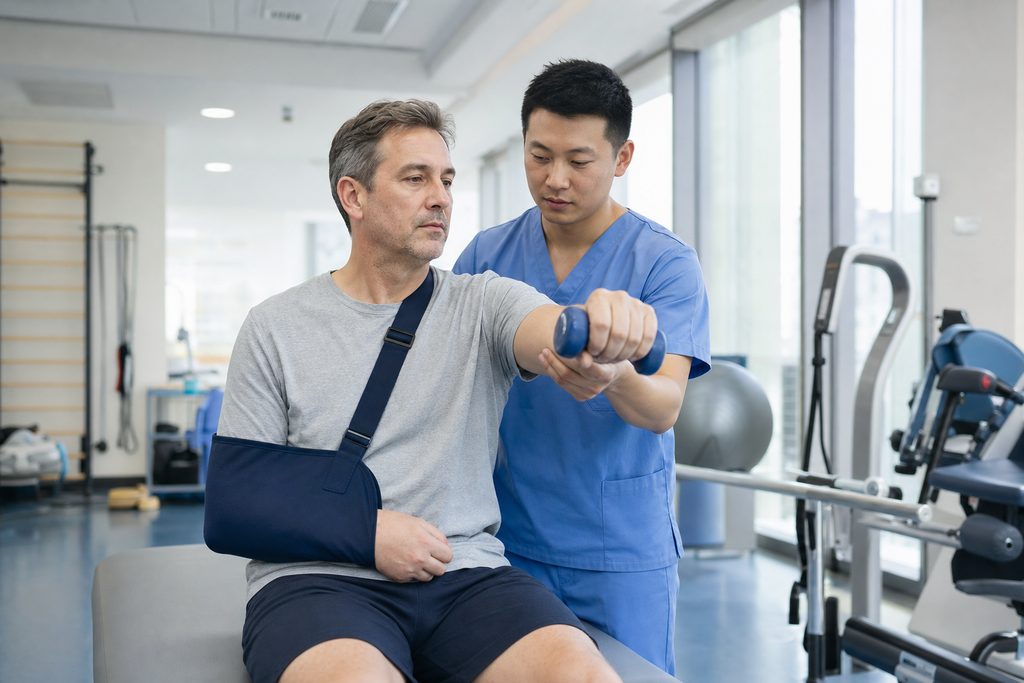
China’s top orthopedic hospitals operate differently. Physiotherapists are embedded within the surgical department. A patient who undergoes rotator cuff repair at 9 AM meets their rehabilitation therapist by the following morning. Passive range-of-motion exercises begin within 24 hours. This is protocol, not exception.
For shoulder replacement patients, the timeline is similarly aggressive. Continuous passive motion devices are applied in the recovery room. Active-assisted exercises start on day two. The surgeon and therapist review progress together daily — not through emailed reports, but in person at the bedside. This is what coordinated care actually looks like.
Patients searching for how long is physiotherapy after shoulder arthroplasty abroad often find vague answers. Here is the reality: structured, supervised physiotherapy typically runs 12 to 16 weeks post-arthroplasty in China’s integrated programs. The first 4 weeks focus on passive motion and pain control. Weeks 5 through 8 introduce active-assisted and then active exercises. Weeks 9 through 12 build strength. After week 12, patients transition to a home program with periodic check-ins. The key difference is not the timeline — it is that every phase happens under one roof with one care team.
Cost Structure: The Numbers Behind the Savings
Let us address the question directly. The rotator cuff surgery cost China ranges from $5,000 to $10,000 at top-tier public hospitals, depending on tear complexity and implant choice. Shoulder arthroplasty — total or reverse — runs $12,000 to $20,000. These figures include surgeon fees, hospital stay, and implant costs.
Compare this to the United States, where rotator cuff repair averages $25,000 to $35,000 and shoulder replacement can exceed $60,000 to $80,000. The gap is structural: lower labor costs, higher efficiency, and a hospital payment system that does not layer on the administrative overhead common in Western healthcare.
What about shoulder replacement rehab packages Shanghai patients ask about? Integrated surgical-plus-rehab packages at Shanghai hospitals typically land between $15,000 and $25,000 total — surgery, inpatient physiotherapy, and 8 to 12 weeks of outpatient follow-up included. This is not a stripped-down offering. It is the standard pathway at hospitals like Shanghai Sixth People’s Hospital and Huashan Hospital‘s sports medicine center.
Lower cost does not mean lower quality. A 2022 study comparing outcomes of reverse shoulder arthroplasty across international centers found that Chinese hospitals using modern implant systems achieved functional scores and complication rates statistically equivalent to US and European benchmarks. The implants are the same global brands — Zimmer Biomet, Stryker, DePuy Synthes. The difference is the system around them.
| Procedure | China (USD) | United States (USD) | Includes Rehab? |
|---|---|---|---|
| Rotator Cuff Repair (Arthroscopic) | $5,000 – $10,000 | $25,000 – $35,000 | Yes, integrated |
| Total Shoulder Arthroplasty | $12,000 – $18,000 | $50,000 – $70,000 | Yes, integrated |
| Reverse Shoulder Arthroplasty | $15,000 – $20,000 | $60,000 – $80,000 | Yes, integrated |
| 8-Week Outpatient Physiotherapy Package | $800 – $1,500 | $2,500 – $4,000 | Standalone |
All figures are estimates and vary by hospital, implant selection, case complexity, and length of stay. Final quotes require a formal assessment.
What You Need to Know Before Booking
We are honest about the barriers. They exist. They are manageable — but only if you know about them in advance.
- Visa Requirements: Medical treatment in China requires an S2 visa with a specific invitation letter from the treating hospital. This is not a tourist visa. Processing takes 2 to 4 weeks. The hospital must provide documentation confirming your scheduled treatment. Without a coordinator who understands this pipeline, the paperwork alone can delay treatment by months. Your accompanying family member also needs an S2 visa — not a tourist L visa, which technically does not cover medical escort purposes.
- Payment Systems: Chinese public hospitals operate on a prepaid model. You deposit funds at admission. Services are deducted daily. International credit cards are not universally accepted at public hospital counters. WeChat Pay and Alipay dominate, but linking a foreign card requires setup before arrival. Private international hospitals accept major credit cards and direct insurance billing — but their surgical fees run higher, closer to $25,000 to $40,000 for shoulder arthroplasty.
- Medical Records and Imaging: Chinese surgeons require a current MRI (within 3 months) and a full medical history translated into Chinese or English. Reports alone are insufficient — they need the original DICOM imaging files on CD or USB. Many patients arrive with printed reports and discover they must repeat imaging, adding cost and delay.
- Rehab Continuity After You Leave: This is the hardest piece. You will eventually return home. Your Chinese surgical team can provide a detailed rehab protocol in English — but your local physiotherapist must be willing to follow it. We recommend identifying a local therapist before you travel and sharing the anticipated protocol with them early. Some patients book shoulder surgery and physio package China for the initial 4 to 8 weeks, then transition to a home-country therapist with a clear handoff document.
How We Help You Navigate This
These barriers are structural. They are not personal failings. Our job is to handle them so you focus on recovery.
Before you travel, we translate and submit your medical records to matched hospitals. We verify that your imaging files are complete and compatible. We coordinate the hospital invitation letter for your S2 visa application. We confirm that your chosen hospital runs an integrated shoulder rehab unit — not a fragmented system where surgery and physiotherapy operate in separate silos.
During your stay, a bilingual medical companion accompanies you to every appointment. They handle registration, payment, queue management, and real-time translation between you and your care team. They ensure your surgeon’s rehab protocol reaches the physiotherapy team on the same floor — not via a portal days later. They sit in on your physiotherapy sessions so nothing gets lost in translation.
After you return home, we facilitate the handoff. Your discharge summary, rehab protocol, and surgeon’s notes come to you in English. We can arrange a video follow-up with your Chinese surgeon at the 6-week and 12-week marks. These consultations cost $100 to $300 and are often the difference between a smooth recovery and a stalled one.
This is case management. Not a concierge who books flights. We coordinate the clinical and logistical pieces so the surgeon and therapist work from the same plan — and you are never left guessing whether you are doing the right exercise at the right time.
Patients often ask us, is shoulder rehab after rotator cuff repair successful in China? The answer depends on coordination. The surgical techniques and implant technologies are world-class. The physiotherapy protocols are evidence-based and aggressive in the best sense — early mobilization, daily progression. But success hinges on whether the left hand knows what the right hand is doing. When it does, outcomes are excellent. A 2020 study from Huashan Hospital reported that patients completing their integrated 12-week shoulder rehab pathway after rotator cuff repair achieved a mean Constant-Murley score improvement of 42 points — comparable to outcomes reported in top US and European centers.
Frequently Asked Questions
For most patients, yes. Even with round-trip flights ($1,500–$3,000), 4 to 8 weeks of accommodation ($2,000–$5,000), and the full surgical and rehab package, the all-in cost typically lands at 40% to 60% of the US surgical fee alone. A total shoulder replacement that costs $65,000 in the US can be done, rehabbed, and fully supported in China for $25,000 to $35,000 including travel and lodging. The math holds for most cases — but we always recommend getting a personalized quote before making any decision.
This is the question we take most seriously. Before you leave China, you receive a detailed, surgeon-signed rehab protocol in English. We also schedule a video follow-up at 6 and 12 weeks post-op. If your local therapist has concerns, we can facilitate a direct video consultation between them and your Chinese surgeon. These consultations cost $100 to $300. Any consultation fee paid within 90 days of your surgery is credited in full toward on-the-ground coordination if you need to return to China for further treatment.
Look at volume and subspecialization. A hospital that performs 500 shoulder arthroscopies annually is in a different league from one that does 50. China’s Fudan University hospital rankings include a dedicated orthopedics specialty list. Hospitals like Peking University Third Hospital, Shanghai Sixth People’s Hospital, and Huashan Hospital consistently rank among the top for sports medicine and joint surgery. We can help you interpret these rankings and match you to a center that fits your specific diagnosis — rotator cuff tear size, arthritis stage, revision needs — rather than sending you to whichever hospital has the best English website. You can browse our database of top-ranked orthopedic departments to start your research.
Most US and European insurance plans do not cover elective surgery abroad. Some international health insurance policies do — especially those designed for expatriates. Chinese public hospitals require upfront payment. Private international hospitals like United Family and Jiahui can sometimes bill international insurers directly. We recommend checking with your insurer before travel and getting pre-authorization in writing if coverage exists. Our team can provide the procedural codes and documentation you need for reimbursement claims. Visit our guide to private international hospitals in China for more on insurance-compatible options.
For rotator cuff repair, plan on 4 to 6 weeks minimum. The first 2 weeks involve daily physiotherapy and wound monitoring. Weeks 3 through 6 transition to 3 to 5 sessions per week. For shoulder arthroplasty, 6 to 8 weeks is more realistic. Some patients stay the full 12 weeks to complete the entire structured rehab pathway before returning home. Your surgeon will advise based on your specific procedure and progress. We can help arrange extended-stay accommodation near your hospital — many are in Shanghai, where international patient infrastructure is well-developed.
Your Next Step
Shoulder surgery is a significant decision. The rehab that follows determines whether that decision pays off. China offers a combination that is genuinely hard to find elsewhere: high-volume surgical expertise, integrated physiotherapy from day one, and a cost structure that makes the full care pathway accessible. But coordination is everything. Without it, even the best surgeon’s work can be undone by a fragmented recovery.
If you are considering shoulder surgery abroad, start with information — not commitment. A free consultation with our team gives you a clear picture of hospital options, estimated costs, rehab timelines, and what the full journey would look like for your specific case. No pressure. Just clarity.
Medical Disclaimer: This article is for informational purposes only and does not constitute medical advice. Surgical decisions should be made in consultation with a qualified orthopedic surgeon after a thorough clinical evaluation. Outcomes vary by individual case. We do not guarantee specific surgical results or recovery timelines.
For more medical information and treatment options in China, visit chinamedservices.com (China Medical Services).
