Which Scans Are Included in a China Checkup: What You Get and Why It Costs Less
Key Takeaways
- A comprehensive screening in China typically bundles bloodwork, ultrasound, ECG, chest imaging, and often MRI or CT — for roughly $500 to $2,500 depending on the tier you choose.
- Top-tier Chinese hospitals run these scans on the same equipment Western centers use, frequently at one-fifth to one-tenth of US list prices.
- The hard part is not the medicine. It is the logistics — public hospitals rarely accept overseas bookings in advance, and almost nothing is translated for a first-time foreign visitor.
- Before you commit to any package, ask for the itemized scan list. “Full body” means different things at different hospitals.
In the United States, a self-pay whole-body MRI can run $2,500 on its own — before a single blood test. At a top-tier Chinese hospital, a screening package that includes that same MRI, plus ultrasound, ECG, and a full lab panel, often lands under $1,200. That gap is why searches for the full body checkup cost China travelers actually pay have climbed so sharply in recent years.
But cost is only half the question. The other half is what you actually get. Which scans are included? Who reads them? And can a foreigner walk in and book one?
The Problem: “Full Body Checkup” Is a Marketing Term, Not a Medical Standard
Here is the uncomfortable truth about health screening worldwide. There is no universal definition of a “full body checkup.” A clinic in Dubai, a hospital in Seoul, and a private center in Texas can all use that phrase and mean completely different things.
A 2021 analysis published in JAMA Internal Medicine found that general health checks in asymptomatic adults produced no measurable reduction in all-cause mortality. That does not mean screening is useless. It means what gets screened matters enormously. A package built around a chest X-ray and a basic metabolic panel is not the same product as one built around low-dose CT, carotid ultrasound, and tumor markers.
So when a patient asks us which scans are included in a China checkup, the honest answer is: it depends entirely on the package tier and the hospital. And that is exactly why you need to read the itemized list before you pay.
Full Body Checkup Cost China: What the Numbers Actually Look Like
Chinese hospitals structure screening in tiers. The naming varies — basic, standard, premium, VIP — but the underlying logic is consistent. Higher tiers add imaging, specialist review, and faster turnaround.
| Package Tier | Typical Price (USD) | What Is Usually Included |
|---|---|---|
| Basic screening | $150 – $400 | CBC, liver and kidney function, lipids, urinalysis, ECG, chest X-ray, abdominal ultrasound |
| Standard comprehensive | $500 – $1,000 | Everything above plus thyroid ultrasound, carotid ultrasound, tumor markers, cardiac stress ECG |
| Premium / executive | $1,200 – $2,500 | Adds low-dose chest CT, MRI of a targeted region, gastroscopy, colonoscopy, specialist consultations |
| VIP international-department | $2,500 – $5,000+ | English-speaking coordinator, same-day reporting, senior physician review, private suites |
Prices vary by hospital and case complexity, and they shift with the city. A screening in Chengdu or Xi’an generally costs less than the identical package in Shanghai or Beijing.
For a single point of comparison: an MRI at a Shanghai tertiary hospital typically runs $150 to $400. The same scan billed to insurance in the US averages closer to $1,400, according to data compiled by the International Federation of Health Plans. That is the structural gap in one number.
What Scans Are Included in a Health Checkup in China — Item by Item
Let’s break down the imaging components, because this is where packages diverge most.
Ultrasound (Sonography)
Nearly every tier includes abdominal ultrasound — liver, gallbladder, pancreas, kidneys, spleen. Standard and premium tiers add thyroid and carotid ultrasound. Ultrasound is radiation-free, fast, and operator-dependent. Chinese tertiary hospitals perform enormous volumes, which means their sonographers see a very wide range of findings.
Chest Imaging: X-Ray vs. Low-Dose CT
Basic packages use chest X-ray. Premium packages use low-dose CT, which detects pulmonary nodules far earlier. China has one of the world’s highest volumes of low-dose chest CT screening, partly because lung cancer incidence is high. If you are a former smoker over 50, the CT tier is the one worth paying for.
MRI
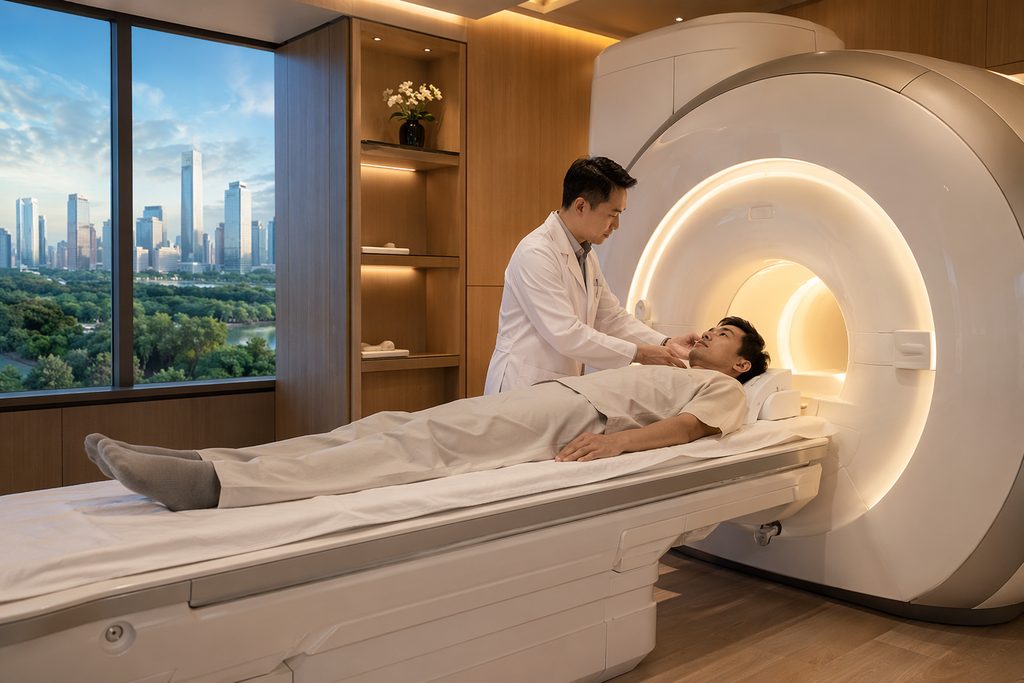
MRI is usually not part of a baseline package. It appears in premium tiers, and typically targets one region — brain, cervical spine, or abdomen. Whole-body MRI exists in China but is not standard, and reputable hospitals will tell you it generates a high rate of incidental findings that require follow-up.
Cardiac Screening
Resting ECG is universal. Stress ECG, echocardiography, and carotid ultrasound appear in higher tiers. For anyone with a family history of coronary disease, these are the components that matter.
Endoscopy
Gastroscopy and colonoscopy sit at the top of the pyramid. They require sedation, preparation, and a dedicated appointment slot. They are also, for stomach and colorectal cancer, the only screening tools that both detect and prevent disease.
Is a CT Scan in China Safe for Foreigners?
This question comes up constantly, and it deserves a direct answer.
The scanners are the same machines. Siemens, GE, Philips, and United Imaging equipment fills Chinese tertiary hospitals. Radiation doses follow international protocols, and quality-control standards at Fudan-ranked hospitals are audited.
Two practical points. First, low-dose chest CT delivers roughly 1 to 1.5 millisieverts — comparable to a few months of background radiation. Second, contrast-enhanced CT requires a kidney function check first, which any competent hospital will run automatically.
What you should watch for is unnecessary repetition. If you had a CT six months ago, bring the discs. Chinese physicians will generally accept prior imaging rather than repeat it. That saves money and radiation.
How Much Does an MRI Scan Cost in Shanghai — And Why Location Matters
Shanghai pricing sits at the higher end of the Chinese market, but still far below Western rates. A non-contrast brain MRI at a major Shanghai hospital generally falls between $200 and $450. Adding contrast pushes it toward $500. At a private international hospital such as Jiahui or United Family, expect $700 to $1,200 — higher, but with English-speaking staff and direct insurance billing.
Beijing prices are broadly similar. Guangzhou and Chengdu run 10 to 20 percent lower.
The trade-off is straightforward. Public tertiary hospitals offer the lowest prices and the deepest specialist expertise, but booking is genuinely difficult from overseas. Private international hospitals cost more and offer a smoother experience. Many of our patients split the difference: screening at a public hospital, coordination handled separately.
How to Book a Medical Checkup Package in Beijing
Here is where expectations need adjusting, and this is the part most guides leave out.
Chinese public hospitals generally do not accept advance overseas bookings for standard health checkups. The health examination center operates on a walk-in or short-notice appointment basis, and the queue is managed in Chinese. You cannot simply email a hospital and reserve a slot six weeks out.
What does work:
- International departments and VIP wings at major hospitals do accept advance scheduling, with English-speaking coordinators. Expect to pay roughly 1.5 to 2 times the standard rate.
- Private international hospitals in Beijing — United Family, for example — take bookings directly by phone or email and bill insurers directly.
- Coordinated booking through a service that handles registration, medical card creation, and on-site navigation.
Timing matters too. Chinese hospitals are busiest Monday and Tuesday mornings. A Wednesday or Thursday appointment means shorter waits and less crowded imaging suites. Results for basic panels often return within 24 hours; imaging reports take two to three days.
If you want to compare hospitals by specialty before choosing, our directory of Fudan-ranked hospitals by city groups them by tier and location, and the department-level rankings show which institutions lead in cardiology, oncology, and orthopedics.
China Health Screening Package Price Comparison: Reading the Fine Print
Two packages at the same price can deliver very different value. Here is what separates them.
Who reads the images. At a Fudan Top 100 hospital, a radiologist subspecializing in chest imaging reads your CT. At a commercial screening chain, a general radiologist may read two hundred scans a day. Volume helps, but subspecialization helps more.
Whether the report is translated. Most Chinese hospital reports are issued in Chinese only. A translated summary costs extra and is not automatic.
What happens after an abnormal finding. This is the real differentiator. A good screening package includes a pathway to specialist consultation. A cheap one hands you a report and closes the door.
Whether tumor markers are included. These blood tests are inexpensive in China and frequently bundled. Understand their limits — markers like CEA and CA19-9 are not diagnostic on their own and can produce false alarms.
Practical Considerations Before You Book
Visa. Medical travel to China uses the S2 visa, with a notation for medical treatment purposes. Stays exceeding 180 days require S1. Accompanying family members apply for S2 as well. Note that the M visa is for commercial and trade activity and is not the correct category for medical treatment. Requirements change, so confirm current rules with the nearest Chinese embassy or consulate and prepare supporting hospital documentation.
Payment. Chinese public hospitals require prepayment. International credit cards are accepted at international departments and private hospitals, but not always at standard public counters. Bring a card that works on UnionPay networks, or arrange payment through your coordinator.
Insurance. Most international insurers reimburse after the fact for public hospital care. Private international hospitals often bill directly — check your policy’s network before choosing.
Records. Bring prior imaging on disc and a translated medication list. Chinese physicians will use them.
Follow-up. Ask upfront how abnormal results will be communicated once you have returned home. A written summary you can hand to your physician at home is worth requesting.
Frequently Asked Questions
At private international hospitals and the international departments of major public hospitals, yes — English-speaking staff handle registration and results. At standard public hospital health centers, realistically no. Registration, payment, and department navigation all happen in Chinese, and there is no English signage in most facilities.
For international departments and private hospitals, two to four weeks is usually sufficient. For premium packages that include endoscopy, allow more time, since sedation slots fill quickly. Coordination services typically start around $300, and the fee is refunded in full if the appointment cannot be secured.
This is the question that matters most, and the answer depends on where you are screened. At a Fudan-ranked hospital, an abnormal finding routes directly into that hospital’s specialist system — you are already inside one of the country’s strongest clinical networks. At a standalone screening center, you receive a report and must arrange follow-up yourself. Before booking, ask explicitly: if something is found, what is the next step, and who manages it?
Imaging discs and raw data are universally readable, and most Western physicians will review them. Narrative reports written in Chinese need translation. Request both the original disc and a translated summary, and expect your home physician to want the source images rather than the report alone.
Your Next Step
The scans in a Chinese checkup are not mysterious — they are the same modalities used anywhere, delivered at a fraction of the price, with the friction concentrated entirely in logistics and language. Know what is in your package before you pay, and the rest becomes manageable.
We are China Medical Services, a coordination service — not a hospital, and we do not diagnose or treat. Our team helps international patients compare screening packages, arrange appointments at hospitals across 37 Chinese cities, and navigate the day itself in English. If you would like a straight answer on what a specific package includes and what it costs, start with a free consultation. No pressure, no obligation — just clarity before you decide.
For more medical information and treatment options in China, visit chinamedservices.com (China Medical Services).
