Abdominal Ultrasound in a China Checkup: Real Costs and Top Hospitals
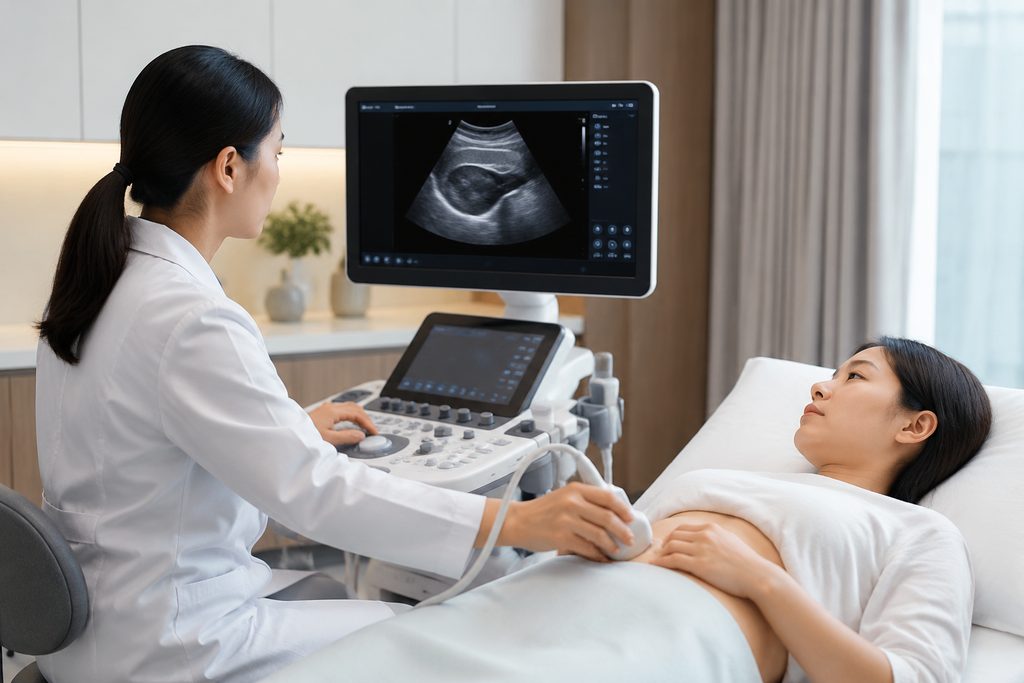
You’ve probably heard that medical care outside the West means cutting corners. With an abdominal ultrasound in a China checkup, the reality runs the other way: the equipment is often newer than what your local clinic owns, the radiologists read hundreds of scans a week, and the abdominal ultrasound cost in China is frequently one-fifth of the U.S. price. What actually trips people up isn’t quality. It’s navigation — booking, language, and knowing which hospital tier fits your situation.
Here’s the honest picture, including the parts that are genuinely inconvenient.
Abdominal Ultrasound in a China Checkup: The Short Answer
A standalone abdominal ultrasound at a Chinese public tertiary hospital typically runs $80 to $250, and results usually come back the same day or within 24 hours. At a private international hospital, expect $250 to $400, with English-speaking staff and direct insurance billing.
The scan itself takes 15 to 30 minutes. That’s the easy part. The harder part is that public hospitals generally don’t let you book an outpatient slot from overseas in advance — you queue for a same-day number, and the paperwork is entirely in Chinese. That gap is where most international patients get stuck.
Who This Is Right For — and Who It Isn’t
An abdominal ultrasound is a low-risk, non-invasive imaging study. It uses sound waves, no radiation, and it’s commonly used to look at the liver, gallbladder, pancreas, kidneys, spleen, and major abdominal blood vessels.
You’re likely a good fit if you:
- Want a baseline look at liver, gallbladder, or kidney health as part of a broader checkup
- Have known fatty liver, gallstones, or kidney stones and need periodic monitoring
- Are already traveling to China for other care and want to fold imaging into the trip
- Are comparing imaging prices abroad and want a same-week alternative
You should probably not build a trip around this if you:
- Have acute abdominal pain, fever, or jaundice — that’s an emergency, and you should be evaluated locally and immediately
- Need a diagnosis that ultrasound can’t provide. Ultrasound is operator-dependent and limited by body habitus; a CT or MRI may be the right study, and no amount of travel changes that
- Are pregnant and seeking a first-trimester scan — obstetric ultrasound is a different protocol with different specialists
- Expect a single scan to replace a full clinical workup. It won’t, and any provider implying otherwise is overselling
The Options, Compared
Three tiers dominate the landscape for foreign patients. The differences are real, and so is the price spread.
| Option | Typical Cost (USD) | Booking From Overseas | English Support | Results Turnaround |
|---|---|---|---|---|
| Public tertiary hospital, standard outpatient | $80–$150 | Generally not possible in advance | Limited or none | Same day to 24 hours |
| Public hospital international / VIP department | $150–$250 | Yes, with coordination | Yes | Same day, often with written report |
| Private international hospital | $250–$400 | Yes, online | Yes, native-level | Same day |
| Full checkup package including abdominal ultrasound | $400–$1,500 | Yes, at international departments | Varies by tier | 1–3 days for the full report |
Which column suits you depends less on budget than on how much friction you’re willing to absorb. If you read Chinese, have a local contact, and don’t mind queueing, the standard outpatient tier is genuinely cheap and the imaging quality is high. If you’re arriving from abroad with limited time, the international department tier is the pragmatic middle ground — roughly 1.5 to 2 times the standard price for a fraction of the hassle.
Where to Go: Best Hospital for Abdominal Ultrasound in Shanghai and Beyond
Shanghai is the most common entry point for international patients, and it has the deepest bench of English-capable hospitals outside Beijing. For imaging-heavy checkups, the strongest public options sit within the Fudan-ranked tertiary network — hospitals in Shanghai like Zhongshan and Ruijin handle enormous daily volumes, which means their sonographers see an unusually wide range of cases. Volume builds pattern recognition. That matters for subtle findings.
Beijing carries the largest concentration of top-tier facilities — 21 of the Fudan Top 100 sit there, versus 18 in Shanghai and 10 in Guangzhou. If your checkup is bundled with a specialist consultation, Beijing often wins on breadth.
Private international hospitals — United Family, Jiahui, Parkway, Raffles — are the other path. English-speaking staff, JCI accreditation, direct insurance billing, Western-style appointment scheduling. You pay for the convenience, and for many first-time visitors it’s worth it. Our directory of private international hospitals lists which ones accept foreign insurance directly.
One thing to know about rankings: the Fudan general hospital list publishes tiers (A++++ down to A), not individual positions. Specialty reputation lists do rank the top 10 per discipline. So “ranked among China’s top 10 for gastroenterology” is a claim we can verify. “The number three hospital in China” is not something anyone should tell you.
How Long Does an Abdominal Ultrasound Take — and What the Day Looks Like
The scan itself: 15 to 30 minutes, longer if the sonographer needs you to reposition repeatedly or if your body composition makes certain organs harder to visualize.
The full visit is a different number. At a public hospital, budget three to four hours door to door — registration, payment, waiting, scanning, waiting again for the printed report. At a private international hospital, roughly 60 to 90 minutes.
Preparation is where people make avoidable mistakes:
- Fasting: 8 to 12 hours with no food. Water is usually fine, and for some protocols you’re asked to drink 4 to 6 cups and hold it — a full bladder pushes bowel out of the way and improves the view of the pelvis.
- Medications: take them as normal unless told otherwise, with a sip of water
- Clothing: two-piece, loose. You’ll be asked to lift your shirt and lower your waistband
- Prior imaging: bring any previous ultrasound, CT, or MRI discs and reports. Comparison is most of the diagnostic value
What It Costs, and What Drives the Variance
Returning to the headline number: abdominal ultrasound cost in China clusters between $80 and $400 depending on tier. A full body checkup with abdominal ultrasound price in Beijing ranges from about $400 at a public international department to $1,500 at a premium private facility with same-day comprehensive reporting.
For context, a comparable abdominal ultrasound in the United States commonly bills $500 to $1,200 before insurance, and a comprehensive executive checkup runs $2,000 to $5,000. That’s the gap people are responding to when they search.
What moves the price:
- Hospital tier — the single biggest factor, roughly a 3x spread from standard public to premium private
- Whether it’s bundled — a standalone scan costs more per unit than the same scan inside a package
- Reporting language — an English-language written report sometimes carries a separate fee
- Add-ons — Doppler flow studies, elastography for liver stiffness, or contrast-enhanced protocols all raise the total
What’s typically included: the scan, a radiologist’s written report, and a printed or digital image set. What’s usually not: specialist consultation to interpret the findings in clinical context, translation, and any follow-up imaging.
Practical Considerations: Records, Visa, Payment, and Follow-Up
Records. Bring your prior imaging on disc, plus a written list of your medications and any relevant surgical history. If your records are in English, ask in advance whether the hospital needs certified translation — some international departments handle this internally, others don’t.
Visa. For medical travel to China, the applicable short-stay category is S2, which covers medical treatment and private affairs; stays beyond 180 days fall under S1. Accompanying family members apply under the same category. Requirements shift, so confirm current documentation with the nearest Chinese embassy or consulate and secure your hospital’s supporting letter before applying. Note that the M visa is for commercial and trade activity and has nothing to do with medical treatment — anyone telling you otherwise is misinformed.
Payment. Public hospitals require prepayment; you settle up front and seek reimbursement from your insurer afterward. Private international hospitals frequently bill insurance directly. International credit cards work at most international departments but not reliably at standard public counters — bring cash or a UnionPay-capable card as backup.
Language. China’s top hospitals handle tens of thousands of outpatient visits daily. Signage, forms, and queue announcements are in Chinese. This isn’t a reason to avoid the system, but it is a reason to plan for it.
Follow-up. Before you fly home, get the full report and image files in a format your home physician can open. Ask for DICOM files on a USB drive, not just a PDF summary. Radiologists abroad can re-read the raw images, which is often more useful than a translated report.
Frequently Asked Questions
Yes. Ultrasound uses high-frequency sound waves, not ionizing radiation, and carries no known cumulative risk. The safety question isn’t the modality — it’s the operator. Top-tier Chinese hospitals employ experienced sonographers working with modern equipment, and quality at that level is comparable to Western academic centers. Standards at small local clinics are less predictable, which is one reason tier selection matters.
At private international hospitals, yes — online booking is standard. At public hospitals, standard outpatient slots generally cannot be reserved from overseas; you take a same-day number and queue. Public hospital international and VIP departments are the exception and can often be scheduled in advance through coordination. If advance booking is essential to your trip, plan around the international department tier.
Most foreign nationals need a visa to enter China, and medical treatment falls under the S2 category with accompanying documentation. Short checkup trips are covered by the same framework. Rules vary by nationality and change periodically, so verify with the Chinese embassy or consulate in your country before booking flights. Never travel on a tourist visa intending to receive medical treatment without checking the current requirements.
International and VIP departments routinely issue English reports. Standard public outpatient departments typically issue Chinese-language reports, and you’d need a translation. If you’re relying on the report for follow-up care at home, confirm the language question before your appointment rather than after.
Your Next Step
An abdominal ultrasound is one of the least complicated procedures you can have done in China, and the cost advantage is real — often 70 to 85 percent below U.S. pricing. The complexity lives entirely in logistics: which tier, how to book, who translates, and how the report reaches your doctor back home.
We’re China Medical Services, a coordination service rather than a hospital. We don’t diagnose, and we don’t treat. What we do is match you with appropriate facilities from our database of 340+ top-ranked hospitals across 37 cities, handle appointment coordination, and provide bilingual accompaniment through the registration, payment, and reporting steps. You can start with a free consultation through our patient support page, or browse our full hospital database to see what’s available in the city you’re planning to visit. No pressure either way — most people find the information alone is enough to decide.
This article is for general information only and is not medical advice. Imaging decisions should be made with a qualified physician who knows your history. Costs and availability vary by hospital and case complexity.
For more medical information and treatment options in China, visit chinamedservices.com (China Medical Services).
