Abdominal Ultrasound in China: What to Expect and What It Costs
Key Takeaways
- An abdominal ultrasound in China typically runs $80–$250 at a top-tier public hospital — often 5–10 times less than the same scan in the United States.
- China’s best hospitals use the same ultrasound platforms (GE, Philips, Siemens) found in Western academic centers, read by physicians who perform hundreds of scans weekly.
- The real obstacle is not quality or price — it is access. Most public hospital outpatient slots cannot be reserved from abroad, and walk-in registration without Mandarin is genuinely difficult.
- Understanding the difference between a routine scan and a diagnostic workup will save you both money and time before you book anything.
The Problem: You Need a Scan, and the Wait Is Measured in Weeks
In Canada, the median wait for a diagnostic ultrasound sits around four to eight weeks in many provinces. In the UK, the NHS target of six weeks for a diagnostic test is missed regularly — Cancer Research UK has documented patients waiting well beyond that for imaging that should confirm or rule out disease. In the US, the scan itself may be quick, but the bill is not: a routine abdominal ultrasound at a hospital outpatient department can land between $500 and $1,500 before insurance adjustments.
So patients start looking elsewhere. And a growing number are looking at China.
Here is the thing most people do not realize: an abdominal ultrasound is one of the most operator-dependent imaging studies in medicine. The machine matters less than the person holding the probe. A skilled sonographer or radiologist who scans forty abdomens a day sees things a general practitioner scanning twice a week will miss. That single fact reshapes how you should think about where to get scanned — and why volume matters more than brand name.
Why China Delivers Results for Diagnostic Imaging
Clinical Volume That Sharpens Accuracy
Top Chinese hospitals are enormous by Western standards. A single tertiary hospital may perform more abdominal ultrasounds in a week than a mid-sized European hospital does in a month. That volume translates into pattern recognition — the kind that catches a subtle pancreatic lesion or a borderline biliary dilation that a lower-volume reader might dismiss.
Our database covers 340+ top-ranked hospitals across 37 cities, representing the top 5% of China’s 35,000+ hospitals as ranked by Fudan University and JCI accreditation. These are the institutions where imaging departments run at genuine scale.
Equipment and Standards You Already Recognize
Walk into the imaging department at Ruijin Hospital in Shanghai or Peking Union Medical College Hospital in Beijing and you will find the same GE Logiq, Philips EPIQ, and Siemens Acuson systems used at Massachusetts General or the Cleveland Clinic. There is no “China version” of the technology. The probes, the software, the contrast agents — identical.
What differs is throughput and price. And that difference is structural, not a quality compromise. Physician salaries in China are lower relative to Western markets, hospitals operate at higher daily patient volumes that spread equipment costs across more scans, and the public system does not carry the same administrative overhead per procedure. Lower cost here reflects economics, not corner-cutting.
The Cost Gap, in Plain Numbers
This is where the conversation usually gets interesting for international patients. The abdominal ultrasound cost in China at a top public hospital generally falls between $80 and $250 depending on the hospital tier and whether contrast or Doppler studies are included. Private international hospitals run higher — $300 to $700 — but add English-speaking staff and direct insurance billing.
| Location / Type | Typical Cost (USD) | Wait Time |
|---|---|---|
| Top public hospital, Beijing or Shanghai | $80–$250 | Same day to 3 days |
| Private international hospital (JCI) | $300–$700 | Same day to 1 week |
| United States (hospital outpatient) | $500–$1,500 | 1–4 weeks |
| United Kingdom (private) | £300–£600 (~$380–$760) | 3–10 days |
Prices vary by hospital and case complexity. A simple screening scan costs less than a full diagnostic workup with Doppler flow studies of the liver vasculature.
What Actually Happens During the Appointment
Knowing the sequence removes most of the anxiety. Here is how a standard abdominal ultrasound unfolds at a Chinese tertiary hospital.
Step 1 — Preparation. You will be asked to fast for 6–8 hours before the scan. A full bladder is often required for pelvic views, so you may be told to drink water and hold it. This is standard worldwide.
Step 2 — Registration and payment. Public hospitals require upfront payment before the exam. You register at the ultrasound department desk, pay at a cashier or self-service kiosk, then wait for your number to be called. Without Mandarin, this sequence is where most foreign patients get stuck.
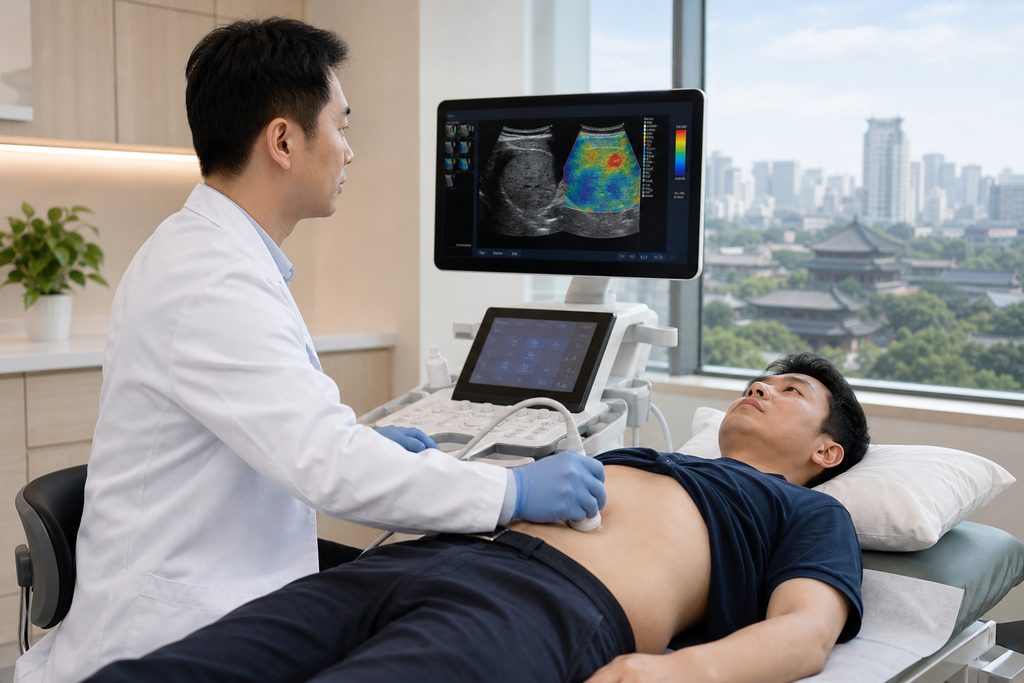
Step 3 — The scan itself. Expect 15–30 minutes. You lie supine, the sonographer applies gel, and images are captured of the liver, gallbladder, pancreas, spleen, kidneys, and major abdominal vessels. You may be asked to turn or hold your breath. Results are typically available within hours — sometimes the same day.
Step 4 — The report. You receive a written report, usually in Chinese. If you need an English version for your home physician, request it in advance — not every hospital produces one automatically.
How to Book an Abdominal Ultrasound in China as a Foreign Patient
This is the part nobody explains clearly online, so let us be direct.
Public hospital outpatient appointments generally cannot be reserved from overseas. You show up, register on the day, and queue. For a simple ultrasound this is workable if you have language support and time. For anything requiring a specialist review afterward, it becomes harder.
If you want to lock in a specific date, a specific hospital, or a specific senior physician, the realistic route is the hospital’s international department or VIP channel. These exist at most top-tier hospitals, offer English-speaking coordinators, and cost roughly 1.5 to 2 times the standard fee. That premium buys predictability, not better medicine.
As for referrals: China does not require one for most imaging. You can book an ultrasound directly without seeing a doctor first. But — and this matters — if the scan reveals something needing treatment, you will need a face-to-face consultation before any procedure can be scheduled. That is a firm rule at public hospitals.
If you would rather not navigate registration, payment, and queueing in a hospital that sees 10,000+ outpatients daily, our bilingual medical companion service handles exactly that: queueing, registration, payment, wayfinding, and translation, from $300 per day.
Is Abdominal Ultrasound Safe in China?
Yes — and the question deserves a direct answer. Ultrasound uses no ionizing radiation. It is the same physics whether performed in Houston or Hangzhou. The safety profile is identical because the technology is identical.
The legitimate concerns are different ones. Sterilization protocols at top-tier hospitals meet international standards; at smaller facilities, they may not. Probe hygiene and gel quality vary. This is precisely why we only work with hospitals in the top 5% nationally — the ones with JCI accreditation or Fudan Top 100 standing, where infection control is audited.
Another practical point: if you are pregnant or suspect you are, tell the sonographer immediately. Abdominal and pelvic ultrasound is considered safe in pregnancy, but the protocol changes.
Frequently Asked Questions
At a top public hospital in Shanghai such as Ruijin or Zhongshan, expect $80–$200 for a standard abdominal scan. Private international hospitals like Jiahui or United Family charge $350–$700 but include English-speaking staff and often direct insurance billing. Final pricing depends on whether Doppler or contrast studies are added.
No. You can book an ultrasound directly at most Chinese hospitals without a prior doctor’s referral. However, if the scan finds something requiring treatment, a face-to-face consultation is mandatory before any procedure can be arranged — this is a standard public hospital rule, not a bureaucratic hurdle you can bypass.
The imaging technology is identical — the same GE, Philips, and Siemens machines used in the US and Europe. Safety concerns, where they exist, relate to facility standards rather than the modality itself. Choosing a JCI-accredited or Fudan Top 100 hospital addresses that concern directly.
Often yes, but you must request it in advance. Not all hospitals produce English reports automatically. At international departments, English reports are standard. At public hospitals, you may need a translation service — something a bilingual companion can arrange.
A scan is a diagnostic step, not a treatment. If findings require intervention, the next step is a specialist consultation, then a treatment plan. Our team can coordinate that sequence — but we do not diagnose, and no hospital can guarantee admission or outcomes in advance.
Your Next Step
An abdominal ultrasound in China is fast, affordable, and technically on par with anything in the West — provided you choose the right hospital and solve the language and access problem before you arrive. That is the whole equation.
We are China Medical Services, a coordination service that connects international patients with top-ranked Chinese hospitals. We are not a hospital and we do not provide medical diagnoses. If you would like help identifying the right facility, understanding costs for your specific case, or arranging a specialist review, you can start with a free consultation — no obligation, no pressure. Just clarity.
For more medical information and treatment options in China, visit chinamedservices.com (China Medical Services).
