Your Checkup Day in China: A Timeline for Foreign Patients
Your Checkup Day in China: A Timeline for Foreign Patients
A comprehensive private health screening at a top-tier Western hospital often carries a price tag north of $2,500 and a scheduling backlog measured in months. In China, a comparable executive checkup at a Fudan-ranked public hospital can be arranged within days and, depending on the scope, for a fraction of that figure. That gap is exactly why so many international patients now ask us about the medical checkup cost in China before they book a flight.
What follows is the honest, hour-by-hour shape of a checkup day — plus the days before and after it. No fantasy version where everything runs on a Western schedule. A real one, with the queues, the paperwork, and the moments where a bilingual companion earns their keep.
How This Actually Works, Step by Step
The sequence rarely starts on the morning of the checkup. It starts two to four weeks earlier, usually with a message to our team describing what the patient wants screened and why.
From there, the path looks like this:
- Records and goals. The patient sends existing reports — recent bloodwork, imaging, a list of medications, family history, and any specific concerns. A 45-year-old with a father who had early colon cancer needs a different package than a 60-year-old managing hypertension.
- Hospital and package matching. Our coordinators map the request against the appropriate tier: a public tertiary hospital’s international clinic, a private international hospital, or a dedicated executive health center. This is where the checkup scope gets defined — basic panels versus advanced imaging like low-dose CT, cardiac calcium scoring, or a full tumor-marker panel.
- Appointment coordination. We register the patient, create the hospital medical card, and lock in a date. Public hospital general clinics do not accept overseas advance booking in the ordinary queue — the international or VIP channel is what makes a scheduled slot possible.
- Arrival day. The patient lands, rests, and confirms the appointment. The checkup itself typically happens the next morning, fasting.
- Results and review. Reports come back in stages. A physician walks through the findings, and if something needs follow-up, that conversation happens before the patient flies home.
That last point matters more than people expect. A screening that flags an abnormality is only useful if there is a clear next step attached to it.
What Happens During a Medical Checkup in China
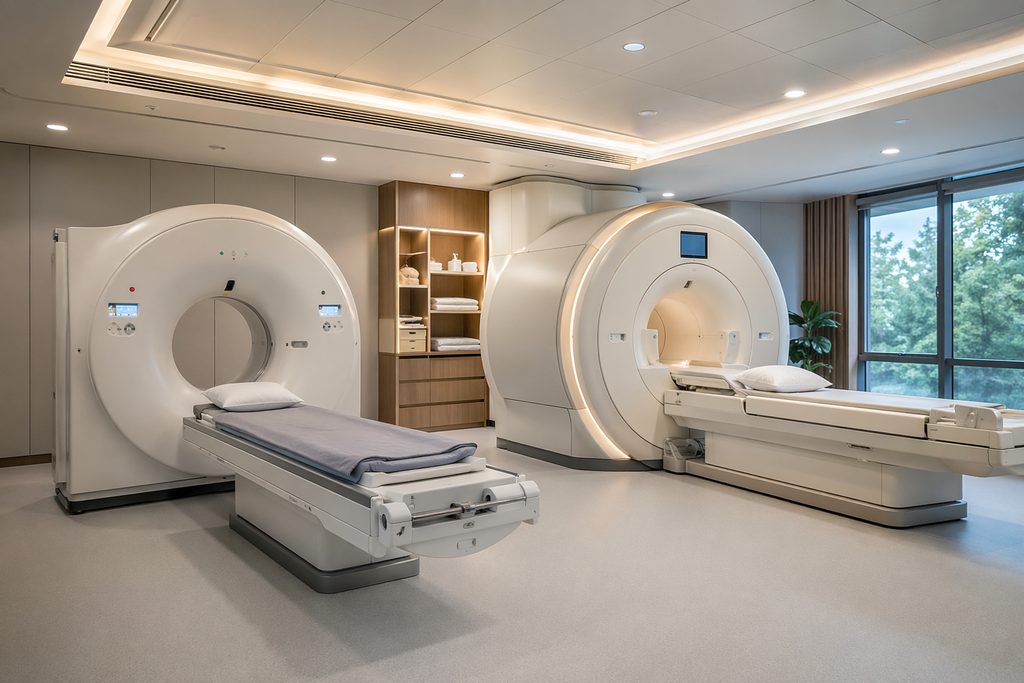
The single biggest surprise for Western patients is the pace and the choreography. Chinese executive health centers are built for volume, and a well-run one moves you through stations like a carefully designed assembly line — except the line is staffed by specialists and the equipment is often newer than what you’d find in a comparable Western clinic.
A typical morning runs roughly like this:
| Time | What Happens |
|---|---|
| 7:00–7:30 AM | Arrival, ID and passport check, registration confirmation, receipt of your checkup card |
| 7:30–8:00 AM | Fasting blood draw — complete blood count, metabolic panel, lipids, liver and kidney function, thyroid, tumor markers as ordered |
| 8:00–8:45 AM | Height, weight, blood pressure, ECG, and vision or hearing screening |
| 8:45–9:30 AM | Ultrasound suite — abdomen, thyroid, carotid, pelvic, depending on the package |
| 9:30–10:15 AM | Chest imaging (X-ray or low-dose CT), plus mammography or other modality if included |
| 10:15–11:00 AM | Physician consultation, physical exam, and review of your history and medications |
| 11:00–11:30 AM | Light meal (many centers provide one after fasting), then any remaining specialty stations |
| Early afternoon | Preliminary results discussion; some imaging and lab results arrive the same day |
So how long does a full body checkup take in China? For a standard executive package, budget three to five hours on site. Add imaging like MRI or a colonoscopy prep and it stretches to a full day or even two. The variable is never the hospital’s speed — it’s how many specialties your package touches.
A Realistic Timeline
Here is the honest version, with the waiting steps people forget.
| Stage | Typical Duration | What’s Happening |
|---|---|---|
| Initial inquiry to package proposal | 2–5 business days | Records reviewed, hospital tier matched, scope defined |
| Appointment confirmation | 3–10 business days | Registration, medical card creation, slot locked at the international clinic |
| Visa (if required) | 1–3 weeks | S2 short-stay visa for medical treatment and private affairs, subject to embassy requirements and hospital supporting documents |
| Travel and adjustment | 1–2 days | Arrival, rest, jet-lag recovery before a fasting morning |
| Checkup day | 3–5 hours (up to 2 days for complex packages) | The station sequence above |
| Preliminary results | Same day to 48 hours | Bloodwork and basic imaging often same-day; pathology takes longer |
| Full report and physician review | 3–7 days | Consolidated report, translated if needed, with recommendations |
| Follow-up appointments (if flagged) | 1–2 weeks | Specialist consultation, additional imaging, or a biopsy |
Total realistic window from first message to final report: about three to five weeks for a straightforward screening, longer if you need a visa and longer still if anything requires follow-up. Anyone promising a two-day turnaround is either selling a very thin panel or skipping the review step that makes a checkup worth doing.
What Can Go Wrong — and What Happens Then
Screening days go sideways for predictable reasons. Here’s the honest list.
The appointment isn’t actually confirmed. Public hospital general clinics work on same-day queuing, and a verbal “we’ll fit you in” is not a booking. The fix is to use the international or VIP channel, which is designed for scheduled foreign patients and typically runs 1.5 to 2 times the standard price. If a coordinator cannot produce a written confirmation with a date and time, you do not have an appointment.
A result comes back abnormal and you’re already booked to fly home. This is the most common genuine problem. The recourse is to extend the trip or authorize a proxy follow-up — a designated representative can attend an in-person visit with your materials, and any subsequent admission remains subject to hospital rules. Deciding this in advance is far cheaper than rebooking a flight.
The package turns out to be thinner than expected. Some budget “full body” packages are mostly bloodwork and an ultrasound. If the goal is genuine early detection, confirm in writing exactly which imaging modalities are included before you pay.
Language breaks down at the worst moment. A Chinese tertiary hospital can see tens of thousands of outpatients in a single day. Signage is in Chinese, the queue system is in Chinese, and the one radiologist who speaks fluent English may be off that morning. This is precisely the gap a bilingual medical companion fills.
How to Choose a Hospital and Book a Medical Checkup Package in China
Three tiers exist, and they suit different people.
Public tertiary hospitals — the Fudan-ranked institutions — offer the deepest diagnostic capability and the best value. A dedicated executive health center at one of these can deliver a thorough screening for a medical checkup cost in China that often lands between $500 and $1,500 for a standard package, and $2,000 to $5,000 for an advanced one with CT, MRI, and cardiac workup. Final pricing varies by hospital and case complexity. The tradeoff is volume: these are busy places, and the international clinic exists to smooth that, not eliminate it.
Private international hospitals carry English-speaking staff, JCI accreditation, and direct insurance billing. They are calmer, more familiar, and more expensive — often two to three times the public international-clinic rate.
Specialty-focused centers make sense when there is a specific concern. If cardiac risk runs in the family, a hospital ranked among China’s top 10 for cardiac surgery will structure the screening differently than a general executive center.
For a city-by-city view of which institutions sit in the top tier, our ranked guide to China’s top hospitals groups them by location and tier. If you already know the specialty you need — oncology, cardiology, orthopedics — the department-level rankings narrow it further.
Two mistakes recur. The first is choosing on price alone and ending up with a package that misses the one thing you actually needed screened. The second is over-buying: a 30-year-old with no symptoms does not need a full-body MRI, and a good coordinator will say so.
Practical Considerations: Records, Visa, Payment, and Follow-Up
Records. Bring prior imaging on disc or in the original digital format, not just printed reports. Chinese radiologists frequently prefer to re-read the source images, and having them saves a repeat scan.
Visa. Foreign patients traveling for medical treatment use the S2 short-stay visa, annotated for medical purposes; stays beyond 180 days fall under S1. Accompanying family members apply under the same S2 category. Requirements shift, so confirm current rules with the relevant embassy or consulate and make sure your hospital supporting documents are in order. Note that the M visa is for commercial and trade activity and has nothing to do with medical travel.
Payment. Public hospitals generally require prepayment, with insurance reimbursed afterward. Private international hospitals often bill insurers directly. Budget for the possibility that a flagged finding triggers additional testing you did not plan for.
Language. Even with an English-speaking physician, the surrounding logistics — registration, payment, pharmacy, imaging queues — run in Chinese.
Follow-up at home. Ask for your full report in English, with images, before you leave. Your physician at home will want the raw data, not a summary.
Frequently Asked Questions
Standard executive packages at public hospital international clinics commonly run from about $500 to $1,500. Advanced packages including CT, MRI, or cardiac workup typically fall between $2,000 and $5,000. Private international hospitals cost more. Final pricing varies by hospital and case complexity, so treat these as ranges, not quotes.
Yes. Appointment coordination and visa processing run in parallel, and a confirmed hospital appointment strengthens an S2 application. Just leave enough lead time — one to three weeks for the visa is realistic.
A standard package takes three to five hours on site. Packages with MRI, colonoscopy, or cardiac stress testing can require a full day or span two visits. Results arrive in stages, with a consolidated report usually within three to seven days.
The checkup flags it; a physician confirms it. Follow-up may mean an additional consultation, further imaging, or a biopsy. If treatment is recommended, admission and scheduling follow hospital rules — no service can guarantee a bed, a surgeon, or an outcome. Planning for a possible trip extension is the practical safeguard.
Not always, but often. If your package is at a private international hospital with English-speaking staff, you may manage alone. At a large public hospital, a bilingual medical companion handles registration, queuing, payment, wayfinding, and translation — typically from $300 per day, half-day or full-day.
Your Next Step
A checkup in China can be faster, more thorough, and considerably less expensive than the equivalent at home — provided the appointment is real, the package matches your actual risks, and someone is standing beside you when the language barrier hits. That is the whole game.
China Medical Services connects international patients with more than 340 top-ranked hospitals across 37 cities, and we handle the coordination, the bilingual accompaniment, and the paperwork that surrounds a screening day. We are not physicians and we do not diagnose or promise outcomes. If you’d like a straightforward conversation about what a checkup in China would look like for your situation, start with a free consultation — no pressure, no obligation.
This article is for general information only and is not medical advice. Always consult a qualified physician about your individual health needs.
For more medical information and treatment options in China, visit chinamedservices.com (China Medical Services).
