Why Mexican Patients Choose China for Spine Surgery: A Full-Service Latin America Alternative
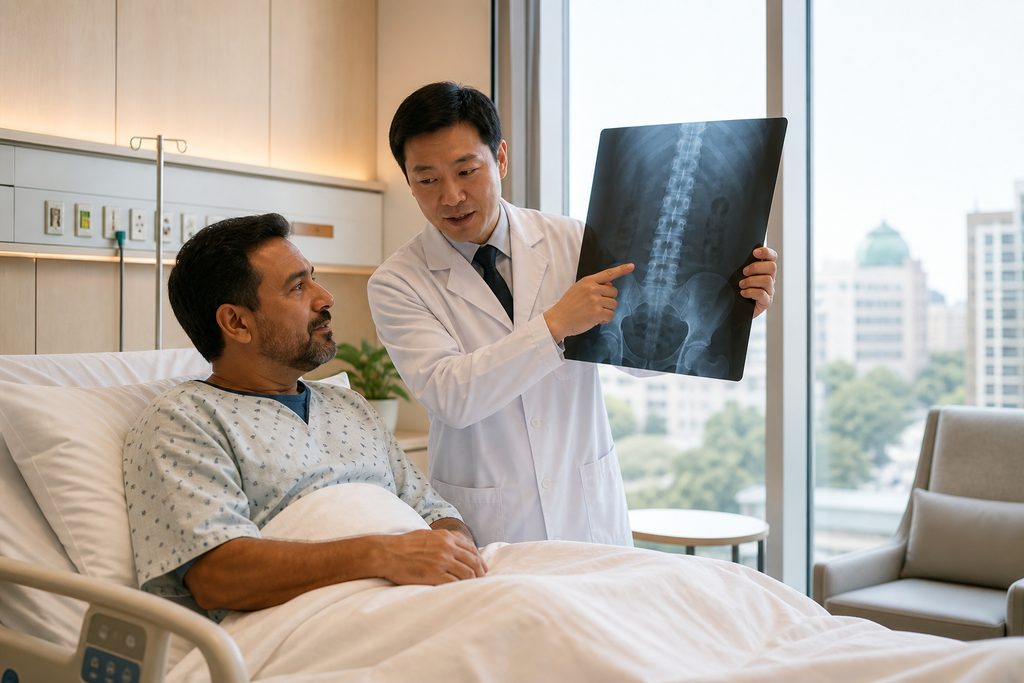
Degenerative disc disease affects approximately 40% of adults over 40 in Latin America, according to a 2023 study published in the Global Spine Journal. For many Mexicans facing quotes of $35,000 to $70,000 for a lumbar fusion in private hospitals at home, those numbers don’t just cause pain — they cause paralysis. You need the surgery. You can’t afford the surgery. So you wait. And waiting makes everything worse.
Some look north to Texas or California. Prices there start around $80,000 and climb fast. Others have asked us a different question: what about China? The spine surgery cost China vs Mexico comparison reveals something most Latin American patients never expected — a third path that combines advanced surgical volume, transparent pricing, and full-service coordination designed specifically for international patients who don’t speak Mandarin and have never set foot in Asia.
We coordinate care for patients from Mexico, Colombia, Chile, and across Latin America. The question isn’t just “how much does it cost.” The real question is whether the entire journey — from remote evaluation to recovery at home — can actually work for someone traveling from Mexico City or Monterrey. It can. Here’s exactly how.
How This Actually Works, Step by Step
You don’t book a flight and show up. That would be a disaster. The process starts from your living room, with your existing medical records. Here’s the sequence our team walks every patient through.
First, you send us your imaging and reports. MRI, CT scans, X-rays. Your orthopedic or neurosurgeon’s notes from Mexico. We translate everything into clinical Mandarin — not Google Translate, but proper medical translation that preserves diagnostic detail. This matters. A mistranslated radiology finding leads to a wrong surgical plan.
Second, your case goes to a spine surgery department at one of China’s top-tier hospitals. Not a general orthopedics department. A dedicated spinal surgery unit that handles thousands of cases annually. The team reviews your images, assesses your surgical candidacy, and delivers a written second opinion. This typically takes 5 to 7 business days.
Third, you get a treatment plan with a price range. Not a brochure price. A case-specific estimate based on your pathology, the recommended procedure, and the hospital’s international department fee schedule. If you agree to proceed, we coordinate the surgical slot. This is where the timeline gets real — and where most patients need honest guidance about what’s possible.
Fourth, you travel. We handle the hospital registration, the bilingual companion who stays with you through admission, pre-op testing, the surgery itself, and post-operative recovery. You focus on healing. We handle everything that requires Mandarin, local knowledge, and navigation of a hospital system that sees over 10,000 outpatient visits daily at major centers.
Spine Surgery Cost China vs Mexico: The Numbers That Change Decisions
Let’s look at what Mexican patients actually pay. In Mexico, private hospital pricing for a single-level lumbar fusion runs from roughly $28,000 to $65,000 depending on the city, the surgeon’s reputation, and whether you’re in Mexico City, Monterrey, or Guadalajara. Public sector care costs less but comes with wait times that can stretch beyond 18 months for non-emergency cases.
In China, through the international department of a top-ranked public hospital, the same procedure typically ranges from $18,000 to $28,000. That includes the surgeon’s fee, hospital stay, implants, anesthesia, and post-operative monitoring. It does not include your flight, accommodation outside the hospital, or our coordination service — but even with those added, the total often lands below what a Mexican private hospital charges for the surgery alone.
| Cost Component | Mexico (Private) | China (International Dept) |
|---|---|---|
| Single-level lumbar fusion | $28,000 – $65,000 | $18,000 – $28,000 |
| Cervical disc replacement | $22,000 – $45,000 | $16,000 – $24,000 |
| Pre-op diagnostics (MRI, CT, labs) | $800 – $1,500 | $400 – $700 |
| Hospital stay (per night, ward) | $300 – $600 | $80 – $150 |
| Bilingual coordination (full service) | N/A | From $300/day |
These are real ranges. They vary by hospital, by case complexity, and by implant choice. A multi-level fusion with advanced instrumentation costs more. A minimally invasive procedure at a private international hospital like those on our private hospitals page costs more than a public hospital international wing. But the pattern holds: the spine surgery cost China vs Mexico gap is wide enough to fund your flights, your companion’s travel, and weeks of recovery accommodation — and still leave savings.
A Realistic Timeline
People underestimate the calendar. They think “I’ll send my records and be in surgery next week.” That’s not how international spine surgery works. Here’s what a real timeline looks like, from first contact to walking out of the hospital.
| Stage | What Happens | Timeframe |
|---|---|---|
| Week 1 | You send medical records; we translate and submit | 3–5 business days |
| Week 2–3 | Hospital reviews case; written second opinion delivered | 5–7 business days |
| Week 3–4 | You decide; we coordinate surgical slot and issue hospital invitation letter | 3–5 business days |
| Week 4–6 | You apply for S2 visa at Chinese embassy/consulate in Mexico | 5–10 business days |
| Week 6–7 | Travel to China; pre-op testing at hospital (2–3 days) | 2–3 days |
| Week 7 | Surgery | 1 day |
| Week 7–9 | In-hospital recovery and initial rehabilitation | 5–14 days |
| Week 9–12 | Local accommodation near hospital; follow-up wound check; suture removal | 1–2 weeks |
| Month 3 | Cleared for flight home (surgeon’s assessment required) | — |
That’s 8 to 12 weeks from “I’m considering this” to “I’m flying home.” Some patients stay longer for rehabilitation. Some leave sooner if the procedure was minimally invasive. But nobody flies home the week after a lumbar fusion. Plan for at least 10 to 14 days in China after discharge — longer if you’re traveling alone.
And yes, the visa step is real. Mexican passport holders need an S2 visa for medical treatment in China. We provide the hospital invitation letter required for the application. Processing times at Chinese consulates in Mexico City and Monterrey vary. Budget two weeks minimum. Don’t book flights until the visa is in your passport.
What Can Go Wrong — and What Happens Then
This section is why you should keep reading. Because anyone who tells you international spine surgery is risk-free is either lying or has never actually coordinated it.
The surgical slot shifts. China’s top spine hospitals run at near capacity. A trauma case comes in. An emergency pushes the schedule. Your Tuesday surgery becomes Thursday. This happens. Our team’s job is to catch the change early, communicate it to you in Spanish or English, and adjust your companion schedule and accommodation without you having to navigate it alone in Mandarin.
The surgeon recommends a different procedure. The remote second opinion is based on your images. But when you arrive, the surgeon does a physical exam. Sometimes the clinical picture shifts. Maybe you need one level fused, not two. Maybe a disc replacement is possible instead of fusion. This is good news — it means the surgeon is being thorough. But it changes the plan. And the price. We’ve seen this happen. You get the new recommendation, the new estimate, and you decide.
Recovery takes longer than expected. Some patients fly home at week 3. Some need week 5. If you develop a superficial wound infection or your fusion is taking longer to stabilize, the surgeon won’t clear you for a 14-hour flight. You extend your stay. That means extra accommodation costs, extra companion days, and possibly a visa extension. Budget for this. A 20% contingency on your non-hospital budget is sensible.
The implant isn’t the brand you expected. Chinese hospitals use FDA-approved and CE-marked implants, but the brands may differ from what a Mexican surgeon would use. Medtronic, Johnson & Johnson, and Stryker are common. So are high-quality Chinese manufacturers you won’t recognize. Ask about the implant during your video consultation. Get the manufacturer name. Verify it yourself.
Is Spine Surgery in China Safe for Latinos? What the Data Shows
The question behind the search “is spine surgery in China safe for Latinos” isn’t really about ethnicity. It’s about trust. Can a hospital system 13,000 kilometers from Mexico City deliver outcomes comparable to what you’d expect at home — or better?
China’s top-tier hospitals operate at volumes that change the risk calculus. A spine surgery department at a major Fudan-ranked hospital may perform 3,000 to 5,000 spinal procedures annually. That’s more than many entire hospitals in Latin America. Surgical volume correlates with lower complication rates — this is well-established in the orthopedic literature. A 2022 meta-analysis in Spine found that hospitals performing more than 250 lumbar fusions per year had significantly lower rates of surgical site infection, hardware failure, and 30-day readmission compared to low-volume centers.
Infection control standards at JCI-accredited Chinese hospitals match international benchmarks. The top-ranked hospitals in our network are drawn from the top 5% of China’s 35,000+ hospitals, ranked by the Fudan University hospital ranking system and often holding Joint Commission International accreditation. These are not small clinics. They are massive academic medical centers with dedicated international patient departments that have treated patients from over 100 countries.
Language is the real safety concern — not clinical quality. A Spanish-speaking patient who doesn’t speak English or Mandarin faces a communication barrier that can affect everything from informed consent to post-operative pain reporting. This is where a bilingual companion becomes a safety intervention, not a luxury. Your companion translates the surgeon’s pre-op briefing. They sit with you in recovery and relay your pain scores accurately. They read the discharge instructions and make sure you understand every line before you leave the hospital.
Full Service Spinal Surgery Package China: What That Actually Includes
When Mexican patients search for a “full service spinal surgery package China,” they’re asking a practical question: can someone handle the entire logistics chain so I can focus on getting better? The answer depends on what you mean by “package.”
China does not have standardized medical tourism packages the way Thailand or India sometimes does. What exists instead is a coordinated service layer — what our team provides — that sits on top of the hospital’s clinical care. Here’s what a full-service coordination engagement typically covers for a spine surgery patient traveling from Latin America.
Pre-arrival: medical record translation, hospital and surgeon matching based on your specific pathology (degenerative disc disease, spondylolisthesis, spinal stenosis, herniated disc), remote written second opinion, video consultation with the surgical team, surgical slot coordination, hospital invitation letter for visa application, and guidance on the S2 visa process at the Chinese consulate serving your region in Mexico.
Arrival and admission: airport pickup, hotel or serviced apartment check-in near the hospital, hospital registration and medical card creation, pre-operative testing coordination (blood work, ECG, chest X-ray, any additional imaging the surgeon requires), and admission paperwork — all with a bilingual companion present.
In-hospital: daily companion visits, translation during surgeon rounds, communication with nursing staff, coordination of any additional consultations (anesthesia, cardiology clearance if needed), and assistance with hospital payment and deposit management.
Post-discharge: wound care coordination, suture removal scheduling, follow-up imaging, surgeon clearance for flight, and discharge summary translation into Spanish for your referring physician in Mexico.
This is not a fixed-price “package” because every case differs. A 35-year-old with a single-level microdiscectomy needs far less support than a 68-year-old with multi-level decompression and fusion. Our coordination fee starts from $300 per day for bilingual companion service, with hospital appointment coordination from $300. A written second opinion from a top-tier spine specialist ranges from $300 to $500. These are the building blocks. You assemble what your case requires.
Practical Considerations: Records, Visa, Payment, and Follow-Up at Home
Medical records. You need a complete imaging file — not printed films, but DICOM-format files on a CD or USB drive. MRI within the last 3 months. CT scan if your surgeon in Mexico ordered one. X-rays (standing, flexion/extension if assessing instability). Your Mexican orthopedic or neurosurgeon’s clinical notes, ideally in English or with a professional translation. If you only have Spanish-language records, budget for translation. We handle the Spanish-to-Mandarin step, but clearer source documents mean faster review.
Visa. Mexican citizens apply for an S2 visa at the Chinese Embassy in Mexico City or the Consulate General in Monterrey. You need a passport valid for at least six months beyond your planned stay, a completed visa application form, a recent passport photo, and the hospital invitation letter we provide. Processing takes 5 to 10 business days. The S2 visa is issued for short-term private affairs including medical treatment. Your accompanying family member applies for the same category. Do not apply for an M visa — that’s for commercial and trade activities, not medical care.
Payment. Chinese public hospitals require deposit payments upfront — typically 50% to 100% of the estimated procedure cost before admission. International departments accept wire transfers and major credit cards. Private international hospitals may accept direct insurance billing; public hospital international wings generally do not. You pay, then seek reimbursement from your insurer if your policy covers overseas treatment. Confirm this with your Mexican insurer before you travel. Get it in writing.
Follow-up at home. You leave China with a discharge summary, operative notes, implant card (listing the exact hardware in your spine), and post-operative instructions. Bring these to your orthopedic surgeon or neurosurgeon in Mexico. They need to know what was done, what implant was used, and what the recommended rehabilitation protocol is. Chinese surgeons are generally willing to correspond with your home physician if clinical questions arise — our team can facilitate that communication.
Frequently Asked Questions
You don’t need to travel for an initial evaluation. The process starts remotely: you send your imaging and clinical records, we translate and submit them to a spine surgery department, and you receive a written second opinion with a treatment plan and cost estimate. You can also schedule a video consultation with the surgical team to discuss your case face-to-face before committing to travel. This remote evaluation path is how most of our Latin American patients begin. It saves you an expensive scouting trip and gives you a concrete plan before you book a flight.
Plan for six to ten weeks total. That breaks down as: two to three days of pre-operative testing after arrival, one day for surgery, five to fourteen days in the hospital, and then two to four weeks in local accommodation near the hospital for wound checks, suture removal, and initial recovery. Your surgeon must clear you for flight — typically around four to six weeks post-op for a lumbar fusion. Some patients stay longer if they want supervised rehabilitation before flying home. A cervical procedure may allow earlier departure. Your surgeon makes the call, not a calendar.
What is the best spine hospital in China for international patients?
There is no single “best” — the right hospital depends on your specific condition. For complex spinal deformity and scoliosis, Peking Union Medical College Hospital (PUMC) in Beijing has one of the world
For more medical information and treatment options in China, visit chinamedservices.com (China Medical Services).
