Gastroscopy Prep in China: Fasting Rules, Costs, and Booking
Gastroscopy Prep in China: Fasting Rules, Costs, and How to Book
Digestive complaints are among the most common reasons international patients seek care in China. Each year, hospitals in Beijing and Shanghai report that a meaningful share of their endoscopy volume now comes from overseas visitors — and the single most frequent question our team receives before a procedure is simple: what are the fasting rules? If you are researching gastroscopy cost China figures or trying to understand how long do you fast before a gastroscopy, this guide walks you through the entire process, from preparation to recovery, in plain English.
Here is the short answer: for a standard diagnostic gastroscopy, you should fast for at least 6 to 8 hours before the procedure. Most Chinese hospitals ask for nothing by mouth after midnight if your appointment is in the morning. Water is usually permitted up to 4 hours before, but always confirm with your specific facility.
That is the headline. The rest of this article covers the details that actually matter — how the prep differs for sedation, what to expect on the day, realistic costs, and how to arrange everything when you do not speak Mandarin.
How This Actually Works, Step by Step
If you are coming from abroad, the process is more structured than you might expect. Here is the real sequence, based on how our team coordinates cases with Chinese hospitals every week.
Step 1 — You send your existing records. This includes any prior endoscopy reports, blood work, imaging, and a summary of your symptoms. Our team translates these into a format the Chinese hospital’s international department can review.
Step 2 — A specialist reviews your file. The relevant gastroenterology department assesses whether a gastroscopy is appropriate, whether sedation is advisable, and whether any additional tests (like a Helicobacter pylori breath test or biopsy) should be planned.
Step 3 — You receive a written second opinion or a video consultation. This is where the plan becomes concrete. You will know the recommended approach, the estimated cost, and the timeline before you book a flight.
Step 4 — Appointment coordination. Once you agree, we assist with hospital registration, creation of your medical card, and scheduling through the international or VIP channel. Public hospital general outpatient slots cannot be reserved from overseas in advance — this is a hard rule in most Chinese public hospitals. The international department is the practical route for visitors.
Step 5 — You arrive, prep, and have the procedure. A bilingual companion can meet you at the hospital, help with check-in, payment, and translation during the consent process.
The Fasting Rules in Detail — and Why They Matter
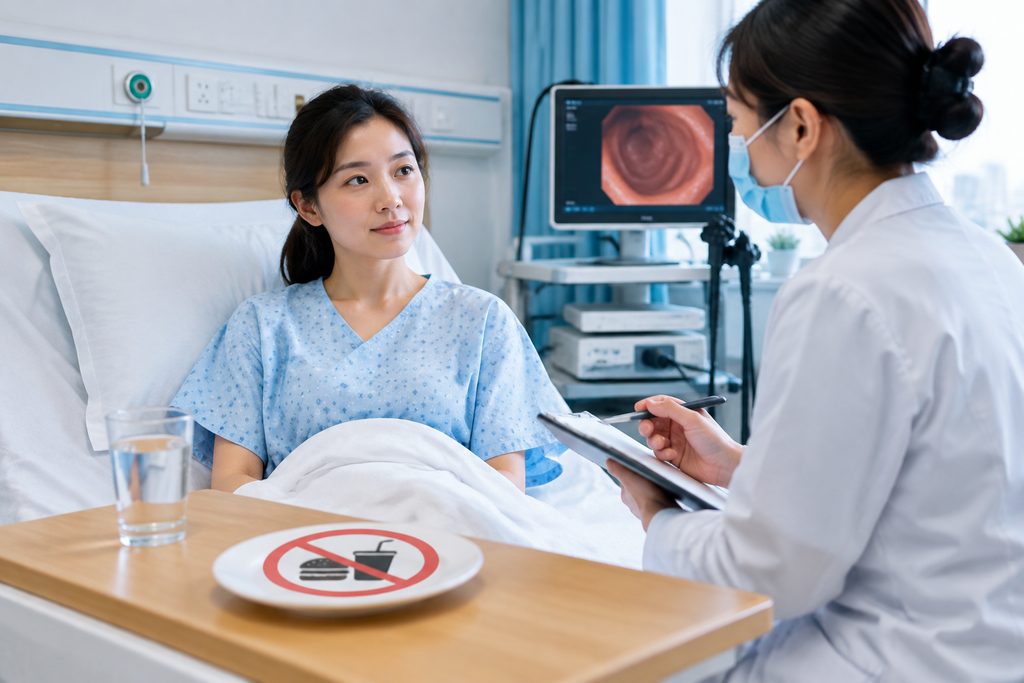
The fasting requirement exists for two reasons: an empty stomach gives the endoscopist a clear view of the esophageal and gastric lining, and it reduces the risk of aspiration if sedation is used. Both are safety issues, not bureaucratic formalities.
Standard guidance from Chinese hospitals generally follows this pattern:
- Solids: stop eating 8 hours before the procedure
- Clear liquids: permitted up to 4 hours before, unless otherwise instructed
- Morning appointments: nothing by mouth after midnight is the most common instruction
- Afternoon appointments: a light early breakfast may be allowed, but this varies by hospital — confirm in writing
For patients with diabetes, the fasting window requires extra planning. Insulin timing may need adjustment, and this should be discussed with the prescribing physician and the endoscopy team in advance. Chinese hospitals will typically ask about diabetes history during pre-procedure screening.
One more point that surprises many international patients: if a biopsy or polyp removal is planned, you may be asked to pause blood-thinning medications for several days beforehand. This is not a decision to make on your own. The gastroenterology team will give specific instructions based on your medication list.
Endoscopy Prep Instructions Fasting China: What Else Besides Fasting?
Fasting is the core requirement, but it is not the only one. Here is what a typical endoscopy prep instructions fasting China protocol includes, based on what our partner hospitals consistently request.
Arrive early. Most hospitals ask patients to check in 30 to 60 minutes before the scheduled time. This allows for registration, payment, and pre-procedure vitals.
Bring your identification and records. Your passport, any prior reports, and a list of current medications — ideally translated into Chinese if possible. Our team handles translation as part of coordination.
Arrange for someone to accompany you if sedation is used. You should not drive or travel alone after a sedated procedure. If you are coming alone from overseas, a bilingual companion service can fill this role.
Wear loose, comfortable clothing. You will be asked to remove glasses, dentures, and any jewelry before the procedure.
Expect the procedure itself to take 10 to 20 minutes. Recovery from sedation usually takes another 30 to 60 minutes. Most patients are discharged within two to three hours of arrival.
Is Gastroscopy Safe in China Hospitals? What the Data Shows
This is a fair question, and it deserves a direct answer. China’s top-tier hospitals perform gastroscopy at very high volumes. Fuwai Hospital, for example, is known globally for its cardiac surgery volume — more than 14,000 procedures annually — and that kind of high-volume infrastructure extends across major specialties at the country’s leading institutions.
The hospitals in our network are drawn from the top 5% of China’s 35,000+ hospitals, ranked by the Fudan University hospital rankings and JCI accreditation. These are not small clinics. They are large, modern facilities with dedicated endoscopy centers, standardized sedation protocols, and infection-control standards that meet international benchmarks.
That said, safety is not only about the hospital. It is also about preparation. Patients who follow fasting instructions correctly, disclose their full medication list, and arrange proper post-sedation support have the smoothest experience. Patients who skip steps — eating too close to the procedure, not disclosing blood thinners — create avoidable risks.
A Realistic Timeline
Here is what the process looks like from first contact to follow-up, based on typical coordination timelines our team sees.
| Stage | Typical Duration | What Happens |
|---|---|---|
| Records submission and translation | 2–5 business days | You send reports; our team translates and prepares a summary for the hospital |
| Specialist review / written second opinion | 3–7 business days | A gastroenterologist reviews your file and provides recommendations |
| Video consultation (if requested) | Scheduled within 1–2 weeks | You speak with the medical team to discuss symptoms and goals |
| Appointment coordination | 1–2 weeks lead time | Hospital registration, medical card creation, scheduling through international channel |
| Visa processing (S2) | 1–3 weeks, varies by consulate | Short-stay visa for medical treatment; family companions apply for S2 as well |
| Travel and procedure | 2–4 days on the ground | Arrival, pre-procedure check, gastroscopy, recovery, discharge |
| Results and follow-up | 3–10 days for biopsy results | Pathology report issued; follow-up consultation arranged |
The waiting steps people forget: document translation, hospital appointment lead time, and visa processing. If you are planning around a work schedule or a family obligation, build in a buffer of at least three to four weeks from first contact to procedure date.
What Can Go Wrong — and What Happens Then
Honest failure modes matter more than optimistic promises. Here is what can go sideways, and what the recourse looks like.
Your appointment cannot be confirmed. Public hospital general outpatient slots are not reservable from overseas in advance. If you are working through the international department, this is less of an issue, but scheduling can still shift. Our coordination service operates on a clear term: if we cannot secure the appointment you requested, the coordination fee is refunded in full.
Your visa is delayed. S2 visa processing times vary by consulate and by season. If your procedure date is tight, a delay can force rescheduling. Build in extra time. No service can guarantee visa approval — that decision rests with the consulate.
The procedure reveals something unexpected. A gastroscopy may find an ulcer, a polyp, or a lesion that requires biopsy or further investigation. This is not a failure of planning — it is the purpose of the test. The hospital will discuss next steps, and our team can help coordinate any follow-up appointments or additional consultations.
Sedation does not agree with you. Adverse reactions are uncommon but possible. Chinese hospitals are equipped to manage them, and patients are monitored during recovery. If you have a history of anesthesia complications, disclose it early.
Language barriers cause confusion. This is the most common friction point. Consent forms, prep instructions, and discharge summaries are typically in Chinese. A bilingual medical companion can prevent misunderstandings that lead to missed instructions or unnecessary stress.
What Does a Gastroscopy Cost in China?
For international patients, gastroscopy cost China figures vary widely depending on the hospital, the city, and whether sedation or biopsy is included. As a general reference, a standard diagnostic gastroscopy at a top-tier public hospital’s international department typically falls in the range of a few hundred dollars, while private international hospitals charge more. Biopsy and pathology fees are usually separate.
Compared to the United States, where a diagnostic gastroscopy can run into the thousands of dollars even before pathology, the cost difference is substantial. This is one reason medical travelers consider China for endoscopic procedures. But cost should never be the only factor. Hospital quality, endoscopist experience, and follow-up care matter more.
For a gastroscopy package price Beijing or a comparable quote in Shanghai, the honest answer is that pricing depends on the specific hospital and what the package includes. Some hospitals offer bundled screening packages that combine gastroscopy with other tests. Our team can request itemized quotes from multiple hospitals so you can compare like for like.
If you want to book gastroscopy appointment Shanghai or Beijing, the practical route for international patients is through the hospital’s international department or a coordination service that works with those departments directly. General outpatient registration is not designed for overseas scheduling.
Practical Considerations: Records, Visa, Payment, and Follow-Up
Records. Bring everything. Prior endoscopy reports, biopsy results, medication lists, and allergy information. If your records are in English, translation into Chinese is usually required. Our team handles this as part of coordination.
Visa. The S2 visa is the applicable short-stay category for medical treatment and private affairs, subject to the latest embassy or consulate requirements and supporting hospital documents. Family members accompanying you also apply for S2. The M visa is for commercial and trade activities and is not the correct category for medical travel.
Payment. Public hospitals generally require prepayment, with insurance reimbursement handled afterward. Private international hospitals often bill insurance directly. Confirm the payment process before you arrive.
Language. This is where most international patients underestimate the challenge. Chinese top-tier hospitals are enormous — some see tens of thousands of outpatients daily. Without Mandarin, navigating registration, payment, and pre-procedure instructions is genuinely difficult. A bilingual medical companion can make the difference between a smooth experience and a stressful one.
Follow-up at home. If a biopsy is taken, results may take several days. Arrange for the pathology report to be translated and sent to your home physician. This ensures continuity of care after you return.
For a broader look at how hospital selection works across specialties, our department-by-department rankings page lists top hospitals for gastroenterology and related fields. If you are comparing cities, the Fudan-ranked hospital directory groups facilities by location and tier.
Frequently Asked Questions
At least 6 to 8 hours for solid food. Most Chinese hospitals ask for nothing by mouth after midnight for morning appointments. Clear water is often allowed up to 4 hours before, but confirm with your specific hospital.
It is possible through a hospital’s international department, but the process is much smoother with bilingual support. Consent forms, prep instructions, and discharge summaries are typically in Chinese. A medical companion can translate and help you navigate registration and payment.
Top-tier Chinese hospitals perform gastroscopy at high volumes with standardized protocols. Safety depends on both the facility and your preparation — following fasting rules, disclosing medications, and arranging post-sedation support all reduce risk.
Costs vary by hospital, city, and whether sedation or biopsy is included. Top public hospitals’ international departments are generally more affordable than private international hospitals. Request an itemized quote so you can compare accurately.
The S2 visa is the applicable short-stay category for medical treatment, subject to consulate requirements and supporting hospital documents. Accompanying family members also apply for S2. Approval is never guaranteed.
Your Next Step
The core message is simple: gastroscopy prep in China is manageable if you know the fasting rules, plan for translation and scheduling lead time, and choose a hospital that fits your needs. The procedure itself is quick and well-tolerated by most patients. The logistics are what require attention.
Our team at China Medical Services helps international patients navigate exactly this kind of process — from records translation and written second opinions to appointment coordination and bilingual hospital accompaniment. We are not a hospital and we do not provide medical advice. We are the bridge between you and the medical team.
If you would like to understand your options before committing to travel, a free consultation is the lowest-pressure way to start. No obligation, no sales pitch — just a conversation about what is possible.
For more medical information and treatment options in China, visit chinamedservices.com (China Medical Services).
