Tianjin Cancer Hospital International Patient Service: Northern China Oncology Treatment Hub
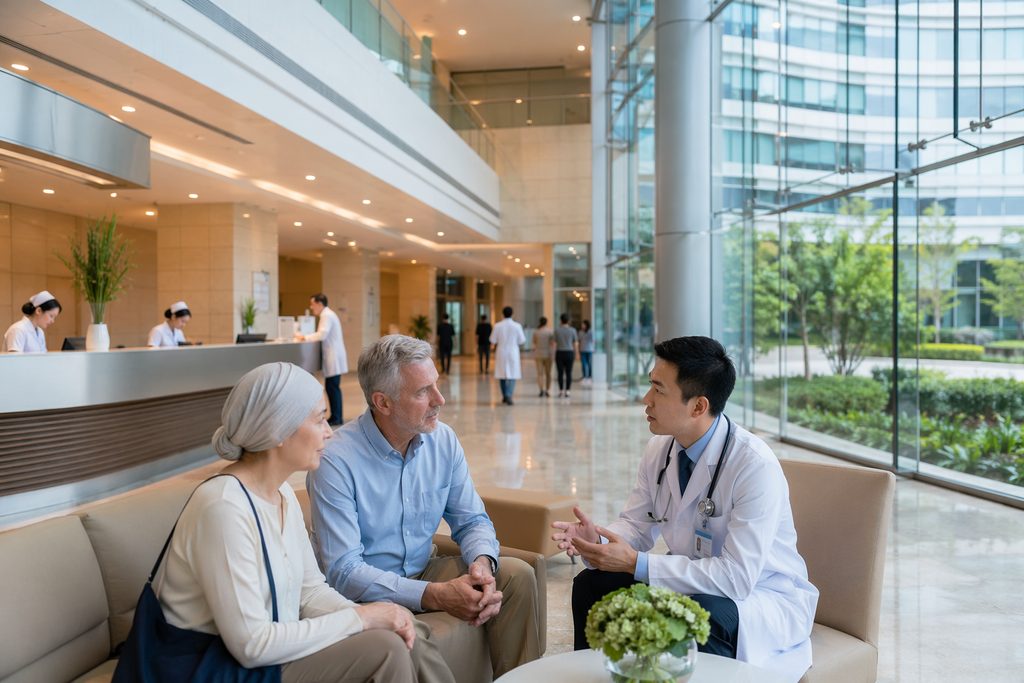
When 54-year-old Elena from London first heard the word “glioblastoma,” she didn’t sleep for three nights. The NHS oncologist was clear about the standard protocol. But the waiting list for the next phase of her radiotherapy stretched into weeks that felt like months. Elena started searching. Late one night, she typed “cancer treatment in China cost” into her phone. She landed on a name she had never heard before: the Tianjin Medical University Cancer Institute and Hospital. A public institution in northern China performing over 40,000 cancer surgeries a year. She had questions. Lots of them. What would it cost? Could she even get in? Would they speak English?
Her questions are the reason this page exists.
Key Takeaways
- Tianjin Cancer Hospital is one of China’s largest dedicated oncology centers, with over 2,400 beds and a clinical volume that dwarfs most Western cancer institutes.
- International patients access care through a dedicated department, but you cannot simply book a surgery slot online — a formal medical review and in-person consultation come first.
- The estimated cost of complex oncology treatment here typically ranges from 30% to 50% of what it would cost in the US or UK, but getting an exact figure before a case review is impossible.
- The biggest barrier for foreign patients is not medical quality — it is navigating a purely Chinese-language hospital system without local logistical support.
The Problem: Cancer Care Costs Are Breaking People — And Wait Times Are Not Helping
Cancer does not wait. But healthcare systems often make patients do exactly that. In Canada, the median wait time between specialist referral and treatment initiation for oncology cases reached 27.4 weeks in 2023, according to the Fraser Institute. In the UK, NHS England reported that only 65.2% of patients started their first cancer treatment within 62 days of an urgent GP referral — well below the 85% operational target. For someone with an aggressive malignancy, delays of this magnitude are not just frustrating. They are clinically consequential. And then there is the financial side. The American Cancer Society notes that 42% of newly diagnosed cancer patients in the US deplete their entire life savings within two years of starting treatment. Out-of-pocket costs for a single course of immunotherapy can exceed $150,000. These numbers are not abstractions. They are the reason patients like Elena start looking across borders.
Northern China has emerged as a serious option in the medical travel conversation. Not because it is cheap. Because it is concentrated. High clinical volume. Streamlined diagnostic pathways. And one institution anchors the entire region’s oncology reputation.
Who We Are
We are China Medical Services. We are not a hospital. We do not provide medical treatment, offer clinical diagnoses, or make promises about outcomes. What we do is build the bridge between you and China’s top-tier oncology institutions. Our team handles hospital matching, appointment coordination, bilingual medical companion services, visa guidance, and on-the-ground logistics. We work across a network of over 340 top-ranked hospitals in 37 cities. When a patient contacts us asking about the Tianjin Cancer Hospital international patient price list, we do not quote a generic brochure. We ask for medical records first. Then we talk to the hospital’s international department. Then we come back to you with real numbers — not estimates pulled from a website. That distinction matters.
Why Tianjin Cancer Hospital Commands Attention Among International Patients
Sheer Clinical Volume Drives Pattern Recognition
Tianjin Medical University Cancer Institute and Hospital (TMUCIH) is not a general hospital with a cancer ward. It is a dedicated oncology fortress. The institution houses over 2,400 inpatient beds and runs 43 clinical departments, all focused on malignancy. In a single year, the hospital performs more than 40,000 cancer surgeries and delivers over 300,000 radiotherapy fractions. Those numbers matter because oncology is a field where pattern recognition — seeing thousands of rare presentations — directly influences diagnostic accuracy and treatment planning. A surgical oncologist here may perform more esophagectomies in one month than a counterpart at a regional US center performs in an entire year. Volume does not guarantee better outcomes. But the correlation between case volume and survival rates for complex cancer surgeries is well-documented in the surgical literature. That is the clinical reality patients are tapping into when they search for how to get cancer treatment at Tianjin Cancer Hospital as a foreigner.
Technology Concentrated in One Campus
Scattered across the hospital’s campus is equipment that many Western centers share across multiple institutions. The radiotherapy department operates multiple linear accelerators, including stereotactic radiosurgery platforms for brain and spinal tumors. The surgical suites are equipped for robotic-assisted procedures. The pathology labs run next-generation sequencing for targeted therapy matching. But the operational difference is speed. A patient arriving for a first consultation can often complete imaging, biopsy review, and molecular profiling within a compressed window — sometimes days, not weeks. This is not because the hospital is magical. It is because the entire diagnostic pipeline sits under one administrative roof. No referrals to external imaging centers. No waiting for a separate molecular tumor board to convene. The system is built for throughput. For international patients asking is Tianjin Cancer Hospital good for international patients, the answer is nuanced: clinically, it is formidable. Operationally, for someone without local language skills, it is nearly impossible to navigate alone.
The Cost Structure: Why Northern China Oncology Treatment Costs Less
Let us address the question that brings most patients to this page. The Tianjin Cancer Hospital international patient price list is not a fixed document published online. It varies by diagnosis, stage, treatment modality, and whether the patient accesses care through the standard public channel or the hospital’s VIP international department. But we can provide benchmarks based on cases we have coordinated. A course of intensity-modulated radiotherapy (IMRT) for head and neck cancer typically ranges from $8,000 to $15,000. A complex surgical oncology procedure — say, a radical gastrectomy with lymph node dissection — may run $12,000 to $22,000. Chemotherapy protocols vary enormously depending on drug selection, but a six-cycle regimen using standard agents often falls between $6,000 and $18,000. Compare these figures to US cash-pay rates: the same IMRT course can exceed $60,000. The same gastrectomy can exceed $80,000. The cost gap is structural. Chinese hospital systems operate on lower labor costs. Pharmaceutical pricing is negotiated differently. And the sheer volume of patients spreads fixed equipment costs across more cases. Lower cost does not mean lower quality. It means a different economic model.
| Treatment Type | Estimated Cost at TMUCIH (USD) | Approximate US Cash-Pay Range (USD) |
|---|---|---|
| IMRT Radiotherapy (Head & Neck) | $8,000 – $15,000 | $50,000 – $80,000 |
| Radical Gastrectomy | $12,000 – $22,000 | $60,000 – $100,000 |
| Standard Chemotherapy (6 cycles) | $6,000 – $18,000 | $30,000 – $90,000 |
| PET-CT Scan | $600 – $900 | $2,500 – $5,000 |
These figures are indicative. They come from cases we have coordinated. Your cost will depend on your specific diagnosis, the treatment protocol the oncology team recommends, and the channel through which you access care. Anyone quoting you a firm price before reviewing your medical records is guessing.
What You Need to Know Before Going Alone
We have walked patients through the doors of this hospital. We have also seen what happens when someone tries to navigate it solo. Here is the honest picture.
- Language Barrier: The hospital’s clinical staff communicate almost exclusively in Mandarin. Medical records, consent forms, billing documents — all in Chinese. The international department has some English-speaking coordinators, but they are not available to interpret during every consultation or treatment session. Walking into this building without a bilingual medical companion means relying on hand gestures during conversations about chemotherapy dosing.
- Payment Systems: The hospital does not accept foreign credit cards at the standard cashier windows. International patients typically pay via wire transfer or through the international department’s separate billing channel. WeChat Pay and Alipay dominate on-site transactions. If your mobile payment setup is not configured before arrival, you will hit a wall at the pharmacy counter.
- Appointment Reality: You cannot email the hospital and book an appointment with a specific oncology professor. The public registration system requires in-person queueing for same-day slots. The international department can pre-arrange consultations, but this requires medical record submission, translation into Chinese, and a review by the receiving department before any date is confirmed. The phrase book appointment Tianjin Cancer Hospital medical tourism sounds straightforward. It is not. It is a multi-step, multi-week coordination process.
- Medical Records and Imaging: The hospital requires hard copies of pathology slides for review — not just digital reports. Tissue blocks or unstained slides must be physically delivered. Radiology images should arrive in DICOM format on a CD or USB drive. Paper reports without source images are often deemed insufficient for treatment planning. This is not bureaucratic stubbornness. It is a clinical safety standard. But it catches many international patients off guard.
How We Help You Navigate This
These barriers are not designed to exclude foreign patients. They exist because the hospital was built to serve a domestic population of over one billion people, where Mandarin fluency and local payment infrastructure are assumed. Our role is to bridge that gap.
Before you travel, we collect your medical records, coordinate certified translation into Chinese, and submit the package to the international department for preliminary review. We do not promise you will be accepted — that decision rests with the receiving oncologist. But we ensure your case is presented completely and professionally. Once a treatment plan is confirmed, we handle the scheduling, the visa invitation letter (S2 visa for medical treatment and accompanying family members), and the logistical scaffolding: airport transfers, accommodation near the hospital, and a bilingual medical companion who stays with you during every consultation, every procedure, every billing interaction.
During treatment, our companion does not just translate words. They translate context. They explain why a certain test is being ordered, what the doctor’s hesitation might mean, and how to navigate the pharmacy queue efficiently. After treatment concludes, we coordinate follow-up communication with the hospital and arrange for medical record consolidation in English for your home oncologist.
We have coordinated cases at this hospital for patients from the UK, Australia, the Middle East, and Southeast Asia. The cost of oncology treatment at Tianjin Cancer Hospital varies case by case — but the process for accessing it follows a consistent pattern. We know that pattern. That is the value we provide.
Frequently Asked Questions
There is no single published price list. The hospital’s international department provides cost estimates on a case-by-case basis after reviewing medical records. The estimate typically covers the treatment itself — surgery, radiotherapy, or chemotherapy — but may not include accommodation, interpretation services, or post-discharge medications. We help patients obtain a detailed cost breakdown before committing to travel. Expect the final number to be an estimate, not a fixed quote, because clinical needs can shift once treatment begins.
The pathway starts with medical record submission. You cannot book a consultation without first providing pathology reports, imaging, and a clinical summary — translated into Chinese. The hospital’s receiving department reviews these materials and decides whether to accept the case. If accepted, the international department issues an invitation letter for your S2 visa application. You then travel for an in-person consultation, after which the treatment schedule is finalized. This process typically takes three to six weeks from initial submission to confirmed appointment. We manage every step of it.
Clinically, yes — it is ranked among China’s top oncology institutions and is a major national clinical research center for cancer. The hospital participates in international clinical trials and maintains academic collaborations with oncology centers in the US, Japan, and Europe. Operationally, it is challenging for international patients without support. English signage is limited. Billing systems assume domestic payment methods. The international department exists and is professional, but its capacity is finite. Patients who arrive with a bilingual companion and pre-arranged logistics have a fundamentally different experience than those who do not.
The hospital does not market a standardized “package” in the way some medical tourism facilitators in Southeast Asia do. What the international department can provide is a coordinated care pathway: pre-arranged consultations, VIP ward accommodations (subject to availability), and a dedicated coordinator. The cost of this coordinated pathway is higher than the standard public channel — typically 1.5 to 2 times the standard rate — because it includes priority scheduling and English-language coordination. We help patients understand whether this premium channel makes sense for their specific situation.
This is common in oncology. A scan reveals something the initial records did not show. A biopsy comes back with unexpected molecular markers. The treatment plan shifts. When this happens, the hospital’s international department issues a revised cost estimate. We help the patient understand what changed, why, and what the financial implications are. There is no contractual lock-in. You retain the right to decline additional treatment and return home. But having someone on the ground who can explain the clinical reasoning in your native language — in real time — makes a disorienting situation manageable.
Your Next Step
Elena did come to Tianjin. She completed her radiotherapy course. Her follow-up scans are stable. Her path was not simple — but it was possible because someone handled the logistics before she boarded the plane. If you are researching the Tianjin Cancer Hospital international patient price list, you are probably trying to solve a hard equation: clinical quality, cost, and speed. This institution delivers on all three. But only if you can get through the door. We can help with that part. Contact our team for a free consultation — we will review your case, explain the likely pathway and costs, and tell you honestly whether this hospital makes sense for your diagnosis. No pressure. Just clarity.
Medical Disclaimer: This article is for informational purposes only and does not constitute medical advice. Treatment decisions should be made in consultation with a qualified oncologist. Costs cited are estimates based on cases we have coordinated and may vary significantly depending on individual clinical circumstances.
For more medical information and treatment options in China, visit chinamedservices.com (China Medical Services).
