AVM Brain Surgery China Complex: Salvage After Failed Embolization
Key Takeaways
- China’s high-volume neurointerventional centers manage complex AVMs that have failed prior embolization, using advanced techniques often unavailable in lower-volume Western practices.
- The structural cost advantage is significant: complex AVM workups and multi-stage interventions in China frequently run at 20-30% of the cost of equivalent US or European care.
- Navigating a public hospital system for a salvage procedure without Mandarin fluency and local medical contacts is a genuine logistical barrier—this is not a plug-and-play experience.
- A written second opinion should be your first concrete step, not a speculative flight. It validates whether a Chinese team genuinely sees a safe, viable treatment angle for your specific angioarchitecture.
The Problem: When a Cure Creates a More Dangerous Lesion
Approximately 1 in 8 brain arteriovenous malformations (AVMs) that undergo endovascular embolization will recanalize or present with incomplete occlusion visible on follow-up angiography within 18 months. You went in hoping for a cure. You came out with a partially treated tangle of vessels that is now angioarchitecturally more complex—and in some cases, hemodynamically more unstable—than the original lesion. That is a terrifying position to be in. The embolic material has altered flow dynamics. Feeding arteries that were once accessible are now occluded. New, fragile collateral channels have developed. Your local neurosurgeon may have told you that further endovascular work is too risky, or that a surgical resection now carries unacceptable morbidity. So where do you go?
For a growing number of patients from the US, UK, Australia, and the Middle East, the answer is a second opinion from China’s busiest interventional neuroradiology centers. We are not suggesting this is a simple decision. But if your AVM has been labeled “inoperable” or “too complex for further embolization” after a failed first attempt, you owe it to yourself to understand what volume-driven expertise looks like.
Who We Are
We are China Medical Services, a medical concierge team built specifically for international patients. We do not hold a scalpel. We do not push a microcatheter. Our team handles the architecture of your journey: translating and submitting your imaging for a formal second opinion, matching your specific AVM angioarchitecture to the interventional team that sees hundreds of similar cases annually, and managing the visa, accommodation, and bilingual escort logistics so you focus entirely on recovery. We bridge the gap between your need and China’s top-tier expertise.
Why China’s Interventional Neuroradiology Approach Delivers Salvage Options
When a Western patient searches for “AVM interventional neuroradiology China cost,” they are usually not price-shopping. They are looking for capability. The cost question is a proxy for access. The real question is: can Chinese centers fix what my local team cannot? The answer often hinges on three structural advantages that have nothing to do with magic and everything to do with volume, technology density, and surgical philosophy.
Clinical Volume Drives Intraoperative Decision-Making
A senior interventional neuroradiologist at a top Chinese neurosurgical center may perform over 200 AVM embolizations per year. A busy Western neurointerventionalist might do 30 to 50. That gap matters most when things go wrong intraoperatively. Recognizing a dangerous microcatheter position seconds before a perforation, or deciding in real time to switch from a transarterial to a transvenous approach on a complex lesion—these are not textbook decisions. They are pattern-recognition skills forged by sheer repetition. When you ask “how do they treat failed brain AVM embolization in China,” the answer begins with this: they see more failures, from more centers globally, and they have developed salvage protocols precisely because their referral base sends them the cases nobody else wants to touch.
Technology Density and Hybrid Operating Environments
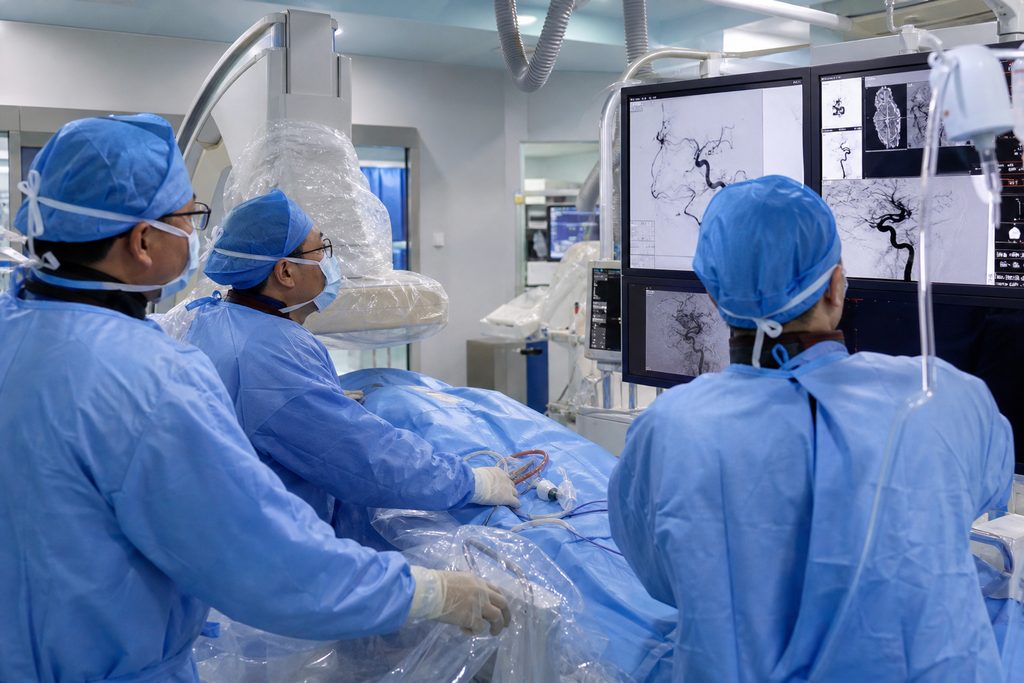
China’s top neurosurgical hospitals have invested heavily in hybrid operating suites that combine high-resolution biplane angiography, intraoperative MRI, and full craniotomy capability in a single room. This matters for a failed embolization case. If a transvenous approach goes wrong and you need an emergency craniotomy, the transition from endovascular to open surgical rescue happens without moving the patient. That is not a luxury—for a high-risk salvage case, it is a risk mitigation strategy that directly impacts mortality. Centers like the neurosurgical department at Xuanwu Hospital in Beijing or Huashan Hospital in Shanghai run these hybrid workflows daily.
Cost Structure Makes Multi-Stage Treatment Feasible
Let us address the “AVM interventional neuroradiology China cost” question directly. A complex AVM requiring a staged embolization followed by surgical resection, with a 10- to 14-day inpatient stay, typically ranges from $35,000 to $65,000 at a top Chinese public hospital’s international department. The same staged treatment plan in the US can exceed $250,000. This is not because Chinese care is discounted. It is because the underlying cost of hospital infrastructure, specialist labor, and device procurement is structurally lower. The practical implication for a patient with a failed prior embolization is significant: multi-stage salvage plans that would be financially catastrophic out-of-pocket in the US become feasible. You can afford the two or three sessions needed to safely obliterate a complex nidus.
What You Need to Know Before Going Alone
We tell every patient this directly: China’s public hospital system is not designed for walk-in international patients. The barriers are real. Acknowledging them upfront is the only honest way to prepare you.
- Visa Requirements: Medical treatment in China requires an S2 visa with a specific annotation for medical purposes. Your accompanying family member also needs an S2. A standard tourist L visa or business M visa will not work for hospital admission. The hospital’s international department must issue an official invitation letter confirming your treatment plan before the visa application can proceed. Getting that letter without a local contact inside the hospital is slow and uncertain.
- Language and Clinical Navigation: Even at international departments with English-speaking coordinators, the interventional neuroradiologist, the anesthesiologist, and the ICU nurses will communicate in Mandarin during the procedure and recovery. Informed consent discussions about risks specific to a salvage embolization—like microcatheter retention or delayed hemorrhage—require a medically fluent interpreter who understands neurovascular terminology, not a general translator.
- Payment and Pre-Authorization: Public hospitals require a substantial deposit upfront, typically 50-70% of the estimated treatment cost, paid via international wire transfer or UnionPay. Credit card limits from Western banks often cap at $10,000 per transaction, which can delay admission. International insurance reimbursement is possible but requires meticulous pre-authorization and translated invoices—something you will be managing while recovering from a brain procedure.
How We Help You Navigate This
These barriers exist for structural reasons. They are not malice, but they are real friction points. Our process is designed to dissolve them sequentially, starting with the only question that matters: is there a genuine treatment option here for you?
We begin with a written second opinion. You send us your full DICOM imaging, your embolization reports, and your clinical history. We translate everything into medical-grade Mandarin and submit it to the interventional neuroradiology team best matched to your Spetzler-Martin grade and nidal architecture. For a complex salvage case, this written second opinion costs from $300 to $500. What you get back is not a generic “we can try” letter. You get a specific assessment: which feeders are still accessible, whether a transvenous approach is indicated, how many stages are anticipated, and what the estimated risk of procedural morbidity is. If the opinion is negative, you have spent a few hundred dollars to avoid a futile international trip. That alone is worth it.
If the opinion is positive and you decide to proceed, our team shifts into coordination mode. We secure the hospital invitation letter for your S2 visa application. We schedule the pre-procedural workup to minimize your pre-admission waiting days. During your stay, a bilingual medical companion—from $200 per day—handles registration, payment processing, pre-op consultations, and post-procedure ICU translation. You are never alone in a corridor trying to explain your prior embolization failure to a registration clerk who does not speak English. After discharge, we coordinate follow-up imaging and remote consultations so your local neurologist stays fully informed.
Frequently Asked Questions
The honest answer depends entirely on your current angioarchitecture. Some recanalized AVMs with multiple small feeders are ideal candidates for transvenous embolization, a technique Chinese centers have published extensively on. Others with deep perforating supply and prior Onyx casts in eloquent cortex may be judged too risky by any team, anywhere. The only way to know is a formal imaging review by a high-volume interventional neuroradiologist. We have seen cases labeled inoperable in other countries successfully treated, but we have also seen cases where the Chinese team concurred that further intervention posed an unacceptable risk. We never push a patient toward treatment when the expert opinion says no.
There is no single “best” hospital for every failed AVM. The right center depends on your lesion’s location, size, and prior embolization material. Xuanwu Hospital in Beijing runs one of the world’s highest-volume neurointerventional services and has published specific salvage protocols for recanalized AVMs. Huashan Hospital in Shanghai has a hybrid neurosurgical-interventional team that handles complex deep-seated lesions. For patients specifically searching for “complex AVM treatment packages Beijing,” Xuanwu’s international department and the neurosurgery program at Peking Union Medical College Hospital are logical starting points. Our job is to match your specific case to the team whose published work and clinical volume align with your needs.
You do not need to travel for the initial opinion. The process is entirely remote. You upload your DICOM files and medical records to us. We translate and submit them to the appropriate department. The written opinion comes back in English, typically within 7 to 10 business days. If you subsequently decide to travel for treatment, any second opinion fee you paid is credited in full toward our on-the-ground coordination service. There is no financial penalty for deciding not to proceed.
This is the question you should be asking. The procedural complication rate for salvage embolization of previously treated AVMs is higher than for de novo lesions—published rates of transient or permanent neurological deficit range from 5% to 12% depending on Spetzler-Martin grade. The Chinese centers we work with manage these complications in dedicated neuro-ICUs with 24/7 neurosurgical backup. The hybrid operating suites we mentioned earlier exist precisely for this scenario. We also ensure that your accompanying family member has real-time translation access during any emergency, so they are not left in a waiting room without information. We cannot eliminate risk. We can ensure you face it with a team that has managed the same complication hundreds of times before.
Your Next Step
A failed AVM embolization puts you in a difficult clinical space where local options may have run dry. China’s interventional neuroradiology centers offer a combination of high clinical volume, hybrid technology, and cost accessibility that makes a salvage attempt logistically and financially feasible. But feasibility is not the same as appropriateness for your specific case. The only responsible next step is a formal imaging review. If you are ready to learn whether a Chinese team sees a viable path forward for your AVM, we can facilitate that second opinion without you leaving home.
For more medical information and treatment options in China, visit chinamedservices.com (China Medical Services).
