Medical Escort in Shijiazhuang: Practical Guide for International Patients
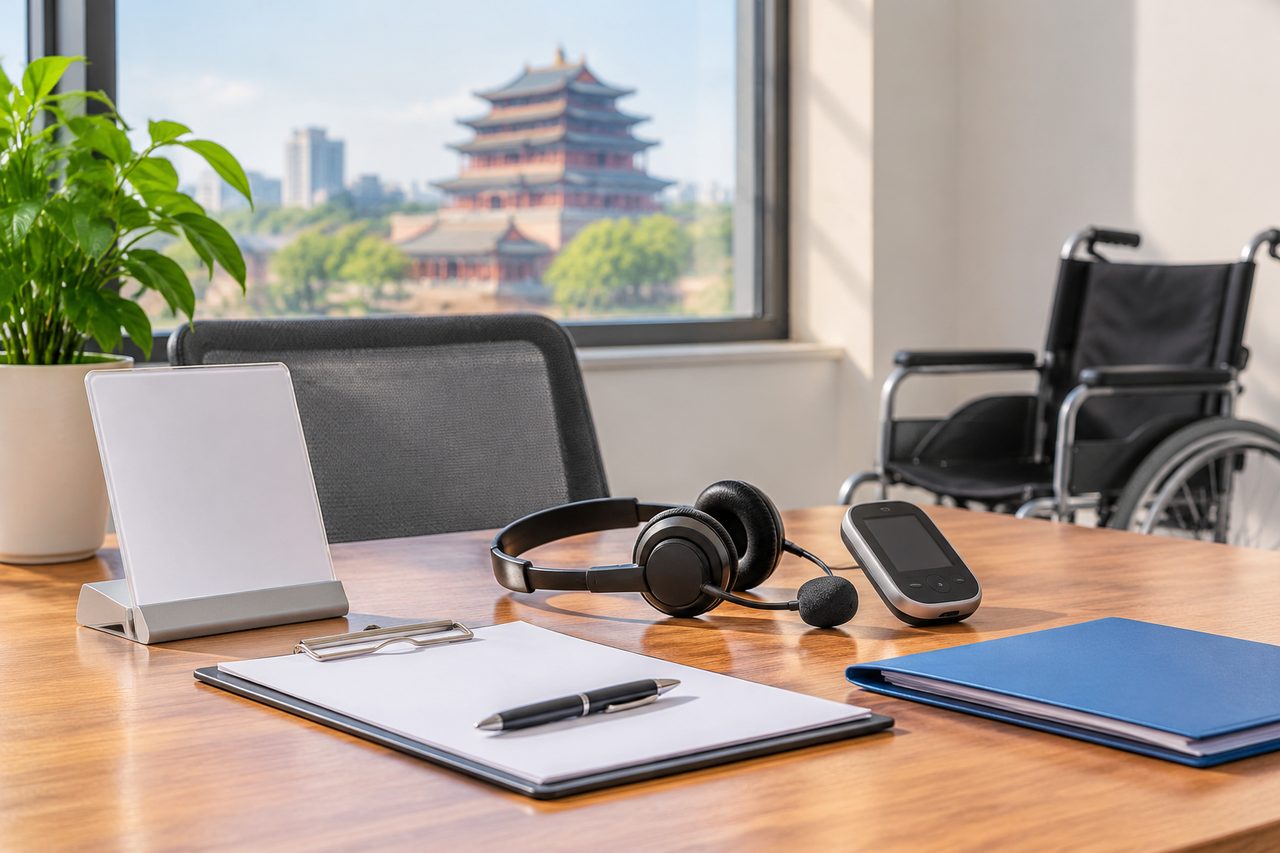
A medical escort in Shijiazhuang is a bilingual support professional who accompanies an international patient through the practical side of Chinese hospital care — registration, queuing, payment, wayfinding and translation — so that a language barrier never becomes a safety problem. The term is sometimes used loosely to mean “someone who meets you at the airport.” In practice, the work that matters happens inside the hospital building, and it is mostly about navigation and communication rather than clinical care.
This guide explains what a medical escort in Shijiazhuang for international patients actually does, why Shijiazhuang is a credible destination rather than a compromise, what the service costs, and how to prepare before you travel. We are not a hospital and we do not diagnose or treat. Our role is coordination and interpretation, and we will be direct about where the limits sit.
Key Takeaways
- Shijiazhuang is the capital of Hebei Province, roughly two hours from Beijing by high-speed rail, and offers a lower-pressure alternative to the capital’s mega-hospitals for many routine and specialist consultations.
- A bilingual medical companion in China typically starts from $300 per day (half day of four hours or full day of eight hours), covering registration, queuing, payment, wayfinding, translation and accompaniment — not a promise of a specific doctor.
- Public hospital outpatient registration generally cannot be booked from overseas in advance; you queue for a same-day number, and surgery is scheduled only after an in-person consultation. This is the single most common misunderstanding among first-time medical travelers.
- Foreign patients entering China for treatment use the S2 visa (annotated for medical treatment), not the M visa, which is for commercial and trade activity.
The Problem: A Hospital You Cannot Read
China’s largest public hospitals see extraordinary daily volumes. Top-tier institutions routinely handle more than ten thousand outpatient visits in a single day, spread across buildings that can be the size of a small campus. Signage is predominantly in Chinese, registration kiosks run on Chinese-language interfaces, and the queue system is often organized by department rather than by appointment time. For a patient who reads no Chinese, the clinical encounter — the ten or fifteen minutes with a specialist — may be the easiest part of the day. Everything around it is where things go wrong.
The failure modes are mundane and expensive. You arrive at the wrong building. You queue for a registration number in the wrong department. You pay at a window that does not accept your card. You misunderstand the instructions for a fasting blood test and have to return the next morning. You receive a prescription you cannot read and cannot have filled without a Chinese ID-linked payment app. None of these are medical catastrophes, but together they can consume days, and for a patient traveling with a serious diagnosis, days matter.
This is the gap a medical escort fills. Not by practicing medicine, but by making the hospital legible.
Why Shijiazhuang Deserves a Place on Your Shortlist
Most international patients default to Beijing or Shanghai. That is understandable, and those cities host many of the country’s strongest institutions. But the reflex has a cost: those hospitals are the busiest, their international departments are the most in demand, and accommodation near them is priced accordingly. Shijiazhuang, as the provincial capital of Hebei, sits in a different position — large enough to support serious tertiary hospitals, close enough to Beijing for specialist referral, and considerably calmer.
Proximity Without the Crowds
The high-speed rail connection between Shijiazhuang and Beijing makes the capital accessible for a day trip or a referral. That matters if your case turns out to need a subspecialty that is concentrated in Beijing. You can begin your workup in a less congested setting and escalate only if the clinical picture calls for it. This staged approach is often more efficient than starting at the most competitive hospital in the country.
A Genuine Cost Advantage
Broadly speaking, the same surgical procedure in a top Chinese public hospital costs a fraction of the US equivalent — commonly cited ranges put cardiac bypass in China at roughly $12,000 to $20,000 against $120,000 or more in the United States. These figures vary by hospital and case complexity, and they are not a quote. But the direction of the gap is real, and it is driven by labor economics, hospital efficiency and clinical volume rather than by shortcuts in care. Shijiazhuang’s lower cost of living relative to Beijing extends that advantage to accommodation, transport and daily expenses during recovery.
Traditional Chinese Medicine in Its Home Region
Hebei has a substantial TCM tradition, and Shijiazhuang’s TCM hospitals offer acupuncture, tuina massage and herbal consultation — modalities that some international patients seek for chronic pain, rehabilitation and supportive care. If TCM is part of your plan, our traditional Chinese medicine hospital directory explains how these institutions are organized and what to expect from a first consultation.
What a Medical Escort in Shijiazhuang Actually Does, Hour by Hour
Job descriptions vary widely, so here is the concrete version. A companion day is typically structured around the hospital’s rhythm, not yours.
Morning, before opening. Your companion confirms the department, the specialist’s clinic day and the registration window. They meet you at your hotel or the hospital entrance and review your documents: passport, prior imaging, pathology reports, medication list. Anything missing gets flagged now, not at the counter.
Registration and queuing. Your companion takes the queue number, completes the hospital card registration, and handles the payment steps at each stage — consultation fee, then investigation fees, then pharmacy. Public hospitals in China generally require prepayment, with insurance reimbursement handled afterward in your home country.
The consultation itself. Interpretation is consecutive, not simultaneous. Your companion relays your history and symptoms, then the specialist’s findings and instructions. Expect to leave with a written summary in English; ask for it explicitly if it is not offered.
Investigations. Blood draws, imaging and ECG are usually in separate buildings with separate queues. This is where a companion saves the most time, because the sequence matters and the signage does not help.
After the visit. Prescription collection, scheduling of follow-up appointments, and a plain-language debrief of what was decided and what happens next.
How to Judge Whether You Need One — and What It Costs
Not every patient needs a full-day companion. A traveler who speaks Mandarin, or who is visiting a private international hospital with English-speaking staff and direct insurance billing, may need nothing more than appointment coordination. The calculation changes for public tertiary hospitals, for patients over sixty-five, for anyone traveling alone, and for cases involving multiple departments.
The table below sets out the confirmed service options and reference prices. These are starting figures in US dollars; final quotes depend on the hospital and the complexity of your case, and service fees are billed separately from hospital medical charges, with no offset against later treatment costs.
| Service | Reference price (USD) | What it covers |
|---|---|---|
| Bilingual medical companion | From $300 per day | Registration, queuing, payment, wayfinding, translation, accompaniment (4-hour or 8-hour blocks) |
| Airport transfer | $200 round-trip | Arrival and departure transfers |
| Written second opinion | $300–$500 | Specialist review of submitted records; written analysis for reference only, not a prescription |
| Video consultation (standard international department) | $100–$300 | Online discussion of symptoms and goals with the specialty team |
| Top-specialist video consultation | $500–$800 | Senior specialist review by video |
| Hospital appointment coordination | From $300 | Scheduling for checkups, outpatient visits, admission or surgery; full refund if the listed appointment cannot be secured |
Practical tip: Ask any provider to state in writing what happens if a requested appointment cannot be obtained. A refund policy is a clearer signal of good faith than a long list of partner hospitals.
Two honest caveats. First, no coordination service can guarantee a specific named professor or a specific surgical date — public hospital scheduling is controlled by the hospital. Second, the companion is a language and logistics professional, not a clinician; they will not interpret test results or advise on treatment choices. That boundary protects you.
Practical Considerations Before You Book a Flight
Visa category. Foreign patients traveling to China for medical treatment use the S2 visa, annotated for medical treatment; stays exceeding 180 days fall under S1. Accompanying family members apply for S2 as well. The M visa is for commercial and trade activities and is not the correct category for medical travel. Requirements are set by the Chinese embassy or consulate in your country and typically include supporting documents from the treating hospital — confirm the current checklist before applying, and note that approval is never guaranteed.
Records. Bring imaging on disc as well as printed reports, a pathology report if relevant, and a medication list with generic drug names. Chinese specialists work from original imaging, not summaries.
Payment. Public hospitals require prepayment. International cards are accepted at some counters but not all; a companion can help navigate this, and a local payment method arranged in advance removes friction.
Insurance. Most international policies reimburse after the fact rather than paying Chinese public hospitals directly. Private international hospitals more often offer direct billing. Confirm with your insurer before departure.
Timing. Build in a buffer. A first visit, investigations and a results consultation may span several days, and surgery is scheduled only after an in-person consultation.
Frequently Asked Questions
For standard public hospital outpatient clinics, generally no — registration happens on the day, and surgery follows an in-person consultation. Some hospitals’ international or VIP departments can arrange appointments in advance, typically at roughly 1.5 to 2 times the standard channel price. Our consultation and coordination service can clarify which route applies to your case.
No. A companion handles language, registration, payment and navigation. They do not provide clinical care, administer medication or interpret test results. If you need clinical support during recovery, that must be arranged separately with the hospital.
Plans change often, and that is normal. A written second opinion or video consultation before travel reduces the risk of an unnecessary trip, but it cannot eliminate it. If the specialist recommends a different path, your companion can help reschedule appointments and adjust logistics. What no service can promise is a particular clinical outcome.
Your Next Step
The core message is simple: in Shijiazhuang, the medicine may be excellent, but the hospital system is built for Chinese-speaking patients, and bridging that gap is a solvable logistics problem rather than an insurmountable one. China Medical Services is a coordination service — we match patients with hospitals from our directory of 340+ top-ranked institutions across 37 cities, arrange appointments through official international departments, and provide bilingual accompaniment. We are not a hospital and we do not provide diagnoses or treatment. If you would like to talk through your situation before committing to anything, start with a free consultation through our patient support page or explore our China medical services overview.
This article is for general information only and does not constitute medical advice. Treatment decisions should be made with a qualified physician who has reviewed your individual case. Prices are reference ranges and vary by hospital and case complexity.
For more medical information and treatment options in China, visit chinamedservices.com (China Medical Services).
