Australia to China Joint Replacement: Hip and Knee Surgery Without 12 Month Wait
Key Takeaways
- China’s top-tier orthopedic hospitals perform joint replacements for approximately $12,000–$20,000 — roughly one-fifth to one-third of Australian private surgery costs — with zero public waitlist.
- Surgeons at hospitals ranked in China’s Fudan Orthopedics Top 10 complete 300–500 knee and hip procedures annually, a surgical volume strongly linked to lower complication rates.
- Language barriers, visa logistics, and hospital registration systems make independent navigation extremely difficult — this is not a trip to book on a hotel website.
- You need a clear understanding of S2 visa requirements, international department protocols, and realistic recovery timelines before committing to surgery abroad.
The Problem: Twelve Months Is Too Long to Live in Pain
Waiting 12 months for a hip or knee replacement is not just inconvenient. It is destructive. According to the Australian Institute of Health and Welfare, the median wait time for a total knee replacement in Australia’s public hospital system reached 209 days in 2022–23. For hip replacements, the figure sat at 185 days. Those are medians. Half of all patients waited longer. Some waited over a year. That means 12 months of deteriorating mobility, lost income, muscle atrophy, opioid dependence, and a quality of life that shrinks week by week.
Private surgery in Australia solves the wait time problem. But it creates another one. A total hip replacement in a private Australian hospital costs between AUD $30,000 and $55,000. A knee replacement runs AUD $25,000 to $45,000. Even with private health insurance, out-of-pocket gaps routinely hit $5,000 to $15,000. For the uninsured or underinsured, those numbers are simply impossible.
That leaves a large group of Australians stuck between two bad options: wait in agony, or pay a sum that wipes out savings. Around 1 in 8 Australians over 45 have osteoarthritis severe enough to eventually require joint replacement. The backlog is not getting shorter. The health system is not getting faster. Something has to give.
Who We Are
We are China Medical Services. We are not a hospital. We do not provide medical treatment, clinical diagnoses, or surgical recommendations. What we do is build the bridge between you and China’s highest-ranked orthopedic hospitals. Our team handles the architecture of your medical journey — hospital matching based on your specific condition, appointment coordination through official international departments, bilingual medical companion support on the ground, and visa guidance. We have built relationships with over 340 top-ranked hospitals across 37 Chinese cities. We know which orthopedic departments publish internationally, which surgeons handle high volumes of international patients, and how to navigate a system that was not designed for foreign visitors. You focus on getting better. We handle everything else.
Why China Delivers Results for Joint Replacement
Surgical Volume That Changes the Math
Joint replacement outcomes are not mysterious. The single strongest predictor of a good result is surgeon volume. A 2022 systematic review in The Journal of Arthroplasty found that high-volume surgeons — those performing over 100 total hip replacements per year — had significantly lower rates of dislocation, revision, and 90-day mortality compared to low-volume peers. In Australia, an orthopedic surgeon might perform 50 to 80 knee replacements annually. At a top Chinese orthopedic center like Peking University Third Hospital or Shanghai Sixth People’s Hospital, a dedicated arthroplasty surgeon completes 300 to 500 procedures per year. Some exceed 600. That is not a marginal difference. It is an order of magnitude. Repetition builds pattern recognition. Pattern recognition catches complications before they spiral. When you ask the question “is joint replacement in China safe for Australians,” the volume data provides the most honest answer: the safety is not in the country. It is in the hands doing the work.
Technology Deployed at Scale
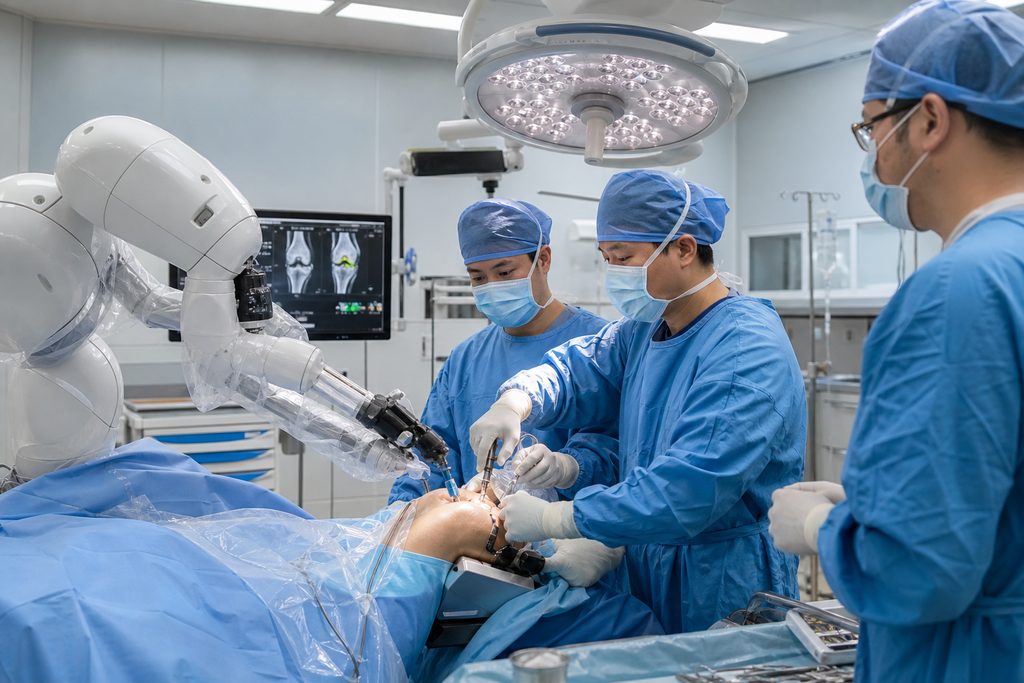
China’s leading orthopedic hospitals adopted robotic-assisted joint replacement systems years ago. The Mako system, CORI, and domestically developed platforms like TiRobot are standard in international patient wings. These are the same systems used in Melbourne and Sydney private hospitals. The difference is throughput. A single Shanghai hospital may run four robotic-assisted knee surgeries in one operating theater in a single day. That operational density means surgical teams, anesthesiologists, and recovery nurses work in tight, experienced units. They see complications rarely because they see cases constantly. Post-operative protocols are standardized and data-driven — not dependent on which surgeon happens to be on rotation.
Pre-operative planning here often includes 3D-printed patient-specific cutting guides and custom implant sizing based on CT reconstruction. This is not experimental. It is routine. The technology exists to reduce alignment errors and soft tissue damage. When alignment is off by even three degrees, implant wear accelerates. These hospitals have built workflows around getting alignment right because they have done it tens of thousands of times.
The Cost Structure Makes Sense Once You See It
Let us address the elephant in the room directly. A knee surgery price China no wait list scenario sounds too good to be true. Low cost must mean low quality, right? Wrong. The cost difference is structural, not qualitative. Chinese hospital labor costs are lower. Malpractice insurance is a fraction of Australian premiums. Hospital administrative overhead is leaner. Implant costs — often the single largest line item — are comparable globally because multinational manufacturers like Zimmer Biomet and Stryker supply the same components used in Australian operating rooms. You are not getting a discount implant. You are getting a discount on the system around the implant.
| Procedure | Australia Private (AUD) | China Top Hospital (USD) | Approx. Savings |
|---|---|---|---|
| Total Hip Replacement | $30,000–$55,000 | $14,000–$20,000 | 50–65% |
| Total Knee Replacement | $25,000–$45,000 | $12,000–$18,000 | 50–60% |
| Bilateral Knee Replacement | $45,000–$70,000 | $22,000–$30,000 | 45–55% |
These prices are all-in for the international patient pathway: implant, surgeon fee, anesthesiologist, hospital stay (typically 3–5 days), operating theater, and standard post-operative monitoring. They vary by hospital and case complexity. They do not include flights, accommodation, or our coordination services. But even with travel costs added, the total outlay rarely exceeds half the Australian private quote. And you skip the 12-month wait entirely. That is the core trade-off: travel for surgery now, or stay home and wait.
What You Need to Know Before Going Alone
We need to be blunt here. Some Australians attempt to arrange joint replacement surgery in China independently. A few succeed. Most hit walls they did not see coming. Here are the barriers that break the DIY approach:
- Visa Complexity: Medical treatment in China requires an S2 visa with a specific endorsement for medical purposes. This is not a tourist visa. You need an invitation letter from the treating hospital, confirmed appointment documentation, and a clear treatment plan. Consulates reject applications that lack proper hospital documentation. A tourist visa used for surgery violates Chinese immigration law. Your accompanying family member also needs an S2 visa — not a tourist visa, not a business visa. Get this wrong and you are denied entry or, worse, removed from the country mid-recovery.
- Hospital Registration Is Not Online Booking: Chinese public hospitals do not operate like Australian private clinics. You cannot browse a website, click a surgeon’s profile, and book a surgery date. Outpatient registration is often same-day, in-person, and conducted in Mandarin through a hospital app or kiosk system. Top surgeons’ outpatient slots fill within minutes of opening. There is no English-language portal. There is no international call center at most hospitals. The international department exists — but finding it, contacting the right person, and securing a confirmed surgical slot from overseas requires local relationships and Mandarin fluency.
- Payment and Insurance Hurdles: Chinese public hospitals require upfront payment. Credit card systems sometimes reject foreign cards. Australian private health insurance generally does not provide direct billing arrangements with Chinese hospitals. You pay first, then claim reimbursement — if your policy covers overseas surgery at all. Many do not. You need to verify this before departure. We have seen patients arrive assuming their Bupa or Medibank policy would cover them, only to discover exclusions for elective overseas procedures. That is a devastating conversation to have in a hospital lobby.
- Medical Records and Imaging Gaps: Chinese surgeons expect a specific set of pre-operative images — weight-bearing X-rays, recent MRI, full blood panels, cardiac clearance. Australian GP referrals and radiology reports often lack the detail or format Chinese orthopedic departments require. Translation must be medically precise, not conversational. “Bone-on-bone osteoarthritis” needs to carry the exact clinical nuance in Mandarin medical terminology. Google Translate will not cut it.
How We Help You Navigate This
These barriers are real. They exist for structural reasons, not because anyone is trying to make things difficult. Our entire service exists to dissolve them. When you contact us about hip replacement cost China Australia patient options, we start with a detailed case review. You send us your imaging, your medical history, your surgeon’s notes. Our team translates everything into precise clinical Mandarin. We then match your case to the orthopedic departments best suited to your specific condition — not just the biggest name, but the right fit. A patient with severe hip dysplasia needs a different surgeon than someone with straightforward osteoarthritis. A patient with a BMI over 35 needs a hospital equipped for higher-risk cases. We make that match based on real data, not marketing brochures.
Once matched, we coordinate through the hospital’s official international department to secure a confirmed outpatient consultation slot. We handle the invitation letter for your S2 visa application. We arrange airport transfer, accommodation near the hospital, and a bilingual medical companion who meets you on day one and stays with you through every step — registration, consultation, pre-op testing, admission, discharge, and follow-up. Our companion translates in real time, not just words but context. They explain what the surgeon is actually saying, not just the dictionary definition.
After surgery, the companion coordinates pharmacy runs, physiotherapy appointments, and the final clearance documentation you need for your flight home. We stay in contact through your recovery. If you need a post-operative video consultation with your Chinese surgeon three months later, we arrange it. The relationship does not end when you board the plane.
For patients looking to book hip surgery China medical tourism package solutions, we structure everything around confirmed clinical dates — not wishful thinking. We never promise a surgery date until the surgeon has reviewed your case and the hospital has confirmed availability. When we do confirm, it is binding. If we cannot secure the appointment we committed to, our coordination fee is refunded in full. That is the only ethical way to operate.
Frequently Asked Questions
Safety depends on hospital selection, surgeon experience, and proper pre-operative screening. When you choose a hospital ranked in China’s Fudan Orthopedics Top 10 — institutions that perform thousands of joint replacements annually with published outcomes — the clinical safety profile is comparable to high-volume centers in Australia. The key is going through the right channel. International departments at these hospitals follow protocols designed for overseas patients, including English-speaking coordinators, private recovery rooms, and extended monitoring. The risk comes from cutting corners: choosing an unaccredited facility, skipping pre-operative cardiac clearance, or attempting surgery without proper imaging. We eliminate those risks through rigorous hospital matching and mandatory pre-op screening. Your safety is not a variable we experiment with.
Hospital stay for a standard total knee replacement is typically 3 to 5 days. You will be walking with a walker within 24 hours of surgery — that is the protocol at every major Chinese orthopedic center. After discharge, you need to remain near the hospital for at least 10 to 14 days for wound checks, suture removal, and initial physiotherapy. Flying long-haul immediately after knee replacement is dangerous due to deep vein thrombosis risk. Most Australian patients plan for a total stay of 18 to 21 days in China: a few days pre-op for final consultation and testing, the surgery and inpatient recovery, and two weeks of supervised rehabilitation before clearance to fly. Full recovery — return to normal gait, stairs, driving — takes 6 to 12 weeks, same as anywhere. The early phase happens in China. The rest happens at home.
Complications in elective joint replacement are rare but real. Infection rates at top Chinese orthopedic hospitals run approximately 0.5% to 1%, in line with international benchmarks. Deep vein thrombosis, implant loosening, and stiffness are the other major risks. Chinese international departments carry protocols for all of these. If a complication arises during your inpatient stay, the treating team manages it on-site. If a problem develops after you return to Australia, your Chinese surgeon can provide a detailed operative report and imaging for your Australian GP or orthopedic follow-up. We arrange post-operative video consultations so your surgeon can review your progress directly. What we cannot do — and no service can honestly promise — is guarantee a complication-free outcome. Surgery carries inherent risk. What we can guarantee is that you will be operated on by a high-volume, experienced surgeon in an accredited hospital with documented safety protocols. That is the best risk mitigation available, in any country.
Most Australian private health insurance policies exclude elective surgery performed overseas. Some premium-tier international policies include limited coverage, but you must verify this directly with your insurer before making any commitments. We strongly recommend requesting written confirmation of coverage, including specific procedure codes and hospital accreditation requirements. Some Chinese hospitals hold JCI accreditation, which certain international insurers recognize. The private international hospitals in our network often have direct billing relationships with major global insurers. Public hospitals generally do not. You pay the hospital directly upon admission, then pursue reimbursement from your insurer if eligible. We help you obtain the itemized invoices and medical reports required for claims, but we cannot guarantee your insurer will pay. Budget for self-payment, treat any insurance reimbursement as a bonus.
There is no single “best orthopedic hospital Shanghai for international patients” that fits every case. Shanghai Sixth People’s Hospital is renowned for limb reconstruction and trauma orthopedics. Peking University Third Hospital leads in sports medicine and knee surgery. West China Hospital in Chengdu handles high volumes of complex revision cases. The right choice depends on your diagnosis, age, bone quality, prior surgeries, and specific joint involved. Our matching process considers all of these factors against the actual subspecialty strengths of each department. We direct you to the orthopedics department rankings where you can see Fudan Hospital Ranking data by specialty. Then we help you interpret what those rankings mean for your situation. A hospital ranked #1 for spinal surgery is not necessarily the right choice for your hip replacement. Nuance matters.
Your Next Step
You have been living with joint pain long enough. The Australian public system cannot offer you a timeline that respects your quality of life. Private surgery at home demands a financial sacrifice that may not be feasible. China’s top orthopedic hospitals offer a third path: high-volume, technology-driven joint replacement at a fraction of the cost, with no waiting list. The trade-off is travel. The requirement is proper coordination. We have been building the bridge between Australian patients and Chinese orthopedic excellence for years. We know the hospitals, the surgeons, the visa process, and the recovery logistics. If you want to understand whether this path fits your specific situation, reach out for a free consultation. No pressure. No sales script. Just an honest conversation about your options. Visit our patient coordination page to start that conversation. You have waited long enough.
For more medical information and treatment options in China, visit chinamedservices.com (China Medical Services).
