Lumbar Discectomy vs Lumbar Fusion: What the Difference Means
Key Takeaways
- Lumbar discectomy and lumbar fusion solve different problems: discectomy removes the portion of a herniated disc pressing on a nerve, while fusion permanently joins two vertebrae to stop painful motion.
- Most guidelines place discectomy ahead of fusion for straightforward disc herniation with nerve symptoms; fusion is generally reserved for instability, certain types of spondylolisthesis, or revision situations.
- Recovery expectations differ sharply — many discectomy patients are walking within days, whereas fusion patients face a longer, more protected recovery while bone heals.
- Before agreeing to either operation, patients should understand why that specific procedure was chosen, what alternatives exist, and what the surgeon’s own revision rate looks like.
If two surgeons have given you two different operation names for the same back pain, you are not alone — and the question of lumbar discectomy vs lumbar fusion is one of the most consequential comparisons in spine care. The two procedures are not competing versions of the same surgery. They treat different problems, carry different recovery timelines, and are appropriate for different patients.
This guide explains the distinction in plain terms, shows where international guidelines draw the line between them, and sets out what you should clarify before consenting to either. It is general information, not a diagnosis, and nothing here replaces an assessment by a qualified spine surgeon who has examined you and reviewed your imaging.
The Problem: Two Operations, One Confusing Decision
Low back pain is among the leading causes of years lived with disability worldwide, according to the Global Burden of Disease analyses published in The Lancet. Most episodes improve without surgery. But when a disc herniation produces radiating leg pain, numbness, or weakness, or when a vertebra has slipped and the spine is unstable, surgery enters the conversation — and that is where the terminology becomes confusing.
The confusion has real consequences. A patient told “you need your disc out” may assume fusion is the only option; another told “we’ll fuse the level” may not realize that a simpler decompression might have addressed the same symptom. International bodies have repeatedly flagged fusion being used in situations where decompression alone would be reasonable. The North American Spine Society (NASS) publishes coverage recommendations that distinguish clearly between decompression for radiculopathy and fusion for instability, and those documents are publicly available for patients to read.
The practical risk is not that one operation is “bad.” It is that the wrong operation for your particular problem means a longer recovery, more cost, and — in the case of fusion — a permanent change to how one spinal segment moves.
Lumbar Discectomy vs Lumbar Fusion: How the Two Operations Actually Differ
The clearest way to understand the difference is to ask what each operation is trying to achieve.
Lumbar discectomy: removing pressure on a nerve
A discectomy removes the part of a herniated disc that is compressing a nerve root. It is a decompression procedure. The goal is to relieve leg pain, tingling, or weakness caused by that compression. In many cases the surgeon also removes a small amount of bone (laminotomy) to reach the disc, and this is often described as a microdiscectomy when performed with magnification through a small incision.
Crucially, a discectomy does not stabilize the spine and does not stop the disc from degenerating further. It addresses the nerve, not the mechanics of the segment.
Lumbar fusion: stopping motion at a segment
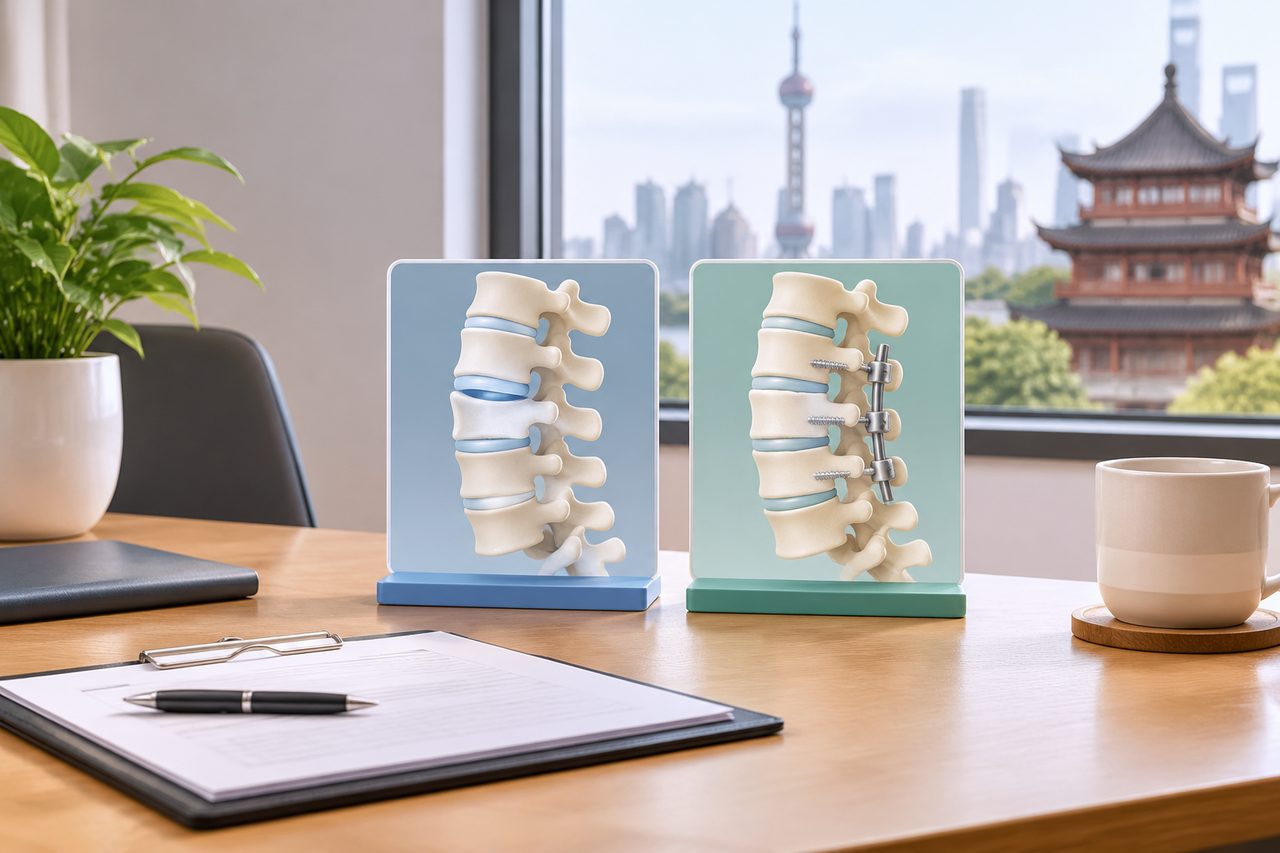
A fusion joins two or more vertebrae so they heal into a single unit, usually with bone graft and instrumentation such as screws and rods, or with an interbody cage placed in the disc space. It is used when motion at that segment is itself the source of pain or instability — for example degenerative or isthmic spondylolisthesis, certain fractures, deformity correction, or revision after a previous operation failed.
Fusion is a bigger operation with a longer recovery, and it changes load transfer to the adjacent segments. That is why surgeons generally do not offer it for an uncomplicated disc herniation in a patient with normal alignment.
| Feature | Lumbar discectomy | Lumbar fusion |
|---|---|---|
| Primary goal | Relieve nerve compression | Eliminate painful segment motion / instability |
| Typical indication | Disc herniation with radicular leg pain | Spondylolisthesis, instability, deformity, revision |
| Spinal motion afterward | Preserved at that level | Intentionally eliminated at the fused level |
| Usual hospital stay | Often same-day or 1–2 nights | Typically longer, varying by approach and case |
| Return to desk work | Often within a few weeks | Commonly several weeks to a few months |
| Main long-term concern | Recurrent disc herniation | Adjacent segment degeneration, non-union |
These are typical patterns, not guarantees. Hospital stay, return to work, and long-term outcomes vary by hospital, surgical approach, and case complexity, and your surgeon should give you figures specific to your situation.
What the Evidence Says About Choosing Between Them
For disc herniation with radiculopathy, several randomized trials and systematic reviews have compared discectomy with conservative care and with fusion. The consistent finding is that discectomy gives faster and more reliable leg-pain relief than prolonged non-operative treatment in carefully selected patients, while fusion offers no advantage over discectomy for a simple herniation and carries higher risk and cost.
For lumbar spinal stenosis with degenerative spondylolisthesis, the picture reverses. Landmark randomized work published in The New England Journal of Medicine found that adding fusion to decompression improved outcomes compared with decompression alone in that specific population. The distinction matters: it is the instability, not the stenosis, that justifies the fusion.
Practical tip: Ask your surgeon to point to the finding on your MRI or standing X-rays that justifies fusion — for example a measurable slip, abnormal movement on flexion-extension films, or a deformity. If no such finding exists, ask directly why fusion rather than decompression is being proposed.
Recovery: What the Difference Means Week by Week
Recovery is where patients feel the difference most acutely.
After a straightforward microdiscectomy, many patients notice leg pain easing within days. Walking is usually encouraged early. Lifting restrictions — commonly in the range of a few kilograms — typically apply for the first several weeks, and physiotherapy focuses on gradual return to activity. Desk work is often feasible within two to four weeks for uncomplicated cases.
After fusion, the early phase centers on protecting the construct while bone heals. Patients are usually mobilized with guidance, bracing may be used depending on surgeon preference and approach, and return to heavier work is measured in months rather than weeks. Bone consolidation is typically assessed on follow-up imaging. These are general patterns; your surgeon’s protocol governs.
One honest point: neither operation reliably eliminates all back pain. Discectomy is most predictable for leg pain. Fusion is most predictable when instability is genuinely the pain generator. Patients whose dominant symptom is central low back pain without a clear structural cause are the group least likely to benefit from either — and the group most in need of a careful second opinion.
Practical Considerations: Records, Costs, and Follow-Up
Wherever you are treated, the decision quality depends on the information in front of the surgeon. Bring your MRI images (not only the report), standing X-rays if available, flexion-extension views where instability is suspected, and any previous operative notes. A surgeon reviewing someone else’s images benefits from the original DICOM files.
Cost structures differ substantially between countries, and it is difficult to give a single figure for either procedure because implant choice, levels fused, approach, and hospital tier all move the number. In China, spine surgery at top-tier public hospitals is generally priced well below equivalent care in the United States, but any specific quote must come from the treating hospital after review of your case. For context on how hospital tiers and departments are organized, our overview of top-ranked Chinese hospitals explains the ranking system, and the orthopedics listings under specialty departments show which hospitals are recognized for spine work.
On logistics: foreign patients traveling to China for treatment generally use the S2 visa category for short-stay medical treatment, with supporting documentation from the treating hospital; stays beyond 180 days fall under S1. Requirements are set by the relevant Chinese embassy or consulate and can change, so confirm current rules before booking. Payment at public hospitals is typically upfront with insurance reimbursement afterward, while many private international hospitals bill insurers directly.
Plan follow-up before you travel. Ask who will review your wound and imaging after you return home, and obtain your operative note and imaging in a format your local clinician can open.
Frequently Asked Questions
Sometimes yes, sometimes no — it depends on why fusion was proposed. If the reason is a documented slip, instability, or deformity, decompression alone may not be safe or durable. If the reason is unclear, seeking a second opinion with your imaging is reasonable and is not a sign of distrust.
Not always. A minority of patients experience recurrent disc herniation and may need further treatment. Most, however, obtain lasting relief of leg pain. Your surgeon should be able to quote their own revision rate rather than a generic figure.
Both operations carry risks including infection, nerve injury, and, for fusion, non-union. This is precisely why follow-up planning matters. Before traveling, confirm in writing who handles postoperative questions locally, request your full records, and understand what your travel insurance covers for complications abroad.
Your Next Step
The core message is simple: discectomy and fusion answer different questions, and the right choice follows from a clear diagnosis of what is actually generating your pain. China Medical Services is a coordination service, not a hospital — we do not diagnose or recommend operations, but we can arrange a written second opinion from a Chinese spine specialist who reviews your existing imaging, or a video consultation so you can hear the reasoning directly. If that would help you decide with more confidence, you can start a free consultation and we will explain the options available to you.
Medical disclaimer: This article is general information and does not constitute medical advice, diagnosis, or treatment recommendations. Always consult a qualified physician about your individual situation.
For more medical information and treatment options in China, visit chinamedservices.com (China Medical Services).
