Dr Mao Ying Neurosurgeon China: Shanghai Huashan Hospital Glioma and Pituitary Adenoma Surgery
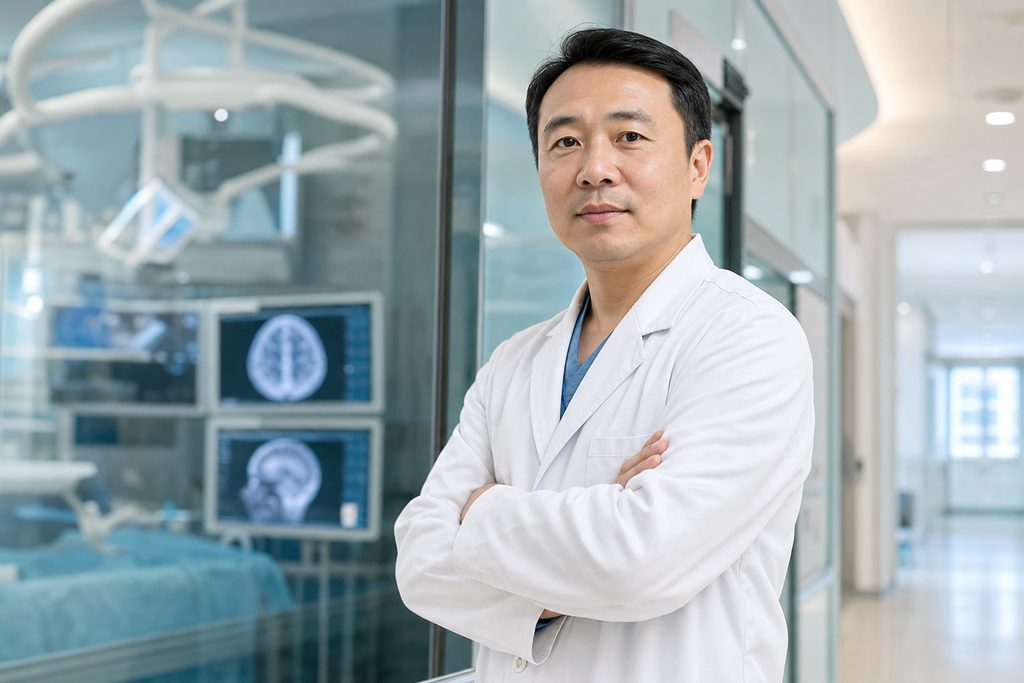
You have probably heard that traveling to China for brain surgery means gambling with quality. The assumption runs deep: lower cost must signal lower standards. The data tells a completely different story. Shanghai’s Huashan Hospital performs over 15,000 neurosurgical procedures annually. That volume is not just a number. It is a structural advantage that reshapes what is possible for patients facing a glioma or pituitary adenoma diagnosis.
Key Takeaways
- Dr. Mao Ying leads one of the world’s highest-volume neurosurgery centers at Huashan Hospital, with the department completing more than 15,000 procedures each year — a scale that directly correlates with surgical precision and lower complication rates.
- The total cost for glioma surgery in Shanghai typically ranges from $18,000 to $35,000 USD, compared to $80,000 to $150,000+ in the United States — and this includes hospital stay, imaging, and surgeon fees.
- International patients cannot simply book Dr. Mao through a website or email. The public hospital system requires an in-person consultation first. Navigating this without local support means language barriers, payment hurdles, and scheduling dead ends.
- You should understand the difference between the public pathway and the VIP international pathway before committing to any plan. One saves money but demands time and Mandarin fluency. The other costs more but removes friction entirely.
The Problem: A Brain Tumor Diagnosis With No Clear Path Forward
Finding out you have a glioma or pituitary adenoma is disorienting enough. Then comes the second shock. You start calling hospitals in your home country and hear wait times of six weeks, eight weeks, sometimes longer. You get quoted a surgery price that exceeds a year’s salary. Approximately 1 in 4 patients in the US report delaying medical care due to cost, according to Commonwealth Fund data. For brain surgery, delay is not an abstraction. Gliomas do not pause while you figure out financing.
Pituitary adenomas present a different kind of pressure. Many are benign. But they grow. They press on the optic chiasm. Vision narrows. Hormonal cascades go haywire. You need a surgeon who has removed hundreds — ideally thousands — of these tumors. The average neurosurgeon in a Western community hospital might perform 20 to 30 pituitary surgeries a year. That is competent. It is not mastery.
This is the gap patients fall into. You want expertise. You want an experienced surgeon. You want a price that does not force you to liquidate retirement savings. And you want it soon. The conventional wisdom says you can pick two of those four. The reality is more interesting.
Who We Are
We are not a hospital. We do not provide medical treatment, clinical diagnoses, or surgical referrals. Our team operates as your logistical backbone — we bridge the distance between you and China’s top-tier neurosurgery departments. We handle visa guidance, hospital selection, appointment coordination, bilingual medical interpretation, and post-operative recovery logistics. Think of us as the operational layer that makes international treatment feasible. We work with 340+ top-ranked hospitals across 37 cities. Our job is to remove every non-medical barrier so you can focus entirely on getting well.
Why Dr. Mao Ying and Huashan Hospital Deliver Results
Volume That Rewrites the Risk Equation
Huashan Hospital’s Department of Neurosurgery is not simply large. It is a reference center. The department handles over 15,000 surgeries annually across all subspecialties. Dr. Mao Ying, as a senior neurosurgeon within this system, operates in an environment where high-complexity glioma resections and transsphenoidal pituitary adenoma removals are daily occurrences, not quarterly events. The relationship between surgical volume and patient outcomes is well-documented. A 2017 study in The Lancet Oncology found that for complex cancer surgeries, each doubling of hospital volume was associated with a 4% to 7% reduction in 30-day mortality. A surgeon who performs a procedure 200 times a year simply sees patterns — and complications — that a surgeon performing it 20 times a year cannot.
This matters acutely for glioma surgery. The goal is maximal safe resection. Remove too little tumor and recurrence odds spike. Remove too much and you risk permanent neurological deficit. Walking that line requires intraoperative judgment refined through thousands of cases. Huashan’s neurosurgery team uses intraoperative MRI and awake craniotomy techniques routinely. These are not experimental add-ons. They are standard protocol for eligible patients.
Technology Deployed at Scale
Huashan Hospital invested early in integrated neurosurgical suites. What does that mean on the day of your surgery? It means the MRI scanner is in the operating room, not down the hall. The surgeon can pause mid-procedure, scan your brain, and verify that the tumor margins are clean — then continue operating. No closing up and hoping the post-op scan looks good. This intraoperative imaging capability is available at top Western centers. The difference is throughput. At Huashan, the system is optimized to move patients through these suites efficiently, which keeps costs down without rushing the surgery itself.
For pituitary adenoma patients, the standard approach is endoscopic endonasal surgery — entering through the nasal passage, no scalp incision, no visible scar. Dr. Mao’s team performs these procedures with neuronavigation systems that overlay preoperative MRI data onto the surgical field in real time. A 2020 meta-analysis in the Journal of Neurosurgery reported gross total resection rates for endoscopic pituitary surgery ranging from 70% to 85% at high-volume centers, with cerebrospinal fluid leak rates below 5% when standardized closure techniques are used. Huashan’s published data aligns with these benchmarks.
The Cost Question Answered Directly
Let us address the elephant in the room. Many patients searching for “Dr Mao Ying glioma surgery cost Shanghai” are trying to solve a financial equation. Here are the numbers as they stand in 2024:
| Procedure | Estimated Total Cost — Shanghai (USD) | Estimated Total Cost — USA (USD) |
|---|---|---|
| Glioma Resection (awake craniotomy with intraoperative MRI) | $25,000 – $35,000 | $100,000 – $180,000 |
| Endoscopic Pituitary Adenoma Removal | $18,000 – $25,000 | $60,000 – $100,000 |
| Pre-operative Imaging & Consultation | $1,500 – $3,000 | $5,000 – $12,000 |
| Post-operative Hospital Stay (per day, ICU step-down) | $500 – $800 | $3,000 – $5,000 |
These figures include surgeon fees, anesthesia, hospital bed charges, standard medications, and imaging. They vary by case complexity and hospital pathway. The public ward rate is lower. The international VIP ward rate is higher — roughly 1.5 to 2 times the public rate. But even the VIP rate lands far below Western prices.
Why is the gap this wide? Not because Chinese surgeons are paid less for inferior work. Labor costs in Chinese healthcare are structurally lower across all roles — nurses, technicians, anesthesiologists, administrators. Hospital construction costs are amortized differently. Malpractice insurance burdens are a fraction of what US neurosurgeons carry. The equipment is the same — Medtronic, Brainlab, Zeiss microscopes. The consumables cost similarly. The difference is the system wrapped around the surgery.
What You Need to Know Before Going Alone
The idea of booking Dr. Mao Ying directly sounds straightforward. It is not. The Chinese public hospital system operates on rules that can frustrate anyone accustomed to Western patient portals and email scheduling.
- Public Outpatient Registration Cannot Be Done Remotely: Huashan Hospital’s general neurosurgery clinic requires in-person registration on the day of the visit. You line up. You get a number. You see whichever specialist is on duty that day. There is no mechanism for an overseas patient to email the department and lock in a Tuesday appointment with a specific senior surgeon. This is not a policy choice — it is the structural reality of a hospital serving tens of thousands of outpatients daily.
- Surgery Requires an In-Person Consultation First: No surgeon at Huashan will schedule a glioma resection based on emailed MRI files alone. You must physically present for evaluation. The surgeon reviews your imaging, examines you, and only then discusses a surgical plan and date. This means at least one trip to Shanghai before any surgery date is set.
- Language Is a Hard Barrier: Huashan’s public-facing registration counters, nursing stations, and billing offices operate in Mandarin. Medical records, consent forms, and discharge instructions are in Chinese. Even if the surgeon speaks some English, the system around the surgeon does not. You cannot navigate this with a translation app.
- Payment Is Upfront and Cash-Based for International Patients: Public hospitals in China do not accept foreign insurance for direct billing. You pay a deposit upon admission — typically the estimated full cost of the procedure — and settle the balance upon discharge. You then seek reimbursement from your insurer. The deposit for neurosurgery can exceed $20,000. International wire transfers take days. Alipay and WeChat Pay dominate local transactions. Foreign credit cards are often rejected.
How We Help You Navigate This
These barriers are not insurmountable. They are structural features of a system designed for domestic patients at massive scale. Our role is to route you through the alternative pathway — the hospital’s official international department or VIP channel — where the rules are different.
Before you travel, we coordinate the submission of your medical records, translated imaging reports, and case summary to the appropriate department. We confirm that your case is appropriate for Dr. Mao’s team and that the hospital can accommodate your timeline. We guide you through the S2 visa application — the specific visa category for medical treatment in China, which requires an invitation letter from the hospital. We handle that letter. We also arrange your airport transfer and accommodation near the hospital.
On the day of your consultation, a bilingual medical companion meets you at the hospital entrance. This person does not simply translate. They know which floor the neurosurgery international clinic is on. They know where to pay the consultation fee, which window processes your registration, and how to read the queue number display. They sit with you during the surgeon’s evaluation and ensure every question you have is asked and answered clearly. After the consultation, if surgery is recommended, they coordinate the admission deposit payment, the pre-operative testing schedule, and the bed reservation.
During your hospital stay, your companion visits daily. They translate nursing instructions, clarify medication schedules, and communicate any concerns you have to the medical team. When discharge day arrives, they collect your discharge summary, medications, and imaging discs. They arrange your follow-up appointment before you leave Shanghai. This is not a luxury service. It is the operational minimum required for a safe international patient experience.
For those seeking a fully managed experience, our VIP end-to-end coordination covers everything from pre-travel case review through post-discharge recovery logistics. The coordination fee ranges from $5,000 to $8,000, depending on case complexity. Importantly, any fees paid for an initial video consultation or written second opinion are fully credited toward the coordination service if you proceed within 90 days. This is a one-time credit toward our service fee — never toward hospital treatment charges.
Frequently Asked Questions
Dr. Mao Ying is a senior neurosurgeon at Huashan Hospital’s Department of Neurosurgery, which is consistently ranked among China’s top neurosurgery centers by the Fudan University Hospital Rankings. The department’s annual surgical volume exceeds 15,000 procedures, and Dr. Mao’s subspecialty focus includes brain tumor surgery — specifically glioma resection and endoscopic pituitary adenoma removal. Patient-reported outcomes and published departmental data indicate complication rates in line with international benchmarks for high-volume centers. The appropriate question is not whether a single surgeon is “good” in isolation. It is whether the surgical team, hospital infrastructure, and perioperative care system produce reliable results. At Huashan, the evidence supports that they do.
The total cost for glioma surgery at Huashan Hospital typically falls between $25,000 and $35,000 USD for international patients using the hospital’s VIP or international ward pathway. This includes surgeon fees, anesthesia, intraoperative MRI, ICU stay, and standard ward recovery. The public ward pathway is less expensive — roughly $15,000 to $22,000 — but requires Mandarin fluency and does not include the coordination support that international patients need. By comparison, the same procedure in the United States routinely exceeds $100,000. The price difference reflects structural economic factors, not a quality differential.
Not directly through the public hospital system. Huashan Hospital’s general neurosurgery clinic does not accept remote bookings from international patients. You must appear in person for registration and consultation. However, the hospital’s international department does accept pre-arranged appointments through authorized coordination services. This pathway allows your medical records to be reviewed in advance and a consultation to be scheduled before you travel. The international department charges higher consultation and ward fees, but it provides English-speaking staff and streamlined admission processes. Our team handles this coordination on your behalf.
We facilitate written second opinions from top-tier specialists, including neurosurgeons at Huashan Hospital and other Fudan-ranked neurosurgery centers. The process works as follows: you provide your complete medical records and imaging (DICOM format preferred). We arrange professional medical translation. A senior neurosurgeon reviews your case and produces a written opinion covering diagnosis confirmation, surgical resectability assessment, and recommended treatment approach. The cost ranges from $300 to $500 USD. This written opinion is for reference only — it is not a prescription and does not establish a doctor-patient relationship. If you later proceed with treatment through our coordination service within 90 days, the second opinion fee is credited in full toward the coordination fee.
This is the question every patient should ask. Huashan Hospital’s neurosurgery department maintains a dedicated neuro-intensive care unit (NICU) staffed by neurocritical care specialists — not general intensivists. Post-operative complications such as hemorrhage, infection, or neurological deficit are managed within this unit according to standardized protocols. The hospital carries institutional liability coverage. International patients should understand that Chinese medical malpractice law operates differently from Western systems. Financial compensation for adverse outcomes is typically lower and pursued through mediation rather than jury trials. We strongly recommend that all international patients carry comprehensive medical travel insurance that includes emergency evacuation coverage. Our team assists with insurance coordination and can facilitate transfer to an international hospital in Shanghai if needed. We do not downplay surgical risk. Brain surgery carries real dangers regardless of where it is performed. The question is whether the system around you can respond effectively when complications arise. At a high-volume center like Huashan, the NICU team has seen and managed virtually every post-operative scenario.
Your Next Step
A glioma or pituitary adenoma diagnosis forces decisions under pressure. The impulse to act immediately is understandable. But the most consequential choice you make is not which surgeon to pick on day one. It is which pathway you use to access that surgeon. The public pathway saves money and demands everything of you — language, logistics, patience. The international pathway costs more and removes the friction. Both lead to the same operating room. The difference is whether you arrive prepared or overwhelmed.
If you are seriously considering brain tumor surgery in Shanghai, start with a clear-eyed assessment of your case. Request a free consultation with our team. We will review your diagnosis, explain which hospitals and specialists match your needs, and give you an honest picture of costs and timelines. No pressure. No vague promises. Just the information you need to make an informed decision.
For more medical information and treatment options in China, visit chinamedservices.com (China Medical Services).
