An eSIM for China: How It Works Before You Land
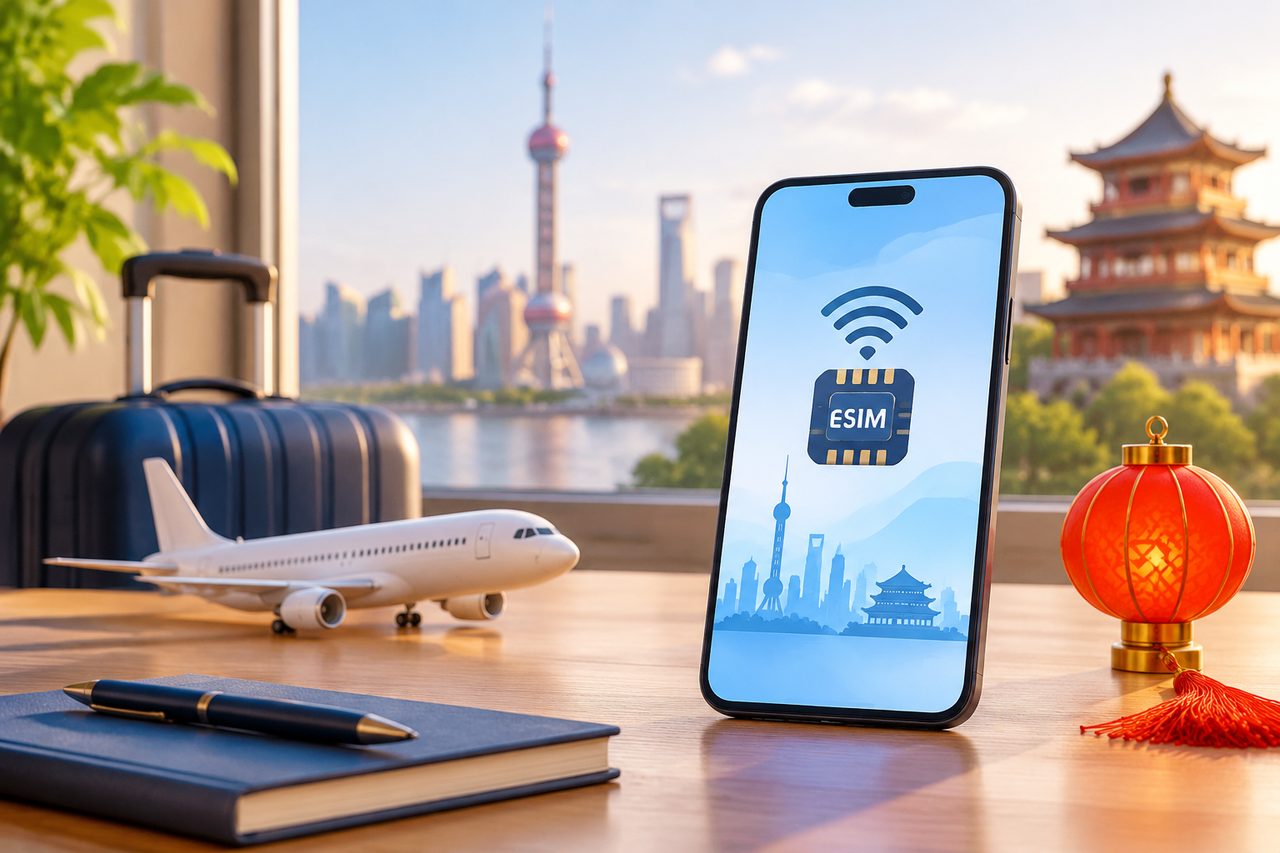
An eSIM for China is a small piece of software inside your phone that replaces a physical SIM card. Instead of buying a plastic chip at the airport, you download a data plan from a provider before you fly, scan a QR code, and your phone connects to a Chinese mobile network when you arrive. That is the short version. The longer answer to “how does esim work in China” matters if you are traveling for a hospital appointment, because your phone is not a luxury on a medical trip — it is how you reach your coordinator, show a booking confirmation, translate a symptom, and call a driver.
This guide explains the mechanics honestly, including the parts that trip people up: activation timing, data limits, blocked apps, and what happens when a plan that looked cheap turns out to be throttled on day three.
How This Actually Works, Step by Step
The sequence is simpler than most people expect, but each step has a timing detail worth knowing.
1. Check that your phone supports eSIM. Most iPhones from the XS generation onward support it, as do many recent Samsung and Google Pixel models. Some phones sold in mainland China do not support eSIM at all, and some carrier-locked handsets will refuse a foreign plan. Check your device settings under “About” or “Mobile Data” before you buy anything.
2. Buy the plan before you travel. You purchase from an eSIM provider online, usually with a credit card. You receive a QR code by email or in an app.
3. Install the profile while you still have reliable home Wi-Fi. Scan the QR code and the plan installs as a second line on your phone. Do this at home, not in the arrivals hall. Installation needs an internet connection, and airport Wi-Fi in China often requires a Chinese phone number to authenticate — a chicken-and-egg problem you want to avoid.
4. Label the line. Name it something like “China data” so you do not accidentally switch your primary number off and miss calls from home.
5. Activate on arrival. Turn the eSIM line on and enable data roaming for that line only. The phone registers with a local network, and you have data within a minute or two.
6. Keep your home SIM active for calls and texts. Most phones let you run the eSIM for data while your original number stays available for incoming verification codes — which you will need for banking and email logins.
What an eSIM for China Actually Connects To
Here is the part that separates a good experience from a frustrating one. Most travel eSIMs sold for China are roaming products. They do not give you a mainland Chinese number. Instead, your data is routed through a foreign carrier’s home network and then into China through an international gateway.
That routing has two consequences. First, the good one: because your traffic exits through the provider’s home country, apps that are normally restricted on mainland networks — Google services, WhatsApp, Instagram — often work without a separate VPN. This is a genuine practical benefit for a patient who needs to message family abroad or open a Google Maps link.
Second, the limitation: you get data, not a local phone number. A Chinese hospital’s automated appointment reminder, a delivery driver, or a hotel reception calling you back cannot reach you on a data-only eSIM. For that you need either your home number roaming (expensive but functional) or a local SIM with a Chinese number.
A Realistic Timeline
Timing matters more on a medical trip than on a holiday, because appointments are fixed. The table below reflects typical ranges, not promises — provider policies and hospital scheduling both vary.
| When | What to Do | Typical Duration |
|---|---|---|
| 2–4 weeks before travel | Confirm your phone supports eSIM and is carrier-unlocked; decide between a travel eSIM and a local SIM | 10 minutes to check; a day or two if you need to contact your carrier |
| 1–2 weeks before travel | Buy the plan and install the profile at home on Wi-Fi; test that the line appears in settings | 15–30 minutes |
| 2–3 days before travel | Download offline maps, save hospital addresses in English and Chinese characters, screenshot your appointment confirmation | 30–60 minutes |
| Day of arrival | Switch on the eSIM line, enable data roaming for that line, confirm connectivity before leaving the airport | 2–5 minutes |
| Day 1–2 in China | Test video calls and messaging; note your data usage against the plan limit | Ongoing |
| Week 1 | If you need a local number for hospital reminders, visit a carrier store with your passport | 30–60 minutes in store |
The step people forget is the offline preparation. Hospital addresses in Chinese characters, saved as screenshots, work when data fails. A translator app downloaded for offline use works in a basement imaging department where signal drops. These take minutes at home and save an hour of confusion later.
What Can Go Wrong — and What Happens Then
Honest failure modes, and the realistic recourse for each.
The plan starts counting before you land. Some providers begin the validity period at purchase or at first network connection, which can be at home if you are not careful. Recourse: check the activation policy before buying, and install without activating. If the clock has already started, contact support — many providers will adjust a plan once, but not reliably.
Data runs out mid-trip. Video calls and photo uploads burn through a plan fast. Recourse: buy a top-up from the same provider, or keep a backup plan installed but switched off. A second eSIM from a different provider is cheap insurance.
The phone will not register. Usually this is a locked handset or a roaming setting left off. Recourse: check that data roaming is enabled specifically for the eSIM line, restart the phone, and manually select a network. If it still fails, airport SIM counters and carrier stores in major cities can issue a physical SIM with your passport.
Apps still do not work. A roaming eSIM usually bypasses restrictions, but not always, and policies change. Recourse: do not rely on any single app for something critical. Save phone numbers, not just chat contacts.
You need a Chinese number urgently. A hospital wants to confirm an appointment by phone. Recourse: ask your coordinator to handle the call, or visit a carrier store. This is exactly the kind of gap a bilingual companion closes.
Choosing a Plan: What the Numbers Actually Mean
When you compare the best eSIM for China travel options, the headline price is the least useful number. Look at four things instead.
Data volume versus your real usage. Messaging and maps use little. Video calls, photo backups, and streaming use a lot. A traveler who video-calls family daily can consume several gigabytes in a week; someone who mostly texts uses a fraction of that. Match the plan to behavior, not to the biggest number on the page.
Throttling policy. Many “unlimited” plans reduce speed after a threshold. Check the exact wording on the eSIM China unlimited data price page of any provider — “unlimited” frequently means unlimited at reduced speed after a stated cap. For maps and messaging, throttled speed is often fine. For video, it is not.
Validity period and activation trigger. A 30-day plan that starts at purchase is a 23-day plan if you buy a week early. Confirm whether the clock starts at purchase, installation, or first connection.
Hotspot support. If you are traveling with a family member, hotspot capability matters. Some plans block it.
One more consideration specific to medical travel: coverage inside large hospital buildings. Thick walls and dense occupancy can weaken signal regardless of provider. Download what you need in advance rather than assuming connectivity in every corridor.
Practical Considerations: Records, Language, and Payment
Connectivity is one layer of a medical trip, not the whole thing. A few practical points that sit alongside it.
Records and appointments. If you are preparing for treatment in China, the remote steps — sending examination reports for a written second opinion, or arranging a video consultation — happen before you travel and depend on reliable internet at home, not in China. Get those done early. Our team can explain how the staged options work, starting with a records review rather than an immediate flight.
Visa category. Medical travel to China uses the S2 visa for short stays, with S1 for stays exceeding 180 days; accompanying family members apply under the same category. Requirements and supporting documents are set by the latest embassy or consulate guidance, and approval is never guaranteed. The M visa is for commercial and trade activity and is not a medical visa.
Payment. Mobile payment in China is dominant, and setting it up often requires SMS verification to your home number. Keep your original SIM active for that reason alone. Carry a physical card as backup.
Language. Translation apps help with words, not with a hospital’s registration queue. If you are navigating a large public hospital, a bilingual companion handles the排队 — the queuing, the payment counters, the directions — so your phone stays a tool rather than a lifeline.
Follow-up at home. Ask before you leave how results and discharge summaries will be sent, and in what language. Confirm this while you still have someone to ask in person.
Frequently Asked Questions
Usually not. Most travel eSIMs for China are data-only roaming plans and do not include a mainland number. If you need to receive calls or SMS from Chinese businesses or hospitals, you will need a local SIM issued in China with your passport, or you can rely on your home number roaming.
Often yes, because roaming eSIM traffic is routed through the provider’s home country rather than the mainland network. But this depends on the provider and can change. Do not assume it, and do not depend on any single app for something critical — keep phone numbers and screenshots as backup.
First, check that data roaming is enabled for the eSIM line and restart the phone. If it still fails, most major cities have carrier stores and airport counters where you can buy a physical SIM with your passport. In the moment, ask hospital staff or your coordinator to make calls on your behalf — this is a routine request, not an imposition.
It depends on how you use data. If you plan daily video calls and photo uploads, a larger or unlimited plan avoids mid-trip top-ups. If you mostly message and use maps, a moderate plan is usually sufficient. Read the throttling terms carefully, because “unlimited” often means reduced speed after a stated cap.
Your Next Step
An eSIM solves one problem well: getting online quickly without hunting for a SIM card after a long flight. It does not solve the harder parts of a medical trip — the appointment, the language, the queue, the follow-up. China Medical Services connects international patients with top-ranked Chinese hospitals and provides bilingual support on the ground; we are a coordination service, not a medical provider, and we do not promise admission, outcomes, or a specific specialist. If you are planning treatment in China and want to understand the staged options before you commit to travel, start with a conversation through our consultation page at https://chinamedservices.com/companion/ — no pressure, just a clear picture of what comes next.
This article is for general information only and does not constitute medical advice. Treatment decisions should always be made with a qualified clinician who has reviewed your individual case.
For more medical information and treatment options in China, visit chinamedservices.com (China Medical Services).
