Hong Kong University Shenzhen Hospital: Cross-Border Academic Medicine from Hong Kong
Key Takeaways
- The University of Hong Kong-Shenzhen Hospital (HKU-SZH) operates as a JCI-accredited academic medical center directly managed by the University of Hong Kong, bringing Hong Kong clinical governance standards to mainland China.
- International patient pricing at HKU-SZH sits approximately 30–50% below Hong Kong private hospitals for comparable procedures, with cardiac surgery packages starting from approximately $18,000.
- Navigating the hospital independently as a non-Chinese speaker is difficult. The International Medical Center handles foreign patients, but advance coordination is essential for surgical scheduling and specialist access.
- Cross-border medical services in Shenzhen carry structural advantages—lower operating costs than Hong Kong, mainland pharmaceutical pricing, and HKU faculty rotations—but the visa process and payment systems require careful planning before travel.
The Problem: When Hong Kong Private Care Exceeds Budget, and Mainland Hospitals Feel Unfamiliar
Hong Kong’s private hospitals deliver excellent care. The cost is the problem. A coronary artery bypass graft at a private Hong Kong hospital runs between HK$350,000 and HK$550,000—roughly US$45,000 to US$70,000. For uninsured international patients or those with capped coverage, this is a financial wall. Some patients look to mainland China for savings but hesitate. The concern is real: will clinical standards match what Hong Kong delivers? Can I communicate with my surgeon? What happens if something goes wrong?
These are not abstract fears. A 2023 survey by the Hong Kong Patient Advocacy Foundation found that 42% of respondents who considered cross-border care cited “uncertainty about physician qualifications” as their primary barrier. Another 31% worried about post-operative follow-up logistics. These patients need a middle path—Hong Kong academic medicine delivered at mainland China’s cost structure. That path exists. It is called the University of Hong Kong-Shenzhen Hospital.
Who We Are
We are China Medical Services. We are not a hospital, and we do not provide medical treatment, clinical diagnoses, or physician referrals in the regulatory sense. What we do is simpler to describe and harder to execute: we act as logistical architects for international patients seeking care at China’s top-tier hospitals. Our team handles hospital matching based on your clinical needs, appointment coordination through official international departments, bilingual medical companion services, visa guidance, and the hundred small friction points that make cross-border healthcare genuinely difficult. We work with over 340 top-ranked hospitals across 37 cities. We know which institutions handle foreign patients well—and which ones do not. Our recommendations come from operational experience, not marketing partnerships.
Why Hong Kong University Shenzhen Hospital Delivers a Different Model of Cross-Border Care
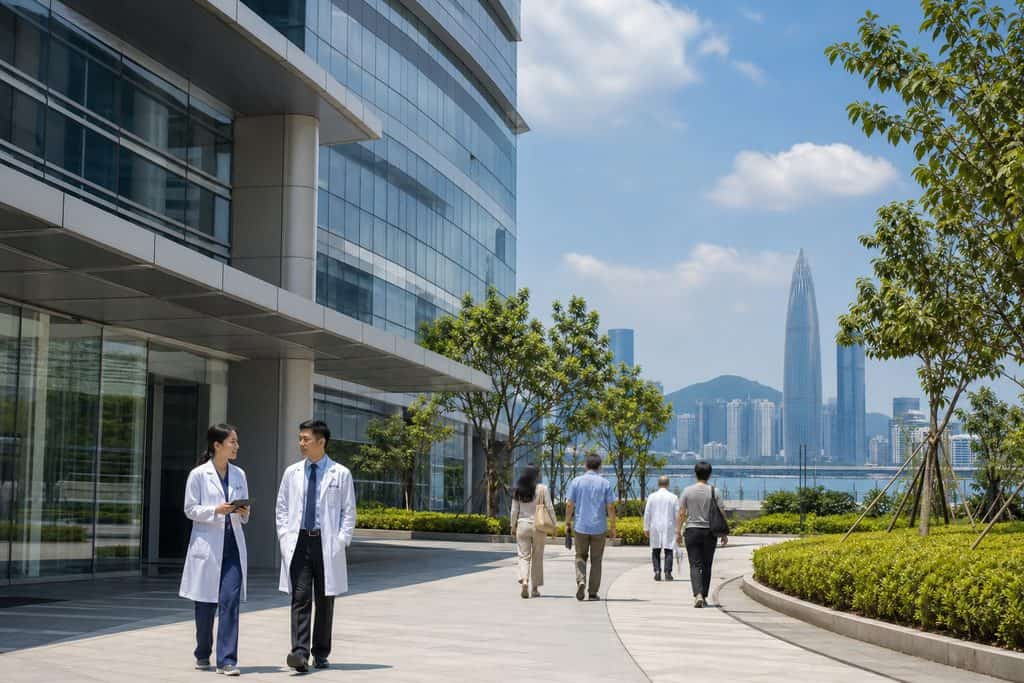
Most international patients researching Chinese hospitals encounter a familiar pattern: large public institutions with massive patient volumes, Chinese-language workflows, and clinical cultures that differ markedly from Western expectations. HKU-SZH breaks this pattern. Opened in 2012, the hospital is a wholly-owned subsidiary of the University of Hong Kong, governed by HKU’s clinical faculty and administrative leadership. The hospital’s CEO, Chief Medical Officer, and department heads are HKU appointees. Clinical protocols follow Hong Kong Hospital Authority guidelines, not mainland Chinese standards. Medical records are maintained in English and Chinese. Informed consent procedures mirror Hong Kong’s patient-rights framework. This is not a mainland hospital with a Hong Kong branding layer. It is a Hong Kong hospital operating on the mainland side of the border.
Clinical Governance That Crosses the Border
The structural difference matters for outcomes. HKU-SZH operates under a “two-hospital, one-system” model with Queen Mary Hospital, HKU’s flagship teaching hospital in Pok Fu Lam. Surgeons rotate between both campuses. Tumor boards include faculty from both locations. For complex cases—a challenging hepatobiliary resection, a pediatric congenital heart repair—the surgeon operating in Shenzhen is the same HKU faculty member who operates in Hong Kong. The difference is the facility cost structure, not the hands holding the scalpel.
This model has attracted serious clinical talent. The hospital’s Liver Transplant Center, led by Professor Lo Chung-mau—who also serves as Hong Kong’s Secretary for Health—performed mainland China’s first living-donor liver transplant using a modified right-lobe graft technique. The Reproductive Medicine Center operates under HKU’s assisted reproduction protocols, which are aligned with the Hong Kong Council on Human Reproductive Technology’s ethical framework. For international patients concerned about treatment variability across borders, this continuity of clinical governance provides a concrete answer.
JCI Accreditation and What It Means for International Patients
A question we field regularly: is Hong Kong University Shenzhen Hospital JCI accredited? Yes. The hospital earned its initial Joint Commission International accreditation in 2018 and successfully completed re-accreditation in 2022. JCI surveys evaluate over 1,200 measurable elements across patient safety, medication management, infection control, anesthesia and surgical care, and patient rights. For international patients, JCI status serves as a practical filter. It means the hospital’s patient identification protocols, surgical time-out procedures, and adverse event reporting systems meet a globally recognized standard. Many international insurers require JCI accreditation for direct billing arrangements. HKU-SZH’s JCI status opens that door.
That said, JCI accreditation alone does not guarantee a smooth patient experience. The hospital’s International Medical Center (IMC) handles foreign patients through a dedicated outpatient unit and inpatient ward. English-speaking nurses and coordinators staff the IMC. But the IMC is a service layer built atop a large Chinese public hospital. Outside the IMC’s immediate footprint, corridor signage defaults to Chinese. The pharmacy, laboratory, and imaging departments operate in Chinese-language workflows. A bilingual companion who can navigate these transitions is not a luxury. It is the difference between a 45-minute registration process and a three-hour one.
Understanding Hong Kong University Shenzhen Hospital International Patient Price Structure
Let us address the question directly: what is the Hong Kong University Shenzhen Hospital international patient price range for common procedures? The hospital operates a two-tier fee structure. The standard public tier serves mainland Chinese patients at government-regulated public hospital rates. The International Medical Center tier serves foreign patients and Chinese patients who opt for international-level service. IMC pricing is not public-hospital pricing. It is also not Hong Kong private-hospital pricing. It sits in between.
Here is what published IMC rates and our case coordination data show for common surgical procedures:
| Procedure | HKU-SZH IMC (USD) | Hong Kong Private Hospital (USD) | US Hospital (USD) |
|---|---|---|---|
| Coronary Artery Bypass Graft | $18,000–$28,000 | $45,000–$70,000 | $120,000+ |
| Total Knee Replacement | $14,000–$20,000 | $30,000–$45,000 | $35,000–$55,000 |
| Laparoscopic Cholecystectomy | $3,000–$5,000 | $8,000–$14,000 | $15,000–$25,000 |
| Thyroidectomy (Total) | $4,000–$7,000 | $10,000–$18,000 | $20,000–$35,000 |
| IVF Cycle (Single) | $4,500–$6,500 | $12,000–$18,000 | $15,000–$25,000 |
These figures are ranges, not fixed quotes. Final pricing varies by case complexity, implant choice, length of stay, and whether complications arise. But the pattern is consistent: HKU-SZH IMC pricing runs 30–50% below Hong Kong private hospitals for equivalent procedures performed by HKU-affiliated surgeons. The gap widens further when compared to US pricing, where the same coronary bypass procedure can exceed $120,000. The structural reasons are straightforward. Shenzhen real estate and nursing labor cost less than Hong Kong’s. Pharmaceutical pricing follows mainland China’s volume-based procurement system, which has driven down drug and implant costs significantly since 2019. And HKU-SZH’s 2,000-bed capacity generates surgical volumes that amortize fixed costs across more cases.
How to Get Treatment at Hong Kong University Shenzhen Hospital as a Foreigner
The process for accessing care as an international patient follows a specific sequence. It is not the same as walking into a Hong Kong private clinic with a credit card. Step one is documentation. The IMC requires a valid passport, a recent medical summary in English or Chinese, relevant imaging reports, and pathology slides if applicable. For surgical cases, a referral letter from your home physician stating the diagnosis and recommended intervention helps accelerate triage.
Step two is appointment booking. The IMC accepts appointment requests by phone and email. Their English-language hotline operates during business hours. But here is the operational reality: the IMC’s appointment coordinators can book you into an outpatient specialist clinic. They cannot guarantee a specific surgeon or a specific surgery date on the first call. That requires an in-person consultation. The specialist must examine you, review your imaging, and determine surgical candidacy before a procedure is scheduled. This is standard clinical practice—not a bureaucratic obstacle—but it means international patients need to plan for an initial consultation trip before committing to surgery.
Step three is the consultation visit. You fly into Shenzhen Bao’an International Airport or cross the border from Hong Kong via the Futian or Shenzhen Bay checkpoints. The hospital is located in the Futian District, approximately 30 minutes by car from either border crossing. Your specialist consultation typically lasts 20–40 minutes. If surgery is indicated, the IMC coordinator will provide a detailed cost estimate and discuss available dates. For complex cases requiring multidisciplinary input, the hospital can convene a tumor board or multi-specialty conference—often with remote participation from HKU faculty in Pok Fu Lam.
Step four is the treatment phase. Once surgery is scheduled, you return to Shenzhen on the appropriate visa. The hospital’s IMC inpatient ward provides private rooms with ensuite bathrooms, visitor seating, and English-language television. Nursing ratios in the IMC ward are higher than in the general wards. Meals can be ordered to dietary specifications. Your family members can stay nearby—the hospital is surrounded by international-brand hotels in the Futian central business district.
Cross-Border Medical Services Shenzhen Cost: The Full Picture
Surgery pricing at HKU-SZH is one component. The full cross-border medical services Shenzhen cost includes several additional line items that patients should budget for upfront. Visa fees for an S2 visa—the correct category for medical treatment in China—range from $140 to $180 depending on nationality and processing speed. Round-trip economy airfare from North America to Shenzhen typically runs $1,200–$2,000. From Europe, $800–$1,500. From the Middle East, $600–$1,200. Accommodation near the hospital in a business-class hotel costs approximately $80–$150 per night. For a two-week surgical stay, including pre-operative workup, procedure, and initial recovery, total non-medical costs typically land between $3,000 and $6,000 per trip.
Then there are service coordination costs. If you engage a medical concierge to handle hospital matching, appointment booking, and bilingual companionship, expect to budget from $300 for appointment coordination and from $200 per day for a bilingual medical companion. These are not hospital charges. They are separate fees for logistical services that make the hospital experience navigable. Some patients ask whether they can skip this and manage independently. The honest answer: if you speak fluent Mandarin, understand Chinese hospital registration workflows, and can read Chinese-language billing statements and consent forms, you can. If any of those conditions is not met, a companion pays for itself in avoided delays, miscommunication, and administrative dead ends.
What You Need to Know Before Going Alone
We have coordinated care for enough international patients to know where the friction points cluster. Here are the barriers that catch people off guard:
- Visa Requirements Are Specific and Unforgiving: Medical treatment in China requires an S2 visa with the purpose of visit explicitly stated as medical treatment. M visas—issued for commercial and trade activities—are not valid for hospital admission. We have seen patients arrive at hospital registration desks with M visas and get turned away. The S2 application requires a formal invitation letter from the treating hospital. HKU-SZH’s IMC issues these letters, but processing takes 5–10 business days. Apply early.
- Payment Is Upfront, Not Post-Treatment: Unlike Western hospitals that bill insurance after discharge, Chinese hospitals—including HKU-SZH’s IMC—require a deposit before admission and settlement before discharge. The deposit amount typically equals 80–100% of the estimated procedure cost. International credit cards are accepted at the IMC, but daily transaction limits on foreign cards can complicate large deposits. Wire transfers work but require 3–5 business days to clear. Plan your payment method before you travel.
- Medical Records Transfer Is Your Responsibility: The IMC will request your prior imaging, pathology reports, and treatment summaries. These need to be in English or Chinese. If your records are in Arabic, French, or Russian, you need certified translation before submission. DICOM-format imaging files on a CD or USB drive are preferred. Cloud-based image sharing links often fail behind Chinese firewall restrictions. Physical media works reliably.
How We Help You Navigate This
These barriers exist for structural reasons, not because anyone is trying to make the process difficult. A large academic medical center in China processes thousands of patients daily. The workflows are optimized for volume and local patients. International patients represent a small fraction of total volume, and the systems do not bend easily. That is where we fit in.
Before you travel, our team reviews your medical records, matches your clinical needs to the appropriate department and specialist at HKU-SZH, and coordinates directly with the IMC to secure an appointment. We handle the invitation letter for your S2 visa application. We confirm the deposit amount and payment method in advance so there are no surprises at the registration desk. During your consultation visit, a bilingual medical companion meets you at the hospital entrance, guides you through registration, sits with you during the specialist consultation to ensure accurate translation of clinical details, and handles prescription pick-up, imaging appointments, and billing settlement. If surgery is scheduled, the same companion supports your admission process, communicates with nursing staff about your needs, and remains available throughout your inpatient stay. After discharge, we coordinate follow-up appointments, medication refills, and medical record collection.
We do not practice medicine. We do not influence surgical scheduling or specialist availability. What we do is remove the logistical obstacles that stand between you and the care you came for. For patients considering a top academic medical center in China for international patients, that operational layer is the difference between a stressful solo journey and a supported treatment experience.
Frequently Asked Questions
Yes. The International Medical Center operates an English-language hotline and email address for direct appointment booking. You can call during Shenzhen business hours (UTC+8) and speak with an English-speaking coordinator. The limitation is that the coordinator can schedule an outpatient specialist consultation but cannot provide detailed guidance on which specialist is most appropriate for your specific condition, nor can they assist with visa documentation, payment logistics, or on-the-ground navigation. Direct booking works for straightforward cases where you already know which department you need and have your documents ready. For complex cases or first-time visitors, the coordination support saves measurable time and stress.
HKU-SZH’s specialists provide a written discharge summary in English that includes the diagnosis, procedure details, medication regimen, and recommended follow-up schedule. This document is designed to be shared with your home physician. For surgical patients, the hospital typically schedules a follow-up consultation at 4–6 weeks post-discharge, which can be conducted via video consultation through the IMC’s telemedicine service. Video consultations cost between $100 and $300 depending on the specialist. If a physical examination is required, you would need to return to Shenzhen or arrange equivalent follow-up with a local provider. The hospital does not assume responsibility for coordinating care with your home-country physicians—that handoff is yours to manage.
The lower cost reflects structural economics—Shenzhen’s lower labor and real estate costs, mainland pharmaceutical pricing, and higher patient volumes—not lower clinical standards. The surgeons, clinical protocols, and governance systems originate from HKU. A 2022 study published in the Hong Kong Medical Journal comparing surgical outcomes between HKU-SZH and Queen Mary Hospital for colorectal resections found no statistically significant difference in 30-day mortality, anastomotic leak rates, or length of stay. The study covered 847 patients across both sites. That said, no hospital is uniform across all departments. HKU-SZH’s strongest programs are in hepatobiliary surgery, reproductive medicine, orthopedics, and cardiology—areas where HKU faculty maintain active clinical presence. For other specialties, the clinical leadership may be mainland-trained. Ask specifically about the surgeon assigned to your case and their HKU affiliation before committing.
Yes. The IMC inpatient ward allows one family member to stay overnight in the patient’s private room. A fold-out bed or sofa bed is provided. Additional family members can visit during daytime visiting hours. For extended stays, the hospital’s location in Futian District means numerous international-brand hotels—the Shangri-La, Hilton, and Four Points by Sheraton—are within a 10–15 minute taxi ride. The hospital’s IMC nurses can help arrange hotel bookings if needed. For family members accompanying a patient, an S2 visa is also required, with the patient’s hospital invitation letter serving as supporting documentation for the family member’s application.
Your Next Step
Hong Kong University-Shenzhen Hospital represents a specific value proposition: Hong Kong academic medicine delivered at mainland China’s cost structure, with JCI-accredited systems and English-speaking international patient services. It is not the right fit for every case. But for surgical procedures where HKU faculty expertise aligns with your clinical needs, and where the cost differential versus Hong Kong private care is material, it deserves serious consideration. The process requires planning—visa timelines, deposit arrangements, records preparation—but the pathway exists and is well-trodden. If you would like to discuss whether HKU-SZH matches your specific situation, our team can walk through the fit, the costs, and the logistics. No pressure. Just an informed conversation. Reach out when you are ready to explore your options.
For more medical information and treatment options in China, visit chinamedservices.com (China Medical Services).
